Showing posts with label the defensive backs. Show all posts

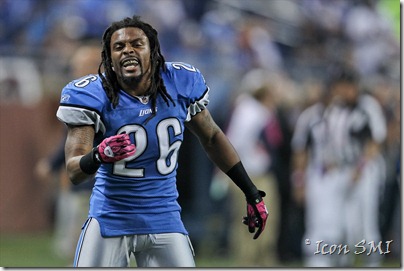
Meet the Cubs: Jonte Green

>> 7.24.2012

6.26 (#196): Jonte Green, CB, New Mexico St.

jonte_green_detroit_lions_cornerback

Florida is one of the most prominent football states in the nation. Some of the best high school football is played there, some of the best college football is played there, and every other college swings through the peninsula to harvest some of the annual bumper crop of talent.

When a 6’-0”, 184-pound kid from football factory Lakewood (Green is the ninth alumnus to be drafted) with all-district honors at tailback and cornerback qualifies for the Florida state track championships in the 100-meter, 4x100 and 4x400 relays, the football world stands up and takes notice . . .

. . . unless his name is Jonte Green.

 Rivals.com rated Green a two-star recruit. I didn’t find a recruit profile for him on Scout.com at all. He didn’t even make the Tampa Bay Times’ annual Top 25 of the Bay [Area] list.

Green ended up signing with South Carolina’s Benedict College, a member of the D-II Southern Intercollegiate Athletic Conference. I don’t know if he had eligibility problems, or if he just wasn’t rated as a prospect. Either way, at Benedict Green’s size, speed and ability stood out. He racked up 41 tackles (16 solo), 4 INTs, 2 passes defensed and a sack.

Yes, for those with sharp eyes and keen minds, Atlanta's Stillman College plays in the same conference. Future Detroit Lions Sammie Hill and Jonte Green faced one another on November 10th, 2007. Hill had 3 solo tackles, 5 assists and a sack, while Green had three solos. For the record: Stillman beat Benedict 35-13.

After Green's excellent true freshman performance he received a D-I offer, from New Mexico State, and committed on February 4th, 2009. After transferring, he redshirted a season.

As a redshirt sophomore, Green took over. In his first career D-I start, vs. Idaho, he racked up 7 tackles and a pass defensed. Ultimately, Green had the fourth-most tackles on the team, racking up 74, and 8 passes defensed, in New Mexico’s 13 games. Green’s junior season: started 12 games, notched 76 tackles (ranked fourth on the team) and 8 passes defensed.

You might be noticing a pattern here: a lot of tackles, some passes defensed, and no interceptions. I’d be tempted to say it’s because the other cornerback, Packers 2011 4th-rounder Davon House, was hogging them all. But Aggie opponents, you’d think, would want throw away from House, who was first-team All-WAC both seasons he started alongside Green, and pick on Green.

But sure enough, when House left, Green’s senior season as the #1 corner saw his statistics skyrocket. He got his only D-I interception, and 15 passes defensed, to go with his usual fourth-best-on-the-team 64 tackles. For his standout campaign, he was named Second Team All-WAC.

Unfortunately, Green once again went unnoticed. Apparently a 5'-11 1/4", 191-pound corner who started three years in the WAC  and starred in Florida high school track (and competed in track at Benedict) doesn’t merit a combine invite. But Green’s Pro Day made up for it: he cut an average 4.41 40-yard dash, which would have tied him for second-best at the Combine. According to Justin Rogers at Mlive.com, though, Green thinks he can run faster.

Actually, his Pro Day results concern as much as they intrigue. His 3-cone drill (7.26) and 20-yard shuttle (4.31) times are definitely on the high end; Green may have straight-line speed but lack the agility and change-of-direction needed to cover downfield at the NFL level.

Let's see what the experts think:

ESPN's Scouts, Inc. graded Green as a 30 overall:

What he brings: Green has excellent range in coverage and he flashed above-average coverage skills, but he's too inconsistent at this point and he needs to get stronger to matchup with bigger receivers.

SI.com graded Green a 1.81, just below their 1.98 maximum for "Free Agent": "Player who will make a 60 or 80 man roster."

Positives: Athletic cornerback who's displayed a variety of skill in his game. Plays with an aggressive nature, works hard to defend the run and makes a lot of tackles up the field. Keeps the action in front of him, gets a nice jump on the throw and displays a good move to the pass. Can burst to the ball out of his plant and works to make plays. Solid return specialist who sets up blocks, finds the running lanes and quickly gets through them.

Negatives: Does not consistently play to his 40 time or show a burst. Loses opponents, blows assignments and does a lot of trailing down the field. Struggles staying with receivers out of breaks.

Analysis: Green is a size/speed prospect who flashed ability the past three years yet has shown little consistency in his ball skills. Best in zone coverage, he's a prospect who must earn his wage on special teams.

Pro Football Weekly's take on Green contains an interesting wrinkle: apparently Green participated in New Mexico's Pro Day as a junior, and he was both smaller (5'-10 3/4", 182 pounds) and slower (4.45) just a year before.

Summary: Three-year starter with outstanding timed speed and range, though his inconsistent play, poor instincts and suspect football character suppress his draft value. Could require simple assignments and needs to get stronger and adopt a more professional approach to the game in order to stick.

CBSSports.com's Dane Brugler didn't give Green a grade, but did have useful notes:

Strengths: Good starting experience as a three-year starter and good career production (30 pass break-ups). Good size/speed blend with good height and length to match up and the speed to stay with receivers. Aggressive in run support and attacks the action, not waiting for it. Quick read/react skills to plant-and-go when the play is in front of him. Toughness isn't a question. Full-go type of player and doesn't play half-speed or take plays off.

Weaknesses: Has room to get stronger and needs to add some more bulk. Plays flat-footed in his backpedal and is often a step too late, relying on his speed to catch up. Smaller hands and has only 2 career interceptions. Needs to do a better job wrapping and not just hitting. Streaky instincts and doesn't always play smart, needs to do a better job trusting his eyes. Didn't face elite competition week-in and week-out. Tight-hipped and doesn't look as natural flipping his body to turn and run downfield.

New Era Scouting didn’t have a profile for Green, nor did he crack their cornerback rankings.

Here I sit, broken hearted. I looked for YouTube Highlight Reels of Jonte Green and all I found were interviews and press conferences.

Conclusion

In some ways, Jonte Green is the archetypal Lions draft pick: starting caliber tools, potential to be a major contributor, big question marks about him ever hitting that upside. But rather than those question marks coming from injuries or character or college system or college competition, the questions are about his football instincts.

Generally, The Grandmaster & Co. prefer players with high football IQ, but generally such players aren’t hanging around in the sixth round when they’re nigh-on six feet cornerbacks with legit 4.40 speed.

As a prospect, he reminds me quite a bit of Stanley Wilson, the Lions’ 2005 third-rounder. Wilson was also 5’-11”, also about 190 pounds, also a track star. Wilson set Stanford records in the 100- and 200-meter dash, and he cut a blazing 4.36 40-yard time at the Combine. The biggest difference between Wilson and Green is Wilson’s Stanford-quality academic background and Pac-10 pedigree.

At the time, I wondered if Wilson wasn’t better suited to playing safety; just like Green his reaction skills were much better with the play in front of him than flipping his hips and running downfield. I thought Wilson would be a great zone/Tampa 2 corner, but he never caught on.

Green, like all Lions cornerbacks, will have every opportunity to earn playing time this season. All he has to is go out on the Allen Park field, and take the opportunity to finally catch everyone’s attention.

Read more...

Old Mother Hubbard: The Safeties

>> 2.28.2012

louis_delmas_detroit_lionsWe round up the defense with the last line of defense: the safeties. Though the cornerbacks took the brunt of public criticism in the last two games, many of the high-profile failures of the secondary in 2012 were actually the fault of the safeties. With Louis Delmas at full speed, Amari Spievey growing into his newfound role, and veteran Erik Coleman coming on board as an insurance policy for both spots, this wasn’t supposed to happen. So what happened?

First, let's look at what 2010's Safety Old Mother Hubbard had to say:

Louis Delmas is an athletic, hard-hitting safety who can make big plays against the run and the pass. Despite being limited by injury, he proved extremely effective on the blitz this year. If he can go full speed, he should be one of the best safeties in the NFL next season.

Amari Spievey is a talented, hardworking kid with the raw ability to be a very good safety. He struggled with consistency and mental mistakes in his first season, and this offseason will be crucial in finding out if he’s a long-term starter or medium-term rotational player.

Chart?

Chart.

Detroit Lions safeties 2011 grades, with Pro Football Focus and Advanced NFL Stats

The best safety in the NFL this year was Troy Polamalu, with an outstanding +19.2  PFF overall grade. He was the NFL’s best blitzing safety, 4th-best in coverage, and 3rd against the run. His 3 penalties called on 930 snaps dinged him just a little. He was 2nd-best in +WPA with a walloping +1.90, meaning he made a huge impact on the Steelers’ chances to win, and his 3rd-best 50.5 +EPA shows he was constantly making positive plays.

On the other side of the PFF ledger, the worst-graded safety in football was Minnesota’s Jamarca Sanford. The polar opposite of Polamalu, Sanford was strongly negative in pass rush, coverage, and run-stopping (but got a small boost from only being flagged once). His –18.2 overall grade was powered mainly by a –15.2 coverage mark, also worst in the biz.

Now here's where things get interesting: Sanford had a 32.2 +EPA and 0.77 +WPA, which were the 23rd- and 36th-best figures in the NFL, respectively. This means Sanford was generating enough positive production to rate as a decent starting safety, but his coverage gaffes were so repeated and pronounced that PFF graded him the worst safety to crack an NFL rotation!

Disclaimer?

Disclaimer.

Pro Football Focus grades are based on TV footage, and while I believe completely in what they do over there, downfield pass coverage grades are the area where they have the hardest time figuring out what’s going on. Without knowing each player’s assignment, and most of the secondary being offscreen at the snap, PFF safety grades have limitations.

Advanced NFL Stats' +EPA measures the expected points added by a player’s positive plays, but cannot measure failures. Cornerbacks are the position where “lack of failure” is arguably more important than positive playmaking, so again—there are real limitations here. Same applies to +WPA: a timely interception can swing the likelihood of winning around very quickly, but a surrendered touchdown can too—and that won’t show up in +WPA.

To sum up: PFF grades and ANS metrics are never going to be more variant and contradictory than when assessing cornerbacks (and safeties are a close second). However, this increases the value of both sets of data. Though we’re going to have to fill in the gaps ourselves, it’s better to know reality lies in the gap than unwittingly treating one number as gospel.

The top-graded Detroit Lions safety was Louis Delmas. Delmas, most Lions fans probably have a vague sense of, was not the playmaker he was in 2009, despite being fully recovered from his groin injury of 2010. In coverage, that’s a good thing: safeties are typically only noticed in coverage when there’s a problem. Pro Football Focus backs this notion up: Delmas was +4.7 in coverage, 10th-best amongst 87 qualifying NFL safeties.

Overall, Delmas's -2.0 grade was slightly above the normalized NFL average of -2.8. But was he really that bad? Drilling down into his grades, we see mostly positives and neutrals and one big nasty red mark: a brutal –5.3 against San Francisco. Most of that was 3 missed tackles against the run, but some of it was allowing three first downs through the air on three “Thrown At”s.

So except for Week 6, and the last 5 games of the regular season (out with an MCL injury, and 'scope to repair it) Louis Delmas, veteran safety, was back there doing his job.

We missed “Da Missile.”

If we in his horrific wild card performance (-6.5, clearly not ready to play), Delmas graded strongly negative against the run in five games, and strongly positive only once. In 2010 and 2009 those ratios were 4:3 and 3:4, respectively. On the flip side, Delmas’s 2011 coverage grades had 2 negatives and 2 positives, an improvement from 4:1 and 3:2.

Statistically, Delmas did very well, allowing just 15 of the 28 balls thrown his way to be caught. He also held completions to an average of just 9.7 yards each, 7th-best in the NFL. He had no interceptions, and just four passes defensed, but also allowed just one touchdown and a 25th-best opponent passer rating of 80.4 (NFL avg.: 90.7).

While Delmas's pass coverage is very good and getting more consistent, his run-stuffing is getting worse. He had 46 solo tackles, 1 assist, and 18 defensive stops. But he missed 12 tackles, 1 per every 3.88 tackles made (seventh-worst in the NFL, well below average of 8.6). In fact, using my metric of “missed tackles per tackles made” (solos plus one-half assists), Lions safeties ranked 64th (Spievey), 80th (Delmas), and 85th (Harris) out of 86.

It’s possible, then, that this is schematic. Relying on the back seven to gang-tackle players the line has allowed through is bound to make it much tougher on the safeties. However, I’ve seen Louis Delmas singlehandedly drop Steven Jackson in the open field with a full head of steam. He’s a better tackler than that.

+EPA agrees with me. Delmas's 19.3 total is low, you'd think because he only played in 12 games. But he was ranked 52nd of 123 in total +EPA, and 50th in +EPA/game with 1.61. His plus-play production was mediocre at best. His +WPA is right in line with his +EPA (and the NFL average) at 0.52. In terms of playmaking, Delmas was at what baseball people call "replacement level;" you can get a safety like that anywhere.

So what now? Last year, I said if Delmas “can go full speed,” he should be “one of the best safeties in the NFL.” Instead he was good in coverage, poor against the run, and mostly invisible when counting the kind of splash plays that used to be his calling card.

Bottom Line: Delmas’s career is at a crossroads. Will he bloom into the all-around badass he looked like as a rookie? Or will he remain a good coverage safety who needs help from a partner? There’s no doubt he has the physical tools and the mental tenacity to be an elite, playmaking safety but something’s missing and I don’t know what.

Chris Harris was an odd, but valuable midseason addition. After the Lions picked apart Chris Harris and the Chicago Bears on Monday Night Football, Harris was released—and the Lions picked him up. Harris’ –7.3 overall PFF grade was below the NFL average of –2.8, tied for 65th out of 86.  Harris was solid against the run; his +0.3 run-stopping grade was just above the NFL average of –0.3. He also kept his nose clean: no penalties called despite a 400-snap workload.

Unfortunately, Harris was just as susceptible to the pass in Detroit as he was in Chicago. He turned in five strongly negative coverage grades out of ten games played; none positive. In fact, he only had one positive mark all season long: a +1.3 against the run in Week 17 at Green Bay—yes, The Game Where They Passed For A Thousand Yards. His +EPA and +WPA were meager, even considering his reduced workload.

I don't mean to be overly harsh on Harris; switching schemes midseason only to be pressed into a starter's workload must be extremely difficult. His Pro Football Focus data for 2008, 2009, and 2010 reveals an average all-around NFL starter; he just had a profoundly down year. The 29-year-old Harris will have to earn 2012 playing time in camp, whether that's in Detroit or elsewhere.

Bottom Line: Chris Harris did about as well as you could ask of a guy who got cut midseason, picked up by another team, and pressed into starting the last five games of a playoff race: not very well. May return as the rotational third safety next season.

And now? The man, the myth, the enigma: Amari Spievey.

Drafted in 2010 to “fill a hole” at cornerback, Spievey’s odd-duck skill set and lack of conditioning got him an immediate switch to safety—and trip to the doghouse. Still, Spievey flashed brilliance in 2010. His physicality made the switch intact, and his not-quite-good-enough-for-cornerback hips still channeled impressive recovery speed.

Of course, he needed that speed as he struggled to keep his head above water last season, and this season was no different. His –11.5 overall grade was partly informed by his –2.2 blitz grade and –3.2 coverage marks, but was his brutal –7.5 against the run that dragged his PFF grade into the murky depths.

Technically, Spievey got better as the season went along; his two positively-graded games came in Weeks 14 and 16, at home against the Vikings and Chargers. But his Wild Card performance was a brutal -4.6, and the rest of his 2011 chart is dripping red as well.

Spievey’s 1:3 TD-allowed-to-INT ratio helped lower his opponent passer rating to a team-best (NFL 13th-best) 63.4. However, his 62.5% completion percentage and 14.6 YpR shows he was a lot easier to beat through the air then Delmas. On the ground, Spievey was the surest-tackling safety the Lions had, missing one for every 4.96 solos+half-assists. Unfortunately, that’s still 64th-worst in the NFL, and significantly worse than the NFL average of 8.6. As I said, scheme may play a part here, but . . .

Spievey's three picks gave him the best +EPA of any Lion at 22.9; that's not great. However, of that meager production he wrung +0.65 +WPA, slightly above-average and the best the Lions had to offer.

Bottom Line: Spievey is no less an enigma than when the season started, but the flashes of brilliance remained flashes and the prolonged stretches of awful remained awful. Like Delmas, his performance in 2012 will decide his long-term future.

SHOPPING LIST: A common theme is developing: “The Lions have some decisions to make” about the safeties. Delmas returns as the starting free safety—but is he a game-changing foundational piece, or a solid role player? Harris supplanted Coleman as the third safety, but will he return? Spievey will have a chance to earn that spot next to Delmas—but the Lions NEED better production than what he’s been able to provide; the safety play in 2011 was unacceptably poor

A veteran upgrade over Spievey, or a talented rookie to compete with him, are a must if the Lions are to shore up the secondary that was so thoroughly exposed at the end of 2011.

Read more...

Old Mother Hubbard: The Cornerbacks

>> 2.22.2012

aaron_berry_detroit_lions_cornerback

Ah, the Detroit Lions cornerbacks. Few units in the NFL took as much heat in the wake of the 2011 season. The Lions surrendered 928 passing yards and 90 points in their last two games; since their last two games were their crucial Week 17 attempt to break the longest road losing streak in the history of professional sport, and their first playoff game in over a decade, respectively . . . that looks bad.

So bad, in fact, that every initial mock draft had the Lions taking a corner in the first round, which as I said at Bleacher Report is completely silly. But is it?

Here's what 2010's Old Mother Hubbard had to say about the cornerbacks we'll analyze today:

With a full #1 starter’s workload, Chris Houston performed at an average, maybe just-below-average, level for an NFL starter. Considering the pittance the Lions paid to get him, performance like that is impressive. As the Lions’ #1 corner, they should draft someone with flashier coverage skills to pair with him. As the Lions’ #2 corner, he’d be excellent. Further, he’s only 26—if the Lions can hold onto this likely RFA, he may continue to improve.

Alphonso Smith is a gifted natural slot cornerback, with the tenacity to play well against the run, and even be dangerous as a pass rusher. His instincts and hands are enough to make him a ballhawk, but his repeated brain farts make him a liability as an outside cornerback. Perhaps time and development will iron this out, but for now pencil him in as a multi-year “starting” nickel back.

Then, from the Shopping for Cornerbacks free-agent Old Mother Hubbard:

Eric Wright’s inclusion on this list may surprise some, as the Browns’ 2007 2nd-round pick actually received death threats over his perceived poor play last season. PFF graded him poorly indeed, with a –4.3 overall. His coverage mark was a rotten –11.9, second-worst in the NFL. However, Wright intrigues me for several reasons: first, he’s 5’-10”, 190, so a decently-sized fellow. Second, was graded +3.3 in pass rush, third-best in the NFL, and +4.7 in run support, 12th-best in the NFL.

Wright is a young, talented player with a lot of experience, and he’s proven to be exceptional—truly exceptional—at a couple different dimensions of his position. It’s true that the one exception, coverage, is the one we’re really looking for, but if he’s available for peanuts, he’s exactly the kind of reclamation project the Lions do brilliantly with.

So how did that all translate to 2011? Let’s look at the data:

detroit_lions_cornerbacks_grades_thu

Let’s talk disclaimers. Pro Football Focus grades are based on TV footage, and while I believe completely in what they do over there, downfield pass coverage grades are the area where they have the hardest time figuring out what’s going on. Without knowing each player’s assignment, and most of the secondary being offscreen at the snap, PFF cornerback grades have limitations.

Advanced NFL Stats' +EPA measures the expected points added by a player’s positive plays, but cannot measure failures. Cornerbacks are the position where “lack of failure” is arguably more important than positive playmaking, so again—there are real limitations here. Same applies to +WPA: a timely interception can swing the likelihood of winning around very quickly, but a surrendered touchdown can too—and that won’t show up in +WPA.

To sum up: PFF grades and ANS metrics are never going to be more variant and contradictory than when assessing cornerbacks. However, his increases the value of including both sets of data. Though we’re going to have to fill in the gaps ourselves, it’s better to know reality lies in the gap than unwittingly treating one number as gospel.

The top Pro Football Focus dog is Darrelle Revis, whose +23.1 overall grade was best in the business by a significant margin. Revis’s +16.8 coverage grade is more than four points higher than the next closest contenders (Baltimore’s Ladarius Webb and Atlanta’s Brent Grimes). Bringing up the PFF rear is St. Louis’s Justin King, who graded out as negatively as Revis did positively.

For the Lions, the highest-PFF-graded cornerback is Aaron Berry. Berry, the scapegoat of the Lions’ wild-card loss, took a world of abuse for dropping potential interceptions. However, he was the Lions’ steadiest cover corner. With 411 snaps played, Berry graded out at +4.1 overall;  24th-best in the NFL. Berry can boast a +2.1 in coverage and +1.3 in run-stopping. In pass rush he was flat at +0.0, and only assessed penalty. All of these grades are above NFL average for corners with at least 25% of their teams’ snaps.

The 5’-11”, 180-pound Berry’s worst game was his first one: his –1.1 showing at Tampa Bay. He was thrown at ten times—a shocking level of picking-on—and allowed 8 catches for 77 yards and a score. It was his only negative grade all season.  His performances got better and better, climaxing in Weeks 6, 7, and 8 with performances of +0.9, +1.6, and +2.0.

After the bye, Berry got a heavy workload in Chris Houston’s absence and graded at zero throughout that stretch. Then, Berry got injured himself in Week 14, and didn’t return until the fateful Wild Card game—where PFF graded him out at a solid +1.6 overall, including a heavy ding for two penalties.

Berry was used primarily in the nickel package throughout the season, though he played on the outside, not the inside, when he did. The 23-year-old was steady beyond his years, though not spectacular; he had no interceptions and four passes defensed. Berry’s +EPA was a meager 0.14, and his +WPA was lacking at 0.44. You see the complete picture: solid, steady, reliable, not a game-breaker—and that’s just fine in this defense.

Bottom Line: Aaron Berry is a 23-year-old cornerback coming off a UDFA rookie year completely wiped out by injury. Incredibly, he was a steady, better-than-average right outside corner (when used . When pressed into full-time duty he performed like an average NFL starting cornerback in coverage and against the run. Even if he never improves (doubtful), Berry has earned a spot in the top four—and a crack at the top two.

The next-highest PFF-graded corner was top starter Chris Houston. Houston had a very up-and-down season, all of which averaged out to +3.7 overall, +1.7 in coverage, and +0.3 against the run. His slight –0.5 ding in rushing the passer is more than made up for by his +2.2 penalty grade; Houston was flagged just twice in 815 snaps.

Houston led the Lions in interceptions with 5, and finished second in passes defensed with another 5. He held opposing quarterbacks to 45 completions on 86 targets, a 52.3% completion percentage (NFL average: 59.1%). However, he allowed 13.0 yards per catch and 4 touchdowns—both slightly worse than the NFL averages of 12.9 and 3. Opposing quarterbacks had a passer rating of 65.4 when challenging Houston; that slots him 21st in the NFL out of 110 qualifying corners.

Houston seemed to be strongly negative or positive all season long; only four of his fifteen games played weren’t greater than 1.0 in either direction. The most fascinating part of this is that Houston’s coverage and run-stuffing grades moved in lockstep. There isn’t a single game where his coverage and run grades aren’t either both negative or both positive . . . this is extremely unusual.

You can see Houston’s positive impact in his +WPA. No corner helped the Lions win with impact plays more than Houston and his 0.69 +WPA. His +EPA is absolutely stonking: 48.1, seventh-best in the NFL. That figure is higher than Revis (40.9) and Finnegan (45.0), but that 0.69 +WPA is well below those two corners’ (1.84 and 0.88 respectively). This shows that Houston was making plays as well as any corner in the NFL, but those plays weren’t contributing to Lions victories like the elite corners.

Bottom Line: Chris Houston is a solid starting all-around NFL cornerback, and the best corner the Lions have. He’s a two-dimensional player given to both great games and shaky games. He struggles against height (Laurent Robinson, Darrius Heyward-Bey), but ultimately comes up big in the biggest moments—and feasts on subpar competition. Houston will enter 2012 as the Lions’ #1 cornerback, barring an unlikely blockbuster trade or megabuck free agent-signing. 2012 will also be the last year of his two-year deal signed this summer.

Alphonso Smith is a curious case. After showing a propensity to make huge plays both good and bad last season, he couldn’t get ahead of Aaron Berry or Eric Wright to save his life in 2011. Until Week 13 at New Orleans, Smith essentially didn’t play.

Then, Smith alternated good games with bad ones the rest of the season. Against Minnesota, he was graded at +1.3. At Oakland, –3.7. Against San Diego, +1.4. At Green Bay, –3.3. Oh, then –1.0 in the playoffs. All told, Smith graded out at –4.7 overall, –1.4 in run defense, and –4.5 in coverage. To his credit, he wasn’t penalized at all in 259 snaps.

To his further credit, Smith allowed just 55.8% of balls thrown his way to be caught, at a 12.0 YpR clip. With his 2 TDs allowed, 3 INTs, and  3 passes defensed, Smith had the Lions’ best passer rating allowed, at 62.8.

It shouldn’t surprise, then, that Smith’s knack for game-breaking positive plays endear him to Advanced NFL Stats’ metrics. His 26.6 +EPA would be unremarkable, except he put up that production in just 9 games played (and only saw significant action in 5). On a per-game basis, Smith was 11th in the NFL in +EPA. His 0.48 +WPA is in the middle of the NFL pack—but again, for just a handful of games played, Smith had a massive positive impact.

But again, Smith also had a massive negative impact that more than offset the plays he made. The bottom line is unchanged from last season, except Smith will be looking up at at least Houston and Berry on the depth chart.

Bottom Line: Alphonso Smith is a gifted natural slot cornerback, with the tenacity to play well against the run, and even be dangerous as a pass rusher. His instincts and hands are enough to make him a ballhawk, but his repeated brain farts make him a liability as an outside cornerback. Perhaps time and development will iron this out.

Finally, Eric Wright. Wright took less money to sign a one-year “prove it” deal with Detroit. What did he prove? Well, he proved he’s still got elite talent—and that he’s maddeningly far away from realizing it. With the Lions’ heaviest workload at 1,043 snaps, Wright earned the NFL’s fifth-worst PFF overall grade of –14.1. It wasn’t just Wright’s –8.3 coverage grade. His pass rush (-1.1), run-stopping (-2.0), and penalty grade (-2.7) were all below NFL average.

But there is a bright side. Though Wright was burned for five touchdowns, he also intercepted four passes (second-best on the Lions) and defended ten (best by a factor of two). In fact, Wright was 11th-best in the NFL with 40.8 +EPA. No Lion cornerback boosted the Lions’ chances to win than Wright; his 0.88 +WPA was 25th-best in the NFL.

When the Lions signed Wright, I suggested they were “on to something.” Clearly, Wright still has playmaking ability, but he’ll fetch a much higher price for that ability on the open market than his week-to-week production is worth. Wright serves as an excellent reminders that gambling on reclamation projects does in fact have a downside.

Bottom Line: Eric Wright still has the talent to become a difference-making NFL cornerback, but he was far too big of a liability far too often in 2011 for the Lions to come in as the highest bidder for his free-agent services. In fact, they weren’t the highest bidder last time around.

SHOPPING LIST: Depends entirely on the Lions’ intentions for the position, and their room underneath the cap. Houston is solid as the #1 corner, and the Lions could do much worse than Berry and Smith as the #2 and slot cornerback. However, the Lions need depth. They would be well-served to draft a corner with long-term starter potential, or go big-time and sign an immediate veteran starter to pair with Houston.

Read more...

In Praise of the Wide Nine, Lions D-Line, & Back Seven

>> 10.14.2011

Back when Nick Fairley suddenly showed up to training camp in a walking boot, I wrote a piece called “Nick Injured? It’s Fairley Insignificant.” In it I said not to PANIC:

The Lions’ defensive line must keep rolling waves, so they’ll need Fairley back—but not the way they needed Ndamukong Suh last season. Suh played a thousand snaps, nearly every single down the defense was on the field last season. Fairley was never going to carry that big of a load even if he showed up to camp in the best shape of his life, dominated every rep, and didn’t suffer so much as a paper cut. He’s an extremely talented player and he seems like a nice, fun-loving guy—but he doesn’t need to be an All-Pro for the Lions to have a good defense this year.

After five games, the Lions’ defense is fourth-best in the NFL, allowing just 17.8 points per game. The talent, skill, and depth of the defensive line has allowed the Lions to contain the run and snuff out the pass. They have 12 sacks, tied for 11th-best in the league—with  nearly zero blitzing. The Lions’ Pro Football Focus team Pass Rush grade is +18.9, fifth-best. Clearly, the line has been fine with or without the #13 overall pick.

Early  during the Monday Night game, Commenter Matt nudged me and said, “Dude, Fairley’s in.” I looked and saw that indeed, #98 was out there, rotating in for a snap or two. It continued throughout the night; Fairley seamlessly blended with Ndamukong Suh and Corey Williams and Sammie Hill and Andre Fluellen.

Fairley got great penetration, fought off blocks, got in on some piles, and per Pro Football Focus had three quarterback pressures. He received a +2.4 overall PFF grade (+1.0 run defense, +1.3 pass rush, +0.1 penalty), amazing work for an 18-snap workload. The impact wasn’t seen but it was felt, as the Lions defensive line constantly rotated players in and out, staying fresh and keeping the pressure at a rolling boil for sixty minutes.

As I'm sure you saw earlier in the week, ESPN Stats & Information found that Cutler was under duress for 42.1% of his throws Monday Night, the highest for any single quarterback in any single game so far this year. Cutler performed incredibly well considering the pressure; any other quarterback might have gone down seven or eight times—or at least, thrown a lot more incompletions or interceptions.

But it’s more than just the defensive line.

Philadelphia fans and media alike are screaming for the Eagles to scrap the “wide nine,” a defensive system wherein the blindside pass-rushing defensive end lines up far outside their opposing offensive tackle, and the rest of the line shifts around to obtain maximum penetration and pass rush without blitzing. Adam Caplan of Scout.com explains:

Does all this sound familiar? It should, because it’s the exact same system the Lions use.

There’s a problem inherent in widening out that defensive line, then coaching them to aggressively penetrate. Trap blocks, counters, and end-arounds become extremely effective. Teams intent on running the ball will succeed. In a recent Detroit News article, Jim Schwartz explained how the Lions deal with this:

"We're vulnerable to trap blocks," Schwartz said. "You tell guys to get up field and rush the passer, they're going to be susceptible to the trap. But our linebackers are expected to play that. We don't want our guys slowing down and playing traps. Suh is an instinctive guy. He's seen those things before. If we are getting off the line the way we are supposed to, our linebackers should fill those (gaps) up."

Stephen Tulloch, Justin Durant, DeAndre Levy, and Bobby Carpenter have combined to do just that. Though opposing running backs are shredding the Lions’ defensive line for 4.78 YpC, the Lions have allowed only one rushing touchdown. Opposing running backs are getting through t the second level, but no further.

On the passing side of the ball, the Lions are one of the best defenses in the NFL. According to one of my favorite pass-defense metrics, Adjusted Net Yards per Attempt, the Lions’ pass defense is tied with the New York Jets for second-best in the NFL. Pro Football Focus grades the Lions pass rush fifth,  and pass coverage No. 1.

In Detroit, the “wide nine” system is working perfectly. The strength, speed, depth and alignment of the Lions’ defensive line is putting heat on quarterbacks with almost no blitzing. The burden of stopping the run is almost entirely on the linebackers’ shoulders—and they’re getting the job done. The Eagles’ linebackers aren’t, and Nnamdi Asomugha is having to explain to reporters that contrary to appearances they do know how to tackle.

The back seven is also working in concert to take away quarterbacks’ safety blankets underneath, prevent being burned deep, jumping the medium routes to pick passes off and get the ball back to the offense. Where the Eagles gazillion-dollar “dream team” secondary is getting gashed on the ground and through the air, the Lions hand-picked cast of role players and reclamation projects is the best back seven in the NFL.

Read more...

Are the Lions on Nnamdi’s Short List?

>> 6.24.2011

So NFL.com analyst Gil Brandt said the Lions are a serious contender for the services of Nnamdi Asomugha:

“I wouldn’t be at all surprised if they make a big play for Asomugha,” Brandt said. “And I think he would consider the situation in Detroit and playing for Jim Schwartz, who has won the respect of his team. A cornerback’s best friend is a great defensive line, and right now the Lions have a pretty good group of defensive linemen.”

Predictably, the Lions-y corners of the Interwebs (and Twitter) caught fire with the idea that Detroit could make Nnamdi’s shortlist. Now, the last time Brandt spouted off about the Lions, he boldly predicted the Lions’ draft strategy . . . and was spot on:

“Everybody seems to think it’s an offensive lineman,” Brandt said. “I have a little bit of a connection with your head coach there (Jim Schwartz), and I don’t think that they will take an offensive lineman. I personally don’t know who it’s going to be, but I think it’s probably going to be a defensive player.”

Now, I’ve gone on the record on this before. I believe Nnamdi Asomugha would be a perfect fit for the Lions’ defense, and—whether or not Chris Houston sticks around—plays a position where the Lions need to acquire a starter. There’s no doubt that he’d be a perfect complement to the Silver Rush; the fearsome pass rush coming from the defensive line would shorten the time he needs to apply his blanketing coverage—and his coverage would allow the rush more time to strike home. The pick package the Lions offered to Arizona for the chance to draft Patrick Peterson shows how much they’d love to add a big, fast, physical cover corner—so could it happen?

It's time to say hi to our long lost friend, Cap Space. Remember Cap Space? He always used to show up whenever we’d talk football, and now it’s time to get reacquainted with him. Nnamdi Asomugha is going to want to blow out the curve in salary—and while the Fords haven’t shied away from writing checks their front office men ask them to write, you’re talking about an enormous investment in a 30-year-old player at a position that Schwartz hasn’t traditionally valued.

The identity of this team is a high-powered offense paired with a world-devouring defensive line; that’s where the Lions have consistently spent their money and picks over the past three seasons. They may well be about to let Chris Houston, a productive young veteran they acquired for peanuts, walk out the door, if he asks for more than they think he’s worth. Would they really break the bank for 30-year-old Nnamdi, even if he’s one of the best corners in the world? I don’t think so.

Now. We all thought we had the Lions’ draft plans figured out, and they completely threw us a curveball. It could well be that Gunther Cunningham shows up on Nnamdi’s doorstep at midnight with a basket of summer sausage or something, who knows. For now though, look for the Lions to set their sights a little lower. Honestly, I think I’d rather have Chris Houston and Antonio Cromartie than Nnamdi Asomugha and, likely, Nate Vasher.

Read more...

Old Mother Hubbard: Wrap-Up, Analysis, Needs List

>> 6.02.2011

Yesterday, I posted the final post-draft “awesomeness” heat map of the Lions’ current depth chart. I didn’t really analyze it, per se, just provided a list of clarifying/qualifying bullet points. The coolest thing about data visualization is that it simply is, and anyone can understand at a glance what’s going on. That said, I slaved over making the thing, so you folks are probably curious about what caught my eye in the process.

The offensive line needs help. Clearly, the center and right guard were well below average last season; Stephen Peterman in particular played poorly (no doubt due to myriad injuries, as he was much much better in 2009). With the exception of right tackle, there isn’t a quality backup anywhere along the line. The left side of the line is actually quite good, though; if Peterman and Raiola return to their usual standard of play, the starting five should be one of the better lines in the game. If not—or if the injury bug bites—the Lions’ line could be in big, big trouble. I also have big concerns for 2012 and beyond; Hilliard, Fox, and/or Culbreath need to stake their claims on future starting roles.

Calvin Johnson is so good. Megatron was the Lions’ best player in 2010, and it wasn’t close. He was the third-best graded WR in the NFL, and two-and-a-half standard deviations from the mean! I think Lions fans forget how good he is, because they know how good he can be. We keep waiting for him to haul in 140 catches for 2,400 yards and 30 touchdowns—and if anyone ever could do that, it’s him—but maybe we should stop a minute to appreciate 77 catches for 1,120 yards and 12 touchdowns, especially given the quarterback situation.

Non-Megatron receivers need to step up. It’s no secret that Bryant Johnson and Derrick Williams simply haven’t produced. Johnson has struggled mightily to catch the ball, and Williams, when used, isn’t getting open. Nate Burleson is dangerous with the ball in his hands, but isn’t a threat to stretch the field. If Titus Young can make an immediate impact, Johnson and Burleson should have much more room to operate. I’m counting the tight ends here, too; Tony Scheffler had a mysterious stretch of poor form after an electrifying first few games, and Brandon Pettigrew dropped an awful lot of balls he got his hands on (and got called for ten penalties!). Both of them have the ability to be top ten receiving TEs—if either of them can play like it, it’ll be a huge boost to the offense.

The defensive line is strong and deep, but wasn’t invincible last season. Ndamukong Suh likely won’t improve his sack total from last year—in fact, I’d expect a regression—but his overall effectiveness should be better than we see here. Corey Williams played like a man possessed, but his horrific penalty total (15 called, 2 declined/offset) put a huge damper on his final grade. Nobody had more penalties called, or assessed, than Williams. Nobody in the NFL, at any position. That’s not just aggression leading to the occasional jump—that’s a chronic problem that extends drives, in a defense built to stop them.

The much-maligned back seven is just below average. As much as observers like to pretend the Lions’ back seven consists of Louis Delmas and six tackling dummies, none of the presumed starters were more than a standard deviation below NFL average. Amari Spievey actually turned in the best grade of the back seven, and Louis Delmas was playing through a severe groin injury. The Lions added Erik Coleman to the safety corps, and should add a corner and/or linebacker in free agency. If they can get a little better in a couple of spots, the excellent defensive line will be backed by a perfectly average ‘backer corps and secondary.

That said, the back seven dominates the remaining shopping list:

  • An impact two-way defensive end to rotate soon, and develop for 2012 [Upon further review, Lawrence Jackson fits this bill].
  • A credible backup middle linebacker.
  • An athletic, pass-rushing OLB ready to start right away.
  • An athletic, pass-rushing OLB to rotate soon, and develop for 2012 [I'm giving Doug Hogue the benefit of the doubt here].
  • An athletic cover corner, ready to take over one side in 2012.
  • If Chris Houston leaves, a complete two-way corner, ready to start right away.
  • A left tackle who can be groomed to replace Jeff Backus [I like Culbreath, and have hope for Jason Fox, but calling this need "filled" is too much of a stretch].
  • A center who will be ready to rotate at guard soon, and compete at center for 2012.
  • A field-stretching #2 WR.
  • A power back to complement Jahvid Best.

Read more...

Old Mother Hubbard: The Defense

>> 4.15.2011

detroit_lions_defense

Now that the Old Mother Hubbarding of the defense is complete, I decided to make a little visualization of the overall quality of the defense. Again, this is based ENTIRELY Pro Football Focus’s overall player grades, and all of the previous disclaimers apply: secondary grades are of unverified voracity, penalties are weighted more heavily than I’d like, and consistently above average play grades out much higher than a “home run hitter.”

Yes, I know there are 12 squares. Modern NFL defenses use nickel as much as they use base, so third corner is just as much of a “starter” as third linebacker. Second, the main color of each square, the inside, represents the Lions’ current projected starter, as best I can figure. The outline of each square represents the second string/top rotational player. Color gradients correspond to one-half of one standard deviation (I’ll call these “tiers”).

The first thing that strikes you is Cliff Avril, in the third positive tier—the only Lion defender to grade out so strongly. Second, both of the starting defensive tackles are in the first tier above average. Corey Williams would have been in the third or fourth positive if not for his hellacious penalty grade! Suh’s PFF grades have been discussed at length, suffice to say he was inconsistent both play-to-play and game-to-game. You see the strong play of Sammie Hill and Lawrence Jackson as the green outlines on the right side of the line.

The only defender in the back seven to be binned in a positive tier was S Amari Spievey, in the first. After that . . . it’s not pretty. Even keeping in mind the grading questions for the secondary, and the low snap counts for all of the OLB (who rotated like crazy), things just don’t look good. Delmas, of course, was hampered with a groin injury all season.

THE COMPLETE DEFENSIVE NEEDS SHOPPING LIST:

  • An impact two-way defensive end to rotate soon, and develop for 2012.
  • A credible backup middle linebacker.
  • An athletic, pass-rushing OLB ready to start right away.
  • An athletic, pass-rushing OLB to rotate soon, and develop for 2012.
  • An athletic cover corner, ready to take over one side in 2012.
  • If Chris Houston leaves, a complete two-way corner, ready to start right away.

Next up, offense . . .


Read more...

Tinderbox: Impending Doom

>> 10.07.2010

oid1%20failed

I’m currently working on the Watchtower for the Rams game, and I can’t get away from a sense of impending doom.  No, the numbers don’t look that bad—in fact, I have no logical reason for this whatsoever.  It’s just . . . well, this one was supposed to be the patsy, the gimme, the sure thing.  And, well, I don’t know if you folks remember, but the Rams were supposed to be the patsy last season too, and, well . . .

Impending doom.

Okay!  Enough of that; let’s keep this fire going.

Remember that time Alphonso Smith was a guy the Lions might have taken with the second pick in second round of last season's draft, but instead they took Louis Delmas so Denver traded their first-round pick this year to take Alphonso Smith instead, and then the Broncos decided they didn’t like him or something and traded us Alphonso Smith for Dan Gronkowski?  Well, Shawn Windsor of the Freep writes that Smith is pushing for a starting spot now, much as if the Lions had taken him in the second round to begin with.

If Smith and Houston continue to play well, it will be a huge boon to the defense—and we may have two starters at cornerback that start next year, as well.  If my research is correct, that’s the first time that’s happened since the Bryant Westbrook/Terry Fair combination, more than a decade ago.

Tom Kowalski writes that Sam Bradford is, if not actually scared, well aware of the heat the Lions’ pass rush can generate:

"To be honest, I think that it's one of the better defenses that we've seen,'' Bradford said. "They're very good up front. I think they cause a lot of problems with what they do up front, with some of the pressures that they bring."

People: the Lions are tied for fifth in the NFL in sacks, with thirteen.  That is HALF of their 2009 total!  They’re fourth in sacks-per-dropback, with ten.  Of course, they’re still 30th in opponent yards-per-attempt, and 28th in opponent passer rating—this is still not a good pass defense.  But pass rush?  Yes, and the Lions will be facing their best-yet combination of sackable quarterback, and porous offensive line.  That, at least, is something to get excited about.


Read more...

Something’s Rotten in Delmas

>> 8.20.2010

Louis Delmas, Detroit Lions safety Sometime during OTAs, Louis Delmas injured his groin.  He missed June minicamp completely, and started off training camp on the PUP list.  With lots of rest, and a little rehab, it was presumed that Delmas would soon be back to normal, running all over the field and making plays as usual.  All seemed to be going according to plan, with rumblings of Delmas returning to practice soon—when out of nowhere, ProFootballTalk.com published a rumor that  Delmas’s injury might not only be serious, but season-threatening:

Though he's widely expected to hit the practice field soon -- indeed, a source with knowledge of the situation insists that Delmas will be ready to go when the regular season begins -- we're hearing that there's quiet concern within the organization regarding the possibility that Delmas ultimately will need surgery to repair the injury.

If you parse the story carefully, you realize something interesting.  Mike Florio and/or the PFT staff heard the rumor about the Lions considering surgery for Delmas, and attempted to confirm with a source—and instead, that source insisted Delmas would be ready to go!  Apparently, the intial rumor was strong enough to run the story anyway, with this foreboding prophesy at the end:

Expect the team and the player to deny the possibility that surgery is needed. But then pay attention to Delmas' health throughout the year -- and whether there's eventually an "aggravation" that results in the player being placed on injured reserve in advance of a procedure aimed at fixing the situation.

This story sent Lions writers scurrying to their figurative Rolodexes:

  • Chris McCosky of the Detroit News declared the PFT rumor debunked, citing sources calling the report inaccurate.
  • Carlos Monarrez of the Freep quoted Schwartz as saying "Louis is a short-term guy. We're erring on the side of caution," though The Grandmaster admitted surgery had been discussed at one point.
  • Tom Kowalski of Mlive.com dismissed the "internet rumor" as well, noting that when Delmas was asked if he had any concerns about starting the season, he said: "Not at all, not at all".

    With all the various stories and angles, a picture was emerging: Delmas had seen a specialist, surgery had been discussed, but rest and rehab was thought to be the best option, and everything was on track.  Nobody was worried, it was a short-term thing, and as soon as his conditioning was up to speed, he’d be going full-bore in no time.  But PFT’s story haunted the situation like a specter, filling our heads with terrible knowledge:

    Expect the team and the player to deny the possibility that surgery is needed. But then pay attention to Delmas' health throughout the year -- and whether there's eventually an "aggravation" that results in the player being placed on injured reserve in advance of a procedure aimed at fixing the situation.

    This grim prophesy weighed on me as I read this week’s practice reports.  Delmas was constantly in and out of the sessions—though Schwartz claimed it was all according to schedule.  But, when Delmas missed practice on Thursday, and admitted he’d be missing today’s session as well, it became clear that he’s not nearly ready for a full slate of full-speed practices and games.  Delmas admitted to the Freep’s Dave Birkett that it’s something that’s going to affect him for quite a while, possibly into the season:

    “It’s a groin injury, so the more you beat it up, the more it’s going to affect you in the long run,” Delmas said. “Take one day on, two days off, one day on, two days off; that’ll be the best treatment for it.”

    And how long does Delmas expect to follow that schedule?

    “The groin injury is never going to heal if you keep aggravating it, so I guess that’ll be something I have to deal with,” he said.

    The Lions and Delmas are absolutely right to be cautious with the injury.  Further, if the specialist Delmas saw didn’t recommend surgery as a first course of action, then why do it unnecessarily?  But this is clearly more serious than “a short-term thing.”  I don’t believe that limited practice reps are going to seriously harm Delmas’s play in 2010—but if going full-speed sporadically isn’t “restful” enough for the groin to completely heal before the season starts, Delmas may not be able to go at full speed all year.

    Delmas’s impact on the defense last season was immediate, and dramatic.  Given the state of the rest of the secondary, his importance cannot be overstated.  If his groin can’t take the punishment, if he goes under the knife and on the shelf—if, indeed, his noble heart were to crack . . . the rest would be silence.


  • Read more...

    One Roster, Well-Scrambled

    >> 8.18.2010

    In the past two days, the Lions have:

    Got all that?  No?  Don’t worry, neither did I.  The most significant move is the release of Jason Hunter, a young guy who contributed significantly last year.  As a perfect physical fit for the Lions’ intended scheme, Hunter was a low-cost, high-upside player.  However, Willie Young looked great against Pittsburgh, and there are only so many long-term developmental DEs you can carry on a roster.  With no future in Detroit, the Lions did the stand-up thing and let Hunter go while he can still catch on somewhere else.

    The confusing thing was that they turned around and signed Korey Bosworth.  Bosworth is a DE/OLB ‘tweener, a guy who’d be a great fit at 3-4 OLB—and in fact, had been a camp invitee of the Broncos.  I immediately presumed he’d be slotted as an OLB in the Lions’ system, given that he’s the exact same height and weight as Zack Follett, and about thirty pounds lighter than the just-released Hunter.  But, quoth the Grandmaster, Jim Schwartz:

    “We had a need at defensive end,” Schwartz said. “He’s a guy that we had interest in from college scouts, a guy that was able to get here and looked like he was in shape and would be able to give us some work.

    “He’s a tough guy, plays hard, he’s got a good opportunity here. I mean we threw him right into the fire. He got reps right away."

    Last season, the acquisitions all fit the long-term picture—but Hunter is a guy who could have helped if he’d stuck around, and Bosworth flatly has no place in a scheme that requires the ends to contain the run on the outside.  Let’s change perspective for a moment: if Willie Young is now the developmental end, the long-term picture doesn’t have a Jason Hunter in it, does it?  Kyle Vanden Bosch, Cliff Avril, Jared DeVries, Willie Young . . . no, no Hunter. 

    Knowing that Hunter's long-term future is elsewhere, they let him seek it.  But, just carrying your top four ends through half of training camp is going to work them too hard—the Lions needed a fifth body out there to burn reps.  They asked the scouting department for the next best DE on the list, and the scouts said “Korey Bosworth.”  So, Bosworth is here, and Hunter is not.

    Let’s hope that the injury bug takes no more bites out of the roster, and the panicked acquisitions stop.  There’s a long way to go, though, before the Lions get down to 53 + practice squad—and of course we know that Martin Mayhew never stops churning the bottom of the roster, never stops scouring the waiver wire, never stops looking for the diamond in the rough.


    Read more...

    The Defensive Line and the Secondary, Part III

    >> 7.23.2010

    Throughout the offseason, it’s been speculated that the Lions’ woeful pass defense will get a boost from the revamped defensive line.  With Kyle Vanden Bosch and developing Cliff Avril on the ends, and Corey Williams and Ndamukong Suh joining Sammie Hill on the inside, the pass rush should be greatly improved.  This should, in turn, take pressure off the unproven secondary . . . right?

    I set out to investigate this in part one, using the NFL’s league-wide data over the past two decades or so.  I tried to find correlation between seasons when sacks were up, and seasons when passing offense was down.  I think I learned more from the comments about how statistics and regression analysis work, than I did about the correlation between pass rush and pass defense—but my early results suggested that there is not a correlation between pass rush and pass defense.

    I tried again with part two, blending pro-football-reference.com’s official and official-derived data for 2009, with profootballfocus.com’s manually film-reviewed defensive stats and grades.  I came up with a stat I called “pass rush rate,” which was opponent pass dropbacks (attempts + sacks) divided by cumulative sacks, hits, and pressures.  Then, I ran a simple correlation between every team’s pass rush rate for 2009, and their yards-per-attempt allowed.  The correlation was weak, –0.152. When squared to get the effect size, it was a negligible .023.

    Importantly, the real-world analysis bore this out: the Jets had an extraordinary pass defense, by far the best in the NFL.  While their pass rush was solid, ranking 9th of 32 in pass rush rate, it was just that—solid, not phenomenal like the overall pass defense was.  Amazingly, the Cleveland Browns generated pressure on the quarterback more often than every team except Dallas and Minnesota—and yet, they were the fifth worst pass defense in the NFL!  Pass rush alone doesn’t make a defense effective.

    For this installment, I wanted to get even more specific: I wanted to isolate defensive line pass rush from everything else.  After all, the idea is that getting an effective rush with just the front four will allow much greater flexibility in coverage and blitzing.  I aggregated the stats of just the defensive linemen, and compared them to what I already had.

    Now, let me tell you a legendary tale . . . or, well, I guess, just a legend:

    • Name: The name of the team.
    • A: The primary defensive alignment.
    • Pass Rush Rate: The percentage of opponent dropbacks (Attempts + Sacks) on which the defense achieved a pressure stat (Sacks + QB Hits + Pressures + Batted Passes).
    • DL Pass Rush Rate: The percentage of opponent dropbacks (Attempts + Sacks) on which the defensive line achieved a pressure stat (Sacks + QB Hits + Pressures + Batted Passes).
    • % of rush from DL: The percentage of defensive pressure stats (Sacks + QB Hits + Pressures + Batted Passes) generated by defensive linemen.

    NAME A Pass Rush Rate DL Pass Rush Rate % of rush from DL
    Dallas Cowboys 3-4 48.2% 18.2% 37.8%
    Minnesota Vikings 4-3 47.7% 38.9% 81.7%
    Cleveland Browns 3-4 44.0% 19.1% 43.4%
    Miami Dolphins 3-4 43.3% 36.0% 83.1%
    Philadelphia Eagles 4-3 43.1% 35.4% 82.2%
    New York Giants 4-3 43.0% 35.3% 82.0%
    Atlanta Falcons 4-3 42.9% 35.1% 81.8%
    Green Bay Packers 3-4 41.6% 13.5% 32.5%
    Pittsburgh Steelers 3-4 41.3% 10.1% 24.4%
    Houston Texans 4-3 41.2% 32.7% 79.4%
    New York Jets HYB 40.3% 19.3% 47.9%
    Denver Broncos 3-4 39.7% 13.1% 33.0%
    Tennesee Titans 4-3 39.6% 36.0% 90.9%
    San Francisco 49ers 3-4 39.4% 16.5% 41.9%
    Washington Redskins 4-3 39.2% 29.2% 74.5%
    Carolina Panthers 4-3 39.2% 35.4% 90.3%
    Arizona Cardinals 3-4 38.5% 18.7% 48.6%
    New England Patriots HYB 37.8% 18.8% 49.8%
    Chicago Bears 4-3 37.3% 29.9% 80.1%
    San Diego Chargers 3-4 37.3% 12.5% 33.5%
    Kansas City Chiefs 3-4 37.1% 12.8% 34.5%
    St. Louis Rams 4-3 37.0% 28.7% 77.5%
    Oakland Raiders 4-3 36.6% 30.5% 83.3%
    Tampa Bay Buccaneers 4-3 36.3% 29.6% 81.6%
    Indianapolis Colts 4-3 35.8% 33.2% 92.8%
    Baltimore Ravens 4-3 35.6% 25.2% 70.7%
    Seattle Seahawks 4-3 34.2% 27.2% 79.4%
    New Orleans Saints 4-3 34.2% 23.6% 69.2%
    Buffalo Bills 4-3 32.5% 27.6% 84.9%
    Cincinnati Bengals 4-3 32.2% 26.2% 81.3%
    Detroit Lions 4-3 29.2% 23.5% 80.2%
    Jacksonville Jaguars HYB 27.9% 10.3% 37.0%

    We can see a few things in action here.  First, the Lions were terrible: second-worst in the NFL in Pass Rush Rate.  Second, the numbers get more wildly varied from left to right.  Most teams generate a pressure stat on 30-40% of the time their opponents drop back to pass, with the extremes at 27.9% and 48.2%.  Most teams generate pressure from the defensive line between 15-35% of the time, with extremes at 10.1% and 38.9%.  The percentage of the pass rush that comes from the defensive line is all over the board, from 92.8% all the way down to 24.4%.  What does this mean?

    Given the amazingly wide range of percentage-of-pass-rush-from-defensive-line stats, and the zero (okay –.120, R-squared .014) correlation between them and Pass Rush Rate, I knew that scheme was a major factor.  The Colts generated almost all of the pass rush from the defensive line, just as a Tampa 2 is supposed to.  Their two ends, Robert Mathis and Dwight Freeney, accounted for 24 of Indy’s 33 sacks, 23 of 45 hits, 78 of 139 pressures, and 1 of 4 batted balls.  That’s right, Mathis and Freeney were fifty-seven percent of the Colts’ pressure statistics; they were the Colts’ pass rush.  Meanwhile the Steelers, despite having one of the league’s better pass rushes, got only 24.4% of their rush from their line.

      I separated the teams out by scheme, grouping 4-3 teams together, and 3-4 and hybrid teams together.  Since the Lions are a 4-3 team, and that’s what this exercise is all about, I discarded the 3-4s and the hybrids, and set about correlating PRR with Y/A, for just 4-3 teams:

    2009 NFL 4-3 Defense Pass Rush Rate vs. Yards per Attempt

    Okay, so these are the 2009 4-3 defenses, and their overall Pass Rush Rate regressed against opponent Yards per Attempt.  Look at the R-squared; there is literally zero correlation between these two statistics.  Okay, we expected that to an extent—but what if we do it for just defensive line?  If the rush is getting there without blitzing, that should make coverage better—so, we should see a tighter correlation when we regress DL-only Pass Rush Rate against Y/A Allowed:

    2009 NFL 4-3 Defensive Lines Pass Rush vs. Yards per Attempt

    That’s a little itsy bit better, but there’s still no real correlation happening here.  Okay, what if we do it for percentage of pass rush that comes from the defensive line?

    2009 NFL 4-3 Defensive Line Pressure vs. Yards per Attempt

    Okay, we’re making tiny, tiny incremental progress, but this is still nothing we can call correlation.  Yards per Attempt, my favorite measure of per-play passing effectiveness, is completely disconnected from pass rush, DL-only pass rush, and percentage of pass rush generated by the DL.  But we know for a fact that teams with good pass rushes have good defenses, right?  I mean, the Vikings have a good defense, right?  Right.

    2009 NFL 4-3 Defensive Line Pressure vs. Points Allowed

    Okay, now we’re talking.  In all of my pass rush data mining, the strongest meaningful correlation I could find was between what percentage of pass rush comes from a 4-3 defensive line, and how many points that defense surrendered on the year.  As I said way back in part one:

    We're left with the depressing conclusion that the only good pass defense is good pass defense. However, that's not really the case, either. Sacks and interceptions, though they don’t affect the interplay of pass offense and pass defense outside of themselves, are still extremely important in terms of total defense. Stopping drives and preventing scoring is the primary job of a defense; a third-down sack or a red-zone INT can erase sixty or seventy yards’ worth of Montanaesque passing effectiveness.

    So again, as I’ve been saying: an improved pass rush won’t improve a team’s pass defense—but it will improve the team’s scoring defense.  Here’s the second-strongest correlation I found: percentage of PRR from a 4-3 DL regressed against Passing 1st Downs Allowed:

    image

    Okay, again, this makes sense: the more pass rush you can generate from your 4-3 defensive line, the fewer passing first downs you allow . . . but we’re not done yet.  I calculated the simple correlation factors for every offensive stat I thought might be illuminating.  Note that these are NOT the R-squared effect sizes you see in the charts above—since that eliminates the direction of the correlation, which is important here.  To get those effect-size figures, square the amounts in this table:

    Category %DB/P %DB/DLP %P/DL Att/PD
    points -0.133 -0.360 -0.547 -0.237
    total first downs -0.007 -0.210 -0.431 -0.262
    passing first downs -0.015 -0.241 -0.482 -0.132
    running first downs -0.187 -0.257 -0.232 -0.114
    yards per attempt -0.064 -0.139 -0.190 -0.062
    yards per completion -0.147 -0.316 -0.418 -0.293
    completion percentage 0.135 0.269 0.325 0.356
    interceptions -0.133 -0.081 0.037 0.165
    touchdowns 0.175 0.205 0.123 0.134
    passer rating 0.156 0.148 0.049 0.012

    Look at completion percentage: there is a weak, but positive correlation between PRR, defensive line PRR, and percentage of PRR from DL and completion percentage.  So, as the defensive line gets more pressure, generally quarterbacks complete more of their passes—but, at what cost?  Look again at yards per completion; there’s a moderate negative correlation between increased DL pressure and average completion length.

    There is a definable “cringe effect!”  When the defensive line generates more pressure, offenses generally tend to complete more and shorter passes—“going into a shell,” as it’s called.  It’s this mechanism, completing more passes for fewer yards, that explains why yards-per-attempt allowed doesn’t change as the pass rush rate increases.  Teams will dink-and-dunk in the face of the rush—meaning they convert fewer third downs, and score fewer points.

    So.  How much better will the Lions’ defensive line have to be?  Well, as we saw, their pass rush numbers are terrible.  In order for the Lions to improve their Pass Rush Rate to the league average, they’d have to increase it from 29.2% of snaps to 37.7%.  To increase DL PRR to league average, they’d have to increase it from 23.5% to 30.7%.  The percentage of PRR from the DL is about right, 80.2% versus 81.3%.

    The league average team faced 567 dropbacks last year, compared to the Lions’ 571, so I’ll normalize the Lions’ pressure stats to 99.3%: 22.83 QB sacks, 34.76 QB hits, 100.29 QB pressures, and 7.94 batted passes.  I’ll do the same for the DL pressure stats, from 18 to 17.86, from 26 to 25.82, from 82 to 81.43, and from 8 to 8.94.  Now, to compare to the NFL average, find the difference, and voila:

    Team/Data %DB/P %DB/DLP %P/DL QBSk QBHt QBPr BP DLSk DLHt DLPr DLBP
    Detroit Lions (normalized) 29.2% 23.5% 80.2% 22.83 34.76 100.29 7.94 17.86 25.82 81.43 7.94
    NFL Average 4-3 37.7% 30.7% 81.3% 33.00 52.00 118.00 10.00 25.00 40.00 98.00 9.00
    Delta (absolute) 8.5% 7.2% 1.1% 10.17 17.24 17.71 2.06 7.14 14.18 16.57 1.06
    Delta (percentage) 29.1% 30.6% 1.4% 44.5% 49.6% 17.7% 25.9% 40.0% 54.9% 20.4% 13.3%

    We can conclude that, in order to bring their pass rush up to NFL average levels for a 4-3, their defensive line will have to increase their sack rate by 40%, their hit rate by 54.9%, their pressure rate by 20.4%, and their batted-ball rate up by 13.3%—and they’ll need a few more sacks and hits from the linebackers and secondary, as well.  I’m still working on projecting all that data out into points allowed, first downs allowed, etc., but there you have it.  If the Lions face the same number of dropbacks in 2010 that the average NFL team did in 2009, the difference between KVB/Avril/Williams/Suh and Avril/Hunter/Cohen/Hill will have to be worth an improvement of 7 sacks, 14 hits, 17 pressures, and 1 batted ball over 2009’s 18, 26, 82, and 8 to get back to average.


    Read more...

      © Blogger template Simple n' Sweet by Ourblogtemplates.com 2009

    Find us on Google+

    Back to TOP