Showing posts with label martin mayhew. Show all posts

Detroit Lions Must Trade Their 2012 1st-Round Pick

>> 4.23.2012

martin_mayhew_jim_schwartz_tom_lewand_detroit_lions

After three full drafts by Martin Mayhew, with Tom Lewand, Shack Harris and the scouts, and Jim Schwartz and the coaches providing input, we’d like to think we understand the Lions’ approach. BATFAN, a term first coined by Josh at Roar of the Lions, seems to encapsulate it: “Best Available that Fits a Need.”

This strategy can be seen at work in the selections of players like Brandon Pettigrew: Tight End was a need at the time, if not nearly the most pressing one, and Pettigrew a special talent. Pettigrew was derided as a “luxury pick,” but it became apparent that locking down the tight end position with a dynamic two-way player was a luxury the Lions couldn’t have afforded to pass up.

We see BATFAN at work in the selection of Titus Young; he perfectly fit a need we were barely aware the Lions had. Was he the “best available player”? It didn’t seem so at the time, but quick flip through the players drafted after him reveals many walked into camp as starters and ended the season on the bench. Few made the impact Young did, or have as clear of a long-term future.

But with the Lions’ draft slot lower, and roster better-stocked, than it’s been since I was but a fanling, BATFAN is being twisted around to mean “whoever I like the best.”

Who are the best prospects that could fall to the Lions’ spot at 1.23? What are the Lions’ “needs”? These are murky concepts. Martin Mayhew said last week there are “about 4-7” prospects the Lions would feel ‘very comfortable’ taking there. When I heard that, I knew the one thing the Lions absolutely should not do: draft a player at 1.23.

Let’s look over our (as yet incomplete) Old Mother Hubbard needs list, sorted in my own opinion of most-pressing to least-pressing:

  • Dominic Raiola's heir at starting OC, possibly backing up or pushing starters at OG.
  • A CB who can immediately contribute in nickel and dime packages, and push to start in 2013.
  • Jeff Backus' heir at starting LT, possibly pushing Gosder Cherilus at RT.
  • A pass-rushing DE to compete with Cliff Avril, Lawrence Jackson, and Willie Young for a long-term starter's role.
  • An OLB who can stop the run and cover the pass, ready to start in 2013.
  • A S who can rotate/compete with Amari Spievey.
  • A developmental TE.

Note that I haven't completed the RB, WR, or QB OMHs yet. Something like "Home-run threat RB to compete with Jahvid Best, Mikel Leshoure, and Kevin Smith" will likely be added, as will "Boom-or-bust developmental quarterback."

This puts our list of positions that have a need at: QB, RB, TE, OT, OG/C, DE, OLB, CB and S . . . basically, the whole team. Outside of QB and probably TE, the Lions could justify spending a late first-round pick on almost any position on the roster—yet, don't NEED to spend a first-round pick anywhere on the roster.

If the Lions get on the clock at 1.23, and have seven players they’d be equally happy with, they must trade down. They’d ideally slide down six slots, add a pick or move up in another round, while still nabbing one of the players they’d have been “very comfortable” taking at their original position.

That sounds great, but the window of opportunity a late-first-round rookie has to contribute to this team is small. Nickel corner, situational runner or situational pass rusher . . . that's about it. If the Lions stand pat at 1.23, it's likely they'll be drafting a developmental player who'll help the team in very specific, limited ways—much like Young’s role last season.

BATFAN, by definition, is a passive strategy. It’s one thing to take the “best available player” when you’re drafting 2nd, or 13th. You can let the draft board come to you. But at the 23rd pick, how other teams draft has a huge say in who the Lions will end up with. If the Lions are going to get a player that has a major impact on how many games the Lions win this year, they must trade up.

Don’t be scared. As I wrote for Bleacher Report, Trading Up is the New Trading Down. Don’t forget, the Lions traded up from the second round into the first for Jahvid Best in 2010—then in 2011, traded up from the third into the second to get Mikel Leshoure. In both cases, the Lions saw a player of great value, the last of a tier, sitting high atop the remaining prospects on their draft board. In both cases, they saw the value of getting an impact player at a position of need, and went and got them.

For years, the going thought has been that the Lions should add value by adding draft picks; by trading down and fleshing out the middle of the roster they’ll get better. But now the strategy must change. It’s no longer about accepting the best of what falls to them, because their needs are so vast almost anything will do. It’s about getting the best possible player to fill their very specific needs.

The Lions cannot risk being left with no immediate-impact prospects, not unless they’ve been compensated for a slide down the draft board. They must aggressively target the player they believe will help them win the most games in 2012, and go get him.

Read more...

The 4th annual Detroit Lions Town Hall Meeting

>> 3.20.2012

detroit_lions_season_ticket_holder_town_hall_meeting_ford_field

“In 20 years in the NFL, that Monday Night Football game was the best football atmosphere I’ve ever been a part of.” That’s what Jim Schwartz told me and over 700 fellow Lions fans Monday night—at least I’m pretty sure that’s what he said, because the last few words were nearly drowned out with applause.

I was lucky enough to be present at the fourth annual Season Ticket Holder Town Hall Meeting. The event was exactly as you see it pictured above: a panel of Tom Lewand, Martin Mayhew and Jim Schwartz, moderated by Lions radio voice Dan Miller. The entire event consisted of the three men running the Lions talking about running the Lions. It was outstanding.

detroit_lions_season_ticket_holder_town_hall_meeting_ford_field_2

My phone couldn't capture it, but Ford Field at twilight had a surprisingly intimate feel. The simple nature of the event, the mostly-empty stadium, and the mood lighting contrasted sharply with every other experience I’d ever had at the venue. Men in blazers and slacks rubbed elbows with jersey-clad fans carrying beers from the single open concession stand. The few staff present were extremely friendly and welcoming.

As I began to Tweet my early impressions, a Lions executive politely asked me to stop. The event was a special privilege for season-ticket holders; the team wanted those present to have a valuable experience, one you couldn’t get from skimming Twitter or YouTube. I appreciated and respected this request.

The three men took a turn making opening remarks, and the overwhelming message was one of gratitude to the fans. Tom Lewand thanked the fans for coming out to the event, but more strongly thanked fans for coming out in the fall and “creating what we think is the best home-field advantage in the NFL.” That sounds like a rock band professing every single city on their tour is the best crowd in the world, but Lewand insisted he was sincere.

“It’s not a cliché,” he said, “when we say you’re the best fans in the NFL.” Jim Schwartz backed Lewand up. “You actually affect the the game on the field,” he said. The energy Lions fans release into Ford Field helps drive the players to better performances—and, as we know, can disrupt the opponent.

I’ve waxed philosophical about this before. It’s the fan’s ultimate thrill: to literally be able to help your team win. To actually tilt the playing field in your team’s favor. To change the final score, even the game’s final outcome, with nothing but the strength of your passion.

"Don't underestimate the effect you have on the networks, either," Lewand said. "I had more than a few people at the NFL and NBC say, 'We heard about that Monday Night game in Detroit. We want some of that.'" It’s a heady thing to hear the President of your team tell you to your face you’re raising the Lions’ national profile with your cheering.

The real headline out of all of this wasn’t the latest news on the draft or free agency; Mayhew is ludicrously close-lipped about such things. When asked about the re-signing of Jeff Backus, Mayhew said “Well, I don’t like to announce things until they’re officially official, but I’ll say you’re probably right” that Backus had been re-inked—despite Lewand and Schwartz openly discussing Backus’s return on either side of him.

Yet, Mayhew spoke openly about “getting Tully’s contract done,” a phrase which smacked of inevitability—and indeed, as I wrote this, PFT reported the Lions inked Tulloch to a five-year deal. When asked to talk about his philosophy of what positions should be taken in what round of the draft, Mayhew glibly demurred. “Our philosophy is not to talk about what positions we’ll be taking in the draft,” cueing a round of laughter.

The real takeaway from the Town Hall meeting was the class of the organization, and the quality of its leaders. Time and again, they stressed doing things the right way, working hard, trusting in each other and their collaborative process, and never resting on their laurels. “We approach it day by day,” Lewand said. “Get better every day. Tackle the mission of that day. Maybe you look back at the end of the month and say ‘that was a good month,’ or at the end of the year say ‘that was a good year,’ but we can’t get caught up in some grandiose goal, or listen to the kudos, or especially read the press clippings."

Schwartz built on Lewand's comments: "Just because we don't talk about playoffs and Super Bowls doesn't mean those aren't our goals. In our experience, the teams that do the most talking about things like that aren't there at the end." He stressed that that emphasis carries through to the players: "We're fortunate that our best players are also our hardest-working players," he said.

Lewand echoed that with a story: “When Calvin was in to sign his contract, he met with the press, and the first words out of his mouth were, 'I'm just looking forward to getting back to work.' That wasn't rehearsed or prepared. He'd just signed a contract that will set him, his children, his children's children, his—” “—neighbors,” Schwartz interjected, “—many future generations of Johnsons up for life, but his focus was getting back to work.” Lewand said. “It was said from a place of authenticity. It was genuine.”

Lewand went on to emphasize how players like Calvin have changed the culture in Detroit. After praising the leadership of veterans like Backus and Kyle Vanden Bosch, Lewand said “You have a lot of young guys we drafted beginning to come into leadership roles and have expectations of winning,” noting the players that join the Lions now are entering a locker room full of players acquired by the current regime, all pulling in the same direction.

Jim Schwartz talked about the community pride the Lions’ success has inspired. “You see people wearing Lions hats at the gas stations now. One of the first things my wife did when we moved here was to go to a sporting goods store. The manager told her, ‘Ma’am, we don’t carry that stuff.’” Now, you see Honolulu Blue everywhere.

The subject of ticket prices was brought up. Lewand thought intensely as he answered the question. "I want to say this: we respect the investment you make in us." Lewand explained the Lions' ticket and concession prices are in the bottom half of the NFL—and that is a hard cap the staff works under at the explicit mandate of the Fords themselves.

I left Ford Field brimming with pride. I’m absolutely convinced that the Lions are being run by the right people; that if anyone can bring a championship to Detroit, it’s these three men. They have, against the odds, retained every key coach and player that made last year a success—and they’ll continue to add talent through the offseason. This team is primed to be one of the NFL’s best, now and for years to come.

Read more...

Lions Slam the Revolving Door of Free Agency

>> 3.19.2012

revolving-doorWhen Martin Mayhew and Tom Lewand took over, they had almost no young talent on the roster. That’s the idea behind the Old Mother Hubbard posts: when they got there, the cupboard was bare. No longer.

The Lions are a playoff team, and an incredibly young one at that. The foundation of this team is No. 9, Matthew Stafford, and his connection with Calvin Johnson—who, thanks to the richest total contract in NFL history, will be a Lion through the end of the decade.

I can't overstate the significance of this.

I remember well the advent of free agency, the splash Reggie White made by going from Philadelphia to the tiny outpost of Green Bay, and the pillaging of the league the 49ers and Cowboys did throughout the 90s.

From the beginning, free agency has been a revolving door for the Lions: Jerry Ball out, Pat Swilling in; Chris Spielman out, Pepper Johnson in; Jeff Hartings out, Brenden Stai in. Time and time again, the Lions lost foundational pieces and replaced them with designer-impostor stopgaps. Even when they drafted well, the Lions seemed all too content to let good players walk out the door. The Old Lions would have let Calvin walk, and signed Josh Morgan to replace him.

Calvin Johnson is not just a good player, he’s a great one—and not only is he a good person, he’s a great one. Despite the mind-boggling figure, his teammates took to Twitter en masse to declare he earned every dollar (and then some) with his attitude and work ethic. That combination of talent and character is breathtakingly rare—and he has chosen to spend the best years of his career as a Detroit Lion. As Justin Durant wrote at MetroTimes, it was a good day for anyone connected to the Lions.

The Lions have also re-signed Jeff Backus to a two-year deal, inked Shaun Hill to another two-year contract, and  brought back veteran safety/special-teamer Erik Coleman. As Anwar Richardson reports, the last major free agent the Lions are looking to add is Stephen Tulloch.

But wait. Don’t I always say that standing pat is losing ground? Don’t I always say that A + B = C doesn’t work in the NFL? That each season is it’s own special potion, an alchemy experiment that can go wildly wrong or wildly right, even with similar ingredients?

Yup, I sure do. But letting Jeff Backus walk and signing Marcus McNeill, or swapping Stephen Tulloch for David Hawthorne, would be classic Old Lions moves. Moving from a sure thing who knows the system to someone new who doesn’t is a risk in and of itself; McNeill and Hawthorne are clear and obvious downgrades from Backus and Tulloch.

In the beginning, the cupboard was so bare the Lions cycled 123 different players on and off the roster in that first contract year. They were desperately clawing to get better at any spot on the roster, even if it was just the 53rd over and over and over. They viewed 1st waiver wire priority as a major tool to improve the roster. Can you imagine any street free agent improving the Lions now?

Let me quote what I said in the final Watchtower of the 2011 season:

For the first time in a long time, it’s truly possible for the Lions to regress. Building blocks of the offense and defense may need to be replaced. Jeff Backus, Cliff Avril, and Stephen Tulloch are all major contributors who may or may not be back, and they only start the list. For the first time since Schwartz was hired, this offseason will not be unidirectional.

Still, what’s important here is that the core, the fundamental truth, the identity of this team will not change. Jim Schwartz is the head coach, Matthew Stafford is the quarterback, Calvin Johnson leads a legion of viable targets, and the defensive line is stacked. That, along with all the other factors, is good enough to get the Lions to the playoffs—and that will be true in 2012 as well.

Can Schwartz, Mayhew, Lewand and company brew a more potent batch of Lions in 2012? Can they add just the right ingredients, and hold back what might spoil the brew? Can they put it over just the right amount of heat so, as the Saints are doing now, it peaks in strength at the perfect time? We’ll see.

We’re seeing right now: not only are the Lions drafting and develop long-term starters, they’re actually paying to keep them here long-term. Slamming the revolving free-agency door shut is crucial to becoming a perennial contender.

If the Lions ink Tulloch to a multi-year deal, and draft as well as they always do, this team is going to be better in 2012 than they were in 2011—and better over the next five years then they’ve been in fifty.

Read more...

Old Mother Hubbard: Stocked and Loaded

>> 8.05.2011

detroit_lions_tickets

“We’re free! We’re free!” shouted Rashied Davis, as twenty-six new and returning Lions veterans rushed onto the field, donning their helmets as thousands of Lions fans cheered them on. Released from the locker room by the ratified CBA, the new NFL League Year began with a roar. The Grandmaster suggested a horn:

“I’ve never been in the army or anything else, but when the cavalry comes, you feel good,” Schwartz said. “If we could have had a horn blowing, that would have been good, put somebody on horseback and bring them out. We needed it. It added so many to our lines, just stretching.”

For the first time yesterday, all of the 2011 Lions fit to play were out on the field in full pads, practicing without limitations, restrictions, or artifice. As I write this, Roger Goodell and DeMaurice Smith are signing the new 10-year collective bargaining agreement with pomp and circumstance normally reserved for Israel-Palestine peace treaties. Season tickets went out, including to a friend of mine (who supplied the above glamour shot). All is finally officially right with the Detroit Lions’ world.

Good.

Now, to work.

Martin Mayhew held a rare press conference at this morning’s practice. Clearly, the kid gloves have come off:

"I think we're at a point now where we expect to challenge for our division, and that's what most good teams expect to do," he said before Friday's practice. "We're at that point."

"We're here to win football games. We're here to be productive. There's no need to talk about it. It's time to stop talking about winning, and it's time to start winning."

Sorry, Martin, I’m going to keep talking about it. Let’s assess the shopping Mr. Mayhew did, starting from our original Old Mother Hubbard needs list:

  • An impact two-way defensive end to rotate soon, and develop for 2012.
         [Lawrence Jackson]
  • An athletic, pass-rushing OLB to rotate soon, and develop for 2012.
         [Bobby Carpenter/Doug Hogue]
  • A field-stretching #2 WR.
         [Titus Young]
  • A power back to complement Jahvid Best.
         [Mikel Leshoure]
  • A credible backup middle linebacker.
         [Levy, Durant, Tulloch]
  • An athletic, pass-rushing OLB ready to start right away.
         [Justin Durant]
  • An athletic cover corner, ready to take over one side in 2012.
         [Eric Wright]
  • If Chris Houston leaves, a complete two-way corner, ready to start right away.
         [Chris Houston]
  • A left tackle who can be groomed to replace Jeff Backus.
  • A center who will be ready to rotate at guard soon, and compete at center for 2012.

I had to fudge the linebackers around a bit; DeAndre Levy, Stephen Tulloch, and Justin Durant will likely be your starting linebackers, all three have the ability to play inside or outside as needed. Bobby Carpenter can rotate right away, and Doug Hogue can develop for 2012 (while likely seeing some mopup duty this year, too). Assuming Titus Young will be “a field stretching #2 WR” is looking like a shaky assumption, considering he still hasn’t even practiced yet, and rookie wideouts rarely produce right away. The only other stretch here is classifying Eric Wright as “an athletic cover corner,” but he has the tools and immediately upgrades the position. Between Wright, Alphonso Smith, Nathan Vasher, and Aaron Berry, the #2-#5 corners should be much better this year than last, across the board.

I remind everyone that half of all top draft picks bust out, and a similar number of free agents fail to live up to their billing. Several of these line items are sure to uncross themselves as the year goes on. But for right now, the larder is well stocked; the Lions are ready for autumn—when the growing season ends, and football season begins.

Read more...

The Lions’ Gate: Detroit Lions D-Line Death Cult

>> 4.29.2011

Last night, as Detroit’s time to pick approached, Spencer Hall a.k.a. Orson Swindle, of Every Day Should Be Saturday, Tweeted:

edsbs_detroit_fairley_suhFollowing the Lions’ pick, he followed it up with:
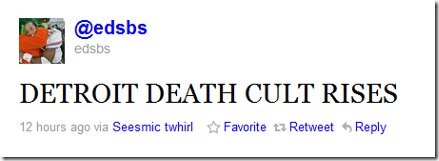
edsbs_detroit_death_cultFrom there, things kind of got out of hand:

edsbs_detroit_death_cult_2

edsbs_detroit_death_cult_3

detroit_the_lions_gate_defensive_line

With Nick Fairley, the Lions have added the player many thought was the best available talent in the draft—especially in that limbo between the college bowl season and the Combine. In Mel Kiper’s first mock (and many other early mocks, Fairley went #1 overall, to the Panthers. Instead of the “reach” that I was worried about yesterday, the Lions had an incredible player fall right into their lap—mostly thanks to four quarterbacks being taken in front of them, pushing a Top 5 talent all the way down to 13. The problem is, he plays the same position as Ndamukong Suh—doesn’t he?

Well, yes and no. First, Fairley spelling Suh would hardly be a bad thing: according to Pro Football Focus, Suh led all NFL defensive tackles with 997 reps. He barely came off the field at all! With Suh and Fairley, Williams and Hill, the Lions will always have two fresh impact tackles on the field. Beyond that, the Lions are extremely creative with their defensive line; they use weird sets, they stunt and loop, they shuffle guys around. Adding this weapon to Kocurek and Cunningham’s arsenal is dangerous, indeed.

Ultimately, it was a question of value. When the Vikings were on the clock, Adam Schefter reported that the Lions wanted, “badly,” to trade out of their subsequent pick. Apparently, the Lions feared Minnesota replacing the aging Pat Williams with Fairley, rather than roll the dice on a quarterback (as they did). This tells us what we need to know about the Lions’ draft board.

Yesterday, I wrote that the Lions, at 1.13, would be sitting on a pile of good-but-not-great prospects. At that point, the Lions would be loathe to stand pat—if they could find a partner, I’d thought, the Lions would try desperately to slide back. Faced with the possibility that Fairley wouldn’t be there, that’s exactly what they did. Clearly, for them, Prince Amukamara fell into that class of “a whole bunch of guys we’d gladly take at 20 but not so much at 13”—and considering he went 19th, that valuation must have been in line with the rest of the NFL’s.

For the Lions to have passed on Amukamara speaks volumes—not just about their thoughts on Fairley, but their thoughts on Amukamara. Obviously, cornerback is an area of pressing concern. Obviously, Amukamara was widely thought of as a Top 10 talent. Ndamukong Suh would be more than willing to tell the Lions everything they need to know about Prince. For them to not only pass on him, but be panicked at the thought of reaching for him at 13—well, as I said, it speaks volumes. It’s not that I think Prince will be terrible now, or something, but that if you woke up today thinking the Lions passed on the guy who’d immediately solve all their problems at corner . . . apparently, they didn’t.

It’s not all air guitars and pryotechnics, however, as not everyone is sold on Fairley and Suh becoming the Lions’ answer to the Mighty Ducks’ Bash Brothers. Pro Football Focus just posted an article called The Fairley Verdict, and the verdict was mixed, indeed:

It wouldn’t be the most ridiculous statement to say the Lions walked into the draft with the best combination of defensive tackles in the league.

So they didn’t need another one. Let alone a guy who on paper looks to suffer from the same weaknesses as Ndamukong Suh, as well as some pretty big character issues that caused him to drop in the first place. Presuming he plays up to his one good year in college, the Lions got themselves a guy who will likely be very good at penetrating, but perhaps lack a little in run defense. Just think how the combo of Suh and Fairley would leave them susceptible to draw plays and trap blocks? To say they don’t have the linebackers to deal with that level of linemen coming at them would be an understatement.

Eep. They even invoke "same old Lions," a phrase that sends a chill down my spine, and should induce shudders in anyone reading this. Yet, it’s important to note, Suh and Fairley will likely be rotating together in the same spot, not always playing side-by side—and, they are, Suh may be playing defensive end. Don’t forget, Suh has always had a little inside-outside to him, and rumors the Lions might play Suh more on the outside compelled Schwartz to publicly denounce them a few weeks ago. I’m not saying Suh is going to switch positions, but that he’ll be able to join the DE rotation for a number of different looks. Think about:

Avril * Suh * Williams * KVB

Jackson * Suh * Fairley * Avril

Suh * Williams * Hill * Jackson

These are just to wet your whistle. My calculator tells me there are 81 possible combinations with Avril, Lo-Jack and Suh rotating at left end, Suh, Fairley, and Williams at 3-tech, Williams, Hill, and Fairley at 1-tech, and KVB, Avril, and Lo-Jack at right end. As Jim Schwartz said:

"Well, we play 130 defensive tackle snaps in a game. So, if we're rotating three guys through and they're playing 45 snaps apiece ... No. 1, there'll be a little bit of pressure. We can keep rolling waves and waves."

Ultimately, this was simply a Mayhew Pick. The Lions have a defensive philosophy: build the most dominant defensive line in the NFL and let them handle it. Mayhew took the best player available—to some, Nick Fairley was the best player available to anyone in this draft—that fit in with their approach.

Now pass me that Honolulu Blue Kool-Aid.


Read more...

the Detroit Lions 2011 Pre-Draft Extravaganza

>> 4.28.2011

28 April 2007: Calvin Johnson is all smiles after the Detroit Lions made him their 2007 #1 draft pick at Radio City Music Hall in downtown Manhattan, New York, New York.25 April 2009: A happy Matthew Stafford holds his jersey after being drafted first overall by the Detroit Lions during the 2009 NFL Draft at Radio City Music Hall in New York, NY.  Super Bowl XLV

images by Icon SMI

All spring long it felt like this day would never come. Now, it’s here: the 2011 NFL Draft begins tonight, smack dab in the middle of the craziest labor chaos the league has ever seen. If you’re looking for my take on the Lions’ draft strategy, head on over to The Honolulu Blue, and check out my interview with THB’s author, Wade. We talk about needs, strategy, and my “gun-to-my-head” first-round choice. Wade does a great job, so keep going back after you listen!

Next, if you’re looking for my mock draft, I collaborated with Michael Schottey and Zac Snyder on #mockThree, a blogger/writer mock conducted entirely on Twitter. Schottey, who’s had real training as a scout, and goes to all the college All-Star games to grade these guys in person, did a fantastic job of wearing the Mayhew Hat. The expert graders haven’t turned in their marks for us yet—but just stepping through it made me thrilled for the Lions’ possibilities:

Picks:

  • 1.13 (13) Da’Quan Bowers, DE – Clemson
  • 2.12 (44) Brandon Harris, CB – Miami
  • 3.28 (92) DeMarco Murray, RB – Oklahoma
  • 4.32 (129) Brandon Fusco, C – Slippery Rock
  • 5.23 (154) Buster Skrine, CB – Tennessee-Chattannooga
  • 5.28 (159) Casey Matthews, LB – Oregon
  • 5.32 (163) Ronald Johnson, WR – USC
  • 7.02 (205) Chris Conte, S – California

Trades:

  • Traded #75 to New England for #92 and #159.
  • Traded #107 to Green Bay for #129, #163, and #233.

This mock was a dream scenario for the Lions. Let’s get this out of the way: I’ll out myself as the guy who pushed hard for Bowers. If the Lions stand pat at 13, they should take a developmental DE or OT. Why? Two reasons.

First, dominant power/speed combo rushers and huge, athletic pass protectors are only available in the top half of the first round. If 2011 goes as expected, the Lions won’t be picking anywhere near this high for a while, and eventually Backus and KVB must be replaced. Taking this opportunity to do so just makes sense.

Second, there are only a few positions on this roster where a rookie can come in and start—and with the possible exception of Prince Amukamara, there won’t be any impact players at those positions. Even if the Lions go with a corner or outside linebacker, they’ll likely be developmental guys anyway. If reaching for an immediate need won’t satisfy that need, then why do it? Take the best prospect that fits a long-term need.

Ultimately, I think the Lions should trade down from 13. There will be four-to-six players the Lions should be happy to add to their roster there, so why not move down a few slots, add a pick, and take who’s left? In #mockThree, Michael Schottey couldn’t find a trading partner before our clock ran out, so we took the prospect with the highest upside: Bowers.

After that, the board unfolded beautifully for the Lions. CB Brandon Harris fell to us in the second round, which I couldn’t believe—but even after that, corners were bountiful throughout the draft. Ras-I Dowling, a corner many believe the Lions might take in the second, fell to us in the third—along with OLBs like Quan Sturdivant and KJ Wright, RBs like DeMarco Murray and Kendall Hunter, and OG/OC Will Rackley. Unable to decide between so many strong options, we traded back and picked up an extra fifth-rounder. At our new, lower third-rounder, we added Murray, a complementary tailback of the sort we know the Lions are looking for.

Things just kept working out. Schottey brought up Slippery Rock C Brandon Fusco’s name in the third, and was Schottey’s #2 choice for our original fourth-rounder. Then we got a whopper of an offer to move back in the fourth and add a fifth and a seventh, and we took it. Fortunately, Fusco was still there with the later pick. Bam, developmental center. With the three fifth rounders, we nabbed Buster Skrine, a CB Schottey had a third-round grade on, and LB Casey Matthews, a 4th-5th graded guy. With the last fifth, we picked up WR Ronald Johnson—a Muskegon product with whom some of you may be familiar. Seventh rounders are always BPA.

After the confounding first round, the board sets up perfectly for the Lions’ needs. Of the Old Mother Hubbard shopping list, (which, I know, isn’t complete), we filled every need except developmental tackle. We added six players who could all be major contributors, if not starters, in 2012. If the Lions are crafty, they could do just as well.

What the Lions won’t be able to do is add three 2011 starters. That’s because of the skill and talent already on the roster, not a lack of skill in the front office or talent in the draft. The Lions have become a good team, and on good teams you don’t draft a raw project in the fourth round and start him Week 1, a la Sammie Hill. On good teams,  a fourth-round project has to work to make the roster, let alone the starting lineup!

I’ll be honest: tonight, I have no idea who the Lions will take. I’m hoping they pull off a trade down, and get a player who’ll be great someday, plus change. Whether they get an OT or DE for the future, or a CB for the present, the amazing thing about this draft is that we can just sit back and enjoy it. If you’re smart, you trust Mayhew, Lewand, Schwartz and his staff, Shack Harris, and all the scouts—they’ve done beautifully with their first two drafts, and I have faith they'll do so with this one, too.

Read more...

Matt Millen is Not Still In The House.

>> 4.04.2011

By now, I’m sure you heard about the Lions erroneously sending out their list of pre-draft rookie visits not just to the league offices, but to the entire league. Pro Football Talk’s Mike Florio reported this, then ended his article with a little jab:

Why do we have a funny feeling that, in some way, this is Matt Millen’s fault?

Har har. Sean Yuille over at Pride of Detroit did an awesome job debunking the notion, noting that Killer reported the list only contained visits to date, not future invites—and Dave Birkett spotted a known visit that wasn’t on the publicized list. The best thing Sean did though, was point out how little the list really matters:

The disclaimer I have presented when tracking these visits is that you shouldn't try to read into them too much. Like Schwartz said, it is fun for us fans to track, but it's not like they are a great indicator of who might be picked in the draft. That is why I don't see this email thing as being a huge "blunder" at all. Hell, with the way Martin Mayhew and company are so secretive with some information, perhaps they meant to send it to the rest of the league. You never can be too sure, but even if this was a mistake I don't see it as being a very big one. It's not like the Vikings or some other team picking ahead of the Lions is going to alter their draft strategy over some names in an email about pre-draft visits. That would be almost as ridiculous as how PFT framed this story in the first place.

I’ll defend Florio, though he doesn’t need my help (and will likely never know I offered it!). He tries to keep things funny; one of the easiest fish to shoot in the barrel is poking fun at a perennial loser. I don’t ascribe this to anti-Lions malice, just Florio trying to punch up a relatively harmless story with a funny angle. We may not find it all that funny—but believe me, if the headline were “Vikings Expose Something Other Than Visanthe Shiancoe” we’d be chortling along with everyone else.

Florio says right in the piece he assumed Schwartz’s quote about “everyone already knowing” referred to agents disclosing what other teams their client has visited. It’s common knowledge in league circles; they just ask around. Yes, it’s embarrassing the Lions made it so easy on everyone else—but it won’t change anyone’s draft strategy. A team brings a guy in for a visit to learn more about him . . . they don’t bring in the guys they’re already sure about—and definitely not the ones they trying to keep their interest in secret. As far as I know, Mike Shanahan didn’t even say Jay Cutler’s name out loud before trading up in the first to build the Broncos around him.

Matt Millen made a lot of mistakes when he was here. He flapped his gums a lot about what the Lions were going to do. He approached the front office like he was the coach of a football team, and not like he was the President and CEO of a billion-dollar company—literally, his job title. He put in 40 and flew home for the weekend, every weekend, for eight years—in an industry where the best leaders sleep at their desk. The results were terrible, but Matt Millen isn’t an idiot. He isn’t a blundering meathead who can’t do anything right. He’s just a well-spoken, likable football guy who was in way, way, way over his skis. His biggest mistake was refusing to quit.

No, Matt Millen wasn’t a human curse upon this franchise. He wasn’t a fell demon whose pestilent shadows still lurk in the corners of Allen Park, making fax machines jam and administrative assistants hit “Reply to All.” To the contrary, the new, infallible leadership that everyone has so much faith in? The executives we’re so sure are awesome that we’re tempted to call this email leak deliberate? They were Millen’s right- and left-hand men. Yet, in just their second season, the Lions won more than they did in all but Millen’s best year. Their track record already speaks for itself: Matt Millen doesn’t live here anymore, and this little oopsy doesn’t reveal any cracks in the Lions’ foundation.

Read more...

Old Mother Hubbard: The Outside Linebackers

>> 3.16.2011

If you're joining our roster review already in progress, here are the Old Mother Hubbard breakdowns for:

Before we delve into the next three positions, let me take a little time to address an email I received about the DE breakdown. Scott D. wrote:

You mentioned while you were watching the Jets game live, that you, in essence, personally discounted the PFF rankings for how KVB played in that particular game because of what ends up being, in your own terms, the "eyeball factor". Yet in every other aspect of the OMH series thus far, you're putting a great deal of credit in the PFF rankings.

It’s important to understand what the PFF data is, and what it isn’t. The PFF player grades are what I’ve been showing on the radar charts. They’re the PFF staff’s opinion on how well a player carries out his assignment. Each player is graded on every snap they play, and the final grades consist of those per-play grades aggregated and normalized. Every-down consistency scores much better than occasional excellence, and penalties weigh heavily on the final grade. On the whole, they present a good benchmark for overall performance, relative to an average NFL starter.

PFF also takes the time to go back and tally sacks, tackles, QB pressures, QB hits, missed tackles, and other stats. These aren’t subjective performance grades, they’re straight tallies of actual results—and they’re far more accurate than “offical” tackle and sack numbers, which are done on the fly, in real time, by team scorers with varying personal standards.

The KVB “eyeball test” you’re talking about?  Here’s what I said:

I had really good seats to the Jets game, and seeing KVB in action live was something else. He never missed an opportunity—before, during, or after the snap—to remind the Jets that he was there. That he was fighting. That they needed to keep their head on a swivel. That they needed to watch their ass. Vanden Bosch and the Lions out-Jetted the Jets on that day, mostly thanks to KVB and his leadership. PFF graded him at a –2.1 on the day, but I know he had a positive impact.

I was insinuating that KVB was playing . . . well, not dirty, but . . . okay, kinda dirty. He played to, and through, and also a little bit after the whistle. Not trying to injure—just not letting up, getting in a little extra on every play. He was very physical, very intense, and set the tone for a Lions defense that came to kick the butt-kickers’ butts. That doesn’t mean KVB was unblockable off the edge, or impossible to run on, or anything like that. In the PFF grader’s opinion, KVB executed his play assignments at a below-average level. But, I know his leadership made the whole defense better on that day.

image

Again: the news is not good. The dark gray line is Kamerion Wimbley, the top-graded 4-3 OLB. The thick black line is the NFL average. The goldish line is Scott Shanle, the backmarker. This means the Saints had both the worst ILB and the worst OLB . . .

Unfortunately, things aren’t so hot for the Lions, either. Julian Peterson was the only Lions OLB to meet PFF’s 25% snap-count threshold; he was also the Lions’ worst-graded OLB. He, like all the Lions OLBs, was right at the NFL average for pass rush, but strongly negative in coverage (-6.6). All that is moot, however, because Peterson was released.

Bobby Carpenter was a deft mid-October signing by the Lions. Apparently the Lions had been high on him for a while; Tom Kowalski reported that Martin Mayhew asked for Carpenter in the Roy Williams trade, Mayhew’s first roster move as Lions GM. The Cowboys ultimately swapped their disappointing first-rounder for the Rams’, OT Alex Barron. The 6’-2”, 245-pound Carpenter was cut by the Rams during training camp, picked up by Miami, and then cut midseason after he screwed up badly on special teams.

In Killer's article on Carpenter's signing, he points out that Carpenter is solid against the run, and in dropping back to cover; the PFF grades partially back that up. Carpenter was right at NFL averages for pass rush, but a bit above average in coverage. In fact, Carpenter’s coverage grade was the best single grade of any returning Lions OLB. Unfortunately, Carpenter was about as far below average against the run as he was above average in coverage, so his final grade is just a smidge below average. Keep in mind, though, that’s for 4-3 OLB who played in at least 25% of their teams’ snaps (which Carpenter did not).

Bottom Line: In limited reps, Carpenter showed he can be a creditable player for the Lions. He’ll never be the pass rusher the Lions want from the OLB spot—but with a full offseason in the system he should be able to pull his weight out there.

Ashlee Palmer was the Typhoid Mary of “One Man’s Trash Syndrome,” a good young player let go because another team was switching schemes. Palmer, 6’-1”, 236 pounds, was a UDFA rookie for the Bills in 2009. He made an impact as a special teams standout, and looked great in backup duty. But, out with the old—Dick Jauron’s 4-3—and in with the new—Jim Haslett’s 3-4—and the Lions got a great value pickup.

Palmer got 240 snaps at outside linebacker, roughly split between the right and left. He also had about a hundred snaps in the middle, so he never had a chance to get comfortable anywhere.  He graded out more or less across-the-board average for the first five weeks, then had a really rough streak in weeks 6, 8, 9, and 11. That’s alarming, since he got many of his snaps in that stretch. He finished with another long streak of averageness in lighter action, though, and put an exclamation point on the season with a +3.1 day against Miami where he played 50% of snaps.

On the whole, Palmer was an average rusher, slightly above average in coverage, and below average against the run. He was slightly less effective in coverage than Carpenter, and a full tick worse in run support.

Bottom Line: Palmer is a young, tough, versatile player forced to play all three LB positions as a 2nd-year UDFA, and produced at a slightly-below-average level. He’ll be a valuable rotation player, and possibly an okay starter with a full offseason at OLB. Still, he doesn’t have impact tools or impact upside.

What a wild ride it’s been for the Pain Train. Zack Follett, member of the Lions Fan Favorite Hall of Fame Class of 2009, entered the season as a starting outside linebacker. After making headlines over the offseason with his Tweeting and vlogging, Follett saw in about 150 snaps at the left linebacker spot, before a scary helmet-to-helmet hit put him out for the season.

Follett was sort of the yang to Ashlee Palmer’s yin. Standing at a nearly identical 6’-2”, 236, Follett was graded slightly below Palmer in pass rush (!), significantly below Palmer in coverage, but significantly above in run support. Follett, to my eyes, is more naturally athletic and has a higher upside, but appeared to be “swimming” out there; thinking instead of reacting. Follett was often a half-step behind, a half-instant too slow in making plays, because he didn’t recognize the need to act quickly enough. However, the recognition did come and the ability is there.

It’s worth pointing out that Follett got heavy reps against the Lions’ stiffest competition, in the front half of the season. Further, defenses were picking on Follett’s coverage more: opponents threw at Follett every 16.45 snaps, as opposed to 21.8 for Palmer.

As a sidebar, they threw at Landon Johnson every 11.4 snaps, which would have been the third-most-frequent in the NFL if Johnson had played more snaps at OLB.

Bottom Line: Zack Follett is still a very young player who showed a lot more pass rush ability at Cal than he’s shown so far in the NFL. With another full offseason to get the defense down pat, he should be able to do less thinking and more reacting. If he’s medically okay to play, he deserves to be in the mix with Palmer and Carpenter, especially being stronger against the run than either.

Right now, the Lions have three very good rotational players who have an interesting mix of youth, experience, and upside. They each bring a slightly different approach to the game, and each have a slightly different skill set. However, my understanding of the Lions defense was that they wanted two (in-his-prime) Julian Petersons at OLB; two big, fast pass rushers who are athletic enough to not be a liability in coverage. Unless Follett puts it together, they don’t have anyone who can rush the passer from the OLB spot.

An interesting observation: note that the best overall 4-3 OLB, Kam Wimbley, was only graded at +23.7, and he had a sizable lead over Nos. 2 & 3: +17.7, and +14.1, respectively. Since the top DT and DE each graded at about +45 , and the top ILB was about +35, this suggests that 4-3 OLBs just don’t play a big of a role in the success of the defense. As long as they aren’t total liabilities against the pass, and don’t miss a slew of tackles, you can get away with a pedestrian OLB . . . or two. Perhaps a major investment at OLB is unwise. Indeed, Mayhew said he’s perfectly comfortable with Palmer and Carpenter as starters in 2011.

SHOPPING LIST: The Lions, undeniably, lack impact players at OLB. The 2010 performances of Carpenter, Palmer, and Follett suggest the Lions could “get away with” drafting a developmental OLB, letting all four compete for snaps at LB, and featuring all four in special teams units. However, if the Lions are looking for impact pass rushers in these spots going forward, they’ll need to draft one and acquire another.

Read more...

GUILTY! GUILTY! GUILTY! Detroit Lions: Dirty Tamperers

>> 2.18.2011

I totally found and read this Doonesbury book when I was a kid.

With the news that the Lions had been found guilty of tampering, forfeiting one draft pick and swapping places with another, every Lions fan is either seething with the injustice of it all, grieving for the loss of the a draft pick, or joyous over having some real live actual Lions news to talk about. Well, every Lions fan but me. I’m more like “Meh.”

Of course, I’m bummed that the league chose to find the Lions guilty of tampering with Jarrad Page, a player the Chiefs didn’t want but were too greedy to let walk. Of course, I’m disappointed that the Lions are going to lose a draft pick. But I wouldn’t be much of a Flamekeeper if I didn’t look at the bright side . . .

Of course, Martin Mayhew is no Richard Nixon; he is not going to resign in the face of this embarrassment. In fact, if you think about it, this isn’t much punishment at all. Here are the Lions’ seventh-rounders over the last two seasons: Tim Toone, Lydon Murtha, and Willie Young. None made the opening 53-man roster their rookie year. Stefan Logan has made Toone’s quest for a spot this year all but futile. Murtha is long gone, signed by the Dolphins off the Lions’ practice squad. Young, despite his pedigree as the son of a panther god, has barely played [Ed.: Link not for the faint of language].

All of that happened while the Lions churned, literally, hundreds of players on and off the roster, desperate for usable talent. This offseason, the Lions’ roster is going to be deeper than it’s been since Millen. The odds that anyone drafted in the seventh round will make the squad are miniscule. It sucks that the Lions have been slapped on the wrist, but they’ve only slapped on the wrist.

In fact, by signing free agent safety Erik Coleman, the Lions have already added a player more likely to make an impact than the seventh-rounder they lost. Coleman is a more physically talented player, and a more skilled coverage guy, than the man he replaces (C.C. Brown). I’d imagine he’ll compete with Spievey throughout the offseason for the spot next to Delmas—and might back up both spots, if he’s not starting. Coleman was solid, if not spectacular, for the Falcons in recent seasons (I had him in my IDP dynasty league, so I was watching).

I know, I know, the Lions hardly have a competitive advantage, and any talent acquisition handicap seems terribly unfair. But in the grand scheme of things, Gunther’s loose lips hardly sank the ship.


Read more...

Three Cups Deep: Winning Like the Packers

>> 2.08.2011

Green Bay Packers QB and Super Bowl MVP Aaron Rodgers #12 holds up the Lombardi Trophy with former NFL QB and Fox Sports broadcaster Terry Bradshaw after the Green Bay Packers defeat Pittsburgh Steelers 31-25 to win Super Bowl XLV at Cowboys Stadium in Arlington, Texas.Congratulations to the Green Bay Packers. Congratulations to Aaron Rodgers, MVP. Congratulations to Mike McCarthy and Ted Thompson, a great coach and a fantastic franchise architect. Congratulations to all the awesome Packer bloggers, through whom I’ve been living vicariously throughout the playoffs. Most of all, congratulations to the Packers’ owners: their fans.

Last season, I wrote a post called “Winning Like the Saints.” In it, I talked about how the NFL is a copycat league—but they often copy wrong. When the Dolphins deployed the Wildcat, they were wildly successful; most teams in the NFL spent the next summer experimenting with some sort of Wildcat or Pistol formation. The Dolphins’ use of the Wildcat, though, was an intelligent response to a desperate situation: they weren’t winning games, and needed a way to maximize their only talent advantage: two strong tailbacks. The reason they went to the Wildcat is because most teams don’t have two strong tailbacks.

The way to copycat the Dolphins was not to “run the Wildcat” with whoever was on the roster, but to have smart coaches who’ll schematically maximize the talent they have. The Saints were a perfect example:

Think about it. What did Drew Brees do so well at Purdue? Pick defenses apart with short-range passes out of multi-WR sets. As a conventional quarterback in San Diego, he was at best inconsistent and at worst a failure. In New Orleans, Sean Payton asks him to do only what he’s excellent at; people think Brees is now “better” than Peyton Manning, which flatly isn’t true.

Sean Payton figured out that Reggie Bush is Kevin Faulk, not Marshall Faulk, and employs him in only in that role—to great success. Payton figured out that Robert Meacham is a short-yardage monster, and employs him in that role—to great success. Payton knew that with his fast-scoring, high-powered offense, he needed an aggressive, blitzing defense that could protect a lead. He hired hyperaggressive DC Gregg Williams to install such a defense, even though he had to give up $250,000 of his own money to do so!

Ironically the Dolphins, having found a way to maximize their talent, latched onto it as their offensive identity. They began reaching for marginal players that fit the scheme, rather than continuing to adapt and respond. This season, their powerful offense fizzled out, as the no-longer-novel Wildcat failed to surprise—and the relative lack of talent prevented the Dolphins from running a conventional offense well. Head coach Tony Sparano was nearly replaced by Jim Harbaugh as a result. Sparano’s eventual extension came hand-in-hand with the departure of Dan Henning—the offensive coordinator who implemented the Wildcat to begin with.

Don’t this next bit wrong: I don’t mean to demean the Packers’ coaching staff. Mike McCarthy is respected schemer, instrumental in getting the most out of both Favre and Rodgers—and, we’re now finding out, he’s a gifted motivator as well. Further, DC Dom Capers’s long track record of innovation and success is well-known, and his defense was magnificent this year. However, this Super Bowl belongs to Ted Thompson.

Thompson, the Packers’ GM, has long been a target of criticism—not least of which from Packers fans—because he approaches team-building in an unconventional way. His first major moves as GM were to let perennial All-Pros Marco Rivera, Mike Wahle, and Darren Sharper walk. His first draft pick was Aaron Rodgers, after the top quarterback prospect fell all the way to the 24th pick. Thompson continued to draft for value, build slowly, refuse to re-sign aging veterans for a penny more than he valued them at, and—with a notable exception in Charles Woodson—eschew free agency almost entirely. It was a long, slow process, that was successful in maddening fits and starts: 4-12, 8-8, 13-3, 6-10, 11-5.

It must be (and has) been said: Thompson had the temerity to sent Brett Favre packing when it was time. Thompson had the confidence in McCarthy and Rodgers to make the correct move for the franchise. When the first season of the Rodgers Era ended with a 6-10 record, and he was asked about coaching staff changes, Thompson replied, “That’s not my bailiwick.” When the Packers’ offensive line again struggled badly to protect Rodgers at the start of 2009, the tide of public sentiment fully turned. Aaron Nagler of Cheesehead TV, up until then one of his most faithful supporters, vehemently outlined Thompson and McCarthy’s failures.

Of course, the very next game, Daunte Culpepper "led" the Lions into Lambeau, and the slaughter that ensued kicked off a 9-3 run to the playoffs. However, a notable undercurrent of anti-Thompson sentiment still ran through the Packers’ fanbase. I repeatedly encountered Pack fans on blogs and Twitter and elsewhere who were convinced McCarthy was the right guy—but successful in spite of Thompson’s lackadaisical talent management. “firetedthompsonnow.com” was registered in March of 2010 . . .

. . . now, all that’s hosted there is a picture of Thompson, overlaid by the words “I’m not afraid to admit it. I was wrong. Congrats Ted.Thompson’s vindication comes not only in the winning of a championship with Aaron Rodgers, while Favre sits at home, disgraced, but in the Packers doing it with the bottom half of their roster. The Pack’s stunning injury losses, and subsequent triumph, proved the top-to-bottom quality of the house Thompson’s built.

So, how do you win “like the Packers”? It’s not by having a #1-overall-pick-caliber quarterback fall into your lap at the bottom of the first, making him wait three years to play, or pushing his veteran superior out the door. It’s not by having a raft of intelligent, talented, hardworking receiving targets. It’s not by deploying a multiple-look 3-4 defense,  or having two great complementary cornerbacks. You win “like the Packers” by building the roster through the draft. You win “like the Packers” by refusing to compromise your long-term vision with stopgap solutions. You win “like the Packers” by refusing to pay a player more than he’s worth, for any reason. You win “like the Packers” by meticulously building a championship-caliber roster, that rolls 53 men deep.

Martin Mayhew is not Ted Thompson. He lacks Thompson’s public idiosyncrasies. He’s been slightly more cognizant of immediate need—see Foote, Larry—and is okay with stopgaps for the right price. Thompson has been judicious in signing players, while Mayhew has churned the roster with incredible vigor: literally hundreds of players have been a Lion for at least a day since Mayhew took over. Then again, Thompson didn’t start with a truly talentless, 0-16 team—who knows what Ted’s approach would have been in Martin’s place?

On the whole, though, Mayhew’s strategy has been much like Thompson’s: the Lions have built their current roster almost entirely through the draft. When they’ve reached into free agency, they’ve been swift and decisive; as in the brilliant all-in move for Kyle Vanden Bosch. The Lions have also refused to pay more than they feel a player is worth. Foote’s arrival was delayed because the Lions refused to part with any more than a seventh-rounder for him. When the Steelers insisted on more, the Lions called their bluff—and got Foote for nothing when the Steelers released him.

Over this offseason, look for both men to stay the course: drafting the best player that fits a need, making judicious moves when the value is there, and being willing to part with unneeded parts. Between the Packers’ injured players coming back, and the Lions’ third full offseason of reconstruction, both teams will be in position to win several more games than they did this year—and both teams will be built to last.

Strap yourselves in, folks--this is going to be a hell of a ride.

Read more...

Drew Stanton: Detroit Lions Starting Quarterback

>> 12.02.2010

By now, you’ve certainly heard the news: Drew Stanton will be starting for the Lions as they face the Bears this Sunday.  This kicked off a cavalcade of reactions:

  • Sean Yuille at Pride of Detroit:
    “Apparently Schwartz said that the offense won't change with Stanton at the helm. All I can say is I'll believe it when I see it.”
  • Neil at Armchair Linebacker:
    "Hell had to find a way to ferret out the tiny pockets of hope that were still left in the fanbase and then crush their fragile spirits, and what better way to do that than to parade down the streets with a clueless Drew Stanton waving and smiling and throwing Grit at horrified onlookers while the devil rides an evil sleigh made from the bones of Matthew Stafford and Shaun Hill?"
  • Big Al at The Wayne Fontes Experience just screamed, senselessly.

I come from a different school of thought entirely.  Way back in March of aught-nine, in this blog’s third month, I penned a little piece I called “On Quarterbacks,” which was much more about Drew Stanton in particular than quarterbacks in general:

Stanton is a player I have an extra soft spot for, because my then-toddler daughter was introduced to football through him. One of the games we'd play with her would be to point out Drew Stanton every time teh camera closed in on him. In fact, one of the first times she recognized a number was during a Spartan football game, and she started shouting, "Green Number Five!" It took us a little while to realize that she was seeing Stanton and calling out his jersey number: a green five. When got a little older, my mother taught her to say "Drew Stanton, what a babe!" (gee, thanks, Mom). Ultimately, DS was kind enough to do an autograph session at the Mall, and my little girl actually got to meet the man in person.

Anyway, when Stanton was drafted by the Lions, it was a dream come true, of course. A second-round pick, at just the right time to draft and groom a QB, and a very Millen kind of QB, a tough-nosed, smart, gritty, vocal leader. The kind of player who legitimately hates opponents and wants to beat them--not for glory, not for stats, not for money, but for the sake of victory. The kind of player who can't stand losing, and will give every last ounce he's got to come out on top. That is exactly the kind of quarterback that most Lions fans have been screaming for for years, yet have not ever seen.

I was both thrilled and scared to tell my daughter about Drew Stanton What A Babe becoming a Lion, because deep down I feared that what happened to Chuck would happen to Drew. That the dark presence that hangs over this organization would roll down upon Ford Field and smite him, and DS would never lead the Lions to anything. Sure enough, it's been two whole seasons now; thanks to injuries, blackouts, and the ineffable Will of Rod, my now-twice-as-old-as-she-was-then daughter has still never seen Drew Stanton play for the Lions.  She roots for the Buccaneers now.

If the Millen/Martz/Marinelli three-headed monster, and multiple untimely injuries, hadn’t snuffed out Drew Stanton’s hopes of ever becoming The Lions’ Quarterback (instead of a Lions quarterback), the selection of Matthew Stafford did.  As soon as the ink was dry on Stafford’s massive contract, the forecast for Drew Stanton’s Lions career read “Cloudy with a slight chance of Charlie Batch in Pittsburgh.”  From that point, Hometown Boy Career Backup was the best Detroit Lion he could hope to be.

Unfortunately, Drew hasn’t made enough of his few chances to get even there.  His first—and until Sunday, his only—NFL start didn’t go so hot: 11 of 21 for 130 yards, no scores, and 3 INTs.  Combined with his various relief and mop-up appearances, he’s completed 55 of 104 attempts for 611 yards, two TDs, and seven interceptions.  That’s a career passer rating of 49.0.

His limitations as a passer are undeniable.  At his best, Drew’s passes are in the right place at the right time, but lack zip, especially on deep routes.  At his worst, his throws are wildly inaccurate and easily intercepted.  As Neil is so fond of pointing out, though, Drew’s stock in trade is Grit: with heart and effort and general athletic ability, he goes out and makes plays and does his best to win, no matter the odds.  In college, it worked—sometimes spectacularly.  Drew did engineer the biggest comeback in NCAA D-I history, after all.

Unfortunately, the same hasn’t been true so far in the pros.  In preseason, we’ve seen Stanton scramble for scores and throw 50-yard bombs—but when the bullets have been live, he’s been a dud.  Some of it’s because his team’s been terrible.  Some of it’s because he gets almost zero practice reps outside of training camp, so never practices with the starters and barely practices at all.  Some of it’s because his best chance to make it in the pros was with slow, steady, careful grooming to build good habits and iron out bad ones.  Some of it’s because . . . well, his limitations as a passer are undeniable.

Even so, this season we saw some real progress out of Drew. When he came in cold against the Giants, he turned in a performance that was a little shaky—but, yes, gritty.  He made plays when he had to, and nearly shocked the Giants at Your Company Name Here Stadium.  He impressed everyone, even Giants head coach Tom Coughlin:

"The third quarterback came in and, geez, he played very, very well,'' Giants coach Tom Coughlin said.

And Dominic Raiola--part of a Lions offensive line that worked incredibly hard to give Drew time against one of the better pass rushes in the NFL--voiced his support of Drew, too:

"Drew is mentally tough. You're not going to tell him he can't play and then he'll go in the tank. The guys are behind him -- he got better and he did a good job for us,'' Lions center Dominic Raiola said. "Drew's come a long way. He's so improved. People who think he's not an NFL quarterback ... he looked like one out there to me. He did a great job of preparing and he gave us a chance."

. . . and Stephen Peterman, too:

"I thought he did great,'' guard Stephen Peterman said. "He came in and stepped in and played a helluva game. He made checks and looks that you wouldn't expect from a guy who hasn't been in there. He did a great job."

In the wake of the Bills loss, I angrily blamed Jim Schwartz for starting a severely hampered Shaun Hill (who was too hurt to practice the whole playbook that week), instead of giving Drew a solid week of preparation with the starters.  Surely, I said during the Fireside Chat, if you knew that that was all Shaun Hill could give you, you have to start Drew.  If you can’t count on your third quarterback to play when your second-stringer is too hurt to take snaps under center, then what is he doing on the roster?  Schwartz answered that very question this week:

"There's a reason we've kept him around, and you only keep a guy around if you have confidence to put him in a game," Schwartz said. "His role has been third quarterback, and now it's time for him to be able to answer that and be able to go."

Obviously, actions speak louder than words: if Shaun Hill, playing at about 52% of his usual ability, gets the nod over a healthy Drew Stanton, then in fact you don’t have confidence to put him in a game.  Then again, actions speak louder than words—Schwartz and Mayhew have had plenty of opportunities to cut Drew loose and bring in someone else.  The Lions have not been shy about churning the roster; there’ve been no sacred cows.  Even beloved, respected, hometown boy, brought-in-by-this-regime Jon Jansen was sent packing when the Lions thought his roster spot would be better served on someone younger.  In fact, they have brought in several other quarterbacks: Brooks Bollinger, Kevin O’Connell, Zac Robinson—and they just worked out Josh McCown and J.T. O’Sullivan earlier this week.  If any of those guys offered a floor, or ceiling, higher than Stanton, Drew’d be gone.

I realize, at this point, that I sound like a fool.  I realize, at this point, that everyone else long ago boarded the Drew Stanton Sucks So Bad it’s Funny train, even though the reality of his situation hasn’t changed: he’s still a 2007 second-round draft pick, and he’s still only getting his second real shot at playing quarterback for this team.  He’s getting a full week of practice reps with the ones, a full week of preparing as the starter, a sellout home crowd, and a team eager to play for him—and get the victory over the Bears that was taken from them.

Go get ‘em, Drew.


Read more...

One Roster, Well-Scrambled

>> 8.18.2010

In the past two days, the Lions have:

Got all that?  No?  Don’t worry, neither did I.  The most significant move is the release of Jason Hunter, a young guy who contributed significantly last year.  As a perfect physical fit for the Lions’ intended scheme, Hunter was a low-cost, high-upside player.  However, Willie Young looked great against Pittsburgh, and there are only so many long-term developmental DEs you can carry on a roster.  With no future in Detroit, the Lions did the stand-up thing and let Hunter go while he can still catch on somewhere else.

The confusing thing was that they turned around and signed Korey Bosworth.  Bosworth is a DE/OLB ‘tweener, a guy who’d be a great fit at 3-4 OLB—and in fact, had been a camp invitee of the Broncos.  I immediately presumed he’d be slotted as an OLB in the Lions’ system, given that he’s the exact same height and weight as Zack Follett, and about thirty pounds lighter than the just-released Hunter.  But, quoth the Grandmaster, Jim Schwartz:

“We had a need at defensive end,” Schwartz said. “He’s a guy that we had interest in from college scouts, a guy that was able to get here and looked like he was in shape and would be able to give us some work.

“He’s a tough guy, plays hard, he’s got a good opportunity here. I mean we threw him right into the fire. He got reps right away."

Last season, the acquisitions all fit the long-term picture—but Hunter is a guy who could have helped if he’d stuck around, and Bosworth flatly has no place in a scheme that requires the ends to contain the run on the outside.  Let’s change perspective for a moment: if Willie Young is now the developmental end, the long-term picture doesn’t have a Jason Hunter in it, does it?  Kyle Vanden Bosch, Cliff Avril, Jared DeVries, Willie Young . . . no, no Hunter. 

Knowing that Hunter's long-term future is elsewhere, they let him seek it.  But, just carrying your top four ends through half of training camp is going to work them too hard—the Lions needed a fifth body out there to burn reps.  They asked the scouting department for the next best DE on the list, and the scouts said “Korey Bosworth.”  So, Bosworth is here, and Hunter is not.

Let’s hope that the injury bug takes no more bites out of the roster, and the panicked acquisitions stop.  There’s a long way to go, though, before the Lions get down to 53 + practice squad—and of course we know that Martin Mayhew never stops churning the bottom of the roster, never stops scouring the waiver wire, never stops looking for the diamond in the rough.


Read more...

The Lions Rest, But Do Not Sleep

>> 7.06.2010

Jarrad Page tackles Dennis Northcutt: a future Detroit Lion tackles a current one? According to Chiefs blog Arrowhead Pride, the Lions have inquired about KC’s disgruntled safety Jarrad Page.  Apparently, it didn’t get much past the inquiry stage, possibly due to the asking price.  Scout.com’s Nate Caminata found out from Scout’s Chiefs expert Nick Athan the Chiefs’ valuation of Page ($).  Whether the Page talks develop into a Page trade, or whether they’re not getting any farther than they’ve gotten, this is important.

For starters, it shows the Lions aren’t satisfied with throwing C.C. Brown atop a pile of bodies (Ko Simpson, Marquand Manuel, Marvin White, Daniel Bullocks) at safety.  Brown, nicknamed “Can’t Cover” Brown by Giants fans,  won’t fix the frequent blown assignments we saw from Lions safeties in 2009.  The others . . . well, they’re the same guys from 2009.  So nothing the Lions saw in minicamp gives them confidence that the answer at safety is currently on the roster.

The second, and arguably more, important thing: they’re doing something about it.  Throughout last season, the Lions cycled players on and off the roster at an incredible rate.  Any time they could make a move to improve the roster, they did—and given how much of that roster needed improving, they made a lot of moves.  A commenter, TimT, did a breakdown of last season’s roster churn, showing that 123 different players were Lions (to one degree or another) during the 2009 contract year.

After the free agent bonanza in March, and subsequent draft in April, there was a collective exhalation, as though the mad rush was over.  Outside of a few key spots (RT, OLB, CB, and S), the roster makeover was nearly complete.  Skilled veterans and talented youngsters were all over the starting lineup—and what’s more, they fit what the coaches want to do.  The Lions-observer hivemind was satisfied that with a couple of top free agents next season, and a third solid draft, the Lions would be well on their way to perennial contention.

While the Lions-observer hivemind are satisfied at the progress, the Lions execs and coaches are not.  Rather than call the last 18 months of work good, and head into camp with more answers than questions for the first time in forever, they’re still furiously turning over every stone.  With the signing of Dré Bly, and this move for Page, we see that the Lions aren’t content with improvement in the relative sense, not satisfied with merely being better.  They won’t look on a hard-fought five-win season as a success; they’re not playing for 2011.

Given the brutal division in which they play, and magnitude of the mountain they had to climb just to get to “bad,” and the unknown height yet to climb before “good,” this relentless effort to improve in July won’t really matter, will it?  The difference between Ko Simpson and Jarrad Page won’t be the difference between a winning season and a losing one . . . will it?

Well, even discounting the impact that some of the “minor” additions like Zack  Follett have had on the roster, the greatest impact will be the process of improvement itself.  The phrase “relentess effort to improve” hasn’t been used in association with the Lions since . . . well, it’s been a while.  Just the fact that the Lions are continually adding, improving, changing, looking for more, striving to be better, even when other teams are not . . . it will pay real, material dividends in the W-L column this fall.


Read more...

  © Blogger template Simple n' Sweet by Ourblogtemplates.com 2009

Find us on Google+

Back to TOP