Showing posts with label willie young. Show all posts

Old Mother Hubbard: The Defensive Ends

>> 2.02.2012

Pantry

From last year’s Old Mother Hubbarding of the Lions defensive ends:

Cliff Avril was pigeonholed by most as a 3-4 ROLB, and I’m certain he could shine in that role. But he’s developed into the fast, athletic 4-3 rush end Rod Marinelli thought he could be. Avril will never be a 270-plus-pound, two-way monster—but he’s already an impact defender, top-flite pass rusher, and a huge part of this defense going forward. Signing this RFA to a long-term deal must be a top priority.

Kyle Vanden Bosch is the ultimate leader, a consummate professional—and as a player, the yang to Cliff Avril’s yin. Had he stayed healthy, he would have had seven sacks and fifteen QB hits, more than acceptable standalone production, besides the undeniable halo effect. Unfortunately, he’s 32, and recovering from a major neck injury. The Lions need to find a starting, impact, two-way end to replace him by the 2012 season.

Lawrence Jackson produced like an above-average starter in heavy rotation, and fron Week 10 on was one of the better 4-3 DEs in the game. I’ll hold off on anointing him the starter of the future for now, because I’d like to see more consistency—but there’s no doubt he’d be the perfect physical fit for the void KVB will eventually leave.

Willie Young is a developmental prospect with a very lean frame, a long way to go, and an undeniable knack for playing football. I hope he has a place on the roster for next season.

And then, the shopping list:

The Lions will need to find an impact two-way defensive end, ready to replace KVB as a starter by the 2012 season. Lawrence Jackson has the potential to be that end. Cliff Avril is an RFA who must be re-signed to a long-term deal. The Lions may look for a developmental speed-first end behind Avril, especially if Willie Young does not take major strides in the offseason.

It's important to restate the design goals of the Lions defensive line: to get consistent, excellent pressure from the without assist from the blitz. To have a pair of bookend DEs rushing from wide alignments, fast enough to turn the corner and strong enough to set the edge against runs and screens. To have two defensive tackles who can rush the passer up the middle of the pocket, one of whom can also collapse the running lane between himself and the nine-technique DE. Most importantly, to have depth all across the line, making sure the above design requirements are fulfilled for four quarters each of sixteen (-plus) games.

Now, that in mind, let’s look at the data:
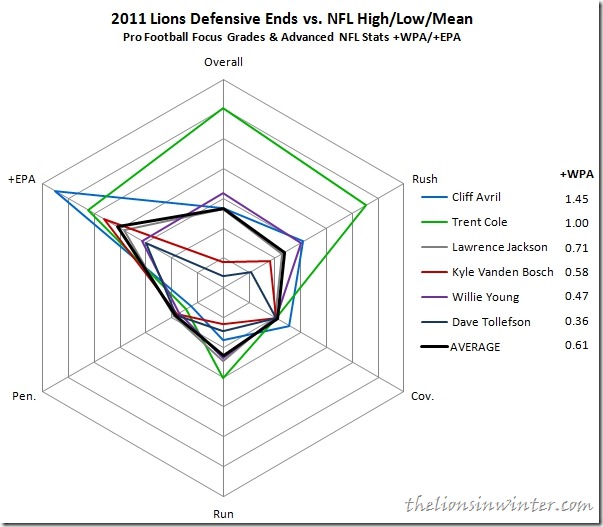
detroit_lions_defensive_ends_2011_grades

For the second straight year, Philadelphia’s Trent Cole is the highest overall PFF-graded 4-3 DE. With the #1 overall pass-rush grade of +40.4, and the 11th-best run-stopping grade at +10.3, Cole fulfilled his responsibilities in the Eagles’ own wide-9 alignment perfectly. His two-way dominance was so complete, he kept his top overall mark despite being called for seven penalties in 640 snaps. Interestingly, Cole’s 1.00 +WPA is only ranked 23rd, and his 32.3 +EPA is 27th. For all his consistently positive play, Cole didn’t help the Eagles win much. May have something to do with the rest of the defense behind him.

Bringing up the rear is the New York Giants’ Dave Tollefson, whose –9.4 rush grade and –5.5 run-stopping grade put him at the bottom. His 0.36 and 10.0 +WPA and +EPA rank him 79th and 86th, respectively, out of 125 defensive ends ranked by Advanced NFL Stats.

Important note: Pro Football Focus separates linemen into DT/NTs, 4-3 DEs, and 3-4 DEs. Advanced NFL Stats has one bucket each for DTs and DEs. The two sites do not always agree on who is what.

Cliff Avril is another example of why I added+WPA and +EPA to these radar charts. When you add up all his positive, negative, and nothing-in-particular plays, he’s an average NFL defensive end. His +6.6 overall PFF grade almost exactly matches the NFL average of +6.5. That includes a pretty heavy ding for 11 assessed penalties, but a major boost from his linebacker-like coverage skills (+5.5). His pass rush grade is solid, ranked 19th overall at +11, but confusingly low for a guy who had 12 sacks, 8 hits, and 37 pressures on 822 snaps (one of those pass rush events per 14.7 snaps, 15th-best rate in the NFL).

For comparison, Trent Cole had 11 sacks, 11 QB hits, and 44 pressures on 640 snaps, one every 9.55 snaps (2nd-best). For further comparison, Jared Allen had 24 sacks, 8 QB hits, and 34 pressures on 1044 snaps—one every 15.8 snaps. Just putting that out there.

So from looking at just the PFF grades and stats, we’d mark Avril down as an average overall defensive end, pretty good at rushing the passer but otherwise mediocre. Then, we look at the +WPA and +EPA and whoa.

Avril’s +EPA is an excellent 45.1, 11th-best in the NFL; that’s well ahead of Cole’s 32.3 (Jason Pierre-Paul’s is tops at 83.4).  His +WPA is an outstanding 7th overall, at +1.45. The discrepancy comes from his impact plays: 4 passes defensed, 6 forced fumbles, 7 TFLs, and an interception. In terms of +WPA, it’s his knack for making big plays at the right times. He helped the Lions’ win-loss bottom line 45% more than Trent Cole helped the Eagles’.

Just as with the defensive tackles, we see Lions defensive ends—as a rule—make big plays when they matter most, far out of proportion to the rest of their production. Avril, though, takes that to the extreme. Keep in mind, he’s doing it from the left side, too: going against bigger/stronger right tackles and often in the quarterback’s field of vision. Imagine if he were working the blind side . . .

Bottom Line: Cliff Avril, in this system, plays like a top ten defensive end. If he is not re-signed, his production and playmaking ability will not be easily replaced—and his production and playmaking ability is essential to the success of the defense. His re-signing must be the Lions’ top priority.

Willie Young, a.k.a. The Great Willie Young, might indeed be the son of a panther god. His +11.7 overall PFF grade would be the highest of any Lions DE, if his 259 snaps weren’t just a few too few to qualify. His +10.2 pass rush grade is just behind Avril’s +11.0, and his run-stopping grade is far superior, +3.7 to –2.5. In a huge surprise, the not-as-spindly-as-he-used-to-be Young’s run defense was better than all but Lawrence Jackson’s.

Again, this is on limited snaps—and that cuts both ways. Young makes fantastic plays whenever he’s in the game, but he’s in the game most often when the situation is ripe for him to make plays. His 3 sacks, 4 hits, and 19 pressures put his snaps-per-pass-rush at 9.96 which would be third-best in the NFL if he’d played just thirty or so more snaps.

I believe that’s at least part of Trent Cole’s story above: he played 182 fewer snaps than Cliff Avril, and I’d be willing to bet a good chunk of “negative” plays were eliminated because of it. It’s a lot easier to be great against the run when you only have to do it on 2nd- and 3rd-and-long . . .

Still, Young’s +11.5 EPA and +0.47 +WPA speak to just how effective he was when he was in. The average +WPA for qualifying DEs was 0.61, meaning that in just 259 snaps Willie Young helped the Lions win almost as much as an average starter. Nobody put much stock in a sub-260-pound all-legs-and-no-torso seventh rounder developing into a vital contributor, but Young’s already there in just his second year. How much better can he get?

Bottom Line: Willie Young has proven his worth as a rotational end, and should be a big part of the picture for 2012, his make-or-break year. If he can shoulder an increased workload without his rate stats falling off, he’ll be every bit the player Cliff Avril has been. That is an enormous “if.”

Lawrence Jackson had an outstanding 2011, producing at the same level as Avril and KVB when he got reps. The natural big-bodied run-stuffer Avril isn’t, he seemed destined to take over on the left side as Avril transitioned to the right rush end spot.

Instead, Jackson played almost exclusively on the right side, in relief of KVB. He struggled against Tampa Bay, but had strongly positive games in Weeks 2-5. His season crescendoed on Monday Night Football, with a +3.4 overall grade (1 sack, 1 hit, 2 pressures on just 31 snaps). After that game, however, Jackson had three flat games before Week 10—where he graded out very well and suffered a deep thigh bruise that would bench him until Week 16.

You can’t help but feel like Jackson missed his opportunity to stake his claim as the Lions’ third-now-and-second-soon DE. However, Jackson’s 18.4 +EPA is a very positive sign; he nearly matched the NFL average of 21.07 with just 341 snaps. His 0.71 +WPA is an even better one: with less than half the snaps of a typical starting DE to work with, Lo-Jack contributed more to the Lions’ winning games than some other teams’ starters . . . unfortunately, that includes the Lions’ Kyle Vanden Bosch.

Bottom Line: Lawrence Jackson had a chance to prove to the Lions they were set at this position for years to come. Instead, his deep thigh bruise—and midseason lull—leaves us no closer to knowing if he’ll be ready to step in for KVB as a full-time starter when the time comes. However, he also flashed enough of that Secret Superstar form to prove he can play as well as anyone in the NFL when he’s “on.” Like Willie Young, 2012 will be his make-or-break year.

Kyle Vanden Bosch had a fantastic bounceback year, right? With 8 sacks, 6 QB hits, and 26 pressures, this was his best statistical year since the glory days of 2008. Unfortunately, he had a beefy 777-snap workload, meaning he only generated pass rush on one of every 19.4 snaps—35th-best in the NFL and below the 19.0 NFL average.

Vanden Bosch's -11.3 overall PFF grade is absolutely mortifying; it's the fourth-worst in the NFL. He was graded at –1.9 in the pass rush, definitely below the NFL average of +2.5. His run-stopping grade, however, was through the basement: –7.9, worse than everyone but St. Louis’s Chris Long. We saw this time and time again in the games: Vanden Bosch overpursuing like a maniac, and opposing teams scheming to take advantage.

Vanden Bosch improved in this area throughout the season. He got dinged with strong negative run-defense grades in Weeks 2, 3, 4, 6, and 7, but only once more after that. Unfortunately, that coincided with a huge dropoff in his pass-rush productivity. He had only one negative pass rush grade in the first ten games, then was in the red for Weeks 12, 13, 15, and 16.

KVB is the only Lion DE not to add Win Probability far beyond what his snap count and production would project: Despite those 8 sacks, he almost exactly met the NFL average with 0.58 +WPA. His 26.30 +EPA is solidly above-average, but that just highlights the fact that he got it done more often when it didn’t matter than when it did.

Bottom Line: Kyle Vanden Bosch’s time as a premier two-way defensive end is over. His heart, desire, toughness, and leadership are unquestionable, but he’s simply not getting it done as well or as frequently as the rest of the defensive ends. Without finding the fountain of youth, he cannot start and play the majority of every game in 2012 or the defense will suffer for it.

SHOPPING LIST: The Detroit Lions have some serious decisions to make at the Defensive End position, and have little information to go on. Kyle Vanden Bosch must recover his youthful form or play a reduced role in 2012. Cliff Avril is a proven game-changer but not under contract. Willie Young and Lawrence Jackson have played extremely well in limited time but are not proven full-time performers.

If the Lions have complete faith in Young, Jackson, or both they are set for defensive ends. If not, they need to acquire a defensive end who can step in and play at least as well as Vanden Bosch, if not better, in 2012.

Read more...

Old Mother Hubbard: The Defensive Ends

>> 3.07.2011

The Old Mother Hubbarding of the DTs got a bit of attention; I was even linked by ProFootballTalk. I’ve been a dedicated PFT reader for, like, ever, and secretly I’m over the moon about that—but I’ve decided to act like I’ve been there before.  So.

The Pro Football Focus data I’m using is widely misunderstood, so let me explain a couple of key points. First, the PFF data doesn’t measure pure talent. The final grade doesn’t mean that one player is “better” than another, just that they turned in a more effective performance, on a down-by-down basis. Second, PFF weighs penalties in the final grade—so Sammie Hill, who didn’t commit a penalty, graded out higher than Corey Williams, who was more effective, but flagged a ridiculous number of times.

Second, it’s my observation that PFF’s system rewards consistency. A player that repeatedly makes a positive impact (and is rarely a liability) will have a much higher final grade than a player who “swings for the fences,” makes a few spectacular plays, and is otherwise often ineffective . . . even if those few spectacular plays change the outcome of the game. Watching at home on TV, at full speed, we tend not to notice line play unless the results are spectacular—so a player who is always a little more effective than you think (like Sammie Hill) is going to grade out surprisingly well. Meanwhile, the home run hitters (like Ndamukong Suh) are going to grade out surprisingly poorly, since every time you notice them, they’re doing something awesome.

Sometimes, this leads to counterintuitive results. However, a lot of what’s really happening on the field is counterintuitive from a fan perspective. I’ve said before that watching film is the “red pill of fandom;” if you start doing it you learn the truth about what’s happening on the field . . . and you realize just how wrong most of the national football groupthink is. PFF is a group of dedicated football fanatics (like you and I) who spend outrageous amounts of time popping red pills like candy. If you and were committed enough do to what they do, we’d likely get the results they’re getting; that’s why I’m using their data. So, with all that in mind . . . to Wonderland.

image

Just as before, I’ve included the top-graded 4-3 DE, the Eagles’ Trent Cole, and the bottom-graded 4-3 DE, Kentwan Balmer of the Seahawks. The thick black line represents the average for 4-3 DEs who saw at least 25% of their team’s available snaps.

Just a week ago, I wrote that Cliff Avril was one of the two Lions who had the most to prove in 2010; boy, did he ever prove it. Avril was massively improved over 2009, and finished as PFF’s 11th-best graded 4-3 DT. He was 7th-best in the pure pass rush grading, and 4th-best in coverage. His athleticism, and linebacker pedigree, shows through in those grades. The question mark with Avril is his ability to anchor against the run; he grades out below-average there, but was far from a liability.

Avril was the Lions’ best defensive end, by a long shot, and a true difference-maker for the defense. He saw an average of number of snaps, fewer than most of the other top-ten-type—but that was due to injury, not lack of use. If he was healthy, he was in there. By my calculations, Avril was behind only Ray Edwards and Dwight Freeney in pressures-per-snap—he had a truly outstanding year applying heat to the quarterback. When Kyle Vanden Bosch was hurt, Avril not only didn’t wilt under the pressure, he took the reigns and ran with them, handing in better grades as the season went on. Food for thought: he turns 25 next month.

Interestingly, Avril only had two QB hits all season, far fewer than most with his kind of sack and pressure numbers. My guess is that he’s relying on pure speed to get around right tackles—then either getting there and flushing/sacking the QB, or not. I wonder if pass rushers the QB can see coming don’t get as many hits . . . an interesting project for another time.

Bottom Line: Cliff Avril was pigeonholed by most as a 3-4 ROLB, and I’m certain he could shine in that role. But he’s developed into the fast, athletic 4-3 rush end Rod Marinelli thought he could be. Avril will never be a 270-plus-pound, two-way monster—but he’s already an impact defender, top-flite pass rusher, and a huge part of this defense going forward. Signing this RFA to a long-term deal must be a top priority.

The centerpiece of the Lions’ free-agent additions, Kyle Vanden Bosch had a lot to prove, too: namely, that he could still get to the quarterback like he used to. In his first game, it seemed like he answered those questions in style; I said it was “one of the most amazing individual performances I’ve seen.” KVB poured his heart and soul out into that game, trying to will the Lions to victory. He was sideline-to-sideline, or as much so as a defensive end can be.  He put up a truly dominant PFF grade that week, too: a +6.1.

Unfortunately, KVB was inconsistent the rest of the season. He turned in very solid games against the Giants and Redskins, but was negatively, or neutrally, graded in every other game. He was graded well below-average in pass rush; negative in five of eleven games. He was the 46th-best pass rusher out of 65, and had less than half the pressures Avril did—yet, KVB had five sacks and ten quarterback hits in just eleven games. His sack-and-hit per-snap rate was 25th-best in the NFL. This suggests that he was “saving it up” for critical moments; generally just below average except for several plays a game.

However, all of this does an injustice to KVB’s contribution. He was the bell cow for the defensive line, the tone-setter; he pushed every single Lion on the line to practice at full speed, to workout like you practice, to push, to go to the limit and then realize it’s not really the limit and keep going. Avril, Suh, Hill, all the young linemen repeatedly pointed to KVB’s leadership as a major factor in their progression; he was a catalyst, and without him I doubt the others take the strides they did.

I had really good seats to the Jets game, and seeing KVB in action live was something else. He never missed an opportunity—before, during, or after the snap—to remind the Jets that he was there. That he was fighting. That they needed to keep their head on a swivel. That they needed to watch their ass. Vanden Bosch and the Lions out-Jetted the Jets on that day, mostly thanks to KVB and his leadership. PFF graded him at a –2.1 on the day, but I know he had a positive impact.

Bottom Line: Kyle Vanden Bosch is the ultimate leader, a consummate professional—and as a player, the yang to Cliff Avril’s yin. Had he stayed healthy, he would have had seven sacks and fifteen QB hits, more than acceptable standalone production, besides the undeniable halo effect. Unfortunately, he’s 32, and recovering from a major neck injury. The Lions need to find a starting, impact, two-way end to replace him by the 2012 season.

The most surprising line in the chart above is the red one, the one representing Lawrence Jackson. Jackson was the 25th overall pick in 2008, a four-year starter at USC. Lo-Jack is a 6’-4”, 270-pound two-way defensive end, the prototype end for this defense. He was the victim—and the Lions, again, the beneficiary—of “One Man’s Trash” syndrome. The Seahawks let a first-round pick two years into his career go in exchange for a sixth rounder, because he no longer fit their system. To replace Lo-Jack, the Seahawks traded their own sixth-rounder to the 49ers for . . . Kentwan Balmer, picked just a few spots after Jackson in the 2008 draft. Balmer, for the Seahawks this year, was the worst-graded DE in football (see chart).

Jonah Keri just wrote a whole book on how the Tampa Bay Rays went to the world series by making these kind of deals, over and over again. By trading one commodity for another, similar commodity, and getting a 2% edge, over time it really adds up—and at some point, you’ll get a few surprise deals where the edge is way more than 2%. In this case, the Seahawks essentially traded Lo-Jack for Kentwan Balmer. The difference, as you see above, is way more than 2% . . . and where did the benefit go? To the Lions.

Lo-Jack was not a terrifying speed rusher at USC. He had 30.5 sacks in four full seasons: 6, 10, 4, and 10.5, in order. But with size, strength, and attitude sharpened by life in hardscrabble Inglewood, Jackson was a force in both dimensions of the game; in his senior year he paired his 10.5 sacks with 60 tackles—a prototypical Schwartz/Cunningham defensive end.

When injuries hit the defensive line, Jackson answered the bell in a big, big way. Getting a steady diet of snaps from week 10 on, Lo-Jack had a huge (+5.0) game against Buffalo, at left end. He was flipped to the right when KVB went down, and was average against the Bears in his first game on that side. He was flipped back to the left against Green Bay, and had a very strong game, then back to the right against the Bucs and dominated (+4.5). He stayed on the right side the rest of the way out, struggling against Jake Long, but finishing strong against Bryant McKinnie.

Bottom Line: Lo-Jack produced like an above-average starter in heavy rotation, and fron Week 10 on was one of the better 4-3 DEs in the game. I’ll hold off on anointing him the starter of the future for now, because I’d like to see more consistency—but there’s no doubt he’d be the perfect physical fit for the void KVB will eventually leave.

Next, the ever-controversial Turk McBride. Controversial, because I repeatedly dismissed him in my offseason assessments last year, much to the chagrin of the commentariat. This season, the 6’-2”, 278-pound ex-Chief played about 40% fewer snaps than Avril or KVB, but about 40% more than Lo-Jack—exclusively at the left end until Vanden Bosch went down, then exclusively at the right end for the rest of the season.

The stats suggest that McBride was nearly as successful as Jackson; McBride had five sacks to Lo-Jack's eight. The second Green Bay game sheds some light on why they graded out so differently, though. By PFF’s reckoning, both McBride and Jackson had two sacks, yet McBride’s grade for that day was –0.3, and Jackson’s was +2.1. Jackson is clearly having more of an impact down-to-down; Lo-Jack’s run support is much better than McBride’s, as well.

Bottom Line: McBride is an interesting case. Phyiscally, he’s a bit of a ‘tweener, and he did manage to get to the quarterback five times. However, I’ve never liked the cut of his jib for reasons I couldn’t fully explain. The PFF grades show why: when he’s not sacking the quarterback, he’s simply not a factor. PFF’s consistency/home-run bias may be coming into play here, but it supports my eyeball take: Lo-Jack has long-term starter potential here; Turk McBride does not.

There’s nothing that can be said about The Great Willie Young that Neil from Armchair Linebacker hasn’t already said (at breathtakingly profane length!), but I will say this: in only six snaps, he was graded at a +1.5 on the season. He also impressed during the preseason.

Bottom Line: Willie Young is a developmental prospect with a very lean frame, a long way to go, and an undeniable knack for playing football. I hope he has a place on the roster for next season.

We’ve already talked about Andre Fluellen as a defensive tackle. He played 81 snaps there, as opposed to 72 at end, during the Avril/KVB injury phase of weeks 11-15. As a DE, he graded out as a below-average pass rusher, and a well-below-average everything else. I believe his future on this team is as a tackle.

Bottom Line: At 6’-2”, 302, Fluellen is a defensive tackle. He should get this offseason to be developed and coached strictly within that role, rather than being moved all over the line. Instead of frantically gaining and losing weight to fit immediate need, the Lions should develop him this year as strictly a three-technique DT.

SHOPPING LIST: The Lions will need to find an impact two-way defensive end, ready to replace KVB as a starter by the 2012 season. Lawrence Jackson has the potential to be that end. Cliff Avril is an RFA who must be re-signed to a long-term deal. The Lions may look for a developmental speed-first end behind Avril, especially if Willie Young does not take major strides in the offseason.

Read more...

GUILTY! GUILTY! GUILTY! Detroit Lions: Dirty Tamperers

>> 2.18.2011

I totally found and read this Doonesbury book when I was a kid.

With the news that the Lions had been found guilty of tampering, forfeiting one draft pick and swapping places with another, every Lions fan is either seething with the injustice of it all, grieving for the loss of the a draft pick, or joyous over having some real live actual Lions news to talk about. Well, every Lions fan but me. I’m more like “Meh.”

Of course, I’m bummed that the league chose to find the Lions guilty of tampering with Jarrad Page, a player the Chiefs didn’t want but were too greedy to let walk. Of course, I’m disappointed that the Lions are going to lose a draft pick. But I wouldn’t be much of a Flamekeeper if I didn’t look at the bright side . . .

Of course, Martin Mayhew is no Richard Nixon; he is not going to resign in the face of this embarrassment. In fact, if you think about it, this isn’t much punishment at all. Here are the Lions’ seventh-rounders over the last two seasons: Tim Toone, Lydon Murtha, and Willie Young. None made the opening 53-man roster their rookie year. Stefan Logan has made Toone’s quest for a spot this year all but futile. Murtha is long gone, signed by the Dolphins off the Lions’ practice squad. Young, despite his pedigree as the son of a panther god, has barely played [Ed.: Link not for the faint of language].

All of that happened while the Lions churned, literally, hundreds of players on and off the roster, desperate for usable talent. This offseason, the Lions’ roster is going to be deeper than it’s been since Millen. The odds that anyone drafted in the seventh round will make the squad are miniscule. It sucks that the Lions have been slapped on the wrist, but they’ve only slapped on the wrist.

In fact, by signing free agent safety Erik Coleman, the Lions have already added a player more likely to make an impact than the seventh-rounder they lost. Coleman is a more physically talented player, and a more skilled coverage guy, than the man he replaces (C.C. Brown). I’d imagine he’ll compete with Spievey throughout the offseason for the spot next to Delmas—and might back up both spots, if he’s not starting. Coleman was solid, if not spectacular, for the Falcons in recent seasons (I had him in my IDP dynasty league, so I was watching).

I know, I know, the Lions hardly have a competitive advantage, and any talent acquisition handicap seems terribly unfair. But in the grand scheme of things, Gunther’s loose lips hardly sank the ship.


Read more...

Tinderbox: Watchtower today!

>> 10.15.2010

I’m working feverishly on the Watchtower post; I’m being tripped up because both Giants coordinators have run, or been taught under, several distinct schemes.  I’m trying to figure out what’s relevant data and what isn’t.  In the meantime, here are some excellent links to tide you over:

  • Dave Birkett of the Free Press wrote a great piece on C.C. Brown's understanding of Eli Manning's game. I'd forgotten that C. C. played with the Giants last year, and has seen an awful lot of reps against Eli.
  • Tim Twentyman wrote a nice story for the Detroit News about Jeff Backus, and his 150-game starting streak.  Backus has overcome a lot of physical adversity, yes, but this season has also wrestled with some serious personal stress.  Definitely worth a read.
  • Big Al of The Wayne  Fontes Experience did a cool Q&A with UltimateNYG, Bloguin’s Giants blog.  They have not forgotten that C. C. Brown played for their favorite team last year.  Also, they have similar feelings to my own about their OC, Kevin Gilbride.
  • If you haven't been following the Adventures of the Great Willie Young, Armchair Linebacker's chronicling of Lions DE Willie Young's epic feats throughout human history, the latest installment reveals Willie’s adventures in the heart of 8th-century China.  Fair warning: Willie (according to the legendary tale of his epic legend) was involved in some seriously not-family-friendly stuff, so if that kind of thing isn’t your thing, don’t bother.
  • EDIT TO ADD: Oh, one more thing. I don't have a Homecoming post up yet—but this is Homecoming Weekend for Michigan State.  So, if you’re in to MSU football, check out my new MSU football blog, A Beautiful Day for Football.  Wolverines, fret not: I’ll keep TLiW Spartan-free.


    Read more...

    One Roster, Well-Scrambled

    >> 8.18.2010

    In the past two days, the Lions have:

    Got all that?  No?  Don’t worry, neither did I.  The most significant move is the release of Jason Hunter, a young guy who contributed significantly last year.  As a perfect physical fit for the Lions’ intended scheme, Hunter was a low-cost, high-upside player.  However, Willie Young looked great against Pittsburgh, and there are only so many long-term developmental DEs you can carry on a roster.  With no future in Detroit, the Lions did the stand-up thing and let Hunter go while he can still catch on somewhere else.

    The confusing thing was that they turned around and signed Korey Bosworth.  Bosworth is a DE/OLB ‘tweener, a guy who’d be a great fit at 3-4 OLB—and in fact, had been a camp invitee of the Broncos.  I immediately presumed he’d be slotted as an OLB in the Lions’ system, given that he’s the exact same height and weight as Zack Follett, and about thirty pounds lighter than the just-released Hunter.  But, quoth the Grandmaster, Jim Schwartz:

    “We had a need at defensive end,” Schwartz said. “He’s a guy that we had interest in from college scouts, a guy that was able to get here and looked like he was in shape and would be able to give us some work.

    “He’s a tough guy, plays hard, he’s got a good opportunity here. I mean we threw him right into the fire. He got reps right away."

    Last season, the acquisitions all fit the long-term picture—but Hunter is a guy who could have helped if he’d stuck around, and Bosworth flatly has no place in a scheme that requires the ends to contain the run on the outside.  Let’s change perspective for a moment: if Willie Young is now the developmental end, the long-term picture doesn’t have a Jason Hunter in it, does it?  Kyle Vanden Bosch, Cliff Avril, Jared DeVries, Willie Young . . . no, no Hunter. 

    Knowing that Hunter's long-term future is elsewhere, they let him seek it.  But, just carrying your top four ends through half of training camp is going to work them too hard—the Lions needed a fifth body out there to burn reps.  They asked the scouting department for the next best DE on the list, and the scouts said “Korey Bosworth.”  So, Bosworth is here, and Hunter is not.

    Let’s hope that the injury bug takes no more bites out of the roster, and the panicked acquisitions stop.  There’s a long way to go, though, before the Lions get down to 53 + practice squad—and of course we know that Martin Mayhew never stops churning the bottom of the roster, never stops scouring the waiver wire, never stops looking for the diamond in the rough.


    Read more...

    Meet the Cubs: Willie Young Scouting Report

    >> 4.29.2010

    7.6, 213: Willie Young, N.C. State DE
    Detroit Lions 7th round pick, N.C. State DE Willie Young
    Willie Young is the most intriguing pick of the Lions' 2010 draft class.  At 6’-5”, 251 pounds, Young is the only selection with no obvious niche in the roster cut out for him.  Every defensive end brought in by the New Lions has been around 270 pounds; then again the New Lions have never drafted a defensive end.  As you can see, Young’s very lean.  With that frame, he should be able to get much bigger—but adding 20 pounds of lean muscle?  When he’s already 24 years old?
    It’s confusing.  Young seems to be cursed with Cliff Avril’s build; why add another project who’ll need years to build both body and technique in order to contribute?  In a word, BATFAN.
    Young came out of Palm Beach Gardens, FL, with some academic problems--but that didn't keep Florida, Georgia, and Ohio State from offering him a scholarship anyway.  He chose N.C. State over all of them, though, even staying committed after his recruiter there, Doc Holliday left for Florida($).  Presumably, the way that N.C. State developed DEs like Mario Williams and Manny Lawson was a big draw.
    Manny Young was Scout.com's #34 overall defensive end; a high three-star recruit.  Rivals had him ranked even higher; Young was Rivals’ #14 weakside DE and a low four-star.  The “book” on him was the same everywhere: great speed, tremendous first steps, extremely long legs and arms, not really so much size, weight, bulk, strength, or run-stopping ability.  But blazing edge speed, and a knack for getting to the quarterback?  Check, and check.
    After prepping a year at Hargrove Military Academy, he redshirted in 2005, finally getting back on the field in 2006.  He wasted no time making an impact, playing in every game and starting the final four.  He didn’t have any sacks, but according to the N.C. State website Young had 15 QB pressures, more than double anyone else on the team.  He also had one INT, which he returned 34 yards for a touchdown.
    In 2007, he started 8 of 12 games, notching 5 sacks, 16 tackles for loss, and had 24 QB pressures.  That pressures tally was the second-best ever for an N.C. State sophomore, and even one higher than Mario Williams’ sophomore mark.  He also broke up six passes, third-best on the team (!). He started full-time in 2008, leading the team in TFLs (12.5) and sacks (6.5).  He also added an INT, and 26 QB pressures, to his increasingly-impressive career stats.
    In 2009, the expectations were really on him: Phil Steele and Athlon Sports named him to their preseason second-team All-ACC squads.  He delivered, notching 54 tackles, 14 TFLs, 8 sacks, and another INT—earning him actual second-team All-ACC honors.  His 20 1/2 career sacks put him sixth in school history, and his 45 TFLs are second only to Mario Himself.  Here’s a Scout.com article about Young ($) with some good quotes from his opponents, including C.J. Spiller, Christian Ponder, and Maryland QB Chris Turner:

    Every week when you go in the film room there are certain guys you have to game plan for, and he's one of those guys. Whether you double-team him or just try to contain him with one guy, you have to know where he is.
    Unfortunately, his very lean build and his lack of strength almost certainly doom him to a situational role in the NFL.  SI.com grades Young as a 2.27, a top practice-squad type.  They, however, are the most pessimistic I’ve found.  Sideline Scouting grades Willie Young as a 5th rounder, New Era Scouting had Young as the #160th overall prospect, and Scardraft had Young going in the 4th to New England as a 3-4 OLB.  However, there’s a common, disturbing, thread I’m following.
    SI.com:
    Considered a "me" sort of player . . . will be a bargain if he decided to play within the team concept and dedicate himself.
    Sideline Scouting:
    Has been benched for inconsistent effort.
    . . . and then, the ever-excellent NFL Draft Scout gives us hope:
    Intangibles: An admitted free spirit who reportedly struggled initially adjusting to the coaching staff's old-school mentality, he was benched last season due to inconsistent effort and undisciplined play.  Improved as the season went on and represented NC State at ACC Media Day.
    You know what it's time for: YouTube highlight reels! Here's the aforementioned Media Day appearance:
    Oddly, almost all of the rest of the videos I can find on him are postgame interviews . . . I guess people knew where to go for a quote.
    Here, though, is the NFL.com clip of all of Young's combine performances; especially note the crazy jumps, and the stiffness/slipping in the change-of-direction drill.  Finally, here's some actual footage of him playing football--unfortunately, it’s from his days at the military academy, and the film looks like it was shot with authentic 1960's satellite spy camera technology.
    So where does Willie Young fit in with the Lions? Some have suggested that Young is Gunther Cunningham's Secret Outside Linebacker, but according to John Niyo and Tim Twentyman of the Detroit news, Young immediately shot that down:
    "I will be playing defensive end with my hand down," said Young, who also said he could easily gain 10 pounds and not lose any speed or agility.
    Even so, Willie has a long way to go before he'll be able to play DE in the Schwartz/Cunningham system.  Cliff Avril has taken this long to get his body to the point where the Lions are happy with it, and Young might never get there.  Even so, he just represented too much value at the top of the seventh round to deny. 
    I mean, Willie Young was a player that, when we drafted, was a lot higher on the board and really didn't go into the draft anticipating taking a defensive end, but he was there and it made sense at that point. He was sort of too good a player at that point to pass up. He brings some really good pass rush to the table.
    That pretty much says it all.  Best available player that fits a need: developmental defensive end.  Interestingly, though, that quote proves that the Lions truly are satisfied with Cliff Avril’s development.  Neither Jared DeVries nor Jason Hunter represent excellent long-term solutions, so if they weren’t looking to draft a DE this year, Avril’s spot must be secure. That having been said, welcome to the roster, Willie Young.

    Read more...

      © Blogger template Simple n' Sweet by Ourblogtemplates.com 2009

    Find us on Google+

    Back to TOP