Showing posts with label the defense. Show all posts

Meet the Cubs: Jonte Green

>> 7.24.2012

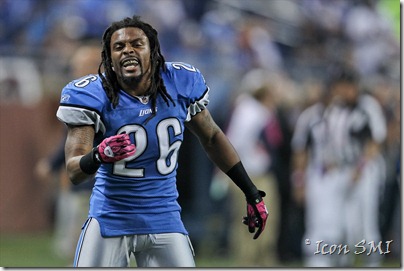
6.26 (#196): Jonte Green, CB, New Mexico St.

jonte_green_detroit_lions_cornerback

Florida is one of the most prominent football states in the nation. Some of the best high school football is played there, some of the best college football is played there, and every other college swings through the peninsula to harvest some of the annual bumper crop of talent.

When a 6’-0”, 184-pound kid from football factory Lakewood (Green is the ninth alumnus to be drafted) with all-district honors at tailback and cornerback qualifies for the Florida state track championships in the 100-meter, 4x100 and 4x400 relays, the football world stands up and takes notice . . .

. . . unless his name is Jonte Green.

 Rivals.com rated Green a two-star recruit. I didn’t find a recruit profile for him on Scout.com at all. He didn’t even make the Tampa Bay Times’ annual Top 25 of the Bay [Area] list.

Green ended up signing with South Carolina’s Benedict College, a member of the D-II Southern Intercollegiate Athletic Conference. I don’t know if he had eligibility problems, or if he just wasn’t rated as a prospect. Either way, at Benedict Green’s size, speed and ability stood out. He racked up 41 tackles (16 solo), 4 INTs, 2 passes defensed and a sack.

Yes, for those with sharp eyes and keen minds, Atlanta's Stillman College plays in the same conference. Future Detroit Lions Sammie Hill and Jonte Green faced one another on November 10th, 2007. Hill had 3 solo tackles, 5 assists and a sack, while Green had three solos. For the record: Stillman beat Benedict 35-13.

After Green's excellent true freshman performance he received a D-I offer, from New Mexico State, and committed on February 4th, 2009. After transferring, he redshirted a season.

As a redshirt sophomore, Green took over. In his first career D-I start, vs. Idaho, he racked up 7 tackles and a pass defensed. Ultimately, Green had the fourth-most tackles on the team, racking up 74, and 8 passes defensed, in New Mexico’s 13 games. Green’s junior season: started 12 games, notched 76 tackles (ranked fourth on the team) and 8 passes defensed.

You might be noticing a pattern here: a lot of tackles, some passes defensed, and no interceptions. I’d be tempted to say it’s because the other cornerback, Packers 2011 4th-rounder Davon House, was hogging them all. But Aggie opponents, you’d think, would want throw away from House, who was first-team All-WAC both seasons he started alongside Green, and pick on Green.

But sure enough, when House left, Green’s senior season as the #1 corner saw his statistics skyrocket. He got his only D-I interception, and 15 passes defensed, to go with his usual fourth-best-on-the-team 64 tackles. For his standout campaign, he was named Second Team All-WAC.

Unfortunately, Green once again went unnoticed. Apparently a 5'-11 1/4", 191-pound corner who started three years in the WAC  and starred in Florida high school track (and competed in track at Benedict) doesn’t merit a combine invite. But Green’s Pro Day made up for it: he cut an average 4.41 40-yard dash, which would have tied him for second-best at the Combine. According to Justin Rogers at Mlive.com, though, Green thinks he can run faster.

Actually, his Pro Day results concern as much as they intrigue. His 3-cone drill (7.26) and 20-yard shuttle (4.31) times are definitely on the high end; Green may have straight-line speed but lack the agility and change-of-direction needed to cover downfield at the NFL level.

Let's see what the experts think:

ESPN's Scouts, Inc. graded Green as a 30 overall:

What he brings: Green has excellent range in coverage and he flashed above-average coverage skills, but he's too inconsistent at this point and he needs to get stronger to matchup with bigger receivers.

SI.com graded Green a 1.81, just below their 1.98 maximum for "Free Agent": "Player who will make a 60 or 80 man roster."

Positives: Athletic cornerback who's displayed a variety of skill in his game. Plays with an aggressive nature, works hard to defend the run and makes a lot of tackles up the field. Keeps the action in front of him, gets a nice jump on the throw and displays a good move to the pass. Can burst to the ball out of his plant and works to make plays. Solid return specialist who sets up blocks, finds the running lanes and quickly gets through them.

Negatives: Does not consistently play to his 40 time or show a burst. Loses opponents, blows assignments and does a lot of trailing down the field. Struggles staying with receivers out of breaks.

Analysis: Green is a size/speed prospect who flashed ability the past three years yet has shown little consistency in his ball skills. Best in zone coverage, he's a prospect who must earn his wage on special teams.

Pro Football Weekly's take on Green contains an interesting wrinkle: apparently Green participated in New Mexico's Pro Day as a junior, and he was both smaller (5'-10 3/4", 182 pounds) and slower (4.45) just a year before.

Summary: Three-year starter with outstanding timed speed and range, though his inconsistent play, poor instincts and suspect football character suppress his draft value. Could require simple assignments and needs to get stronger and adopt a more professional approach to the game in order to stick.

CBSSports.com's Dane Brugler didn't give Green a grade, but did have useful notes:

Strengths: Good starting experience as a three-year starter and good career production (30 pass break-ups). Good size/speed blend with good height and length to match up and the speed to stay with receivers. Aggressive in run support and attacks the action, not waiting for it. Quick read/react skills to plant-and-go when the play is in front of him. Toughness isn't a question. Full-go type of player and doesn't play half-speed or take plays off.

Weaknesses: Has room to get stronger and needs to add some more bulk. Plays flat-footed in his backpedal and is often a step too late, relying on his speed to catch up. Smaller hands and has only 2 career interceptions. Needs to do a better job wrapping and not just hitting. Streaky instincts and doesn't always play smart, needs to do a better job trusting his eyes. Didn't face elite competition week-in and week-out. Tight-hipped and doesn't look as natural flipping his body to turn and run downfield.

New Era Scouting didn’t have a profile for Green, nor did he crack their cornerback rankings.

Here I sit, broken hearted. I looked for YouTube Highlight Reels of Jonte Green and all I found were interviews and press conferences.

Conclusion

In some ways, Jonte Green is the archetypal Lions draft pick: starting caliber tools, potential to be a major contributor, big question marks about him ever hitting that upside. But rather than those question marks coming from injuries or character or college system or college competition, the questions are about his football instincts.

Generally, The Grandmaster & Co. prefer players with high football IQ, but generally such players aren’t hanging around in the sixth round when they’re nigh-on six feet cornerbacks with legit 4.40 speed.

As a prospect, he reminds me quite a bit of Stanley Wilson, the Lions’ 2005 third-rounder. Wilson was also 5’-11”, also about 190 pounds, also a track star. Wilson set Stanford records in the 100- and 200-meter dash, and he cut a blazing 4.36 40-yard time at the Combine. The biggest difference between Wilson and Green is Wilson’s Stanford-quality academic background and Pac-10 pedigree.

At the time, I wondered if Wilson wasn’t better suited to playing safety; just like Green his reaction skills were much better with the play in front of him than flipping his hips and running downfield. I thought Wilson would be a great zone/Tampa 2 corner, but he never caught on.

Green, like all Lions cornerbacks, will have every opportunity to earn playing time this season. All he has to is go out on the Allen Park field, and take the opportunity to finally catch everyone’s attention.

Read more...

Meet the Cubs: Travis Lewis

>> 6.20.2012

7.22 (#223): Travis Lewis, LB, Oklahoma

travis_lewis_detroit_lions_linebacker

Timing is everything. Opportunity knocks but once. Pigs get fed, hogs get slaughtered. You never get a second chance to leave a first impress—okay, well that one doesn’t exactly fit but you get the gist.

The Lions’ final member of the 2012 draft class never dreamed he’d be drafted in the latter half of the seventh round. Indeed, in the 2011 draft cycle the NFL Draft Advisory Board gave him a second-round grade. Lewis, according to Tulsaworld.com, wanted to lead his Sooners to a national championship—and he wanted to be some team’s first draft choice in 2012, not their last.

Coming out of Robert E. Lee HS in San Antonio, TX, Lewis was a 6’-1,” 213-pound linebacker with searing speed  and obvious potential. You can’t have that kind of ceiling in Texas and go unnoticed, and he certainly didn’t. He received offers from pretty much the entire Big XII, and committed to Nebraska as a junior.

Lewis was switched to tailback his senior year, and didn't miss a beat—he rushed for 1,436 yards on 222 carries. He attended the Army combine and NIKE camp, where he ran an “electronically timed” 4.34. Cough.

During that senior season, however, Oklahoma assistant Bobby Jack Wright kept planting bugs in his ear, as Lewis told OUDaily.com:

“He just kept pushing, and he made me think about some things,” Lewis said. “Every time something bad would happen to Nebraska, he would be on the phone saying, ‘You see that?’”

Even while he was committed to Nebraska, Lewis said OU was always in the back of his mind.

“I committed (to NU) as a junior, and that’s too soon to commit,” Lewis said. “You’re young and you don’t really know what you want.”

In the final days and hours before NLI Signing Day, Lewis decommitted from Nebraska, and ultimately signed with OU. Rivals graded Lewis out as a 4-star (5.8) OLB prospect, ranked 20th at his position. Scout also gave Lewis 4 stars, and rated him the 10th-best MLB. Lewis was invited to the 2007 US Army All-American Bowl, and repped Oklahoma (as a tailback).

But the high-flying Sooners had no plans to deploy Lewis as a power back. He switched back to outside linebacker, redshirted a year, and then blew everybody up.

How did he blow everybody up? Let me count the ways: AP Big XII Defensive Newcomer of the Year, AP Big XII first team, All-Big XII Academic first team, 144 total tackles (breaking Brian Bosworth’s freshman record), 12 TFL, 3.5 sacks, 7 passes defensed and 4 INTs for 108 return yards (!). His performance was a big part of why the Sooners made it to the BCS National Championship Game.

What happened over the next two seasons is statistically interesting. His total tackles (109, 109, 84),  TFLs (9.5, 5.5, 4.0), and sacks (1.0, 1.5, 1.0) all declined. OU played 14 games in 2008, 13 games in 2009 and 14 games in 2010, so his rates for all three of those stats declined pretty consistently.

Chart?

Chart.

image

Quick disclaimer: in order to show all this stuff on the same graph in a meaningful way, “tackles per game” has been divided by ten. Still, you can see quite clearly: from his freshman year to his sophomore year, Travis Lewis’s per-game production of tackles, TFLs, sacks and INTs dramatically declined from his freshman year to his senior year.

But what’s that orange line?

That's his solo-to-assist ratio. As a freshman, it was 0.95; he had more assists than solos. As a senior, it was 1.80; he had nearly twice as many solos as assists. This paints a very clear picture of Lewis’ maturation from a “pile jumper” using his speed to run all over the field and get in on every tackle to a veteran run-stopper. In the numbers, you can see him reading the offense, getting to the right hole and making the play unassisted.

His declining total production may have been partially caused by his situation’s decline; Lewis still led the Sooners in tackles for four straight seasons. Rivals.com even listed him as "one

Nevertheless, his offseason accolades grew a little dimmer from his freshman year to his junior campaign. In 2009 he was named first-team All Big XII by the coaches, but the media tabbed him for their second team. In 2010, he was named second team All-Big XII by both coaches and media. He asked the NFL to assess his draft stock and they gave him that fateful second-round grade.

Lewis decided to return to college, try and get the ring he’d fallen just short of in 2008, and to plant himself firmly in first-round territory. Instead he broke his foot.

As Tulsaworld.com recounts, Lewis broke his sesamoid bone on the first day of padded summer practice—missing all of camp, the first game of the season, and an open date. Despite losing that game, and an entire offseason of training and development, Lewis’s 84 tackles still tied for the highest on the team. He again was named to the coaches’ and the AP’s All-Big XII second team.

He added weight to impress the scale at the combine, but he failed to impress the stopwatch. Remember his “electronically timed 4.34” in high school camps? Five years later, weighing 30 pounds more, he cut a 4.88.

“It’s not about stats sometimes. It’s about how fast you run, how high you can jump.” –Travis Lewis, per NewsOK.com

Indeed it is. Most of all, though, it’s about how fast you run and high you jump while garnering those statistics. What did the experts see in his play?

ESPN.com’s Scouts, Inc. graded Lewis a 54, a fifth-rounder:

"Possesses above-average diagnostic skills. Reads keys and reacts quickly to the ball. Takes proper angles with run fits. Can be a quarter count late recognizing and reacting to play-action, though.

Did not see explosive power on tape and possesses just marginal point of attack skills. Will drop head and bury himself into blockers essentially taking himself out of the play and sacrificing gap discipline.

Overall range is just adequate compared with career production (445 tackles). Displays some tightness in hips and can take an extra second to transition when having to make a sudden change of direction. Shows an above-average closing burst once getting pointed in the right direction.

A fundamentally sound and reliable tackler. Does a nice job of bringing his hip through and wrapping up upon contact . . . Generally takes proper angles in pursuit and does a nice job of breaking down in the open field.

Displays very good awareness for targets in his area and for passing lanes. Flashes playmaking ability in coverage and has the ball skills to finish plays and secure INT. He has limitations in man coverage, though. Often overaggressive trying to be physical in man coverage working against RBs and can lose balance. Does not provide much a pass-rusher at this point.”

CBSSports.com's Chad Reuter didn't give Lewis an overall grade:

Read & React: Combines very good instincts with above-average reaction skills . . . Great feel in coverage, sees quarterback and receiver, jumps routes to prevent completion, or at least stop yards after the catch . . . One-man wrecking crew against screens because he sniffs them out and has the quickness to grab the receiver.

Run defense: Tougher between the tackles than many expect. Gap-shooter that grabs backs before they get through the line, also willing to throw his body into the hole to create piles and stands up to blocks to stay in the play. Lacks strength to blow up fullbacks and bulk/length to prevent getting engulfed by better lineman at the second level.

Pass defense: Fluid and quick drop into zone, covers enough ground to be Tampa-Two mike and knows where the markers are. Often arrives at the receiver at the same time as the ball, gives up few yards after the catch . . . Creates turnovers with quick reaction time to bring in tipped balls, closes on balls over the middle or baits quarterbacks intro throwing his directions if they do not seeing his deep drop. Loses size battle to many tight ends, easily pushed away on out routes. Caught looking into backfield occasionally instead of getting to receiver in the flat.

Tackling: As secure and reliable a tackler as you'll see in college football [emphasis added]. Not necessarily explosive, but more physical than a chase-and-drag linebacker.

Pass Rush/Blitz: Works more in space than attacking the backfield, but flashes closing speed and agility to reach passers from the blind side or up the middle before they can escape . . . Takes advantage of large holes to get to the quarterback, but must work on using violent hands to rip off lineman and defeat cut blocks from running backs.

Intangibles: Team captain who leads the team on and off the field with words and by example. Four-year starter for one of the top programs in the country. No known character or off-field issues.

SI.com grades Lewis a 2.40; a Fence Player who "needs time and patience to develop."

Positives: Tough, productive college linebacker with limited upside. Displays a terrific head for the ball, instinctive and quick to react. Chases the action hard, takes good angles to plays and remains disciplined with assignments. Fluid moving laterally, makes plays out to the sidelines and relatively effective in space. Squares into ballcarriers and wraps up when tackling.

Negatives: Slow moving in reverse and lacks a quick backpedal in coverage. Marginally effective on the blitz. Minimal burst to the action and lacks overall closing speed.

Analysis: Lewis was a terrific college linebacker, but he lacks top size/speed numbers for the NFL. He plays smart football, gives effort on every down and could be a valuable backup in a variety of defensive systems.

Projection: 5-6

Pro Football Weekly graded Lewis a 5.39, which I don't have a rubric for but puts him just inside their Top 100, notably higher than anyone else. Also, check out the bolded bit about the interviews; first I've heard of that.

Positives: Athletic build. Instinctive and active. Light on his feet. Good bend, balance and movement skills. Attacks downhill, shoots gaps and ranges to the perimeter. Shows short-area burst and explosion — posted a 36-inch vertical leap and 10-foot, 2-inch broad jump. Flashes striking ability. Times blitzes. Effective dropping into zone — shows awareness, reactions and ball skills. Is productive, does not come off the field and has special-teams experience. Likes to play and it shows. Productive, four-year starter. Confident, intense and motivated.

Negatives: Shows tightness in his hips when he has to redirect suddenly or break down in space. Average bulk strength — outmuscled between the tackles and gives ground to get off blocks (can improve hand use). Struggles to keep himself clean through clutter. Lacks knock-back power. Needs to bring his feet more consistently as a tackler — tries to rip down ballcarriers with his arms and slips off some tackles. Loses positioning in man coverage — can be a liability assigned to quick backs. Turned off executives in the interview process and character has been questioned.

Summary: Brash, emotional, experienced, highly productive, run-and-hit “Will” linebacker and converted running back with chase speed to be effective covered up. Has starter-caliber ability in 4-3 front if he can learn to use his hands better and earn respect of his teammates.

The National Football Post graded Lewis at 6.5, which according to the NFP grading scale is at the top end of "Possible Starter Caliber/Developmental Prospect Caliber" tier.

A shorter, undersized backer who is a bit narrow through the hips, but possesses an athletic looking frame. Displays "plus" instincts inside when asked to read and react to the inside run. Does a nice job staying low when sliding laterally and absolutely explodes downhill when he finds the ball . . . Routinely is able to gain a step, absorb contact and fend off blocks through the play . . . Is only an average tackler, tends to go high into ball carriers and will slip off his fair share of backs. [emphasis added]

Is a natural athlete in space vs. the pass game . . . Doesn't waste much motion when asked to click and close, stays compact with his footwork and generates good closing speed off his frame. Keeps his head on a swivel in zone coverage, feels routes around him and exhibits the fluidity to cleanly open up his hips and run. Exhibits good ball skills when he can make a play on the throw and has a knack for being around the football and coming down with key turnovers. Impression: He's a bit undersized and doesn't tackle as well as you would like inside the box. However, he's a good run and hit backer who plays the run well and will be able to make plays vs. the pass game in the NFL. Looks like a day one starter to me as a 43 backer, either on the weak side or possibly in the middle.

Normally, I'd include New Era Scouting's draft guide. They mocked Lewis in the fifth to the Titans, and ranked him 168th overall, which all fits, but the "strengths" and "weaknesses" section seems to have been the a victim of a publishing whoopsie (they list Lewis as a DE/OLB 'tweener and assess him as a DE).

But you folks know what’s up: none of this matters. It’s all a bunch of hot air from talking heads! There’s only one true way to assess the potential of an NFL prospect: YOUTUBE HIGHLIGHT REELS.

Here's an excellent set of clips from his sophomore season, cut-ups of the 2009 road game at Miami. You can see his excellent instincts and solid tackling in the run game. When he gets into the hole, he makes the tackle. When a guard or tackle (like Jason Fox!) get their hands on him, though, he does struggle to shed the blocks. There's a reverse at 2:00 where he shows outstanding recognition and open-field tackling:

Here's a really, really nice set of "positive" and "negative" cutups from several games in the 2010 season. We see more of the same: a lot of athleticism, great recognition and fluidity in space, a lot of big stops in the hole, and an occasional inability to cut through the wash and get off blocks:

I'm disappointed I couldn't find an old-school “hype video” with intro, music, etc. Still, these clips back up the themes we saw repeated in the expert scouting reports.

Conclusion

This is one of the most interesting Meet the Cubs I’ve ever done. Even given the disappointing senior season, the tailing off of total production, and the poor Combine measurables, Travis Lewis had a monster career at Oklahoma. Moreover, despite the lack of eye-popping tackle stats, his progression from athletic “pile jumper” to two-dimensional, three-down player is obvious from both the numbers and the film.

Lewis doesn't have protypical MLB size, and he doesn't have OLB pass-rush skills. But he has the athleticism and instincts to rotate at OLB early, and the run-stuffing chops to be a Tulloch-esque MLB as he develops. He’ll have very stiff competition from Doug Houge and the yet-to-be-MTC’d linebackers from the word go, but he’s got too much natural talent and too much great play on film against too high of a level of competition to simply wash out at this level.

There’s one more cliché that might apply to the career of Travis Lewis: he who laughs last, laughs longest.

Read more...

Old Mother Hubbard: The Defense & Shopping List

>> 3.02.2012

detroit_lions_defense_grades

One of the problems with a position-by-position breakdown of a team is getting too wrapped up in the individual. We start getting obsessed with that old bugaboo, “filling holes,” and we end up wanting to spend “a second or third rounder” on every single position.

Let’s take a look at the whole.

The 49ers were the NFL’s top defense last season at +240.3, and as you see they had basically no flaws. Their run defense was the best run defense. Their pass rush was the second-best pass rush (Philly’s was top), their pass coverage was fourth-best, and they were right in the middle of the pack on penalties.

At the bottom were the Saints, who at –130.3 had nearly no strengths. Their run defense was 24th, their pass coverage was 28th, and their pass rush was dead last. Penalty-wise, though, they were neck-and-neck with the 49ers at right around the league average.

The Lions were 26th overall at -20.1. You can't see it here, but they were at the bottom of the "neutral-to-meh" tier. The next-best defense was Buffalo at -20.7, then the grades fall into the abyss with Green Bay at -60 and on down from there.

At -8.6, the Lions run defense ranked 26th, and again was at the bottom of the “meh” tier. The Rams were –10, the Cardinals twice that bad . . . and then pretty much it falls apart. In pass coverage, the Lions were graded out at -12.3, above the NFL average of –14.3 and ranked 13th overall.

Ahem. “In pass coverage, the Lions were graded out at -12.3, above the NFL average of –14.3 and ranked 13th overall.

Actually, the Lions were ranked amongst the top ten for much of the season, as was the pass rush—which, as you might have noticed, is nothing too fearsome, either. As one began to tail off, so did the other. Ultimately, the pass rush finished 10th-best in the NFL at +22.1, well above the average of +12.4.

Does this mean there’s a correlation between pass rush PFF grades and pass coverage PFF grades? NOPE.

image

Remember, PFF assigns grades based on observed performance, period. If a cornerback does a good job in coverage, he does a good job in coverage no matter how good the delivered ball was—or if it was delivered at all. The Lions’ pass coverage tailed off at the end of the year because of injuries to Chris Houston and Louis Delmas, and not because the pass rush wasn’t good enough.

That said, the pass rush wasn't good enough.

Now, the shopping list:

  • DTs: None, unless they choose to let Corey Williams walk.
  • DEs: Re-sign Cliff Avril.
  • ILBs: Re-sign Stephen Tulloch, or acquire his replacement: a high draft pick or proven veteran starter.
  • OLBs: If Tulloch is retained, re-sign Levy or acquire a starter to replace him. If Tulloch is not retained and Durant is moved to the middle, re-sign Levy AND acquire a starter.
  • CBs: A rookie with long-term starter potential, or a veteran starter.
  • Ss: A veteran upgrade over Spievey, or a talented rookie to compete with him.
Next up, the centers.

Read more...

Old Mother Hubbard: The Safeties

>> 2.28.2012

louis_delmas_detroit_lionsWe round up the defense with the last line of defense: the safeties. Though the cornerbacks took the brunt of public criticism in the last two games, many of the high-profile failures of the secondary in 2012 were actually the fault of the safeties. With Louis Delmas at full speed, Amari Spievey growing into his newfound role, and veteran Erik Coleman coming on board as an insurance policy for both spots, this wasn’t supposed to happen. So what happened?

First, let's look at what 2010's Safety Old Mother Hubbard had to say:

Louis Delmas is an athletic, hard-hitting safety who can make big plays against the run and the pass. Despite being limited by injury, he proved extremely effective on the blitz this year. If he can go full speed, he should be one of the best safeties in the NFL next season.

Amari Spievey is a talented, hardworking kid with the raw ability to be a very good safety. He struggled with consistency and mental mistakes in his first season, and this offseason will be crucial in finding out if he’s a long-term starter or medium-term rotational player.

Chart?

Chart.

Detroit Lions safeties 2011 grades, with Pro Football Focus and Advanced NFL Stats

The best safety in the NFL this year was Troy Polamalu, with an outstanding +19.2  PFF overall grade. He was the NFL’s best blitzing safety, 4th-best in coverage, and 3rd against the run. His 3 penalties called on 930 snaps dinged him just a little. He was 2nd-best in +WPA with a walloping +1.90, meaning he made a huge impact on the Steelers’ chances to win, and his 3rd-best 50.5 +EPA shows he was constantly making positive plays.

On the other side of the PFF ledger, the worst-graded safety in football was Minnesota’s Jamarca Sanford. The polar opposite of Polamalu, Sanford was strongly negative in pass rush, coverage, and run-stopping (but got a small boost from only being flagged once). His –18.2 overall grade was powered mainly by a –15.2 coverage mark, also worst in the biz.

Now here's where things get interesting: Sanford had a 32.2 +EPA and 0.77 +WPA, which were the 23rd- and 36th-best figures in the NFL, respectively. This means Sanford was generating enough positive production to rate as a decent starting safety, but his coverage gaffes were so repeated and pronounced that PFF graded him the worst safety to crack an NFL rotation!

Disclaimer?

Disclaimer.

Pro Football Focus grades are based on TV footage, and while I believe completely in what they do over there, downfield pass coverage grades are the area where they have the hardest time figuring out what’s going on. Without knowing each player’s assignment, and most of the secondary being offscreen at the snap, PFF safety grades have limitations.

Advanced NFL Stats' +EPA measures the expected points added by a player’s positive plays, but cannot measure failures. Cornerbacks are the position where “lack of failure” is arguably more important than positive playmaking, so again—there are real limitations here. Same applies to +WPA: a timely interception can swing the likelihood of winning around very quickly, but a surrendered touchdown can too—and that won’t show up in +WPA.

To sum up: PFF grades and ANS metrics are never going to be more variant and contradictory than when assessing cornerbacks (and safeties are a close second). However, this increases the value of both sets of data. Though we’re going to have to fill in the gaps ourselves, it’s better to know reality lies in the gap than unwittingly treating one number as gospel.

The top-graded Detroit Lions safety was Louis Delmas. Delmas, most Lions fans probably have a vague sense of, was not the playmaker he was in 2009, despite being fully recovered from his groin injury of 2010. In coverage, that’s a good thing: safeties are typically only noticed in coverage when there’s a problem. Pro Football Focus backs this notion up: Delmas was +4.7 in coverage, 10th-best amongst 87 qualifying NFL safeties.

Overall, Delmas's -2.0 grade was slightly above the normalized NFL average of -2.8. But was he really that bad? Drilling down into his grades, we see mostly positives and neutrals and one big nasty red mark: a brutal –5.3 against San Francisco. Most of that was 3 missed tackles against the run, but some of it was allowing three first downs through the air on three “Thrown At”s.

So except for Week 6, and the last 5 games of the regular season (out with an MCL injury, and 'scope to repair it) Louis Delmas, veteran safety, was back there doing his job.

We missed “Da Missile.”

If we in his horrific wild card performance (-6.5, clearly not ready to play), Delmas graded strongly negative against the run in five games, and strongly positive only once. In 2010 and 2009 those ratios were 4:3 and 3:4, respectively. On the flip side, Delmas’s 2011 coverage grades had 2 negatives and 2 positives, an improvement from 4:1 and 3:2.

Statistically, Delmas did very well, allowing just 15 of the 28 balls thrown his way to be caught. He also held completions to an average of just 9.7 yards each, 7th-best in the NFL. He had no interceptions, and just four passes defensed, but also allowed just one touchdown and a 25th-best opponent passer rating of 80.4 (NFL avg.: 90.7).

While Delmas's pass coverage is very good and getting more consistent, his run-stuffing is getting worse. He had 46 solo tackles, 1 assist, and 18 defensive stops. But he missed 12 tackles, 1 per every 3.88 tackles made (seventh-worst in the NFL, well below average of 8.6). In fact, using my metric of “missed tackles per tackles made” (solos plus one-half assists), Lions safeties ranked 64th (Spievey), 80th (Delmas), and 85th (Harris) out of 86.

It’s possible, then, that this is schematic. Relying on the back seven to gang-tackle players the line has allowed through is bound to make it much tougher on the safeties. However, I’ve seen Louis Delmas singlehandedly drop Steven Jackson in the open field with a full head of steam. He’s a better tackler than that.

+EPA agrees with me. Delmas's 19.3 total is low, you'd think because he only played in 12 games. But he was ranked 52nd of 123 in total +EPA, and 50th in +EPA/game with 1.61. His plus-play production was mediocre at best. His +WPA is right in line with his +EPA (and the NFL average) at 0.52. In terms of playmaking, Delmas was at what baseball people call "replacement level;" you can get a safety like that anywhere.

So what now? Last year, I said if Delmas “can go full speed,” he should be “one of the best safeties in the NFL.” Instead he was good in coverage, poor against the run, and mostly invisible when counting the kind of splash plays that used to be his calling card.

Bottom Line: Delmas’s career is at a crossroads. Will he bloom into the all-around badass he looked like as a rookie? Or will he remain a good coverage safety who needs help from a partner? There’s no doubt he has the physical tools and the mental tenacity to be an elite, playmaking safety but something’s missing and I don’t know what.

Chris Harris was an odd, but valuable midseason addition. After the Lions picked apart Chris Harris and the Chicago Bears on Monday Night Football, Harris was released—and the Lions picked him up. Harris’ –7.3 overall PFF grade was below the NFL average of –2.8, tied for 65th out of 86.  Harris was solid against the run; his +0.3 run-stopping grade was just above the NFL average of –0.3. He also kept his nose clean: no penalties called despite a 400-snap workload.

Unfortunately, Harris was just as susceptible to the pass in Detroit as he was in Chicago. He turned in five strongly negative coverage grades out of ten games played; none positive. In fact, he only had one positive mark all season long: a +1.3 against the run in Week 17 at Green Bay—yes, The Game Where They Passed For A Thousand Yards. His +EPA and +WPA were meager, even considering his reduced workload.

I don't mean to be overly harsh on Harris; switching schemes midseason only to be pressed into a starter's workload must be extremely difficult. His Pro Football Focus data for 2008, 2009, and 2010 reveals an average all-around NFL starter; he just had a profoundly down year. The 29-year-old Harris will have to earn 2012 playing time in camp, whether that's in Detroit or elsewhere.

Bottom Line: Chris Harris did about as well as you could ask of a guy who got cut midseason, picked up by another team, and pressed into starting the last five games of a playoff race: not very well. May return as the rotational third safety next season.

And now? The man, the myth, the enigma: Amari Spievey.

Drafted in 2010 to “fill a hole” at cornerback, Spievey’s odd-duck skill set and lack of conditioning got him an immediate switch to safety—and trip to the doghouse. Still, Spievey flashed brilliance in 2010. His physicality made the switch intact, and his not-quite-good-enough-for-cornerback hips still channeled impressive recovery speed.

Of course, he needed that speed as he struggled to keep his head above water last season, and this season was no different. His –11.5 overall grade was partly informed by his –2.2 blitz grade and –3.2 coverage marks, but was his brutal –7.5 against the run that dragged his PFF grade into the murky depths.

Technically, Spievey got better as the season went along; his two positively-graded games came in Weeks 14 and 16, at home against the Vikings and Chargers. But his Wild Card performance was a brutal -4.6, and the rest of his 2011 chart is dripping red as well.

Spievey’s 1:3 TD-allowed-to-INT ratio helped lower his opponent passer rating to a team-best (NFL 13th-best) 63.4. However, his 62.5% completion percentage and 14.6 YpR shows he was a lot easier to beat through the air then Delmas. On the ground, Spievey was the surest-tackling safety the Lions had, missing one for every 4.96 solos+half-assists. Unfortunately, that’s still 64th-worst in the NFL, and significantly worse than the NFL average of 8.6. As I said, scheme may play a part here, but . . .

Spievey's three picks gave him the best +EPA of any Lion at 22.9; that's not great. However, of that meager production he wrung +0.65 +WPA, slightly above-average and the best the Lions had to offer.

Bottom Line: Spievey is no less an enigma than when the season started, but the flashes of brilliance remained flashes and the prolonged stretches of awful remained awful. Like Delmas, his performance in 2012 will decide his long-term future.

SHOPPING LIST: A common theme is developing: “The Lions have some decisions to make” about the safeties. Delmas returns as the starting free safety—but is he a game-changing foundational piece, or a solid role player? Harris supplanted Coleman as the third safety, but will he return? Spievey will have a chance to earn that spot next to Delmas—but the Lions NEED better production than what he’s been able to provide; the safety play in 2011 was unacceptably poor

A veteran upgrade over Spievey, or a talented rookie to compete with him, are a must if the Lions are to shore up the secondary that was so thoroughly exposed at the end of 2011.

Read more...

Old Mother Hubbard: The Cornerbacks

>> 2.22.2012

aaron_berry_detroit_lions_cornerback

Ah, the Detroit Lions cornerbacks. Few units in the NFL took as much heat in the wake of the 2011 season. The Lions surrendered 928 passing yards and 90 points in their last two games; since their last two games were their crucial Week 17 attempt to break the longest road losing streak in the history of professional sport, and their first playoff game in over a decade, respectively . . . that looks bad.

So bad, in fact, that every initial mock draft had the Lions taking a corner in the first round, which as I said at Bleacher Report is completely silly. But is it?

Here's what 2010's Old Mother Hubbard had to say about the cornerbacks we'll analyze today:

With a full #1 starter’s workload, Chris Houston performed at an average, maybe just-below-average, level for an NFL starter. Considering the pittance the Lions paid to get him, performance like that is impressive. As the Lions’ #1 corner, they should draft someone with flashier coverage skills to pair with him. As the Lions’ #2 corner, he’d be excellent. Further, he’s only 26—if the Lions can hold onto this likely RFA, he may continue to improve.

Alphonso Smith is a gifted natural slot cornerback, with the tenacity to play well against the run, and even be dangerous as a pass rusher. His instincts and hands are enough to make him a ballhawk, but his repeated brain farts make him a liability as an outside cornerback. Perhaps time and development will iron this out, but for now pencil him in as a multi-year “starting” nickel back.

Then, from the Shopping for Cornerbacks free-agent Old Mother Hubbard:

Eric Wright’s inclusion on this list may surprise some, as the Browns’ 2007 2nd-round pick actually received death threats over his perceived poor play last season. PFF graded him poorly indeed, with a –4.3 overall. His coverage mark was a rotten –11.9, second-worst in the NFL. However, Wright intrigues me for several reasons: first, he’s 5’-10”, 190, so a decently-sized fellow. Second, was graded +3.3 in pass rush, third-best in the NFL, and +4.7 in run support, 12th-best in the NFL.

Wright is a young, talented player with a lot of experience, and he’s proven to be exceptional—truly exceptional—at a couple different dimensions of his position. It’s true that the one exception, coverage, is the one we’re really looking for, but if he’s available for peanuts, he’s exactly the kind of reclamation project the Lions do brilliantly with.

So how did that all translate to 2011? Let’s look at the data:

detroit_lions_cornerbacks_grades_thu

Let’s talk disclaimers. Pro Football Focus grades are based on TV footage, and while I believe completely in what they do over there, downfield pass coverage grades are the area where they have the hardest time figuring out what’s going on. Without knowing each player’s assignment, and most of the secondary being offscreen at the snap, PFF cornerback grades have limitations.

Advanced NFL Stats' +EPA measures the expected points added by a player’s positive plays, but cannot measure failures. Cornerbacks are the position where “lack of failure” is arguably more important than positive playmaking, so again—there are real limitations here. Same applies to +WPA: a timely interception can swing the likelihood of winning around very quickly, but a surrendered touchdown can too—and that won’t show up in +WPA.

To sum up: PFF grades and ANS metrics are never going to be more variant and contradictory than when assessing cornerbacks. However, his increases the value of including both sets of data. Though we’re going to have to fill in the gaps ourselves, it’s better to know reality lies in the gap than unwittingly treating one number as gospel.

The top Pro Football Focus dog is Darrelle Revis, whose +23.1 overall grade was best in the business by a significant margin. Revis’s +16.8 coverage grade is more than four points higher than the next closest contenders (Baltimore’s Ladarius Webb and Atlanta’s Brent Grimes). Bringing up the PFF rear is St. Louis’s Justin King, who graded out as negatively as Revis did positively.

For the Lions, the highest-PFF-graded cornerback is Aaron Berry. Berry, the scapegoat of the Lions’ wild-card loss, took a world of abuse for dropping potential interceptions. However, he was the Lions’ steadiest cover corner. With 411 snaps played, Berry graded out at +4.1 overall;  24th-best in the NFL. Berry can boast a +2.1 in coverage and +1.3 in run-stopping. In pass rush he was flat at +0.0, and only assessed penalty. All of these grades are above NFL average for corners with at least 25% of their teams’ snaps.

The 5’-11”, 180-pound Berry’s worst game was his first one: his –1.1 showing at Tampa Bay. He was thrown at ten times—a shocking level of picking-on—and allowed 8 catches for 77 yards and a score. It was his only negative grade all season.  His performances got better and better, climaxing in Weeks 6, 7, and 8 with performances of +0.9, +1.6, and +2.0.

After the bye, Berry got a heavy workload in Chris Houston’s absence and graded at zero throughout that stretch. Then, Berry got injured himself in Week 14, and didn’t return until the fateful Wild Card game—where PFF graded him out at a solid +1.6 overall, including a heavy ding for two penalties.

Berry was used primarily in the nickel package throughout the season, though he played on the outside, not the inside, when he did. The 23-year-old was steady beyond his years, though not spectacular; he had no interceptions and four passes defensed. Berry’s +EPA was a meager 0.14, and his +WPA was lacking at 0.44. You see the complete picture: solid, steady, reliable, not a game-breaker—and that’s just fine in this defense.

Bottom Line: Aaron Berry is a 23-year-old cornerback coming off a UDFA rookie year completely wiped out by injury. Incredibly, he was a steady, better-than-average right outside corner (when used . When pressed into full-time duty he performed like an average NFL starting cornerback in coverage and against the run. Even if he never improves (doubtful), Berry has earned a spot in the top four—and a crack at the top two.

The next-highest PFF-graded corner was top starter Chris Houston. Houston had a very up-and-down season, all of which averaged out to +3.7 overall, +1.7 in coverage, and +0.3 against the run. His slight –0.5 ding in rushing the passer is more than made up for by his +2.2 penalty grade; Houston was flagged just twice in 815 snaps.

Houston led the Lions in interceptions with 5, and finished second in passes defensed with another 5. He held opposing quarterbacks to 45 completions on 86 targets, a 52.3% completion percentage (NFL average: 59.1%). However, he allowed 13.0 yards per catch and 4 touchdowns—both slightly worse than the NFL averages of 12.9 and 3. Opposing quarterbacks had a passer rating of 65.4 when challenging Houston; that slots him 21st in the NFL out of 110 qualifying corners.

Houston seemed to be strongly negative or positive all season long; only four of his fifteen games played weren’t greater than 1.0 in either direction. The most fascinating part of this is that Houston’s coverage and run-stuffing grades moved in lockstep. There isn’t a single game where his coverage and run grades aren’t either both negative or both positive . . . this is extremely unusual.

You can see Houston’s positive impact in his +WPA. No corner helped the Lions win with impact plays more than Houston and his 0.69 +WPA. His +EPA is absolutely stonking: 48.1, seventh-best in the NFL. That figure is higher than Revis (40.9) and Finnegan (45.0), but that 0.69 +WPA is well below those two corners’ (1.84 and 0.88 respectively). This shows that Houston was making plays as well as any corner in the NFL, but those plays weren’t contributing to Lions victories like the elite corners.

Bottom Line: Chris Houston is a solid starting all-around NFL cornerback, and the best corner the Lions have. He’s a two-dimensional player given to both great games and shaky games. He struggles against height (Laurent Robinson, Darrius Heyward-Bey), but ultimately comes up big in the biggest moments—and feasts on subpar competition. Houston will enter 2012 as the Lions’ #1 cornerback, barring an unlikely blockbuster trade or megabuck free agent-signing. 2012 will also be the last year of his two-year deal signed this summer.

Alphonso Smith is a curious case. After showing a propensity to make huge plays both good and bad last season, he couldn’t get ahead of Aaron Berry or Eric Wright to save his life in 2011. Until Week 13 at New Orleans, Smith essentially didn’t play.

Then, Smith alternated good games with bad ones the rest of the season. Against Minnesota, he was graded at +1.3. At Oakland, –3.7. Against San Diego, +1.4. At Green Bay, –3.3. Oh, then –1.0 in the playoffs. All told, Smith graded out at –4.7 overall, –1.4 in run defense, and –4.5 in coverage. To his credit, he wasn’t penalized at all in 259 snaps.

To his further credit, Smith allowed just 55.8% of balls thrown his way to be caught, at a 12.0 YpR clip. With his 2 TDs allowed, 3 INTs, and  3 passes defensed, Smith had the Lions’ best passer rating allowed, at 62.8.

It shouldn’t surprise, then, that Smith’s knack for game-breaking positive plays endear him to Advanced NFL Stats’ metrics. His 26.6 +EPA would be unremarkable, except he put up that production in just 9 games played (and only saw significant action in 5). On a per-game basis, Smith was 11th in the NFL in +EPA. His 0.48 +WPA is in the middle of the NFL pack—but again, for just a handful of games played, Smith had a massive positive impact.

But again, Smith also had a massive negative impact that more than offset the plays he made. The bottom line is unchanged from last season, except Smith will be looking up at at least Houston and Berry on the depth chart.

Bottom Line: Alphonso Smith is a gifted natural slot cornerback, with the tenacity to play well against the run, and even be dangerous as a pass rusher. His instincts and hands are enough to make him a ballhawk, but his repeated brain farts make him a liability as an outside cornerback. Perhaps time and development will iron this out.

Finally, Eric Wright. Wright took less money to sign a one-year “prove it” deal with Detroit. What did he prove? Well, he proved he’s still got elite talent—and that he’s maddeningly far away from realizing it. With the Lions’ heaviest workload at 1,043 snaps, Wright earned the NFL’s fifth-worst PFF overall grade of –14.1. It wasn’t just Wright’s –8.3 coverage grade. His pass rush (-1.1), run-stopping (-2.0), and penalty grade (-2.7) were all below NFL average.

But there is a bright side. Though Wright was burned for five touchdowns, he also intercepted four passes (second-best on the Lions) and defended ten (best by a factor of two). In fact, Wright was 11th-best in the NFL with 40.8 +EPA. No Lion cornerback boosted the Lions’ chances to win than Wright; his 0.88 +WPA was 25th-best in the NFL.

When the Lions signed Wright, I suggested they were “on to something.” Clearly, Wright still has playmaking ability, but he’ll fetch a much higher price for that ability on the open market than his week-to-week production is worth. Wright serves as an excellent reminders that gambling on reclamation projects does in fact have a downside.

Bottom Line: Eric Wright still has the talent to become a difference-making NFL cornerback, but he was far too big of a liability far too often in 2011 for the Lions to come in as the highest bidder for his free-agent services. In fact, they weren’t the highest bidder last time around.

SHOPPING LIST: Depends entirely on the Lions’ intentions for the position, and their room underneath the cap. Houston is solid as the #1 corner, and the Lions could do much worse than Berry and Smith as the #2 and slot cornerback. However, the Lions need depth. They would be well-served to draft a corner with long-term starter potential, or go big-time and sign an immediate veteran starter to pair with Houston.

Read more...

Slowing Down Drew Brees & the Saints With the 3-3-5

>> 12.01.2011

With the suspension of Ndamukong Suh, the Detroit Lions are down one starting interior lineman. With injuries to Louis Delmas, Chris Houston and Brandon McDonald, the Lions may be down two starters and one contributor in the secondary. Now, they face the No. 1 passing offense in the NFL: Drew Brees and the New Orleans Saints.

How can the Lions hope to slow down the lightning-fast Saints without their best interior pass rusher and a banged-up secondary? The answer may lie in a package the Lions deployed on Thanksgiving: the 3-3-5 nickel.

The Lions have used this formation a few times before, most extensively in their first win under Jim Schwartz. Gunther Cunningham’s talk about it during his first minicamp as Lions DC helped fuel speculation the Lions would run a base 3-4. Here's how it looks:

detroit_lions_3-3-5_nickel

The four square boxes are the three nickel cornerbacks, along with safety Amari Spievey. They're playing tight man-to-man coverage on the three Packers wideouts, as well as tight end Jermichael Finley. Louis Delmas is playing one-high zone, lined up deep off camera.

Kyle Vanden Bosch stays put at right defensive end, but 330-pound Sammie Hill is in at the zero-technique nose tackle. Suh is playing LDE. Behind them are the Lions' base linebackers: MLB Stephen Tulloch, and OLBs DeAndre Levy and Justin Durant.

The down and distance here is 3rd-and-3, so the Lions are trying to force a quick incompletion. Let's watch what happens:

The Lions blitz all three linebackers, bringing a total of six rushers. The Packers send Finley out but keep RB John Kuhn in to block, for a total of six blockers. The Packers do establish a pocket, but QB Aaron Rodgers knows he doesn't have all day. He throws the short out to Greg Jennings, and the tight coverage forces him to lead Jennings to the sideline rather than downfield. Even if Jennings had been able to keep his feet, Eric Wright was there to help prevent the first down.

This is a very aggressive play call, but it's perfect for the situation, and would be effective against the Saints' many multi-WR sets.

In different situations, the Lions could blitz two, one or none; this would allow for a variety of zone and man-coverage packages. Defensive coordinator Gunther Cunningham could also do some clever stuff with safety and zone blitzes. By platooning Durant (an outstanding run stopper) with Bobby Carpenter (much better in coverage), the Lions could further tailor this package to suit non-nickel situations.

The onus would be on the defensive line to continue to bring pressure and maintain outside run containment, but the Lions' depth will help them there. Sammie Hill and Corey Williams could platoon at the two-gap nose tackle spot, with DTs Nick Fairley and Andre Fluellen at left end. Vanden Bosch and Cliff Avril could platoon at RDE, though asking Avril to fill two run lanes might be asking too much.

Running the 3-3-5 for 40 or 50 snaps would give Brees time to figure out the looks and attack the deep coverage, especially if the Lions need to blitz two or more players to get pressure.

But, if the Lions are to have a chance, they'll need to avoid what happened the last time they went to the Superdome at all costs: two Saints touchdowns in the first few minutes, leading to a 47-25 blowout. Running a lot of 3-3-5 early, with a lot of blitzing and confusion, could keep the Saints off-balance enough to give Matthew Stafford—and the Lions—a chance.

Read more...

The Lions Running Game: Success and Lack Thereof

>> 11.18.2011

First: for those of you who don’t typically check out my Bleacher Report stuff, you should probably look at today’s Matthew Stafford film breakdown. I took a good look at Stafford’s pocket presence, footwork, and mechanics against the Bears.

Okay, now. A few weeks ago I discussed the Lions success running the football on first and second down. Several of you had been asking for me to update the piece in the aftermath of the Broncos game, but Chase Stuart of Smart Football went and did a leaguewide rushing success analysis.

This is pretty much brilliant, and exactly what I’d planned to do for the Lions. Just as with Pro Football Focus, though, I am happy to stand on the shoulders of giants (or even metaphorically tall regular folks who put in the time and effort that I can’t).

First, Stuart broke it down by individual runner. He sorted the table by total number of successful runs—but since the Lions don’t run nearly as often as other teams, I knew that would skew things. I re-sorted the table by success rate, and here’s what I got:

  Name Tm Car Succ Succ% RshYd YPC
1 Danny Ware NYG 28 18 0.64 91 3.3
2 Jacquizz Rodgers ATL 32 20 0.63 137 4.3
3 DeMarco Murray DAL 97 59 0.61 646 6.7
4 Peyton Hillis CLE 59 35 0.59 216 3.7
5 Derrick Ward HOU 29 17 0.59 88 3
61 Jahvid Best DET 82 34 0.41 388 4.7
62 Maurice Morris DET 41 17 0.41 172 4.2
63 Chris Johnson TEN 146 59 0.4 496 3.4
64 Montario Hardesty CLE 75 29 0.39 245 3.3
65 Deji Karim JAX 54 20 0.37 131 2.4
66 Thomas Jones KAN 67 24 0.36 199 3
67 Javon Ringer TEN 44 16 0.36 147 3.3

Okay, that’s the top five, and bottom seven, rushers by success rate. The first thing you’ll notice is that the Lions’ primary runners to date have identical success rates, despite big disparities in carries, yards, and yards-per-carry. In the Smart Football piece, Stuart singled out Jahvid Best as an example of a runner with deceptively high yards-per-carry: he has the numbers of a back who’s been highly successful when he hasn’t been.

However, he correctly notes that the Lions’ run blocking is atrocious. That Maurice Morris—a different back with different skill sets—has the exact same success rate indicates that the problem isn’t the Lions running backs, it’s the Lions’ running game.

You see the same issue with Tennessee: Chris Johnson and Javon Ringer are almost identically terrible, despite being different runners with different tools. What proves the rule, though, is Cleveland’s backs: Peyton Hills is the 4th-most-successful back, getting the job done 63% of the time with just 3.7 YpC—and his running mate Montario Hardesty is only successful 39% of the time, with 3.3 YpC.

Stuart helpfully included the table of team rushing success, and this time he broke it down by rate as well. Atop the list were New Orleans, Buffalo, and New England, with success rates in the mid-50s. At the bottom? Detroit and Tennessee, with success rates of 40.7% and 39.6%, respectively.

So the Lions aren’t moving the chains on the ground. Worse yet, without Best there’s no threat of the home run, either. Opposing defenses can key on the pass—and that’s putting an awful lot of pressure on Matthew Stafford, the receivers, and the pass protection. They’re talented enough to overcome that pressure, but they have to bring their A game against every non-pushover foe.

I'm thrilled that Stuart included the defensive rushing success rate, as well, because it's an entirely different story: the Lions have the 4th-most successful rushing defense in the NFL. When considering down and distance, the Lions are allowing only 42.2% of carries to succeed. Seattle, San Francisco, and Atlanta are ahead of them with 39.5%, 41.4%, and 41.5% respectively.

The Lions have allowed 944 yards, far more than either of those three teams (771, 516, 676) at a far higher per-carry rate, 4.7 YpC (3.5, 3.3, 3.8). Considering that Stuart eliminated all third- and fourth-and-long carries (so tailbacks wouldn’t be punished for calling the Incredibly Surprising Draw on 3rd-and-forever), this is really impressive stuff. Though the Lions run defense is giving up the occasional long gainer, they’re otherwise completely shutting opponents down—mostly without help from the defensive line.

Read more...

Matthew Stafford is the Detroit Lions

>> 10.18.2011

11 SEP 2011:  Matthew Stafford of the Lions warms up before the regular season game between the Detroit Lions and the Tampa Bay Buccaneers at Raymond James Stadium in Tampa, FL.

The Lions lost their first game of the season because they were gashed by the 49ers’ Frank Gore on wham plays and trap blocks. Jahvid Best, already struggling to run between the tackles, may be unavailable Sunday due to yet another concussion. Clearly, the Lions need to adjust their defense to account for this vulnerability, and maybe pick up a between-the-tackles back who can replace Best in the lineup, right?

Wrong.

The Lions offense is Matthew Stafford and the bristling arsenal of skill position weapons they’ve supplied him with. The Lions defense is the defensive line—which gets after the quarterback first and asks questions later.

The Lions are built from the ground up to score points through the air, then prevent the other team from doing the same. Teams have been able to run the ball successfully against the Lions; they’ve even been able to dominate time of possession. But until Matthew Stafford and the offense failed to muster at 20 points, no team actually beat the Lions.

Fans and media assessing the Lions in the wake of their first loss are frequently citing an inability to grind out yards, and prevent others from doing the same, as the reason they didn’t win. They want the Lions trade for a power back, or feature Redskins retread Keiland Williams more. They want the Lions’ defensive line to quit pinning their ears back and maintain gap responsibility.

It's not going to happen.

There’s no available running back that will turn the Lions into the 2000 Ravens or the 2009 Jets [Ed.- as I wrote this, the Lions completed a trade for Ronnie Brown. My analysis stands]. The Lions interior line can’t run block like that, and the Lions’ massive array of downfield artillery would go unfired. Why assemble all that firepower and then pull a slingshot out of your back pocket?

The Lions can’t neuter the hyperaggressive defensive line; it’s what allows them to drop seven men back into coverage and take away the pass. As I (presciently) wrote last Friday, the Lions defensive line is allowing running backs to run through them. On purpose. They’re counting on the linebackers to clean up, which until Sunday they were doing brilliantly. Even with those two long runs, the Lions' defense allowed the 27.8 points-per-game 49ers offense to score just 23 points.

Much like the 2009 Saints, the Lions defense is built to stop teams from keeping pace with their offense. As of today, they’re allowing 19.0 points per game; the 7th-stingiest  scoring defense in football. But if the offense only ekes out 19 points, as they did on Sunday, there’s not much the defense can do.

I said during the Fireside Chat Detroit Lions podcast something was wrong with Matthew Stafford, the receivers, the coaching, or all three. Stafford was under pressure, yes, but just like in the Cowboys game he had enough time to throw. He didn’t have enough time to stare down Calvin Johnson and wait for him to get 40 yards downfield, but he had enough time to throw. Jim Schwartz gave us a hint of what was happening when talking about the decision to use Maurice Morris instead of Jahvid Best in the fourth quarter:

"He's been effective in the pass game," he explained, "but Mo's also been effective in the pass game. We're working a lot of different combinations and things like that. It really had nothing to do with anything other than that.

"We're sitting there, looking, saying, hey look, we can get Matt some more time - going a lot to Calvin down the field ... trying to push some of those balls down the field. They were playing a little bit different coverage -- rather than 2-Man, they were playing 3-Cloud -- all game decisions."

The Lions were trying to hit the home run. Just like the Chicago game broke open when they hit Megatron with the long ball, the Lions were trying to grab the lead and the momentum. They had Morris in to help pass protect, to give Johnson enough time to get open against a three-deep zone. But they couldn’t pass block long enough, or Megatron couldn’t get open enough, or Stafford couldn’t make a decision quick enough to make it happen. In trying to force the game-changing big play, they passed up a whole lot of little plays that could have helped them win.

In the end, that’s the error I prefer the Lions make. This league is full of almost-good-enough quarterbacks playing almost-good-enough dink-and-dunk ball and mostly hovering within a game or two of .500. That’s not how you win titles in today’s NFL—not without a legendary defense and a Hall of Fame-caliber running back. The Lions don’t have either of those—but what they do have is one hell of a quarterback, one hell of a wide receiver, and an excellent supporting cast.

So the 49ers stopped the unstoppable Stafford-to-Johnson connection, and the Lions by extension. Fine by me! If that’s the only way the Lions lose, they won’t lose more than five games this season. The Lions should not, will not and cannot make wholesale changes to the way they play the game. They have bet their franchise on Matthew Stafford, and they should ride him as far as he’ll carry them.

Read more...

In Praise of the Wide Nine, Lions D-Line, & Back Seven

>> 10.14.2011

Back when Nick Fairley suddenly showed up to training camp in a walking boot, I wrote a piece called “Nick Injured? It’s Fairley Insignificant.” In it I said not to PANIC:

The Lions’ defensive line must keep rolling waves, so they’ll need Fairley back—but not the way they needed Ndamukong Suh last season. Suh played a thousand snaps, nearly every single down the defense was on the field last season. Fairley was never going to carry that big of a load even if he showed up to camp in the best shape of his life, dominated every rep, and didn’t suffer so much as a paper cut. He’s an extremely talented player and he seems like a nice, fun-loving guy—but he doesn’t need to be an All-Pro for the Lions to have a good defense this year.

After five games, the Lions’ defense is fourth-best in the NFL, allowing just 17.8 points per game. The talent, skill, and depth of the defensive line has allowed the Lions to contain the run and snuff out the pass. They have 12 sacks, tied for 11th-best in the league—with  nearly zero blitzing. The Lions’ Pro Football Focus team Pass Rush grade is +18.9, fifth-best. Clearly, the line has been fine with or without the #13 overall pick.

Early  during the Monday Night game, Commenter Matt nudged me and said, “Dude, Fairley’s in.” I looked and saw that indeed, #98 was out there, rotating in for a snap or two. It continued throughout the night; Fairley seamlessly blended with Ndamukong Suh and Corey Williams and Sammie Hill and Andre Fluellen.

Fairley got great penetration, fought off blocks, got in on some piles, and per Pro Football Focus had three quarterback pressures. He received a +2.4 overall PFF grade (+1.0 run defense, +1.3 pass rush, +0.1 penalty), amazing work for an 18-snap workload. The impact wasn’t seen but it was felt, as the Lions defensive line constantly rotated players in and out, staying fresh and keeping the pressure at a rolling boil for sixty minutes.

As I'm sure you saw earlier in the week, ESPN Stats & Information found that Cutler was under duress for 42.1% of his throws Monday Night, the highest for any single quarterback in any single game so far this year. Cutler performed incredibly well considering the pressure; any other quarterback might have gone down seven or eight times—or at least, thrown a lot more incompletions or interceptions.

But it’s more than just the defensive line.

Philadelphia fans and media alike are screaming for the Eagles to scrap the “wide nine,” a defensive system wherein the blindside pass-rushing defensive end lines up far outside their opposing offensive tackle, and the rest of the line shifts around to obtain maximum penetration and pass rush without blitzing. Adam Caplan of Scout.com explains:

Does all this sound familiar? It should, because it’s the exact same system the Lions use.

There’s a problem inherent in widening out that defensive line, then coaching them to aggressively penetrate. Trap blocks, counters, and end-arounds become extremely effective. Teams intent on running the ball will succeed. In a recent Detroit News article, Jim Schwartz explained how the Lions deal with this:

"We're vulnerable to trap blocks," Schwartz said. "You tell guys to get up field and rush the passer, they're going to be susceptible to the trap. But our linebackers are expected to play that. We don't want our guys slowing down and playing traps. Suh is an instinctive guy. He's seen those things before. If we are getting off the line the way we are supposed to, our linebackers should fill those (gaps) up."

Stephen Tulloch, Justin Durant, DeAndre Levy, and Bobby Carpenter have combined to do just that. Though opposing running backs are shredding the Lions’ defensive line for 4.78 YpC, the Lions have allowed only one rushing touchdown. Opposing running backs are getting through t the second level, but no further.

On the passing side of the ball, the Lions are one of the best defenses in the NFL. According to one of my favorite pass-defense metrics, Adjusted Net Yards per Attempt, the Lions’ pass defense is tied with the New York Jets for second-best in the NFL. Pro Football Focus grades the Lions pass rush fifth,  and pass coverage No. 1.

In Detroit, the “wide nine” system is working perfectly. The strength, speed, depth and alignment of the Lions’ defensive line is putting heat on quarterbacks with almost no blitzing. The burden of stopping the run is almost entirely on the linebackers’ shoulders—and they’re getting the job done. The Eagles’ linebackers aren’t, and Nnamdi Asomugha is having to explain to reporters that contrary to appearances they do know how to tackle.

The back seven is also working in concert to take away quarterbacks’ safety blankets underneath, prevent being burned deep, jumping the medium routes to pick passes off and get the ball back to the offense. Where the Eagles gazillion-dollar “dream team” secondary is getting gashed on the ground and through the air, the Lions hand-picked cast of role players and reclamation projects is the best back seven in the NFL.

Read more...

Watchtower Review: Lions at Buccaneers

>> 9.13.2011

From the season’s first Watchtower:

While highlighting the extreme paucity of data, I’m going to swallow hard, wipe the sweat from my forehead, tug at my collar and project the most likely outcome to be another narrow Lions victory: 24-21, albeit in regulation this time.

Now, the final score was 27-20, but the Watchtower only accounts for offense-defense interaction. For the purposes of Watchtower evaluation the “real” score was 27-13. Before you folks cry foul, a quick reminder: the goal of The Watchtower is to spot systemic advantages that the Lions’ offense and defense have over their opponents’ schemes. Counting special teams and return scores throw off our evaluation of those effects.

Detroit Lions defense vs. Tampa Bay Buccaneers offense:

I can’t identify a systemic advantage from one data point. Disproportionately disrupting scoring by stopping drives with sacks is the design goal of the defense. I’m kind of stunned it worked with Blount being so devastating; I expect the Bucs to give Blount more than 15 carries this Sunday. We have no current performance data to go on, so I’ll have to recycle last year’s. I project the Bucs’ offense will meet expectations, scoring 20-23 points. I have extremely low confidence in this projection.

Right off the bat, we see the enormous difference: instead of LeGarrette Blount destroying the Lions at a 7.33 YpC clip, he was held to just 15 yards on 5 carries; a 3.0 YpC. As a team, the Bucs didn’t fare much better: 16 carries for 56 yards, 3.50 YpC.

The Lions’ pass rush didn’t hit home quite as often as last year’s contest, or for as many negative yards (two for -7 vs. three for -25). But, there was just enough pressure to rattle Freeman a bit.

Freeman’s completion percentage was nearly identical, 65.1% to last year’s 65.6%, but his yards-per-attempt was down dramatically. Freeman netted only 5.78 YpA this year—well off last year’s average of 6.80, and well well off the 7.64 he managed against the Lions last season. Between the there-enough-to-be-felt pressure and the excellent downfield coverage, the Bucs’ passing offense had to settle for underneath stuff—again, depressing scoring.

The Lions also intercepted Freeman once, and forced four fumbles, recovering one. Last season, the Bucs didn’t give away the ball at all, so two turnovers this time doubtlessly depressed scoring. We don’t have season averages to work with, but I ascribe this better-than-expectations performance to the Lions’ defense skill level being vastly improved. Over the course of 2011, I expect the Buccaneers to ouutperform their 2010 scoring average—meaning this Lions defense performed like an above-average unit on Sunday.

Detroit Lions offense vs. Tampa Bay Buccaneers defense:

The story is basically the same in reverse: the Lions more-or-less met expectations last time. Without any established trends for this year, I can only project the Lions’ offense to meet expectations, scoring 21-24 points. I have extremely low confidence in this projection.

Of course, the Lions offense did outperform my “wildazzed guess,” as one MLive wag (downbeat) called it. As with the Bucs’, the Lions rushing attack wasn’t nearly as effective this time around. 35 carries for 126 yards netted only 3.6 YpC—nearly identical potency. But twice as many carries is a strong indicator that the Lions were A) moving the chains and B) winning.

There’s an old saying amongst young statisticians: “You’re not winning because you’re running, you’re running because you’re winning.” The Lions weren’t pounding the rock any better than the Bucs were. They were just effective enough to control the ball and deny the Bucs possession. Tampa Bay couldn’t do the same thing because they were playing catch-up. Once they abandoned the run, the Lions could focus on pass rush and coverage—which, I’ll say it again, was excellent.

Through the air, Matthew Stafford’s execution was visibly worse than it was in the preseason—which, since that was quite nearly perfect, was to be expected. He completed 24-of-33 passes—that’s an astounding 72.7%. He wasn’t just dinking and dunking either: he netted 9.24 YpA; equally astounding. He threw three touchdown passes, not including a perfectly-placed TD pass Brandon Pettigrew dropped, and a wide-open Calvin Johnson He threw one interception, counting one tipped catch that came down in Aqib Talib’s hands, and not counting another one Jahvid Best basically shovel-passed to a stone-handed defender.

Even though the story of the game was correctly told as, “Stafford had the butterflies early and then settled down,” Stafford’s “jittery” performance was still outstanding by any measure. The ongoing performance of the Buccaneers’ defense will tell us a lot about how good the offense was this day. If the Bucs’ D turns out to be as good as many expect, this was an excellent statistical showing by an offense likely to average 30+ points per game the rest of the way out. If the Bucs’ defense is more hype than substance, then this was a pretty okay showing—but not near what we think the offense will be capable of.

Conclusion

I projected a close Lions win in regulation, 24-21. I can’t call it “right” or “wrong” because there was neither a long track record of coordinator matchups, nor any in-season data with which to establish expectations. This 27-13 performance showed us a lot of good things, though: the defense stopped the run and covered downfield better than we expected, and the running game was just good enough to control the game after Stafford built a lead.

There were a lot of mistakes, a lot of missed opportunities, and a lot of room to improve. But overall, this Lions team won on the road against a notional playoff contender—and looked better doing it than we could have hoped for.

Read more...

Neither Rain, Nor Snow, Nor Sleet . . . Preseason Gameday Mailbag!

>> 8.12.2011

r1950157602

It’s been far too long since the last mailbag, and since preseason is all about answering questions, I took some questions via email and Twitter, and I’m going to try to answer them. First up:

Casey, sent from his or her iPad--

The bengals have a relatively strong d line. Do you think we'll see how well staffords protection will be tomorrow, even with backups? Also I keep hearing sims is taking snaps. Any insight on that?

The quick answer is no; Jeff Backus will provide Stafford’s blindside protection this season, but he won’t be playing tonight. Per Dave Birkett’s projected two-deeps for tonight, Corey Hilliard will get the start at left tackle, with Johnny Culbreath backing him up. That having been said, the remainder of the offensive line is intact. Rob Sims was getting some snaps at left tackle purely out of a lack of bodies.

At the outset of camp, Hilliard and Ugoh couldn’t play because the new CBA hadn’t been ratified. You need two complete units to rotate “ones” and “twos,” so someone besides the only healthy left tackle had to play left tackle. The Sims experiment, or “necessity” as Schwartz called it, lasted just one practice.

To the greater point, "protection" is more than just the left tackle; only one of Stafford’s three shoulder separations came on a blindside hit. The others were during broken plays, not from a straight-up failure of the left tackle. Without Backus and Pettigrew, protection may indeed be shaky. Most of all, I’m looking for a great night from Stephen Peterman. He was outstanding in 2009, and awful in 2010, and his play will either be a great boon to Jahvid Best, or spell another season of “one yard and a cloud of dust” up the middle.

From @Jimbocity84 - If our patchwork O-Line lets stafford get rocked on the first series, does he see a second one?

Yes. As much as they want to protect him, subconsciously I think you want to see Stafford take a hit and bounce back up.

From @KrisWD40 - Could Rayner actually unseat Hanson as our kicker? He seems like a good option and he's got much more tred on the tires.

Rayner played well enough last year to start somewhere this year, and I’d love to see him take over whenever Hanson is done. But Hanson’s one of the best kickers of all time, and he hasn’t lost much off his leg or his accuracy. Two years ago, he had the best season a kicker’s ever had, on worst team of all time. If nothing else, Hanson deserves to stick around for the playoff run. Who knows? Maybe Rayner waits around for the gig to open up.

From @anthonytimlin - Who should we be keeping our eye on outside of the starters?

I kinda-sorta answered this yesterday:

The Lions’ strongest unit is quarterback; while I hope we’ll see at least two series from Matthew Stafford, I’d also like to see Drew Stanton in the whole second half. I doubt Shaun Hill will be interested in re-upping as a long-term backup, so the Lions have to find out if Drew Stanton is capable of taking his place. Elsewhere offensively, I’m hoping to get a long, long look at Johnny Culbreath at LT, and Derrick Williams at WR. Don’t think I won’t be watching the tailback situation with interest, too; I expect Harrison to get a lot of work.

On the defensive side, I hope to see very little Ndamukong Suh. I want Sammie Hill, Andre Fluellen, and Quinn Pitcock in and causing havoc. I want a BIG dose of The Great Willie Young. I hope to see the starting linebacker trio in for as many snaps as possible. I hope to see a lot of Aaron Berry working against A.J. Green. I want Amari Spievey in there as much as possible, too; I’m convinced that more reps will help him develop quickly into a force.

Berry likely won’t play, so instead I’ll just say “the cornerbacks.” To specify a little more on the tailbacks, I want to see the Jahvid Best we saw last preseason, then a 50/50 mix of Aaron Brown and Jerome Harrsion.

From @AdamantiumAC - Do you think Harrison is capable of moving to HB2 on the depth chart, even with a healthy Morris? (FTR, I do)

Honestly, they’re pretty similar backs. Harrison isn’t nearly as young as everyone seems to think, and Morris has proven himself a very solid #2 for two years running (pun intended). I could see it, but I don’t think it’ll affect the bottom line that much. Neither is Leshoure, so neither will really replace him. It’s going to be up to Best to prove he can be that every-down back.

From @Dustin_aka_D - Our offense is going to need a nickname soon. I don't want any rehashing of "great Lakes offense" or "silver stretch" either

Eh. I'm a fan of nicknames, but they have to be organic. Schwartz picking one from a contest isn’t the same as an actual nickname. “Megatron” was Roy Williams’ honest attempt at describing Calvin Johnson’s ridiculous abilities, and it stuck. Since the Lions’ offense isn’t unique systematically, it’s more about execution and the players. If a nickname for the offense is in the offing, it’ll become apparent during play.

From @johnweeast - Which RB's you have them keeping right now? and WR?

Yikes. I often avoid roster projections, because I'm often wrong. I thought John Wendling had only the most extreme long shot to make last year’s roster, and he made the first 53 in style. Best and Morris have roster spots, and after that it’s up for grabs. Aaron Brown will likely have tonight to prove he’s worth keeping around. If he can’t, Harrison likely gets the third spot—though if they need to keep six wideouts, Harrison may have to fight Felton for that spot. I DO think Derrick Williams makes it, one way or another. One last thing: the “final 53” is anything but; the last few spots will still churn like crazy after other teams release useful players.

From @Dustin_aka_D - do you think the lions will try anything resembling the old Chicago 46 this year on defense?Seems like we have players for it

A: No. B. My gosh, you’re right, they totally do. Check this out:

4-6_defense

The NT is a two-gap tackle; think Sammie Hill and/or Corey Willams there. On either side, Nick Fairley and Ndamukong Suh each directly over a guard, holding the B gaps down. KVB rotating with Lo-Jack at the DE spot. Avril and Levy/Durant at the two upfront LB spots, with Tulloch and Delmas as the back two (Delmas would play the “46” role). Amari Spievey would play centerfield, and Chris Houston and Eric Wright would be in charge of preventinging all pass catching.

The first little bit sounded really great, but by the end you got to see why the 46 just isn’t used much: modern precision short-range passing offenses would just carve this up, unless you did a LOT of zone blitzing—and what’s the point of putting eight in the box and bringing everyone if you don’t bring everyone? As a change-of-pace run-stopping look, I love it. As an occasional blitzing front, why not? But ultimately, I’m not sure it makes the DL enough more effective to make up for how dramatically you’d be exposing a secondary with question marks.

Finally, I want to share with you an email from Bob R. He responded to the Mikel Leshoure piece with some intense memories:

I am fifty three years old and I remember watching a game involving the NY Jets back in the 70's. In this particular game Emerson Boozer, I believe it was, ruptured his Achilles. Back then they didn't have the "in stadium" medical facilities they do now so they helped him off the field to the bench where the team doctors examined what appeared, to the commentators, to be his Achilles region. As the cameras kept cutting back to Boozer on the bench we could clearly see he was sobbing...and not from the pain. Which lead the "Color Man", a former player, to somberly intone, " If this is an Achilles Tendon, then we have just seen Emerson's last play. His career is over." And it was.

So back in the seventies an Achilles rupture was a football players death sentence.

I experienced this first hand when my father back in the 70's ruptured a disc in the lumbar region of his spine. "L5" to be specific. The surgery he endured left him with two vertebra fused together, which limits his movement and causes pain to this day, and left him with a ten inch scar down the center of his back. He spent a week in the hospital after surgery and then two more weeks flat on his back at home in a great deal of pain.

In 1993 I had the pleasure of enduring the same injury to my L5. But the difference in my experience versus his was like night and day.

I went into the hospital at 8am, had surgery at 11:30am and was walking down the hall of my ward by three that afternoon. The scar from my surgery is two inches long and I was back at work , pain free, in seven days.

Now, I know we're talking about apples and oranges when it comes to the demands Mikel's body will require, as opposed to mine. But I think it's safe to say that had Emerson Boozer's injury occurred now, he most certainly would have played again.

Like yours, my heart goes out to him and his family as they face the beginning of the long road back.

All this is to say, I think your right. I think Leshoure has an excellent chance to be a top RB in this league for years to come.

What can I possibly add to that? Leshoure’s injury is a “gut punch” to him, his family, Jim Schwartz, and the franchise—but it isn’t a death sentence. Orthopedic surgery and treatment have advanced tremendously in the past few decades—and NFL stars aren’t getting the same therapy  that weekend warriors are. Josh at Roar of the Lions posted how his own shoulder rehab contrasts with what’s known about Matthew Stafford’s regimen; the difference is astonishing.

To wrap this all up, I’m glad to say I’ll be at the game tonight; please follow @lionsinwinter on Twitter for my real-time updates. I hope whatever TV you’re watching isn’t too tape-delayed—and no matter what, GO LIONS!

Read more...

  © Blogger template Simple n' Sweet by Ourblogtemplates.com 2009

Find us on Google+

Back to TOP