Showing posts with label cliff avril. Show all posts

Cliff Avril’s Contract Demands: is His Production Worth the Money?

>> 5.25.2012

Cliff Avril is holding out. According to an NFL.com report, Avril is seeking about $42 million dollars over four years, with about half of that guaranteed. Per that same report, the Lions are looking to pay him closer to $8M per year, and there the two sides sit.

Is Avril worth that kind of money?

Allow me to quote the defensive end Old Mother Hubbard:

Bottom Line: Cliff Avril, in this system, plays like a top ten defensive end. If he is not re-signed, his production and playmaking ability will not be easily replaced—and his production and playmaking ability is essential to the success of the defense. His re-signing must be the Lions’ top priority.

The answer, for the Lions, is “yes.” Avril is (at this point in the offseason) irreplaceable, and they would need to replace him with a top-flight pass rusher in the 2013 offseason. But is he producing like the kind of ends already making that kind of cash? Let's look at some analytics:

image
  Overall Rush Cov. Run Pen. PRP +EPA +WPA SpY SB $M/PRP
Calais Campbell 34.1 23.5 7 1 2.6 6.6 54.4 2.17 $11.0 $15.0 $1.67
Jared Allen 35 18.9 3.5 12.6 0 9.8 80.5 2.06 $12.2 $15.5 $1.25
Cliff Avril 6.6 11 5.5 -2.5 -7.4 9.6 45.10 1.45 $10.0 - $1.04
Julius Peppers 28.3 19.5 2 6.3 0.5 10.3 52.1 1.35 $14.0 $6.5 $1.36
Mario Williams ('10) 18.3 18.5 0 0.5 -0.7 10.8 29.8 1.13 $16.7 $19.0 $1.54
Trent Cole 40.4 35.2 0.5 10.3 -5.6 14.9 32.30 1.00 $9.9 $8.0 $0.66
Dwight Freeney 5.8 15.5 0 -7.5 -2.2 9.4 27.5 0.85 $12.0 $15.0 $1.28

The chart above is the usual set of Old Mother Hubbard data, with a few new additions:

  • Pro Football Focus Overall: The player’s overall grade, as measured by PFF.
  • Pro Football Focus Rush: The player’s PFF pass-rush grade.
  • Pro Football Focus Coverage: The player’s PFF coverage grade.
  • Pro Football Focus Run: The player’s PFF run-stopping grade.
  • Pro Football Focus Penalty: The player’s PFF grade for incurring penalties (snap count is accounted for).
  • Pro Football Focus PRP: PFF's pass-rush rate stat. Weighted amount of sacks, QB hits, and QB pressures divided by charted pass rush attempts.
  • Advanced NFL Stats +EPA: The amount of positive-impact production the player had, as measured by Advanced NFL Stats.
  • Advanced NFL Stats +WPA: The impact the player had on his team’s chances to win games. The table and chart are sorted by this stat.
  • SpY: Salary per Year. The player’s total contract value, divided by contract length. Data from Spotrac.com.
  • SB: The player’s signing bonus.
  • $M/PRP: The number of salary millions paid per year, per point of PRP.

    First, a reminder: this is a selection of the highest-paid and most-productive defensive ends in football. The idea is to see if Avril’s production is in their elite company, not to see if he’s good or not—we know he’s very good.

    Second, caveats: Calais Campbell is a 3-4 DE, so he gets a lot more tackles than a typical 4-3 pass rusher. This explains his lackluster PRP, but outstanding PFF grades and solid +EPA. Mario Williams’ data is from 2010, the last year he played as a 4-3 rush end.

    The chart is a little helter-skelter but you should be able to see Cliff’s line quite clearly. As before, his PFF Overall grade is very low relative to the other DEs. He’s right at about the NFL average. This is mostly due to his 11 assessed penalties; Avril’s play is quite good but he was flagged constantly.

    Avril’s pass rush grades were better, above average, but still well below NFL leader Trent Cole, and DEs like Jared Allen and Mario Williams. Remember, this PFF pass grade is an accumulated, normalized measure of “how good” every down’s performance was.

    Avril led the 4-3 DEs in PFF Coverage grades, trailing only Calais Campbell (which, again, “good coverage” from a 3-4 DE is a different standard than “good coverage” from a 4-3 DE). Against the run, Avril was comparable to Williams and Campbell, but well behind Allen and Cole, both of whom were in the top ten run-stoppers.

    Avril had the second-worst penalty grade of any 4-3 DE last year.

    Here's where it gets interesting. Pass Rush Productivity is a much more refined version of what I've been doing, dividing snap counts by sacks-plus-hits-plus-pressures. PFF is putting together a weighted total of sacks, hits and pressure then dividing pass rush attempts by that figure. This gives a true picture of how often these pass rushers are getting to the quarterback.

    Avril’s is a very respectable 9.6. That’s tied for 10th-best in the NFL with Baltimore’s Terrell Suggs and New England’s Andre Carter. In fact, it’s just behind Allen’s 9.8. Trent Cole led the NFL with a ridiculous 14.9. For the record, Kyle Vanden Bosch registered a 27th-best 7.3 . . . as I hinted before, that’s half as effective per-snap as Cole.

    Ready to have your mind blown? When I drop the qualifying snap percentage from its default 50% to 25%, The Great Willie Young is 3rd in the NFL with 13.7. Lawrence Jackson comes in 26th with 8.8.

    When it comes to +EPA, Jared Allen laps the field. His positive production was 2nd in the NFL with 80.5. Campbell and Julius Peppers nearly tie for second in this group, and Avril’s right behind them with 45.1. Cole, who’s been blowing all these metrics away so far, has only 32.3 +EPA.

    In terms of +WPA, Avril’s 1.45 was 7th-best in the NFL. Campbell’s 2.17 was 2nd-best, and Allen’s 2.06 was 3rd-best. Again, Cole’s monster productivity only netted him 1.00 +WPA; either his massive pressure didn’t come when the Eagles needed it, or the Eagles were going to lose whether he got there or not. Maybe a little of both? Either way, Avril’s solidly above-average production clearly made a big difference in the Lions’ bottom line.

    So we know Avril’s a very good defensive end, arguably one of the ten best 4-3 DEs in the NFL. We also know he’s worth more to the Lions specifically, right now, than he is in a “relative to the rest of the league” way. But look at those salary figures.

    If the Lions gave Avril the $10M/year he’s asking for, they’d be paying less relative to his pass rush production than any of the measured DEs, save Trent Cole—who had the most productive year of anyone in the NFL while playing on a rookie contract.

    To justify this money, Avril must cut down on the penalties without cutting down on his production. But unlike Corey Williams, whose production was partly due to snap timing, Avril's penalties are often post-play; the kind of thing he should be able to eliminate by keeping his head.

    But outside of that, given his knowledge of the system, his production within the system, and that production’s importance to the system, Avril’s clearly worth $10 milion a year to the Lions.

  • Read more...

    NFL Free Agency: The Detroit Lions Bunker In

    >> 3.13.2012

    Today at 4:00 pm, NFL free agency begins. For the first time in my memory, there will be no 12:02 am faxes to the league office, or midnight gift-bearing showings-up at houses. Free agency will begin in an orderly fashion, just as office workers everywhere would begin looking for football news on the Internet anyway.

    Yesterday a lot of contract-y things happened, the upshot of which is Tom Lewand got the Lions under the cap, as he always does. Unfortunately, he did not get them under enough to sign Cliff Avril or Stephen Tulloch to a long-term deal before the deadline.

    Here is the situation with Tully: last offseason, he thought his body of work merited a long-term deal, and it did. But he and the Lions were unable to come to terms, so both sides agreed to a one-year deal. This is known as a “prove it” deal: sign a contract, prove you’re worth big money, then get that big-money deal from whoever’s offering it.

    Tulloch did his part; he proved it. As the Old Mother Hubbard showed, Tully was one of the best—and most valuable—inside linebackers in the game in 2011. His performance removes all doubt: he is worth the big money he’s sought for years.

    Free agency allows a player to earn his market worth. The problem for Stephen Tulloch is, the market doesn’t think he’s worth a whole lot. As Anwar Richardson pointed out, Tulloch is not being targeted by the teams with big money to spend and a hole at MLB. Whether that’s because he doesn’t fit their system, they like someone better, they don’t think they can afford him, the devaluing of the MLB position in a “base nickel” NFL, or what, I couldn’t tell you.

    The upshot of it is, there is no team who needs Stephen Tulloch more than the Detroit Lions—so salary cap notwithstanding, there will be no team willing to pay more than the Detroit Lions.

    This is all a thought experiment on my part; no hard news or even rumor fuels it. But the vibe I’m picking up is that once again, Tulloch will need the Lions to need him just as much as they indeed need him . . . but first, he has to know for sure; he has to test the market. That’s fine. If and when he comes back, it will be for good.

    Calvin Johnson has been the straw that stirs the Lions’ drink for quite some time, and he is once again today. If he the Lions re-sign him to a long-term deal, it could greatly increase breathing room against the cap—and long-term deals with Tulloch and Cliff Avril become much easier to reach. If not, the Lions can retain Avril at his tendered salary—but Tulloch and the Lions will be in limbo for quite a while.

    Jeff Backus is also an unrestricted free agent, both both sides seem exclusively intent on Backus returning. As I said on Twitter, it’s so not even a thing that they’re not even talking about it. In fact, I wonder if the tacit plan is to simply wait until the last of the CJ/Avril/Tulloch/Eric Wright dominoes has fallen and then get Backus some money however they can.

    I don’t see the Lions as  players for signing other teams’ free agents. The Lions’ roster has matured; there are only a few select roster spots available on either side of the ball. Further, the lack of cap money means they can’t sign starters—and given the choice, I’m sure the Lions prefer to draft their backups.

    So don't plan on any excitement today, Lions fans. The offseason is no longer our Super Bowl; the Super Bowl is our Super Bowl. The Lions need to re-sign their guys as best they can, then draft as wisely as they always do.

    . . . now, watch them go sign Mario Williams.

    Read more...

    Old Mother Hubbard: The Defensive Ends

    >> 2.02.2012

    Pantry

    From last year’s Old Mother Hubbarding of the Lions defensive ends:

    Cliff Avril was pigeonholed by most as a 3-4 ROLB, and I’m certain he could shine in that role. But he’s developed into the fast, athletic 4-3 rush end Rod Marinelli thought he could be. Avril will never be a 270-plus-pound, two-way monster—but he’s already an impact defender, top-flite pass rusher, and a huge part of this defense going forward. Signing this RFA to a long-term deal must be a top priority.

    Kyle Vanden Bosch is the ultimate leader, a consummate professional—and as a player, the yang to Cliff Avril’s yin. Had he stayed healthy, he would have had seven sacks and fifteen QB hits, more than acceptable standalone production, besides the undeniable halo effect. Unfortunately, he’s 32, and recovering from a major neck injury. The Lions need to find a starting, impact, two-way end to replace him by the 2012 season.

    Lawrence Jackson produced like an above-average starter in heavy rotation, and fron Week 10 on was one of the better 4-3 DEs in the game. I’ll hold off on anointing him the starter of the future for now, because I’d like to see more consistency—but there’s no doubt he’d be the perfect physical fit for the void KVB will eventually leave.

    Willie Young is a developmental prospect with a very lean frame, a long way to go, and an undeniable knack for playing football. I hope he has a place on the roster for next season.

    And then, the shopping list:

    The Lions will need to find an impact two-way defensive end, ready to replace KVB as a starter by the 2012 season. Lawrence Jackson has the potential to be that end. Cliff Avril is an RFA who must be re-signed to a long-term deal. The Lions may look for a developmental speed-first end behind Avril, especially if Willie Young does not take major strides in the offseason.

    It's important to restate the design goals of the Lions defensive line: to get consistent, excellent pressure from the without assist from the blitz. To have a pair of bookend DEs rushing from wide alignments, fast enough to turn the corner and strong enough to set the edge against runs and screens. To have two defensive tackles who can rush the passer up the middle of the pocket, one of whom can also collapse the running lane between himself and the nine-technique DE. Most importantly, to have depth all across the line, making sure the above design requirements are fulfilled for four quarters each of sixteen (-plus) games.

    Now, that in mind, let’s look at the data:
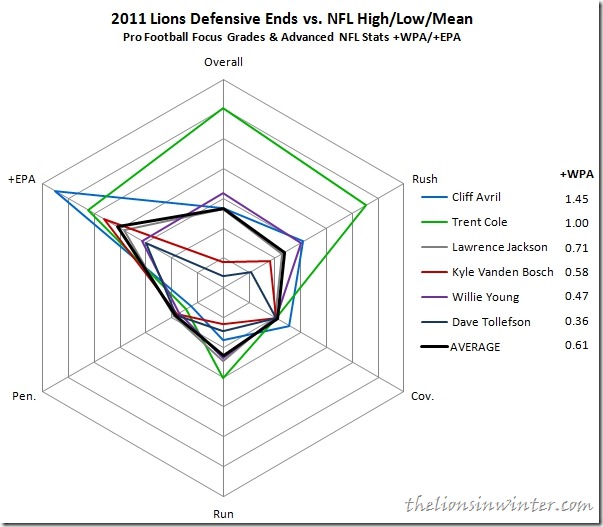
    detroit_lions_defensive_ends_2011_grades

    For the second straight year, Philadelphia’s Trent Cole is the highest overall PFF-graded 4-3 DE. With the #1 overall pass-rush grade of +40.4, and the 11th-best run-stopping grade at +10.3, Cole fulfilled his responsibilities in the Eagles’ own wide-9 alignment perfectly. His two-way dominance was so complete, he kept his top overall mark despite being called for seven penalties in 640 snaps. Interestingly, Cole’s 1.00 +WPA is only ranked 23rd, and his 32.3 +EPA is 27th. For all his consistently positive play, Cole didn’t help the Eagles win much. May have something to do with the rest of the defense behind him.

    Bringing up the rear is the New York Giants’ Dave Tollefson, whose –9.4 rush grade and –5.5 run-stopping grade put him at the bottom. His 0.36 and 10.0 +WPA and +EPA rank him 79th and 86th, respectively, out of 125 defensive ends ranked by Advanced NFL Stats.

    Important note: Pro Football Focus separates linemen into DT/NTs, 4-3 DEs, and 3-4 DEs. Advanced NFL Stats has one bucket each for DTs and DEs. The two sites do not always agree on who is what.

    Cliff Avril is another example of why I added+WPA and +EPA to these radar charts. When you add up all his positive, negative, and nothing-in-particular plays, he’s an average NFL defensive end. His +6.6 overall PFF grade almost exactly matches the NFL average of +6.5. That includes a pretty heavy ding for 11 assessed penalties, but a major boost from his linebacker-like coverage skills (+5.5). His pass rush grade is solid, ranked 19th overall at +11, but confusingly low for a guy who had 12 sacks, 8 hits, and 37 pressures on 822 snaps (one of those pass rush events per 14.7 snaps, 15th-best rate in the NFL).

    For comparison, Trent Cole had 11 sacks, 11 QB hits, and 44 pressures on 640 snaps, one every 9.55 snaps (2nd-best). For further comparison, Jared Allen had 24 sacks, 8 QB hits, and 34 pressures on 1044 snaps—one every 15.8 snaps. Just putting that out there.

    So from looking at just the PFF grades and stats, we’d mark Avril down as an average overall defensive end, pretty good at rushing the passer but otherwise mediocre. Then, we look at the +WPA and +EPA and whoa.

    Avril’s +EPA is an excellent 45.1, 11th-best in the NFL; that’s well ahead of Cole’s 32.3 (Jason Pierre-Paul’s is tops at 83.4).  His +WPA is an outstanding 7th overall, at +1.45. The discrepancy comes from his impact plays: 4 passes defensed, 6 forced fumbles, 7 TFLs, and an interception. In terms of +WPA, it’s his knack for making big plays at the right times. He helped the Lions’ win-loss bottom line 45% more than Trent Cole helped the Eagles’.

    Just as with the defensive tackles, we see Lions defensive ends—as a rule—make big plays when they matter most, far out of proportion to the rest of their production. Avril, though, takes that to the extreme. Keep in mind, he’s doing it from the left side, too: going against bigger/stronger right tackles and often in the quarterback’s field of vision. Imagine if he were working the blind side . . .

    Bottom Line: Cliff Avril, in this system, plays like a top ten defensive end. If he is not re-signed, his production and playmaking ability will not be easily replaced—and his production and playmaking ability is essential to the success of the defense. His re-signing must be the Lions’ top priority.

    Willie Young, a.k.a. The Great Willie Young, might indeed be the son of a panther god. His +11.7 overall PFF grade would be the highest of any Lions DE, if his 259 snaps weren’t just a few too few to qualify. His +10.2 pass rush grade is just behind Avril’s +11.0, and his run-stopping grade is far superior, +3.7 to –2.5. In a huge surprise, the not-as-spindly-as-he-used-to-be Young’s run defense was better than all but Lawrence Jackson’s.

    Again, this is on limited snaps—and that cuts both ways. Young makes fantastic plays whenever he’s in the game, but he’s in the game most often when the situation is ripe for him to make plays. His 3 sacks, 4 hits, and 19 pressures put his snaps-per-pass-rush at 9.96 which would be third-best in the NFL if he’d played just thirty or so more snaps.

    I believe that’s at least part of Trent Cole’s story above: he played 182 fewer snaps than Cliff Avril, and I’d be willing to bet a good chunk of “negative” plays were eliminated because of it. It’s a lot easier to be great against the run when you only have to do it on 2nd- and 3rd-and-long . . .

    Still, Young’s +11.5 EPA and +0.47 +WPA speak to just how effective he was when he was in. The average +WPA for qualifying DEs was 0.61, meaning that in just 259 snaps Willie Young helped the Lions win almost as much as an average starter. Nobody put much stock in a sub-260-pound all-legs-and-no-torso seventh rounder developing into a vital contributor, but Young’s already there in just his second year. How much better can he get?

    Bottom Line: Willie Young has proven his worth as a rotational end, and should be a big part of the picture for 2012, his make-or-break year. If he can shoulder an increased workload without his rate stats falling off, he’ll be every bit the player Cliff Avril has been. That is an enormous “if.”

    Lawrence Jackson had an outstanding 2011, producing at the same level as Avril and KVB when he got reps. The natural big-bodied run-stuffer Avril isn’t, he seemed destined to take over on the left side as Avril transitioned to the right rush end spot.

    Instead, Jackson played almost exclusively on the right side, in relief of KVB. He struggled against Tampa Bay, but had strongly positive games in Weeks 2-5. His season crescendoed on Monday Night Football, with a +3.4 overall grade (1 sack, 1 hit, 2 pressures on just 31 snaps). After that game, however, Jackson had three flat games before Week 10—where he graded out very well and suffered a deep thigh bruise that would bench him until Week 16.

    You can’t help but feel like Jackson missed his opportunity to stake his claim as the Lions’ third-now-and-second-soon DE. However, Jackson’s 18.4 +EPA is a very positive sign; he nearly matched the NFL average of 21.07 with just 341 snaps. His 0.71 +WPA is an even better one: with less than half the snaps of a typical starting DE to work with, Lo-Jack contributed more to the Lions’ winning games than some other teams’ starters . . . unfortunately, that includes the Lions’ Kyle Vanden Bosch.

    Bottom Line: Lawrence Jackson had a chance to prove to the Lions they were set at this position for years to come. Instead, his deep thigh bruise—and midseason lull—leaves us no closer to knowing if he’ll be ready to step in for KVB as a full-time starter when the time comes. However, he also flashed enough of that Secret Superstar form to prove he can play as well as anyone in the NFL when he’s “on.” Like Willie Young, 2012 will be his make-or-break year.

    Kyle Vanden Bosch had a fantastic bounceback year, right? With 8 sacks, 6 QB hits, and 26 pressures, this was his best statistical year since the glory days of 2008. Unfortunately, he had a beefy 777-snap workload, meaning he only generated pass rush on one of every 19.4 snaps—35th-best in the NFL and below the 19.0 NFL average.

    Vanden Bosch's -11.3 overall PFF grade is absolutely mortifying; it's the fourth-worst in the NFL. He was graded at –1.9 in the pass rush, definitely below the NFL average of +2.5. His run-stopping grade, however, was through the basement: –7.9, worse than everyone but St. Louis’s Chris Long. We saw this time and time again in the games: Vanden Bosch overpursuing like a maniac, and opposing teams scheming to take advantage.

    Vanden Bosch improved in this area throughout the season. He got dinged with strong negative run-defense grades in Weeks 2, 3, 4, 6, and 7, but only once more after that. Unfortunately, that coincided with a huge dropoff in his pass-rush productivity. He had only one negative pass rush grade in the first ten games, then was in the red for Weeks 12, 13, 15, and 16.

    KVB is the only Lion DE not to add Win Probability far beyond what his snap count and production would project: Despite those 8 sacks, he almost exactly met the NFL average with 0.58 +WPA. His 26.30 +EPA is solidly above-average, but that just highlights the fact that he got it done more often when it didn’t matter than when it did.

    Bottom Line: Kyle Vanden Bosch’s time as a premier two-way defensive end is over. His heart, desire, toughness, and leadership are unquestionable, but he’s simply not getting it done as well or as frequently as the rest of the defensive ends. Without finding the fountain of youth, he cannot start and play the majority of every game in 2012 or the defense will suffer for it.

    SHOPPING LIST: The Detroit Lions have some serious decisions to make at the Defensive End position, and have little information to go on. Kyle Vanden Bosch must recover his youthful form or play a reduced role in 2012. Cliff Avril is a proven game-changer but not under contract. Willie Young and Lawrence Jackson have played extremely well in limited time but are not proven full-time performers.

    If the Lions have complete faith in Young, Jackson, or both they are set for defensive ends. If not, they need to acquire a defensive end who can step in and play at least as well as Vanden Bosch, if not better, in 2012.

    Read more...

    Three Cups Deep: Lions vs. 49ers

    >> 10.17.2011

    coffee

    In every cup of coffee, there is bitterness. Some bitterness comes from the flavor of the bean, and some bitterness comes from how darkly it was roasted. Ever wonder how Starbucks turns out drinks that taste exactly the same in massive volumes all over the world? They roast all their beans so dark it doesn’t matter what they used to taste like. That’s why a downing a straight shot of Starbucks espresso is like drinking a campfire.

    Yesterday's loss leaves a bitter taste in the Lions fan's mouth. It’s not a delicate touch of acidity awakening the earthy qualities of your Monsooned Malabar, it’s just nasty cup of bitter upon bitter.

    Bitter, because it was an awful loss. The 49ers played well, but the Lions had every opportunity to win the game, and didn’t. Time after time, the defense got stops, and time after time the offense frittered good chances away. The “first quarter jitters” Lions fans have seen from Matthew Stafford and the offense never settled down. As I said in the Fireside Chat, it felt just like the Cowboys game: either the receivers aren’t getting open, or Stafford’s holding onto the ball too long.

    Bitter, because the Lions lost Jahvid Best to a concussion. This is his second concussion of the season, and he had a history of concussions and neck injuries at Cal. This is now a serious concern . . . we must now worry about his medium- and long-range future.

    Bitter, because Jim Schwartz and John Harbaugh got into a postgame skirmish that made both men look bad.  The story of the game wasn’t the 49ers win or the Lions loss or any of the great plays made on either side, it’s “OMG COACHFIGHT.” and that’s too bad.

    Bitter, because 49ers offensive tackle Anthony Davis hopped on Twitter and ran a bunch of silly smack that Cliff Avril and Lawrence Jackson both called out.

    Bitter, because I had a Twitter avatar bet with Bleacher Report NFL editor Dylan MacNamara, and now my avatar is a picture of Anthony Davis.

    But Starbucks sells a hell of a lot of coffee every year, and there’s a reason why: they take that bitter swill and dump a bunch of heat-sweetened milk in it, then slather that in whipped cream and sugary sauces. Here’s the sweetness that makes yesterday’s loss palatable . . .

    The Lions are 5-1. Only three other teams are either 6-0 or 5-1. The Lions are still two games ahead of the Bears, with a head-to-head win and a better division record. They’re now at the soft underbelly of their schedule: hosting Atlanta (3-3), at Denver (1-4), at Chicago (3-3), hosting Carolina (1-5). I’d expect the Lions to win at least three of those four games—and if they beat Chicago, it’s a two-horse NFC North division race.

    They took their only loss against one of the toughest teams on the schedule. Remember when I called the Kansas City game a “must-win?” It’s because the Lions’ schedule is tough enough that they had to win their winnable games. Because the Lions started 5-0, they can lose some of their toughest matchups (this one, at New Orleans, both Packers games, etc.) and still make the playoffs.

    Now that the Lions have brought their B-/C+ game for the third time this season and not won, they can take a breath, reset, and get to work on fixing the issues that winning has glossed over. The team and crowd should be doubly motivated to get a home win against Atlanta next Sunday.

    Finally, though the nation is talking about “OMG COACHFIGHT” and what a black mark it is on both franchises, I choose to look at this a different way. Charles Robinson of Yahoo! said on Twitter:

    Please let San Francisco and Detroit meet in the playoffs. I love it when the NFL coaching fraternity develops some bitterness within it.

    I’ve said before that rivalries—real rivalries—are when it means a little more to the players and coaches. Those naturally happen when games are played for high stakes multiple times in short window. Tempers get high, slights real and perceived get magnified, and both teams carry grudges into the next important matchup. At this point it looks possible—even probable—that the Lions and 49ers will meet again in the playoffs, and both teams will want vengeance.

    NFL.com’s Albert Breer said this kind of swagger is nice to see from two historically great franchises that have been moribund for nearly a decade—and you know what? I agree.

    Take this to the bank: The players on both sides loved seeing their coaches get after each other. Each leader has instilled a fighter's mentality in his team, and this was the manifestation of that approach.

    Harbaugh's bluster, Schwartz's intensity. All there on display.

    I say, enjoy the show. And enjoy that, in this age of chuck-it-around-the-yard-all-day offense, we had a couple of teams going at it Sunday that are a little more Mike Tyson than Muhammad Ali when they get in the ring.

    I’ll happily drink my third cup of bitter office-pot sludge to that.

    Read more...

    Contrition & Forgiveness: The Cusp of A NFL CBA

    >> 7.19.2011

    If all the reports are to be believed, the players and owners are within days, perhaps hours, of agreeing on a new Collective Bargaining Agreement. All outstanding lawsuits will be settled, all remaining hatchets will be buried, the NFLPA* will recertify itself as a union, and by week’s end the engines of professional football will crank up and roar to life.

    I’ve been mulling this for quite a while. I, as much as any single-team independent blogger, have spilled barrels of ink into the rift between players and owners. The first of those pieces, “The NFL, the NFLPA, the CBA, and Their Fans,” laid out all the issues as I understood them, and my feelings as both a true-blue fan and an educated chronicler:

    Pushing Thirty Minivan Me is just that: pushing thirty with a minivan. I’m not pushing fifty with a Harvard MBA, and I’m not pushing twenty with a Rolls Royce Drophead Coupe. I’m not in a position to bear investment risk, or rake in dividends off the profit. I’m the schmuck in line at the gate, ready to part with fistfuls of hard-earned jack I should spend on more important things. I’m the tool with a family of five, all dressed in jerseys on gameday. I’m the fool at the bottom of the pyramid scheme, the rube all this is built upon, the mark they’re all getting rich off of . . .

    . . . and I’m the kid in front of the TV set, eyes as big as saucers, watching Barry run. Owners, players, coaches, front office, staff, agents, flaks, and all the rest: please. Remember me. Remember us. Remember who really bears the financial burden here—and ultimately, who really holds the cards. Baseball, 1994? Hockey, 2005? We are the golden goose, and you have your hands around our neck.

    Many radical outcomes were foretold: an 18-game regular season, the “unpinning” of the salary cap from revenue, even abolition of the draft! There were frequent public spats between members of each side—even over issues like whether or not upcoming negotiations had been scheduled. The resultant bad blood between players and the league has been disturbing (case in point: James Harrison’s comments about Commissioner Goodell). Yet, soon that’s all supposed to be water under the bridge, as the John Hancocks are applied to a new CBA.

    Who won? The biggest winners were the lawyers, and big business (thanks to that 8th Circuit ruling expanding the presumed boundaries of the Norris-LaGuardia Act). The next biggest winners are Roger Goodell and DeMaurice Smith, each of whom was hired to deliver in this moment. To a lesser extent, everyone who loves the NFL, or makes a living off the NFL, wins: we’ll get our full annual recommended amount of football.

    In terms of semantics, the players nearly ran the table. The CBA will arise from a settlement of the Brady v. NFL lawsuit, as presided over by US District Court mediator Arthur Boylen—not collective bargaining sessions with FMCS Director George Cohen. They successfully maintained their decertified trade association status. They kept the money debate focused on a percentage of all monies coming in the door, rather than splitting the hairs of what money “counts” and what doesn’t.

    Yet the result of all the semantics—and layoffs, and furloughs, and prematurely induced labors, and eight digits’ worth of lawyer bills—is a tune-up, not an overhaul. Players will receive an smaller piece of the biggest possible pie, continuing the trend started with the 2006 agreement. Rookie salaries will be reigned in, and the savings will go to active and retired veterans. Those retired veterans will be vastly better taken care of, player safety rules clarified, and player health benefits improved. In lieu of an 18-game regular season, there will be a weekly Thursday  Night package to wring more TV revenue out of the existing 16-game docket.

    In short, the ultimate agreement will look like a very reasonable compromise; this is both good and bad. Good, because it should lay the foundation for another decade or two of labor peace. Bad, because it means the two sides were never really that far apart. All of the grandstanding and caterwauling, all of the doomsaying invective, the lockout and the lawsuit and all the bitter words, it all could have been avoided. I repeatedly begged both sides to do what it took to come to an agreement before the CBA expired—if for no other reason than to respect the investments of the millions of fans making them rich. But no, leverage was protected by any means necessary, and we’ll have a deal in late July that should have been struck in February.

    Back in college, I studied an article by a dude named Francis Fukuyama called “The End of History?” Written at the close of the Cold War, it argued that liberal democratic governments, paired with market-based capitalist economies, were the culmination of human history. Once the entire world had converted to representative democracies, History—capital H, meaning the progress of humanity towards liberty and equality of opportunity—would end.

    As an extension of this idea, some argued that the Cold War itself was History’s pause button. The two superpowers’ opposing ideologies were holding an entire world in thrall; other countries either aligned themselves with one side or felt immense pressure to do so. All that time the US and USSR stood at loggerheads, viewing the rest of the globe as a giant game of Reversi, and other nations’ political and economic development were stifled. Once the Soviet Union fell many democracies sprung up, China became an economic powerhouse, Korea and India started moving to the forefront of technology and industry, and now we’re in the midst of the Arab Spring.

    TO BE CLEAR: I am not equivocating my stepfather’s service in Vietnam to my being really bummed about football. But, I can’t help but feel like the last seven months have been like that for NFL fans. There have been so many sacrifices by and of so many; people have lost their jobs over this. There have been so many feelings hurt, bad blood shared, and regrettable decisions made. Yet, in the aftermath, it feels like it was all a charade. The outcome was inevitable all along, and everyone will pretty much pick back up where they left off.

    In light of that, I want to say a few things. First, to Commissioner Roger Goodell, and NFL PR folks Greg Aiello and Brian McCarthy: there were some times I abused the direct pipeline of Twitter. I crossed the line with my real-time emotions on more than one occasion. I’m sorry.

    To NFLPA executive director for external affairs George Atallah, many thanks. You were open, honest, transparent, and accessible throughout the process—most especially to new-media types such as myself. I also thank DeMaurice Smith for delivering some classic quotes while defending the players’ interests well.

    Special thanks go to the Lions. That includes the players who’ve taken time out to talk about the issues with me—Kyle Vanden Bosch, Lawrence Jackson, Cliff Avril, etc.—and members of the organization who’ve done the same, such as Director of Media Relations Matt Barnhardt. I come out of this experience more convinced than ever that the Lions are a great group of people led by a great group of people, and a classy organization from the top down.

    All that’s left is for them to get on the field and play.

    Read more...

    Old Mother Hubbard: The Defensive Ends

    >> 3.07.2011

    The Old Mother Hubbarding of the DTs got a bit of attention; I was even linked by ProFootballTalk. I’ve been a dedicated PFT reader for, like, ever, and secretly I’m over the moon about that—but I’ve decided to act like I’ve been there before.  So.

    The Pro Football Focus data I’m using is widely misunderstood, so let me explain a couple of key points. First, the PFF data doesn’t measure pure talent. The final grade doesn’t mean that one player is “better” than another, just that they turned in a more effective performance, on a down-by-down basis. Second, PFF weighs penalties in the final grade—so Sammie Hill, who didn’t commit a penalty, graded out higher than Corey Williams, who was more effective, but flagged a ridiculous number of times.

    Second, it’s my observation that PFF’s system rewards consistency. A player that repeatedly makes a positive impact (and is rarely a liability) will have a much higher final grade than a player who “swings for the fences,” makes a few spectacular plays, and is otherwise often ineffective . . . even if those few spectacular plays change the outcome of the game. Watching at home on TV, at full speed, we tend not to notice line play unless the results are spectacular—so a player who is always a little more effective than you think (like Sammie Hill) is going to grade out surprisingly well. Meanwhile, the home run hitters (like Ndamukong Suh) are going to grade out surprisingly poorly, since every time you notice them, they’re doing something awesome.

    Sometimes, this leads to counterintuitive results. However, a lot of what’s really happening on the field is counterintuitive from a fan perspective. I’ve said before that watching film is the “red pill of fandom;” if you start doing it you learn the truth about what’s happening on the field . . . and you realize just how wrong most of the national football groupthink is. PFF is a group of dedicated football fanatics (like you and I) who spend outrageous amounts of time popping red pills like candy. If you and were committed enough do to what they do, we’d likely get the results they’re getting; that’s why I’m using their data. So, with all that in mind . . . to Wonderland.

    image

    Just as before, I’ve included the top-graded 4-3 DE, the Eagles’ Trent Cole, and the bottom-graded 4-3 DE, Kentwan Balmer of the Seahawks. The thick black line represents the average for 4-3 DEs who saw at least 25% of their team’s available snaps.

    Just a week ago, I wrote that Cliff Avril was one of the two Lions who had the most to prove in 2010; boy, did he ever prove it. Avril was massively improved over 2009, and finished as PFF’s 11th-best graded 4-3 DT. He was 7th-best in the pure pass rush grading, and 4th-best in coverage. His athleticism, and linebacker pedigree, shows through in those grades. The question mark with Avril is his ability to anchor against the run; he grades out below-average there, but was far from a liability.

    Avril was the Lions’ best defensive end, by a long shot, and a true difference-maker for the defense. He saw an average of number of snaps, fewer than most of the other top-ten-type—but that was due to injury, not lack of use. If he was healthy, he was in there. By my calculations, Avril was behind only Ray Edwards and Dwight Freeney in pressures-per-snap—he had a truly outstanding year applying heat to the quarterback. When Kyle Vanden Bosch was hurt, Avril not only didn’t wilt under the pressure, he took the reigns and ran with them, handing in better grades as the season went on. Food for thought: he turns 25 next month.

    Interestingly, Avril only had two QB hits all season, far fewer than most with his kind of sack and pressure numbers. My guess is that he’s relying on pure speed to get around right tackles—then either getting there and flushing/sacking the QB, or not. I wonder if pass rushers the QB can see coming don’t get as many hits . . . an interesting project for another time.

    Bottom Line: Cliff Avril was pigeonholed by most as a 3-4 ROLB, and I’m certain he could shine in that role. But he’s developed into the fast, athletic 4-3 rush end Rod Marinelli thought he could be. Avril will never be a 270-plus-pound, two-way monster—but he’s already an impact defender, top-flite pass rusher, and a huge part of this defense going forward. Signing this RFA to a long-term deal must be a top priority.

    The centerpiece of the Lions’ free-agent additions, Kyle Vanden Bosch had a lot to prove, too: namely, that he could still get to the quarterback like he used to. In his first game, it seemed like he answered those questions in style; I said it was “one of the most amazing individual performances I’ve seen.” KVB poured his heart and soul out into that game, trying to will the Lions to victory. He was sideline-to-sideline, or as much so as a defensive end can be.  He put up a truly dominant PFF grade that week, too: a +6.1.

    Unfortunately, KVB was inconsistent the rest of the season. He turned in very solid games against the Giants and Redskins, but was negatively, or neutrally, graded in every other game. He was graded well below-average in pass rush; negative in five of eleven games. He was the 46th-best pass rusher out of 65, and had less than half the pressures Avril did—yet, KVB had five sacks and ten quarterback hits in just eleven games. His sack-and-hit per-snap rate was 25th-best in the NFL. This suggests that he was “saving it up” for critical moments; generally just below average except for several plays a game.

    However, all of this does an injustice to KVB’s contribution. He was the bell cow for the defensive line, the tone-setter; he pushed every single Lion on the line to practice at full speed, to workout like you practice, to push, to go to the limit and then realize it’s not really the limit and keep going. Avril, Suh, Hill, all the young linemen repeatedly pointed to KVB’s leadership as a major factor in their progression; he was a catalyst, and without him I doubt the others take the strides they did.

    I had really good seats to the Jets game, and seeing KVB in action live was something else. He never missed an opportunity—before, during, or after the snap—to remind the Jets that he was there. That he was fighting. That they needed to keep their head on a swivel. That they needed to watch their ass. Vanden Bosch and the Lions out-Jetted the Jets on that day, mostly thanks to KVB and his leadership. PFF graded him at a –2.1 on the day, but I know he had a positive impact.

    Bottom Line: Kyle Vanden Bosch is the ultimate leader, a consummate professional—and as a player, the yang to Cliff Avril’s yin. Had he stayed healthy, he would have had seven sacks and fifteen QB hits, more than acceptable standalone production, besides the undeniable halo effect. Unfortunately, he’s 32, and recovering from a major neck injury. The Lions need to find a starting, impact, two-way end to replace him by the 2012 season.

    The most surprising line in the chart above is the red one, the one representing Lawrence Jackson. Jackson was the 25th overall pick in 2008, a four-year starter at USC. Lo-Jack is a 6’-4”, 270-pound two-way defensive end, the prototype end for this defense. He was the victim—and the Lions, again, the beneficiary—of “One Man’s Trash” syndrome. The Seahawks let a first-round pick two years into his career go in exchange for a sixth rounder, because he no longer fit their system. To replace Lo-Jack, the Seahawks traded their own sixth-rounder to the 49ers for . . . Kentwan Balmer, picked just a few spots after Jackson in the 2008 draft. Balmer, for the Seahawks this year, was the worst-graded DE in football (see chart).

    Jonah Keri just wrote a whole book on how the Tampa Bay Rays went to the world series by making these kind of deals, over and over again. By trading one commodity for another, similar commodity, and getting a 2% edge, over time it really adds up—and at some point, you’ll get a few surprise deals where the edge is way more than 2%. In this case, the Seahawks essentially traded Lo-Jack for Kentwan Balmer. The difference, as you see above, is way more than 2% . . . and where did the benefit go? To the Lions.

    Lo-Jack was not a terrifying speed rusher at USC. He had 30.5 sacks in four full seasons: 6, 10, 4, and 10.5, in order. But with size, strength, and attitude sharpened by life in hardscrabble Inglewood, Jackson was a force in both dimensions of the game; in his senior year he paired his 10.5 sacks with 60 tackles—a prototypical Schwartz/Cunningham defensive end.

    When injuries hit the defensive line, Jackson answered the bell in a big, big way. Getting a steady diet of snaps from week 10 on, Lo-Jack had a huge (+5.0) game against Buffalo, at left end. He was flipped to the right when KVB went down, and was average against the Bears in his first game on that side. He was flipped back to the left against Green Bay, and had a very strong game, then back to the right against the Bucs and dominated (+4.5). He stayed on the right side the rest of the way out, struggling against Jake Long, but finishing strong against Bryant McKinnie.

    Bottom Line: Lo-Jack produced like an above-average starter in heavy rotation, and fron Week 10 on was one of the better 4-3 DEs in the game. I’ll hold off on anointing him the starter of the future for now, because I’d like to see more consistency—but there’s no doubt he’d be the perfect physical fit for the void KVB will eventually leave.

    Next, the ever-controversial Turk McBride. Controversial, because I repeatedly dismissed him in my offseason assessments last year, much to the chagrin of the commentariat. This season, the 6’-2”, 278-pound ex-Chief played about 40% fewer snaps than Avril or KVB, but about 40% more than Lo-Jack—exclusively at the left end until Vanden Bosch went down, then exclusively at the right end for the rest of the season.

    The stats suggest that McBride was nearly as successful as Jackson; McBride had five sacks to Lo-Jack's eight. The second Green Bay game sheds some light on why they graded out so differently, though. By PFF’s reckoning, both McBride and Jackson had two sacks, yet McBride’s grade for that day was –0.3, and Jackson’s was +2.1. Jackson is clearly having more of an impact down-to-down; Lo-Jack’s run support is much better than McBride’s, as well.

    Bottom Line: McBride is an interesting case. Phyiscally, he’s a bit of a ‘tweener, and he did manage to get to the quarterback five times. However, I’ve never liked the cut of his jib for reasons I couldn’t fully explain. The PFF grades show why: when he’s not sacking the quarterback, he’s simply not a factor. PFF’s consistency/home-run bias may be coming into play here, but it supports my eyeball take: Lo-Jack has long-term starter potential here; Turk McBride does not.

    There’s nothing that can be said about The Great Willie Young that Neil from Armchair Linebacker hasn’t already said (at breathtakingly profane length!), but I will say this: in only six snaps, he was graded at a +1.5 on the season. He also impressed during the preseason.

    Bottom Line: Willie Young is a developmental prospect with a very lean frame, a long way to go, and an undeniable knack for playing football. I hope he has a place on the roster for next season.

    We’ve already talked about Andre Fluellen as a defensive tackle. He played 81 snaps there, as opposed to 72 at end, during the Avril/KVB injury phase of weeks 11-15. As a DE, he graded out as a below-average pass rusher, and a well-below-average everything else. I believe his future on this team is as a tackle.

    Bottom Line: At 6’-2”, 302, Fluellen is a defensive tackle. He should get this offseason to be developed and coached strictly within that role, rather than being moved all over the line. Instead of frantically gaining and losing weight to fit immediate need, the Lions should develop him this year as strictly a three-technique DT.

    SHOPPING LIST: The Lions will need to find an impact two-way defensive end, ready to replace KVB as a starter by the 2012 season. Lawrence Jackson has the potential to be that end. Cliff Avril is an RFA who must be re-signed to a long-term deal. The Lions may look for a developmental speed-first end behind Avril, especially if Willie Young does not take major strides in the offseason.

    Read more...

    Presenting TLiW's Inagural Blue Flame Awards

    >> 12.28.2010

    Since it’s award season on the Internets, with everyone handing out notional hardware for their Ten Best ------ or ------ Of The Year, I decided to try bestowing some completelly meaningless, but mildly entertaining, honors of my own.  Behold: the inaugural, and possibly annual, Blue Flame Awards!

    • Game of The Year: Detroit Lions 23, Tampa Bay Buccaneers, 20

      This was a difficult choice.  Of course, my indelible memory from this year will be my son’s first Lions game, against the Jets.  But in a season with five-and-counting wins, one of the ten heartbreaking losses can’t be the game of the year.  The completely improbable 7-3 defeat of the Packers will stand out as the Lions’ most impressive victory, the tallest giant they toppled.  But the win that snapped the Lions’ road streak gets my vote as the Game of the Year.  It featured the game of Drew Stanton’s life, a sustained rushing attack, a masterful drive to tie the game, and a suspense-ending first-possession overtime victory.  Drama.  Majesty.  Victory on the road against a quality opponent.  Game of the Year.

    • Tom Moore Coach of The Year: Scott Linehan, Offensive Coordinator

      Three different quarterbacks have started (and won) football games for this team, and Linehan has done a flatly masterful job of tailoring the offense to the strengths of each.  A downfield aerial attack with Stafford in, a high-percentage shell game with TEs and RBs in the slot with Shaun Hill, and an wild grab bag of quarterback runs, running back by committee (if not an entire Congress), and quick slants with Drew Stanton in.  For most of the season, the Lions have been in the top ten in the NFL in scoring (they’re currently 14th).  Considering the revolving door at quarterback, their nearly-a-touchdown-per-game improvement in scoring over last year (from 16.4 ppg to 22.8) borders on miraculous.  Honorable Mention: Gunther Cunningham, defensive coordinator; Kris Kocurek, defensive line coach.

    • Barry Sanders Cannot Hope To Stop Him Award: Calvin Johnson, WR

      Given to the most dominant offensive player, this award was a complete no-brainer.  For reference, see Johnson’s preposterous 46-yard touchdown catch against the Bears.  He consistently presents a nightmare matchup to any defense in the NFL, anywhere he is on the field.  Just before “print time,” Calvin was named a Pro Bowl starter.  Honorable Mention: Jahvid Best, RB

    • Mike Cofer Tecmo Super Bowl Beast Mode Award:  Ndamukong Suh, DT

      Given to the most dominant defensive player, this award was much harder to give out.  For starters, an argument could be made that Suh, despite the numbers, has not even been the most consistently dominant defensive lineman on the roster.  Corey Williams has been a force against both the run and the pass, and Cliff Avril has blossomed into the edge rusher we all thought he could be.  But Ndamukong Suh, in a position that practically demands two or three years of physical maturation, has brought down the enemy quarterback nine times in his rookie season, leading all NFL DTs.  Further, he’s done it against frequent double-teams.  He’s still against the run, and some of his sacks have more to do with pursuit than penetration—but Suh is a monster talent who’s already dominant—as of this writing, he’d just been named a starter in the Pro Bowl—and is nowhere near his ceiling.  Honorable Mention: Corey Williams, DT; Cliff Avril, DE

    • Mel Gray Three Phases of the Game Award: (tie) Stefan Logan, PR/KR/WR; John Wendling, ST

      I couldn't just pick one of these two as the most game-changing special teams player of the year.  Logan’s long, dynamic returns consistently shortened the field for the offense—and once, even put points on the board.  Logan was also a willing and able tackler on the kick coverage unit.  Wendling consistently lengthened the field for the opponent with his amazing play as a punt gunner, both with on-the-spot tackles of opposing returners, and heroic kills of Nick Harris’s punts.

    • Chris Spielman Heart of a Lion Award: Kyle Vanden Bosch, DE

      Given to the Lion who most profoundly exudes fire, toughness, and determination to win, KVB had this one sewn up Week 1.  His ten-tackle, sideline-to-sideline performance against the Bears was one of the most incredible single games any defensive Lion has had in my memory—singlehandedly willing the Lions to victory.  He clearly set the tone for the Lions’ best unit, both on the field and off.  His approach to practice, preparation, training, and games were cited by coaches and teammates alike as the model for the rest of the squad.  Honorable Mention: Drew Stanton, QB; Dominic Raiola, C

    •   Bryant Westbrook Realized Potential Award: Cliff Avril, DE Cliff Avril, perhaps the prototypical 3-4 rush OLB, was as surprised as anyone when Rod Marinelli drafted him to play as a 4-3 end.  After his rookie season, where he picked up 5 sacks in just four starts, it looked as though the third-round pick was going to quickly develop into the Lions’ premier pass rusher.  However, a change to a philosophy that emphasizes bigger ends, and a lingering hamstring injury, stunted his growth in 2009.  Gunther publicly questioned his “mean streak.”  However, he showed up to OTAs and blew the coaches away with his preparedness, physically and mentally.  He immediately locked down a starting spot, and has racked up eight sacks so far this year—including three against Green Bay.  He responded to the loss of KVB by taking his play to the next level; a sure sign that he has arrived.  Honorable Mention: DeAndre Levy, MLB
    • Commenter Matt TLiW Commenter of the Year Award: echo

    • Those of you who’ve been reading for a long time know that “Matt” has been a prolific, intelligent, and well-spoken commenter since nearly the beginning.  I’m going to name the award after him—but I’m going to give this year’s award to “echo,” who blew up the Emmitt vs. Barry: By the Numbers post with page after page of incredibly well-researched info.  Given how high that post ranks for “Barry vs. Emmitt” searches, echo has done the whole world a permanent favor.  Thanks, man.

    Read more...

    Kyle Vanden Bosch: Music With What We Have Left

    >> 12.08.2010

    Kyle Vanden Bosch drives Eli Manning into the ground as the Detroit Lions very nearly, but not quite, defeat the New York Giants.

    I named this post after a beautiful--but apocryphal--story about violin virtuoso Itzhak Perlman finishing a concert after breaking a string.  Perlman, so the story goes, snapped a string very early in the performance—and forged ahead, using alternate fingerings, different voicings, even detuning strings (!) on the fly to complete the piece without missing a beat.  Perlman, who was stricken with polio as a youth and so walks with crutches, then quieted the enthralled audience and (allegedly) said, “You know, sometimes it’s the artist’s task to find out how much music you can still make with with what you have left.”

    Again, as I said, it didn’t actually happen, as far as anyone can tell—the story appeared in the Houston Chronicle six years after the concert supposedly took place, doesn’t jibe with Perlman’s known performance schedule from the time, and nobody who saw him perform around then reported anything like the above . . . but it is a good story.

    Today, Kyle Vanden Bosch was placed on the Reserve-Injured list, ending his first season as a Detroit Lion.  A captain, and the unquestioned heart and soul of the defense, KVB finished with 33 tackles, 11 assists, 4 sacks, 2 forced fumbles, and a pass defensed.  This included a monster 10-tackle tour de force in the season opener; one of the greatest individual performances by a Lion in recent memory.  We’re told not to worry, the bulging disk will be easily corrected, and KVB will return to play “at a high level.”  I’d be inclined to question The Grandmaster on this one, except he was right about how much KVB had left in the tank to begin with . . .

    So what’s left?  A freshly-broken-out Cliff Avril, Turk McBride, Lawrence Jackson, and (the Great) Willie Young.  If Avril can keep up his dominant play, this group won’t be too shabby—especially if the tackles continue to play as they have.  However, that’s a pretty big “if;” KVB’s leadership inarguably inspired Avril and the rest of the line to play as they have—will they keep it up in his absence?  In a way, KVB’s absence will allow us to judge his off-field impact on the team, just as much as his presence allowed us to judge his impact between the lines.

    Moreover, it’ll be a stern test of just how far the defense has come under Schwartz and Cunningham: can they keep this group motivated and productive without the man they desperately courted in the offseason?  Knowing KVB would be the catalyst for great improvement on the defensive line, will the reaction keep going now that the catalyst is spent?  Can Guntherball keep playing the offense like a fiddle, calling just the right blitz at just the right time, now that a string has snapped?  We’ll get to see just how much music he can still make with what he has left.


    Read more...

    Three Cups Deep: Lions vs. Bears

    >> 12.06.2010

    A couple of years ago, I had what might be called a quarterlife crisis.  I’d just bought a minivan—relegating my newish five-door Pontiac Vibe to pointlessly capacious commuter duty.  In a move designed to both lower my car payment and raise my self-esteem, I decided to trade it in for an older two-seat convertible.  After months of looking for just the right car, negotiating with the dealer, dealing with the bank, navigating my way through the credit crunch, and getting the stamp of approval from Mrs. Inwinter, I finally got everything arranged.  All the pieces were in place, all the numbers were crunched—and though the deal went right down to the absolute bottom dollar, I knew I had finally gotten what I wanted.

    I called the dealer to arrange pickup.  When I asked what I needed to bring with me, he said “Your proof of insurance, title, and payoff statement.”  With fresh memories of the test drive whizzing through my head, I asked my bank to fax over a copy of the payoff statement.  They did so.  It was a thousand dollars higher than I thought it’d be.

    To this day I don’t know how I screwed this up, but I thought I’d owed exactly one thousand dollars less than I really did.  There was nothing to be done; I’d already spent a week going back and forth to make it happen.  I’d negotiated so hard that at one point, I was in a room with the salesman, the sales manager, the service manager, and the general manager, bending them all to my will.  To suddenly be a thousand dollars apart meant it was over.

    I halfheartedly kept searching for another car, another deal, but it wasn’t meant to be.  I was, I thought, thirty minutes away from swapping keys and driving a real, live sports car home . . . instead, I was back in the wagon.  I was crushed, and for a long time felt fated—doomed, even—to drive this car into the ground.  Sadly, I consigned myself to waiting for my midlife crisis.

    In the meantime, though, it’s become easy to remember why I bought this Vibe to begin with: it’s big inside without being big outside, it gets great mileage, and—with a stick—is surprisingly fun to drive, even with five doors and a sewing machine engine.  It’s far from what I wanted, and even farther from what I imagine I’ll be in the market for come Model Year 2031.  But even though it doesn’t put the “permagrin” on my face, I’ve spent a few years wringing enjoyment from this ride; I know how to be happy with it.  I know exactly how hard I can push it around every corner on my commute.  I know that with a well-timed downshift, I can coax just enough “zing” from it to gleefully thumb my nose at an oblivious cell-phone-jabbering Saturn Vue owner as I pass them with authority.

    In some ways, it’s pathetic; I’m psyching myself into getting my he-man car-guy rocks off within the context of posted speed limits.  But in other ways, it’s simply acknowledging reality: I’m a happily committed family man, working hard to give my kids every opportunity that I can.  I’m not going to eat my cake unless my family can have it, too—and that day just isn’t here yet.  So, I’m making do with what I’ve got—and frankly, I’m more blessed than many around these parts these days.

    Being happy while following this Lions team is much the same.  It isn’t what I want—and God knows That Glorious Day has seemed right around the corner so many times.  But . . . this is what I’ve got.  I’m a Lions fan.  If I tried to drape myself in the colors of a winner, it would be a hollow lie.  Until the day comes when the Lions win games consistently, I’m going to revel in the glory of Calvin Johnson stiff-arming half the Bears’ defense en route to the end zone.  I’m going to go crazy about Cliff Avril picking up the slack for an injured KVB with a three-sack masterpiece of a breakdout performance.  And, yes, I’m going to queue up YouTube and watch Drew Stanton run for paydirt and do something vaguely resembling “the Dougie.”

    I’m not going to let this team’s limitations, inexperience, and bad luck ruin my Sundays; I’m just going to watch and cheer and hope, and cherish the good stuff that happens while the snows roll in.  It’s going to be a long, long winter when this season’s said and done . . . maybe the longest winter yet.  With an NFL lockout looming on the horizon, it’s possible that there might not even be Lions football in 2011.  So, please, don’t tune out.  Don’t unplug.  Don’t let Packers fans take over our stadium next week.  Don’t miss out on the really cool moments this team is generating, even without some of their best players.    Make do with what you’ve got, and be thankful you’ve got something to make do with at all.


    Read more...

    Three Cups Deep: Preseason Week 1

    >> 8.16.2010

    Last year at this time, I started a regular Monday post I called “Three Cups Deep,” and the rationale went a little something like this:

    On Mondays, it takes little bit more of the good stuff to get me going. The first desperately-needed cup is often not until nine o'clock or so, often because I’m such a complete zombie that I forget to go get coffee. I’m lucky to make it back to my desk with that first cup before I’m trekking back to the office Bunn—desperately hoping I won’t be the sucker who kills the joe, and therefore beholden to make some mo’.

    The second cup I down steadily, solidly, workmanlike. By the end of that second helping, I’m starting to get the tingle; my eyes aren’t drooping quite so much. I realize I’m slouching so badly in my chair that the backrest is supporting my head instead, and move to an upright position. But the third cup . . . ahh, the third cup. The initial sip of the third cup is like Zeus’s lighting; a bolt from the heavens igniting my nervous system! I lean forward in my chair, attacking the problems of the day with emphatic keyboard strikes, pummeling my dreary to-do list into submission. It is now, at the beginning of that third cup, that I write this.

    For the first time this season, there was Lions football over the weekend—so Three Cups Deep makes its triumphant return.  I spoke at length about my impressions on last night’s Fireside Chat podcast, but a good night’s sleep—or in my case, a bad night’s sleep and three cups of coffee—always provides valuable perspective.

    In my guest Gameday post over at The Steelers N'At, the first sentence I wrote was, “On offense, I want to see a lot of completed passes.”  I got what I wanted on an impressive scale: Lions quarterbacks combined to complete 23 of 32 passes.  Stafford was 8-of-11; two of those were attempted TD strikes to Calvin, and one was the ill-fated swing pass to Jahvid Best.  Other than that, Stafford was nearly perfect.  The Lions spread it around a lot, too: those 23 passes went to 15 different Lions, with no receiver catching more than two balls each.

    It was bizarre to watch the offense simply work.  Dropback, pass, complete.  Dropback, pass, complete.  Handoff, run forward, gain yards.  Dropback, pass, complete.  It was practically boring.  I thought to myself, “This is . . . easy.  Just, you know, complete the passes.  Why didn’t they just do this before?”  After all the wailing and lamentations, after decades of quarterback purgatory, duh, just throw and catch!  It didn’t hurt that this was the preseason, where the reaction from the Steelers crowd was a combination of silent puzzlement and total indifference.  The whole thing felt surreal.

    What was even more surreal was every single end-zone replay showing a perfect pocket for Stafford to throw from.  I don’t know if the Steelers were just laying off, or what—but there was no heat on Stafford whatsoever, and he was getting rid of it quickly anyway.  Kudos to the line for keeping him clean, regardless of the pressure.

    Save for the unfortunate swing pass (assigning blame is irrelevant), Jahvid Best was very impressive, and absolutely looked like an NFL every-down back.  Speed, moves, vision, yes—but strong between the tackles, and fast to the hole.  I’ve said for quite some time that the questions about his size and toughness were unfounded, but anyone who watched Best run this weekend came away knowing he’ll be just fine.

    Defensively, Cliff Avril made his presence known immediately, and the starting defensive line looked every bit as impressive as advertised.  The linebackers weren’t quite as impressive; Zack Follett looked like he was a step slow to react on a lot of things, but at least looked credible out there.  Of course, the loss of Jordon Dizon is unfortunate—but at this point in his career, I can’t tell you how much better he is than Vinny Ciurciu, which says a lot about both him and Ciurciu.

    In the secondary, I was impressed by the ball skills of Chris Houston and Eric King, and undrafted free agent safety Randy Phillips.  We’ll see how long that lasts once things get a little more “for real”, but the starting secondary held their own out there, which is a fantastic first sign.  I still anticipate some real struggles in the back seven over the course of the season, but I’ll take any reason for optimism I can get.

    And now, for the fourth cup . . .


    Read more...

    The Defensive Line and the Secondary, Part III

    >> 7.23.2010

    Throughout the offseason, it’s been speculated that the Lions’ woeful pass defense will get a boost from the revamped defensive line.  With Kyle Vanden Bosch and developing Cliff Avril on the ends, and Corey Williams and Ndamukong Suh joining Sammie Hill on the inside, the pass rush should be greatly improved.  This should, in turn, take pressure off the unproven secondary . . . right?

    I set out to investigate this in part one, using the NFL’s league-wide data over the past two decades or so.  I tried to find correlation between seasons when sacks were up, and seasons when passing offense was down.  I think I learned more from the comments about how statistics and regression analysis work, than I did about the correlation between pass rush and pass defense—but my early results suggested that there is not a correlation between pass rush and pass defense.

    I tried again with part two, blending pro-football-reference.com’s official and official-derived data for 2009, with profootballfocus.com’s manually film-reviewed defensive stats and grades.  I came up with a stat I called “pass rush rate,” which was opponent pass dropbacks (attempts + sacks) divided by cumulative sacks, hits, and pressures.  Then, I ran a simple correlation between every team’s pass rush rate for 2009, and their yards-per-attempt allowed.  The correlation was weak, –0.152. When squared to get the effect size, it was a negligible .023.

    Importantly, the real-world analysis bore this out: the Jets had an extraordinary pass defense, by far the best in the NFL.  While their pass rush was solid, ranking 9th of 32 in pass rush rate, it was just that—solid, not phenomenal like the overall pass defense was.  Amazingly, the Cleveland Browns generated pressure on the quarterback more often than every team except Dallas and Minnesota—and yet, they were the fifth worst pass defense in the NFL!  Pass rush alone doesn’t make a defense effective.

    For this installment, I wanted to get even more specific: I wanted to isolate defensive line pass rush from everything else.  After all, the idea is that getting an effective rush with just the front four will allow much greater flexibility in coverage and blitzing.  I aggregated the stats of just the defensive linemen, and compared them to what I already had.

    Now, let me tell you a legendary tale . . . or, well, I guess, just a legend:

    • Name: The name of the team.
    • A: The primary defensive alignment.
    • Pass Rush Rate: The percentage of opponent dropbacks (Attempts + Sacks) on which the defense achieved a pressure stat (Sacks + QB Hits + Pressures + Batted Passes).
    • DL Pass Rush Rate: The percentage of opponent dropbacks (Attempts + Sacks) on which the defensive line achieved a pressure stat (Sacks + QB Hits + Pressures + Batted Passes).
    • % of rush from DL: The percentage of defensive pressure stats (Sacks + QB Hits + Pressures + Batted Passes) generated by defensive linemen.

    NAME A Pass Rush Rate DL Pass Rush Rate % of rush from DL
    Dallas Cowboys 3-4 48.2% 18.2% 37.8%
    Minnesota Vikings 4-3 47.7% 38.9% 81.7%
    Cleveland Browns 3-4 44.0% 19.1% 43.4%
    Miami Dolphins 3-4 43.3% 36.0% 83.1%
    Philadelphia Eagles 4-3 43.1% 35.4% 82.2%
    New York Giants 4-3 43.0% 35.3% 82.0%
    Atlanta Falcons 4-3 42.9% 35.1% 81.8%
    Green Bay Packers 3-4 41.6% 13.5% 32.5%
    Pittsburgh Steelers 3-4 41.3% 10.1% 24.4%
    Houston Texans 4-3 41.2% 32.7% 79.4%
    New York Jets HYB 40.3% 19.3% 47.9%
    Denver Broncos 3-4 39.7% 13.1% 33.0%
    Tennesee Titans 4-3 39.6% 36.0% 90.9%
    San Francisco 49ers 3-4 39.4% 16.5% 41.9%
    Washington Redskins 4-3 39.2% 29.2% 74.5%
    Carolina Panthers 4-3 39.2% 35.4% 90.3%
    Arizona Cardinals 3-4 38.5% 18.7% 48.6%
    New England Patriots HYB 37.8% 18.8% 49.8%
    Chicago Bears 4-3 37.3% 29.9% 80.1%
    San Diego Chargers 3-4 37.3% 12.5% 33.5%
    Kansas City Chiefs 3-4 37.1% 12.8% 34.5%
    St. Louis Rams 4-3 37.0% 28.7% 77.5%
    Oakland Raiders 4-3 36.6% 30.5% 83.3%
    Tampa Bay Buccaneers 4-3 36.3% 29.6% 81.6%
    Indianapolis Colts 4-3 35.8% 33.2% 92.8%
    Baltimore Ravens 4-3 35.6% 25.2% 70.7%
    Seattle Seahawks 4-3 34.2% 27.2% 79.4%
    New Orleans Saints 4-3 34.2% 23.6% 69.2%
    Buffalo Bills 4-3 32.5% 27.6% 84.9%
    Cincinnati Bengals 4-3 32.2% 26.2% 81.3%
    Detroit Lions 4-3 29.2% 23.5% 80.2%
    Jacksonville Jaguars HYB 27.9% 10.3% 37.0%

    We can see a few things in action here.  First, the Lions were terrible: second-worst in the NFL in Pass Rush Rate.  Second, the numbers get more wildly varied from left to right.  Most teams generate a pressure stat on 30-40% of the time their opponents drop back to pass, with the extremes at 27.9% and 48.2%.  Most teams generate pressure from the defensive line between 15-35% of the time, with extremes at 10.1% and 38.9%.  The percentage of the pass rush that comes from the defensive line is all over the board, from 92.8% all the way down to 24.4%.  What does this mean?

    Given the amazingly wide range of percentage-of-pass-rush-from-defensive-line stats, and the zero (okay –.120, R-squared .014) correlation between them and Pass Rush Rate, I knew that scheme was a major factor.  The Colts generated almost all of the pass rush from the defensive line, just as a Tampa 2 is supposed to.  Their two ends, Robert Mathis and Dwight Freeney, accounted for 24 of Indy’s 33 sacks, 23 of 45 hits, 78 of 139 pressures, and 1 of 4 batted balls.  That’s right, Mathis and Freeney were fifty-seven percent of the Colts’ pressure statistics; they were the Colts’ pass rush.  Meanwhile the Steelers, despite having one of the league’s better pass rushes, got only 24.4% of their rush from their line.

      I separated the teams out by scheme, grouping 4-3 teams together, and 3-4 and hybrid teams together.  Since the Lions are a 4-3 team, and that’s what this exercise is all about, I discarded the 3-4s and the hybrids, and set about correlating PRR with Y/A, for just 4-3 teams:

    2009 NFL 4-3 Defense Pass Rush Rate vs. Yards per Attempt

    Okay, so these are the 2009 4-3 defenses, and their overall Pass Rush Rate regressed against opponent Yards per Attempt.  Look at the R-squared; there is literally zero correlation between these two statistics.  Okay, we expected that to an extent—but what if we do it for just defensive line?  If the rush is getting there without blitzing, that should make coverage better—so, we should see a tighter correlation when we regress DL-only Pass Rush Rate against Y/A Allowed:

    2009 NFL 4-3 Defensive Lines Pass Rush vs. Yards per Attempt

    That’s a little itsy bit better, but there’s still no real correlation happening here.  Okay, what if we do it for percentage of pass rush that comes from the defensive line?

    2009 NFL 4-3 Defensive Line Pressure vs. Yards per Attempt

    Okay, we’re making tiny, tiny incremental progress, but this is still nothing we can call correlation.  Yards per Attempt, my favorite measure of per-play passing effectiveness, is completely disconnected from pass rush, DL-only pass rush, and percentage of pass rush generated by the DL.  But we know for a fact that teams with good pass rushes have good defenses, right?  I mean, the Vikings have a good defense, right?  Right.

    2009 NFL 4-3 Defensive Line Pressure vs. Points Allowed

    Okay, now we’re talking.  In all of my pass rush data mining, the strongest meaningful correlation I could find was between what percentage of pass rush comes from a 4-3 defensive line, and how many points that defense surrendered on the year.  As I said way back in part one:

    We're left with the depressing conclusion that the only good pass defense is good pass defense. However, that's not really the case, either. Sacks and interceptions, though they don’t affect the interplay of pass offense and pass defense outside of themselves, are still extremely important in terms of total defense. Stopping drives and preventing scoring is the primary job of a defense; a third-down sack or a red-zone INT can erase sixty or seventy yards’ worth of Montanaesque passing effectiveness.

    So again, as I’ve been saying: an improved pass rush won’t improve a team’s pass defense—but it will improve the team’s scoring defense.  Here’s the second-strongest correlation I found: percentage of PRR from a 4-3 DL regressed against Passing 1st Downs Allowed:

    image

    Okay, again, this makes sense: the more pass rush you can generate from your 4-3 defensive line, the fewer passing first downs you allow . . . but we’re not done yet.  I calculated the simple correlation factors for every offensive stat I thought might be illuminating.  Note that these are NOT the R-squared effect sizes you see in the charts above—since that eliminates the direction of the correlation, which is important here.  To get those effect-size figures, square the amounts in this table:

    Category %DB/P %DB/DLP %P/DL Att/PD
    points -0.133 -0.360 -0.547 -0.237
    total first downs -0.007 -0.210 -0.431 -0.262
    passing first downs -0.015 -0.241 -0.482 -0.132
    running first downs -0.187 -0.257 -0.232 -0.114
    yards per attempt -0.064 -0.139 -0.190 -0.062
    yards per completion -0.147 -0.316 -0.418 -0.293
    completion percentage 0.135 0.269 0.325 0.356
    interceptions -0.133 -0.081 0.037 0.165
    touchdowns 0.175 0.205 0.123 0.134
    passer rating 0.156 0.148 0.049 0.012

    Look at completion percentage: there is a weak, but positive correlation between PRR, defensive line PRR, and percentage of PRR from DL and completion percentage.  So, as the defensive line gets more pressure, generally quarterbacks complete more of their passes—but, at what cost?  Look again at yards per completion; there’s a moderate negative correlation between increased DL pressure and average completion length.

    There is a definable “cringe effect!”  When the defensive line generates more pressure, offenses generally tend to complete more and shorter passes—“going into a shell,” as it’s called.  It’s this mechanism, completing more passes for fewer yards, that explains why yards-per-attempt allowed doesn’t change as the pass rush rate increases.  Teams will dink-and-dunk in the face of the rush—meaning they convert fewer third downs, and score fewer points.

    So.  How much better will the Lions’ defensive line have to be?  Well, as we saw, their pass rush numbers are terrible.  In order for the Lions to improve their Pass Rush Rate to the league average, they’d have to increase it from 29.2% of snaps to 37.7%.  To increase DL PRR to league average, they’d have to increase it from 23.5% to 30.7%.  The percentage of PRR from the DL is about right, 80.2% versus 81.3%.

    The league average team faced 567 dropbacks last year, compared to the Lions’ 571, so I’ll normalize the Lions’ pressure stats to 99.3%: 22.83 QB sacks, 34.76 QB hits, 100.29 QB pressures, and 7.94 batted passes.  I’ll do the same for the DL pressure stats, from 18 to 17.86, from 26 to 25.82, from 82 to 81.43, and from 8 to 8.94.  Now, to compare to the NFL average, find the difference, and voila:

    Team/Data %DB/P %DB/DLP %P/DL QBSk QBHt QBPr BP DLSk DLHt DLPr DLBP
    Detroit Lions (normalized) 29.2% 23.5% 80.2% 22.83 34.76 100.29 7.94 17.86 25.82 81.43 7.94
    NFL Average 4-3 37.7% 30.7% 81.3% 33.00 52.00 118.00 10.00 25.00 40.00 98.00 9.00
    Delta (absolute) 8.5% 7.2% 1.1% 10.17 17.24 17.71 2.06 7.14 14.18 16.57 1.06
    Delta (percentage) 29.1% 30.6% 1.4% 44.5% 49.6% 17.7% 25.9% 40.0% 54.9% 20.4% 13.3%

    We can conclude that, in order to bring their pass rush up to NFL average levels for a 4-3, their defensive line will have to increase their sack rate by 40%, their hit rate by 54.9%, their pressure rate by 20.4%, and their batted-ball rate up by 13.3%—and they’ll need a few more sacks and hits from the linebackers and secondary, as well.  I’m still working on projecting all that data out into points allowed, first downs allowed, etc., but there you have it.  If the Lions face the same number of dropbacks in 2010 that the average NFL team did in 2009, the difference between KVB/Avril/Williams/Suh and Avril/Hunter/Cohen/Hill will have to be worth an improvement of 7 sacks, 14 hits, 17 pressures, and 1 batted ball over 2009’s 18, 26, 82, and 8 to get back to average.


    Read more...

      © Blogger template Simple n' Sweet by Ourblogtemplates.com 2009

    Find us on Google+

    Back to TOP