Showing posts with label nfl. Show all posts

On Taking the Wind

>> 6.17.2013


Marty Mornhinweg is not the worst head coach in NFL history.

Deadspin's Drew Magary and Dom Cosentino asserted the opposite late last week, based partly on Mornhinweg's 5-27 record as head coach, but mostly on the HILARIOUS STUPIDITY of taking the wind in overtime.

The article makes a lot of cogent points about the NFL having moved beyond coaches getting "hired to be fired," straight into a swirling vortex of hiring blatantly unqualified candidates to turn around talentless rosters, and poleaxing them if they don't immediately succeed.

As I've written before, trying to catch "lightning in a bottle" is the wrong way to hire a coach. As often as not, the young coach who pretends to have the NFL figured out is found out. (see: McDaniels, Josh).

Mornhinweg, in a way, was the model for this particular way to fail. Not only was he not an experienced NFL head coach, the 38-year-old had never been a head coach at any level. He'd been calling plays under Steve Mariucci in San Francisco for only two years, and the 49ers were 10-22 over that span.

Mornhinweg was hired to be fired, quite literally. As rumor had it, Matt Millen's relationship with Mooch was part of the reason the Ford family entrusted the franchise to Millen. Mornhinweg was basically there to install Mariucci's flavor of the Bill Walsh offense and keep Mooch's seat warm.

On December 31st, 2002, Millen announced that the Lions would be retaining Mornhinweg for a third season. Then Mariucci was unexpectedly let go by the 49ers. Three weeks after the public vote of confidence Mornhinweg was awkwardly terminated; a week after that the prodigal Yooper returned.

Marty Mornhinweg was then, and is now, a gifted offensive coach with a bright future. Mornhinweg did a lot of learning on the job, which included a contrived move-for-move reenactment of a Mike Holmgren training camp tirade-and-motorcycle-peel-out. Lions veterans profoundly did not buy it.

One thing Mornhinweg got right, though—or at least, did not get as wrong as everyone thinks—was taking the wind on that fateful day.

Now-defunct site Football Commentary did a beautiful win-probability analysis of the decision back in 2004. I can't find anything today that backs this assertion up, but my memory is that all 34 points scored in regulation that day had been scored with the wind.

I've talked and written many times about football's hilariously risk-averse culture, wherein even the game's greatest coach is pilloried for maximizing win probability instead of "playing the percentages" when he doesn't get a result.

In reality, Mornhinweg's mistake was accepting a holding call on a 3rd-and-8 incompletion that would have forced the Bears to send Paul Edinger out for a 42-yard kick into the hellacious wind—or even wave the white flag and send out Brad Maynard to punt it away. Had the Lions gotten the victory with that decision, Mornhinweg's outside-the-box decision would have been lauded as crazy-like-a-fox, instead of idiotic.

[Ed.- Per request, I used the Advanced NFL Stats WP calculator to judge this decision. The Bears had a 0.68 WP at 4th-and-8 from the 35, and an 0.62 WP at 3rd-and-18 from the 45. However, this is based on modeled leaguewide historical expectations, and wind into the teeth of which none could score is certainly unexpected.]

Continuing to shame Mornhinweg over that call is stupid and destructive and misses the point: Marty Mornhinweg was a great position coach, hired as a Plan D, and put into an impossible situation. 

Mornhinweg took over a not-talented-enough roster filled with veterans not much younger than he was, a brand-new front office with no idea what they were doing, got saddled with a No. 3 overall rookie quarterback he wanted nothing to do with, then was forced to lie through gritted teeth that he was completely on board hitching his career to Joey Harrington.

Mornhinweg made a lot of mistakes, but taking the wind wasn't one of them. Unlike Rich Kotite or Dennis Erickson or many of the others on the list, Mornhinweg has proven he's a quality NFL coach—and before long, will get another head-coaching gig.

Let's just hope he stays away from motorcycles.

Read more...

An Open Cover Letter to the NFL, Re: Refereeing Opportunity

>> 7.18.2012

nfl_referee

To Commissioner Roger Goodell, VP of Officiating Carl Johnson, and all relevant parties of the National Football League:

It has come to public attention you have locked out NFL officials in the course of your collective bargaining. This is, of course, your legal right in order to obtain a fair labor agreement for the coming years.

However, given the extreme specialization of the field, it's not surprising that, per Mike Freeman of CBSSports.com, you're now reportedly scouting the ranks of retired, lower-division college and semi-pro officials to backfill in case of a prolonged work stoppage.

Your organization has rightly placed a strong public emphasis on the health and safety of its on-field employees. But to achieve this, you've asked officials to enforce a wide array of new regulations of on-field actions and techniques.

To turn that great responsibility over to "officials whose window of opportunity for advancement has pretty much closed but who have the ability to work higher levels but just got overlooked" doesn't resonate with your public message of safeguarding the lives and well-being of today's players.

Of course, the most-qualified, most competent candidates are the current NFL officials, and the officials attached to top-tier college conferences. By definition, you won't be able to find candidates who don't represent a significant drop-off in ability, experience or fitness. So, to stave off the coming storm of public opinion, I have a suggestion:

Sign me up.

In the tradition of George Plimpton, why not let a football writer don the tapered stripes of an NFL official? Why not let the public see exactly how difficult, strenuous and exacting the NFL's officiating standards are? Why not let an outsider chronicle the journey of preparation, testing and grading that all NFL refs go through?

Why not help the fans understand that refs aren't "blind," "crazy," "idiots," on the payroll of the other club or on the take from Vegas every time they kick a call—or get a tough call right against the home team?

I'm exceptionally well-qualified to be an unqualified participatory journalist. I've repeatedly called on the NFL to explain the lack of consistency on subjective calls like holding and face-masking. I've repeatedly called on the NFL to simplify, and improve enforcement of, the NFL Playing Rules and Casebook (which I've read all the way from the bit about what font the yard markers have to be painted in to the zillions of "Accepted Rulings" in the back).

I'm ready to put my money where my mouth is.

Messrs. Goodell and Johnson, this is a win-win scenario for you and the league. Not only would you have the opportunity to educate both myself and the public on the world-class standards you hold your officials to, you'll also gain leverage in your negotiations as the public applies pressure to the officials to keep replacement referees, like myself, off the field.

The most likely outcome, of course, is that I'd never take the field. During the last officials' work stoppage, in 2001, replacement refs oversaw just one week of preseason action before an agreement was reached. If history repeats itself, I'll be able to convey all of the above without ever having to blow a whistle in anger.

I deeply appreciate your time and consideration.

Sincerely,

Ty Schalter

Read more...

A Review: Verizon Wireless NFL Mobile on the Samsung Galaxy Nexus

>> 2.24.2012

Verizon-Wireless-Introduces-The-Galaxy-Nexus-By-SamsungI watched the Super Bowl.

So did everybody else, right? 111.3 million people tuned in to Super Bowl XLVI, breaking the Super Bowl’s own record for the most-watched television program of all time. In fact, the ratings for the last four Super Bowls account for 4 of the top 5 all-time television shows.

Watching the Super Bowl is a cultural phenomenon. Whether you’re an NFL diehard or wouldn’t know pigskin from bacon, on Super Bowl Sunday you go over to your friend with the biggest-screened TV’s house and watch—or go out and find a place with a REALLY big screen.

But Verizon Wireless gave me the chance to watch it on a big screen of a different order: the 4.65” Super AMOLED display of the Samsung Galaxy Nexus. For the first time ever, Super Bowl XLVI was streamed to Verizon Wireless mobile devices, through Verizon’s NFL Mobile app.

The device itself is a beautiful piece of hardware, with an enormous display and barely-there bezel. It’s almost too big—but the thin, molded chassis and thumb-pleasingly curved glass did a lot to make the little “big screen” palm-friendly. The Android 4.0 OS and active desktop looked fantastic, and performed just as well. As a longtime iOS devotee, navigation wasn’t perfectly intuitive, but I got my bearings before long.

4G coverage in the Lansing area is solid; the app still delivered quality content and solid video performance even when falling back to 3G and/or WiFi. I was able to get usable bandwidth from inside Jack Breslin Student Events Center while Michigan State defeated Michigan—an impossible ask of my personal device and carrier.

Bringing the Big Game to the small screen worked well. The Nexus’s display natively runs at 720p resolution—and while the stream didn’t broadcast in that definition, the picture quality over Verizon’s 4G LTE network was more than good enough to get wrapped up in the action. I noticed no performance dropoff between my home WiFi and the VZW network. The audio commentary, I believe, was handled by the Dial Global/Westwood One crew.

As a veteran of watching live sports online, I expected a “We’ll be right back” splash screen to pop up during the commercials—but no! The Verizon Wireless feed streamed all of the glitzy Super Bowl ads to the palm of my hand.

But the real value of the NFL Mobile app wasn’t during the game, though. It was in the week leading up to it: live streaming of the NFL Network, on-demand viewing of NFLN analysis and breakdowns, and a menu of stats and highlights were at my fingertips all week. Being able to watch NFL Playbook in waiting rooms, etc. was wonderful.

Watching the Super Bowl itself may not be anything new. But Verizon Wireless and the NFL have put real live NFL action in your pocket for the first time—and even if you’re near a TV display much bigger than the Galaxy Nexus, you’ll still want NFL Mobile on your hip to supplement the action with the interactive status analysis you can’t get from the talking heads.

[Full disclosure: Verizon Wireless sent me an activated Galaxy Nexus to play with for a couple weeks. I played with it for a couple of weeks. I sent it back. I was not otherwise compensated.]

Read more...

Detroit Lions at New Orleans Saints Retrospective

>> 12.06.2011


I have a thing about justice.

I want things to be right. I want things to be fair. I want the playing field to be level. I want people to get what they deserve. When I hear about a story or a news event without a clear right or wrong, I consume all the information about it I can; I have to know what I think is right.

Yesterday I sat down with my third cup of coffee (more or less (more)) and put my hands on the keyboard. My thoughts weren’t ready yet. Perhaps it was the short turnaround from Sunday Night Football to Monday morning, but the events of the Saints game had yet to percolate through my mind. With nothing but the title typed, I stopped “writing.”

Last night I didn’t go near the computer. I didn’t write a word. I let my thoughts brew slowly. I let frustration and disappointment dilute in the liquid heat of my id while I played some FIFA and ate pancakes. Eventually, I found the words to “Justice” on my lips. This morning, I went to the coffee pot and found that overnight my post had brewed.

The way fans talk about football with each other is a shadow of the way players talk smack on the field. As I said last week in response to a post on Cheesehead TV, it’s part of the illusion of fandom. We brand ourselves with their brand, we wrap our identity up in theirs, we take their successes and failures to heart, and others project their successes and failures onto us.

Complaining about the refs is for losers. It’s what happens when loser fans watch their loser teams lose. Winners know the better team usually wins. Why do you think Vegas sets a betting line? In the NFL, any fan can pick straight winners far more often than not. When upsets happen, it’s because the “worse” team showed up and played better on that day.

The Saints are better than the Lions; there’s no doubt about it. They’re undefeated at home. They went up to Lambeau in Week 1 and were a yard and/or bad playcall from taking the Packers to overtime. By SRS, they’re the second-best team in the NFC, and fourth-best team in the NFL. As the Watchtower showed, they’re scoring a little more, and allowing a little less, than the Lions.

The game’s stats reflect that exactly. The Lions gained 408 yards passing on 44 attempts; that’s an awesome 9.27 YpA. The Saints, though, threw for 342 on 36 attempts, a slightly-better 9.50. The Lions did okay on the ground, getting 87 yards on 22 carries (3.95 YpC). The Saints were a little better; 100 on 23 (4.35 YpC). The Lions were sacked 3 times for The Lions turned it over once, but only after the game was all but in the books. As I said in the Watchtower:

The Saints are like the mini-Packers, and the Lions are like the mini-Saints. These two teams hold up a mirror to one another, and the Saints are a little bit better in every phase of the game—except the Lions play much, much better pass defense. I could see this going either way.

So what turned my projected 30-28 Lions win into a 31-17 Lions loss? Well, the Lions had one field goal blocked, and missed another—getting zero points from two good drives. But that only makes it 31-23. Where’d that other touchdown go?

Oh, right: the Lions were flagged 11 times for -107 yards, and the Saints were flagged 3 times for –30 yards. The penalty differential was exactly one scoring drive.

It isn’t that the Lions didn’t commit these infractions; they did. But as with last week, the problem is consistency. Offensive and defensive holding, and offensive and defensive pass interference, are subjective calls. Much like charging and blocking in basketball, there are technical definitions but enforcement is done by “feel.”

When Nate Burleson is flagged three times for offensive pass interference—as Pride of Detroit user “NobodySpecial” pointed out, that’s as much as any offensive player in the NFL had been tagged with OPI all season long—the game “feels” rigged.
I mean, here’s the SaintsNation Saints blog:

In my entire life of watching football I've never seen an offensive player get flagged 3 times for the same penalty in a game, especially something rare like offensive pass intereference. That goes back to the poor discipline, but it's also just weird.

I don't believe the referees were being controlled by Vegas, mobsters, Roger Goodell, or any other outside force determined to make sure the Lions lose. But it’s impossible to claim with a straight face that the Lions are being officiated the same way other teams are. For instance: pushing a hand into another player’s face is a penalty, except when it’s a ball carrier stiff-arming a defender . . . unless that ball carrier is a Detroit Lion, then it’s a penalty again.

My personal belief is that the league and/or officials are trying to send a message to the Lions. Now that they’re a “dirty team,” the Lions not only have to play as clean as everyone else, they have to play cleaner. They’re going to get flagged for things no other team gets flagged for. Rough stuff from the other side is going to go unpunished. The league is sending a message to the Lions, and it’s up to them to listen.

For once, the one-way street of fandom cuts both ways: on Sunday, the Lions were just as furious as fans were. They were feeling just as confused, just as upset, just as impotent as everyone hollering at their TVs. They were playing the game just as well and just as clean as the Saints, but the refs were taking the results away from them. It’s not fair. It’s not right. It’s unjust.

Civil disobedience isn’t a choice here; the Lions cannot #OccupyTheNFL. There are two possible responses: have a tantrum, or grow up. Remember when Gosder Cherilus was our resident hothead? He of all people should be the first to jump in and make a stupid play after the whistle—but he got it. He gets it. He lets it roll off his back. The Lions are going to have to learn to do the same.

The great thing is, the Lions are talented enough to do it. They can win playing clean. They can win playing cleaner. They can beat the Vikings, Raiders, and Chargers with one hand tied behind their back—and that’s good, because they’ll have to.

Read more...

The Lions Running Game: Success and Lack Thereof

>> 11.18.2011

First: for those of you who don’t typically check out my Bleacher Report stuff, you should probably look at today’s Matthew Stafford film breakdown. I took a good look at Stafford’s pocket presence, footwork, and mechanics against the Bears.

Okay, now. A few weeks ago I discussed the Lions success running the football on first and second down. Several of you had been asking for me to update the piece in the aftermath of the Broncos game, but Chase Stuart of Smart Football went and did a leaguewide rushing success analysis.

This is pretty much brilliant, and exactly what I’d planned to do for the Lions. Just as with Pro Football Focus, though, I am happy to stand on the shoulders of giants (or even metaphorically tall regular folks who put in the time and effort that I can’t).

First, Stuart broke it down by individual runner. He sorted the table by total number of successful runs—but since the Lions don’t run nearly as often as other teams, I knew that would skew things. I re-sorted the table by success rate, and here’s what I got:

  Name Tm Car Succ Succ% RshYd YPC
1 Danny Ware NYG 28 18 0.64 91 3.3
2 Jacquizz Rodgers ATL 32 20 0.63 137 4.3
3 DeMarco Murray DAL 97 59 0.61 646 6.7
4 Peyton Hillis CLE 59 35 0.59 216 3.7
5 Derrick Ward HOU 29 17 0.59 88 3
61 Jahvid Best DET 82 34 0.41 388 4.7
62 Maurice Morris DET 41 17 0.41 172 4.2
63 Chris Johnson TEN 146 59 0.4 496 3.4
64 Montario Hardesty CLE 75 29 0.39 245 3.3
65 Deji Karim JAX 54 20 0.37 131 2.4
66 Thomas Jones KAN 67 24 0.36 199 3
67 Javon Ringer TEN 44 16 0.36 147 3.3

Okay, that’s the top five, and bottom seven, rushers by success rate. The first thing you’ll notice is that the Lions’ primary runners to date have identical success rates, despite big disparities in carries, yards, and yards-per-carry. In the Smart Football piece, Stuart singled out Jahvid Best as an example of a runner with deceptively high yards-per-carry: he has the numbers of a back who’s been highly successful when he hasn’t been.

However, he correctly notes that the Lions’ run blocking is atrocious. That Maurice Morris—a different back with different skill sets—has the exact same success rate indicates that the problem isn’t the Lions running backs, it’s the Lions’ running game.

You see the same issue with Tennessee: Chris Johnson and Javon Ringer are almost identically terrible, despite being different runners with different tools. What proves the rule, though, is Cleveland’s backs: Peyton Hills is the 4th-most-successful back, getting the job done 63% of the time with just 3.7 YpC—and his running mate Montario Hardesty is only successful 39% of the time, with 3.3 YpC.

Stuart helpfully included the table of team rushing success, and this time he broke it down by rate as well. Atop the list were New Orleans, Buffalo, and New England, with success rates in the mid-50s. At the bottom? Detroit and Tennessee, with success rates of 40.7% and 39.6%, respectively.

So the Lions aren’t moving the chains on the ground. Worse yet, without Best there’s no threat of the home run, either. Opposing defenses can key on the pass—and that’s putting an awful lot of pressure on Matthew Stafford, the receivers, and the pass protection. They’re talented enough to overcome that pressure, but they have to bring their A game against every non-pushover foe.

I'm thrilled that Stuart included the defensive rushing success rate, as well, because it's an entirely different story: the Lions have the 4th-most successful rushing defense in the NFL. When considering down and distance, the Lions are allowing only 42.2% of carries to succeed. Seattle, San Francisco, and Atlanta are ahead of them with 39.5%, 41.4%, and 41.5% respectively.

The Lions have allowed 944 yards, far more than either of those three teams (771, 516, 676) at a far higher per-carry rate, 4.7 YpC (3.5, 3.3, 3.8). Considering that Stuart eliminated all third- and fourth-and-long carries (so tailbacks wouldn’t be punished for calling the Incredibly Surprising Draw on 3rd-and-forever), this is really impressive stuff. Though the Lions run defense is giving up the occasional long gainer, they’re otherwise completely shutting opponents down—mostly without help from the defensive line.

Read more...

The Watchtower: Detroit Lions at Chicago Bears

>> 11.13.2011

beartowerIn the last Bears Watchtower, I projected both teams to score about ten more points than they actually did. I correctly projected the winner and the margin, however, so things weren’t too far off. If the numbers lead us in that direction again, I wouldn’t mind it.

Mike Martz vs. Gunther Cunningham

Martz Ornk PgG YpA YpC Gun Drnk PpG DYpA DYpC PTS PTSΔ YpA YpAΔ YpC YpCΔ
CHI 21st 20.9 6.47 3.90 DET 19th 23.1 6.75 4.51 19 -9% 10.63 64% 3.26 -16%
CHI 21st 20.9 6.47 3.90 DET 19th 23.1 6.75 4.51 24 15% 6.50 0% 4.07 4%
CHI 10th 25.0 6.69 5.20 DET 6th 18.4 5.23 5.24 13 -52% 6.55 -2% 4.88 -6%

Since the last time these two teams met, both the Bears offense and the Lions defense have gotten a little better. The Bears offense is now the 10th-best scoring unit, up from 13, and it’s averaging 25.0 points per game. The Lions D is two slots better, up to 6th-best (18.4 PpG). The Bears are averaging 6.69 yards per attempt, and rushing for an astounding 5.20 YpC. Meanwhile, the Lions pass defense has ratcheted it even further down: they’re allowing just 5.23 yards per pass attempt. The rushing D has not been so great, of course; the Lions are allowing 5.24 yards per carry.

Yes, the Lions are allowing more yards per average rushing attempt than average passing attempt. I'll just let that sink in for a minute.

Over the past years of Watchtowering, I’d thought I’d identified a trend: that Mike Martz offenses exceed yardage expectations when facing a Cunningham defense, but fell short of scoring expectations because of sacks and turnovers. That didn’t happen in the second Bears game last season, though, and it didn’t happen on Monday night. In fact, the Bears moved the ball almost exactly as well as they have all year—they just scored half as many points.

Without any kind of systemic advantage at work, the Bears should score about 23 points. However, there’s pretty strong evidence now that Gunther has Martz’s number. I’m not going to project a repeat of Monday Night Football; there’s no way the Bears false start themselves nine times. Therefore, I project the Bears to score 17-21 points, passing for 6.50-7.00 YpA and rushing for 4.75-5.25 YpC. I have medium-high confidence in this projection.

Aggravating/Mitigating Factors

Since Monday Night, Cutler and the Bears have been on a roll, hanging 39 on the Vikings, 24 on the Buccaneers, and 30 on the Eagles. Martz has been keeping more blockers in to buy Cutler time, and it’s paid off. Of course, this plays into the Lions’ hands: with fewer targets to cover, they’ll be able to blitz if need be. I can see Cutler being “efficient” without being “effective,” completing a lot of high-percentage passes but not moving the ball in chunks or scoring a lot of points.

As we’ve discussed at length, the Lions can more or less allow Forte to run for five YpC and not sweat it—but they’ll have to keep him from hitting the home run. If Forte can’t break anything long, this projection should hold up.

Scott Linehan vs. Lovie Smith

Lin Ornk PgG YpA YpC Lovie Drnk PpG DYpA DYpC PTS PTSΔ YpA YpAΔ YpC YpCΔ
DET 27th 16.4 5.42 3.95 CHI 21st 23.4 6.36 4.33 24 46% 7.45 37% 2.46 -38%
DET 27th 16.4 5.42 3.95 CHI 21st 23.4 6.36 4.33 23 40% 7.70 42% 4.00 1%
DET 15th 22.6 6.02 3.99 CHI 4th 17.9 6.17 3.73 14 -38% 5.03 -16% 0.95 -76%
DET 15th 22.6 6.02 3.99 CHI 4th 17.9 6.17 3.73 20 -12% 7.42 +23% 4.96 24%
DET 3rd 29.9 6.90 4.08 CHI 14th 21.8 6.47 5.20 24 -20% 8.42 +22% 9.05 +122%

When it comes to Scott Linehan and Lovie Smith, I’ve identified a very strong statistical trend:

Given greater or equal talent, Lovie Smith's relatively aggressive Tampa 2 will surrender a disproportionate amount of yards to Linehan's balanced offense, but also generate high numbers of sacks and turnovers, disproportionately disrupting scoring. Given mediocre or poor talent, Lovie Smith’s Tampa 2 surrenders disproportionately high yardage and points, respective to the Linehan offense’s talent level.

Given this, I projected the then-2nd-best offense in the NFL to score all over the then-20th-best defense. It didn’t happen. The Bears defense has tightened up significantly; it’s now the 14th-best in the NFL, allowing a field goal less per game than just a few weeks ago. The Lions offense is also a field-goal-per-game less potent, though 29.9 points per game is still third-best in the NFL.

When the third-best offense in the NFL goes up against the 14th-best and takes a 20% effectiveness hit instead of meeting its averages, something is up. I don’t think the previous effect I’d described (sacks/turnovers) was at play, more like a good defense showing up for a big game. I think the odds are good they’ll show up for this game, too.

When the 3rd-best offense faces a near-median defense, they should meet their season averages. However, they didn’t do that on Monday Night—and since then, the Lions offense has had some rough games while the Bears defense has had some great ones. I’ll split the difference between their season averages instead, and project the Lions to score 23-27 points, pass for 7.25-7.75 YpA and rush for 4.25-4.50 YpC. I have medium-high confidence in this projection.

Mitigating/Aggravating Factors

This is kind of all over the place. The Lions will be without Jahvid Best, who had one of his best games as a pro in the last matchup. Since then, Matthew Stafford had two poor games against good teams followed by a great one against a terrible team. It’s hard to know which Lions team will show up—and of course, the Soldier Field elements will come into play.

Conclusion

I am extremely, extremely nervous about this game. It was a low-scoring slugfest before, despite only one turnover and four sacks between the two teams—mostly thanks to an absolutely ridiculous 26 total penalties that wiped 198 yards of combined offense off the field.

If the hankies aren’t flying this time like they were a few weeks ago, which offense benefits more? Can two teams currently ranked 1st and 7th in the NFL in turnover margin play another game without turnovers playing a significant role? I’m also haunted by one of my strongest Watchtower rules of thumb: rarely do two teams meet twice in the same season and play to the same result.

Partly because I’m so twitchy about it, I’m going to take the high end of my Bears projection and the low end of my Lions projection; I’ll say the most likely outcome of the game is a 23-21 Lions win.

Read more...

Can The Detroit Lions Outrun The Chicago Bears?

>> 11.08.2011

As the old joke goes, “You don’t have to outrun the bear, just the guy next to you.” But on Monday night, the Chicago Bears gained a step on the Detroit Lions. With their 30-24 defeat of the Philadelphia Eagles, the Bears drew within one game in the NFC North division race—or honestly, with the Packers running away with it, the NFC Wild Card race.

This Sunday the Lions will take on the Bears in an afternoon showcase, and nothing less than their entire season rests on it.

I called the Kansas City game a “must-win.” If the Lions were to make the playoffs, they had to win every winnable game in the front half of the schedule. Now, the Lions’ contest in Chicago is a “must-win” for a different reason: the difference between victory and defeat is enormous.

If the Lions win in Soldier Field, they’ll be two games ahead of the Bears in overall record, and own all the tiebreakers over the Bears. Effectively, they’ll be three games ahead of the Bears with seven left to play—an almost-insurmountable lead. If they lose, they’ll be tied with the Bears, tied head-to-head, tied on division record . . . tied. Huge lead, or tied. That’s the difference between winning and losing this game.

Going forward, both teams host the Chargers. Both will travel to Oakland. Chicago hosts the Seahawks, Detroit hosts the Panthers. Both teams will play the Vikings once more—Detroit at home, Chicago in Minnesota. Both will travel to Lambeau.

So, five out of the seven remaining games are essentially a wash, in terms of strength of schedule. In the two remaining games, the Bears host the Chiefs and play at Denver—but the Lions host the Packers and travel to New Orleans.

You see where I'm going with this: the Lions have two much more difficult games than the Bears. According to SRS, the Lions are the second-strongest team in football (+11.9)—but they play the #1 team twice, projecting a 5-2 stretch run. The Bears (+6.3) “should” go 6-1, by the same metric.

Again: if the Lions beat the Bears, they “should” go 12-4 and possess all the tiebreakers, leaving Chicago effectively two games back at 11-5. If the Lions lose to the Bears, the records are reversed; the Lions will have failed to outrun the Bears.

Here's the good news: the Lions don't need to outrun the Bears to make the playoffs. They just need to outrun the Cowboys (4-4), the Eagles (4-4), the Falcons (5-3) and the Bucs (4-4).

Read more...

Detroit Lions 2011 Regular Season: Halfway There

>> 11.03.2011

Everyone is furiously trying to prove that this 6-2 start capped by a blowout of the Broncos is not the same as 2007’s 6-2 start capped by a blowout of the Broncos. I have something different in mind.

In the Old Mother Hubbard series, I attempt to contextualize individual Lions performances. We watch these guys all season long year after year after year, and we lose perspective on their strengths and weaknesses. I use Pro Football Focus data and radar charts to give you an at-a-glance impression of how Lions are performing against the high, low, and average NFL performances at the same position.

So, if we’re taking the temperature of the Lions at the bye/halfway point . . . why not do the same thing?

image

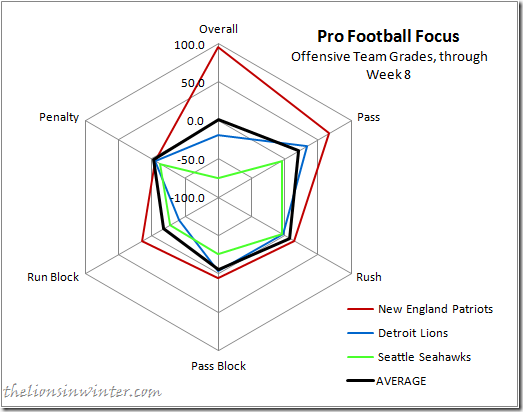
Here are the offensive team grades through Week 8. The dark red line is the New England Patriots, #1-graded offense in the NFL. The bright green line is the Seattle Seahawks, #32-graded offense in the NFL. The thick black line is, as always, the NFL average, and the Honolulu Blue line is the Lions.

This is going to surprise some folks, because we perceive the Lions offense to be one of the best in the NFL—and indeed it is the 4th-best, scoring 29.9 points per game. Keep in mind PFF’s “consistency bias,” as I call it: PFF’s system prefers consistently above-average play to streaky home-run hitters. It’s true for individual players like Ndamukong Suh and Jahvid Best, and it’s true for the Lions as a whole.

No surprise, the Lions’ pass offense was graded 8th-best, at +33.2. Also unsurprisingly, the Lions’ rushing game was well below average; the third-worst in fact. But look: the difference between the best running grades and the worst running grades is miniscule.  Having a very poor running game doesn’t grade out much worse than having an average running game. This is a recurring theme this season.

As far as the offensive line goes, it's no surprise to anyone who’s listened to me or PFF over the years: the Lions do an above-average job of pass blocking. They graded –3.7 (average –6.18) over the course of the season. Also no surprise: they can’t run block for crap. The Lions have the fourth-worst run-blocking line in the NFL to this point, at -40.8 (average –18.15).

On offense, the Lions have taken more penalties than most; they’re ranked 24th with a –5.5 penalty grade. However, since the NFL average is –3.11, that’s not crippling. On the whole, the grades show the Lions have a very good passing offense, a decent pass-blocking offensive line, a terrible running game and a terrible run-blocking offensive line. Add it all up and it’s surprisingly mediocre for a team scoring 30 points per game. Once again, we see: the running game doesn’t matter.

image

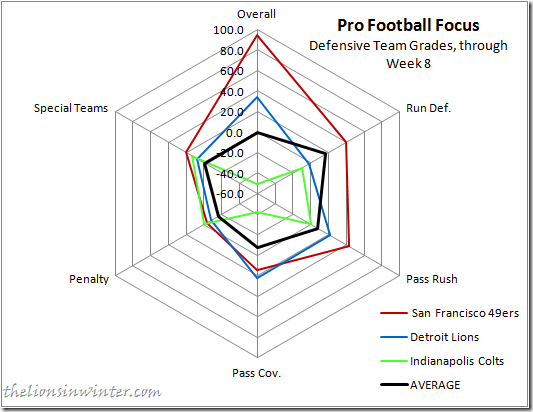
The 49ers have a ridiculous defense. I mean, geez. Just look at that. Also: Indy NOOOOOO!

But check out the Lions: 8th-best graded defense overall, graded +33.7. This jibes with their 6th-lowest scoring defense (18.4 PpG). The run defense is ranked 24th, just –2.2 overall—and the average is +14.8, meaning that’s truly not good. The pass rush, again, is what you’d think: 5th-best in the NFL, graded +21.7 (avg. +8.06).

The jawdropper, though: The Detroit Lions have the best pass coverage grade in the NFL. Not pass defense, not pass rush, not statistical derivation: the play of their corners and safeties grades out better than any other team in the NFL. At +22.1, they’re well ahead of the 49ers’ second-place unit (+14.4), and have lapped the rest of the field (avg. –7.74).

The Lions defense is, as it was last season, heavily penalized. Their -7.9 grade is ranked 27th, well below the –3.4 league average—but not as horrific as it’s been. Special teams-wise, the Lions grade out at +7.4—but that’s not all that, because the average is +12.65.

On the whole, we’re left with a promising, but mixed bag. The Lions offense is struggling to move the ball consistently, but is generating points through the air with home run plays. The run blocking is awful, as is the running game as a whole. The defense is a top ten unit, despite poor run-stopping and penalty grades, because they rush the passer better than most—and cover the pass better than anyone.

At the moment, the Lions are in fantastic shape for the playoffs. My favorite predictive football model, the Simple Rating System, LOVES what the Lions have done this year. It’s a combination of strength of schedule and points differential, and at the halfway point the Lions are the second-highest-rated team in the NFL. Given the teams they’ve played and the results of those games, SRS expects the Lions to be the second-hardest out in football (after the Packers) going forward.

Of course, the Lions play the Packers twice throughout the rest of the season, so SRS would project a final finish of 12-4. Could that really happen? Bizarrely, yes. The road games against Chicago and New Orleans are possible (if not likely) losses—but the Lions should be able to split with the Pack, considering they did so last season without Matthew Stafford. The games at Oakland and against San Diego are worlds less scary than they were a few weeks ago, too.

Let’s be clear: I’m not projecting, or claiming, or promising a 12-4 season. I AM promising, projecting, and claiming that the Lions are going to make the playoffs, as I have since May, and have never wavered from. The Lions are only halfway there, but right now that Lions Kool-Aid tastes sweeter than ever.

Read more...

Watchtower Review: Lions at Broncos

>> 11.02.2011

The accuracy of last week's Watchtower was a wildly pleasant surprise--both in terms of the confidence I had in the projection, and in the result itself.

I project the Broncos to score 15-17 points, pass for 5.75-6.25 YpA, and rush for 4.75-5.50 YpC. I have medium-to-low confidence in this projection.

Turns out this gave the Broncos too much credit. The Lions defense hassled Tim Tebow and the offense all day, excepting only the first and last drives (which netted the Broncos their 10 points). The Broncos ran for a ridiculous 195 yards on 30 carries, a stonking 6.4 YpC.

In a lesson I'm trying to drive home with a sledgehammer, THAT DOESN'T MATTER.

Points come out of the passing game, and the Broncos neither passed nor scored. They gained 172 aerial yards on 39 attempts, a miserable 4.41 YpA. They were sacked 7 times for –55 yards, fumbled five times (lost two, including one for a touchdown) and interception (also returned for a touchdown).

The Lions should score 30-34 points, averaging 8.50-9.0 YpA and 4.00-4.25 YpC, and so I will project them to, but at this point I have medium-to-low confidence in this projection, despite having plenty of data.

Bingo. The Lions scored 31 offensive points, passed for 8.50 YpA, and rushed for 4.04 YpC. This officially qualifies as spookily accurate. I thought the Lions could win even bigger or make it much closer, though, and said so:

In fact, what the Lions should score is almost assuredly what they will not; they’re more likely to do much better or worse than to meet expectations square on the nose.

Whoops. The Lions spooked me so bad with the Falcons game that I just couldn’t trust the numbers:

Given that the Lions offensive starters have more talent than the Broncos 53-man roster put together, I’m not sure why I feel so bad about signing my name to that projection. Maybe it’s because I said almost the same score last week and was brutally disappointed. However, Denver is not Atlanta—not even close. And I have to believe the Lions defense will feast on Tebow and the Broncos offense, giving Stafford many bites at the apple. Worst-case scenario, the D should have some chances to take matters into their own hands, as they did against Minnesota and Dallas.

. . . and indeed they did, boosting the Lions up to a 45-10 clobbering.

As I said in the Fireside Chat, this win, in this fashion, with these stats, proves the numbers right; the Lions are who we thought they were. They are one of the best offenses in the NFL, and one of the most opportunistic defenses in the NFL. When both units are “on” they play football at a very, very, very high level.

Read more...

Three Cups Deep: Lions at Broncos

>> 10.31.2011

coffee

Espresso impresario David Schomer once offered this advice to Seattle-area espresso cart owners about the winter months:

During January and February, hunker down and dream of springtime. No one does great business during the after-Christmas slowdown, and it is particularly hard when you face your coldest weather at that same time. Do not close! The coffee business is built on daily customers who have a habit of stopping at your stand. If you close for a couple of months they will be gone.

The blue fire had been slowly waning over the last few weeks, from an unstoppable inferno to a relaxed, comfortable bonfire. Last week at this time, the fire shuddered alarminglyy, and I realized that the wood racks were almost bare. I set to work with the axe and sled, and many offered their hands and backs in the effort.

Today, all is well. The 45-10 defeat of the hapless Broncos set everything as back it was: the defensive line ate well all afternoon, hauling Tebow down seven times. Matthew Stafford completed 70.0% of his passes for 8.90 YpA, three touchdowns, and no picks. Calvin Johnson hit a home run, and came within several inches of tacking on a second score. The Lions defense outscored the Broncos all by themselves; even if the Lions offense had been completely shut out the Lions would still have Mile High Stadium At Whatever the Corporate Sponsor’s Name Is Geographic Location as winners.

Now, we have the bye week . . . a disruption in the rhythm that keeps us hooked into the Lions seven days a week in-season. Every day, we go to our favorite sites knowing what to expect: the recap, the rehash, the opinion, the analysis, the preview. Somewhere around Thursday it’ll hit us that there will be no Lions football this week.  We’ll break our habit. We’ll attend to the yardwork or that light switch or play catch in the yard or maybe even take a nap.

Meanwhile, the NFL will rage on. The Bears will host the Panthers, and unless Cam Newton does to Chicago what he couldn’t to Minnesota, the Bears will draw to within a game of the Lions. This will make the Lions return to action all-important. Pivotal. Season-defining. If the Lions can defeat the Bears, that’s a 2-game lead with all the tiebreakers; effectively a three-game lead with just six games to play.

The Lions would have the beautiful luxury of being able to go 3-4 through the meat grinder and still end up at 10-6—and likely, in the playoffs. The Lions could dispatch the Panthers and Vikings in Ford Field, and split at Oakland or at home against the Chargers, and still have a nearly guaranteed postseason berth. Were the Bears to lose to Carolina, the Lions could even suffer a Marinellian post-Chicago collapse and still be the second-best team in the NFC North.

In the past, the old bye-week joke has gone, “Well, at least the Lions can’t lose this week.” Instead, let’s be disappointed we can’t get our every-Monday cup of victory.

Read more...

The Watchtower: Lions at Broncos

>> 10.30.2011

bronco_tower

This game sets fire to the Watchtower concept as a whole. Everything about this game confounds this process. The Broncos offensive coordinator has never been a coordinator, or even a coach, under anyone but John Fox. Even if he had, the offense the Broncos are running for Tebow is nothing like the one the Panthers ran with Jake Delhomme, etc.

On the Lions side, the offense of the last two weeks has not resembled the offense of the first five. Last week, I happily predicted a 34-37 point performance for the Lions, and they couldn’t muster half that. Is this a harbinger of things to come for the rest of the season, or just a bump in the road?

I can’t tell you. But what I can do is compare the two teams’ performances so far, and tell you what ought to happen.

Mike McCoy vs. Gunther Cunningham

McCoy Ornk PgG YpA YpC Gun Drnk PpG DYpA DYpC PTS PTSΔ YpA YpAΔ YpC YpCΔ
DEN 21st 20.5 6.35 4.39 DET 7th 19.6 5.57 5.03            

As I said above, Mike McCoy has one of the weirdest resumes I’ve ever broken down. He played quarterback in the CFL. After retiring, he immediately joined the Panthers under OC Bill Musgrave, who I Watchtowered earlier this year (he’s now the Vikings OC). After Musgrave resigned in shame, the Panthers brought in Dan Henning, the current Miami OC (the guy who deployed Ronnie Brown and Ricky Williams in the Wildcat).

It was under Henning that McCoy ascended from "offensive assistant" to QB coach. Though Henning was fired after a disappointing 2006 campaign, Fox kept McCoy around. Henning was replaced by Jeff Davidson, a member of the Belichick/Weis coaching tree. It's likely this experience that's informing McCoy's current offense, with a lot of multi-WR shotgun and multi-TE inside runs.

However, trying to analyze Gunther Cunningham’s success against Weis-style offenses would be folly, because once the ball is snapped, the plans go out the window.

When the Broncos line up under center, they’re doing a nice mix of power runs and clever zone stretch type stuff. Very very very little passing, and even then it’s one-read stuff like screens. When the Broncos line up in shotgun, it’s either a screen, or Tebow Time.

Ndamukong Suh and Cliff Avril are going to have three sacks apiece. Why? They’re relentless in pursuit. Tebow, if he doesn’t have an obvious read, breaks down and starts running around looking to make something happen. It reminds me—a lot—of Mike Vick. Tebow isn’t quite as dangerous on a broken play as Vick, but he’s plenty dangerous. What Tebow must work on is executing the offense; when you see the Broncs line up in a multi-WR shotgun the playcall is effectively “Broken Play.”

The Broncos are averaging 20.5 points per game, 21st-best in the NFL. The Lions scoring defense is ranked 7th, allowing just 19.6. The Broncos are averaging 6.35 YpA, and a solid 4.39 YpC. The Lions are still only allowing 5.57 YpA, which is really pretty incredible. However, the run defense is still alowing 5.03 YpC. I project the Broncos to score 15-17 points, pass for 5.75-6.25 YpA, and rush for 4.75-5.50 YpC. I have medium-to-low confidence in this projection.

Scott Linehan vs. John Fox

Lin Ornk PgG YpA YpC Fox Drnk PpG DYpA DYpC PTS PTSΔ YpA YpAΔ YpC YpCΔ
MIN 8th 24.4 6.60 5.30 CAR 5th 18.9 5.73 3.69 14 -43% 6.37 -3% 4.06 -23%
MIA 16th 19.9 5.94 3.69 CAR 5th 16.2 5.79 3.59 27 36% 5.18 -13% 4.80 30%
STL 10th 22.9 6.69 4.26 CAR 8th 19.1 6.00 3.87 0 -100% 4.17 -38% 3.75 -12%
DET 6th 27.7 7.19 4.08 DEN 29th 25.8 7.43 3.86            

An itinerant, quick-climbing defensive backs coach in college and the pros, John Fox was Pitt’s Defensive Coordinator/DBs coach when Chuck Noll hired him to coach DBs for the Steelers. John Fox is technically a member of the Chuck Noll coaching tree, but if you’re looking for an extensive 3-4 pedigree, you’ll have to look elsewhere.

After three seasons in Pittsburgh, Fox moved on to play the same role in San Diego. He was hired to coordinate the Raiders D by Art Shell, and stuck around for the first year of the Mike White days. Though Fox’s defenses were 17th and 10th in his two years, Fox abruptly resigned as Raiders DC. He has since hinted that clashes with Al Davis forced him out.

His next real gig was coordinating the Giants defense under Jim Fassel; he eventually built a top 5 defense that took the Giants to the Super Bowl. He got his first head coaching job replacing a legend: Carolina Panthers coach George Seifert. Of course, Seifert wasn’t a legend for his work in Carolina, and Fox’s nine-year run nearly quintupled his predecessor’s. Throughout almost all of this, Fox ran a very effective 4-3.

Of course, the Broncos just switched to a 3-4 a couple of years ago, but that didn’t stop Fox from declaring his intent to switch back. The stunning lack of talent on the defensive side is exactly what you’d expect from a team that has overhauled it’s roster to go from 4-3 to 3-4 and back in three seasons.

In Fox’s prior meetings with Linehan, though, lack of talent was never a problem. In 2002, Linehan’s 8th-ranked Minnesota Vikings took on Fox’s 5th-ranked Panthers. Despite an offense that was putting up 24.4 points per game, the Vikings only mustered 14 against Fox’s Panthers. The Vikes’ potent 5.30 YpC rushing attack was held to just 4.06. Minnesota passed for 6.37 YpA, just 3% off their usual pace, but were intercepted 4 times, sacked 5 times, and were fortunate to only lose 1 of their 4 fumbles.

In 2005, things were different. Linehan’s Dolphins were the median offense in the NFL, while Fox’s Panther defense was almost identical to his 2002 unit. They were ranked 5th, allowing an average of 16.2 PpG, 5.79 YpA and 3.59 YpC. Semi-miraculously, the Dolphins actually scored 36% better than average, not at all what you’d expect from the 16th-ranked offense meeting the 5th-ranked defense. In that game, the Panthers slowed the Fins passing attack by 13%, but Ronnie Brown had a field day, boosting the Dolphins rushing effectivness by 30% to 4.80 YpC. Worth noting: Fins QB Gus Frerotte had only one pick, and there  were no sacks or fumbles.

In 2006, it was back to the same old story. Linehan’s Rams were the 10th-ranked offense in the NFL, averaging 22.9 points per game. Fox’s Panthers were again a top ten unit, ranked 8th and allowing 19.1 PpG. The Panthers stone cold shut out the Rams, allowing zero points, a meager 4.17 YpA, and 3.75 YpC. The Rams had one pick, one fumble lost, and were sacked seven times for –62 yards.

We see a pattern emerge: when a Scott Linehan offense surrenders sacks and turnovers to a John Fox, scoring is ridiculously and wildly depressed, as well as offensive efficiency. When the offensive line is able to control the line of scrimmage, Linehan offenses are disproportionately successful at scoring, and possibly running the ball.

This year’s Broncos are nothing like the vaunted Panthers defenses of the 2000s. Ranked 29th in the NFL, they’re allowing 25.8 PpG , 7.43 YpA,  and 3.75 YpC. The rushing defense is solid, but they’re being victimized through the air and allowing points in bunches. The Lions, technically, are the 6th-best offense in the NFL, averaging 27.7 points per game, 7.19 YpA, and 4.08 YpC.

In theory, the Lions have a massive advantage here. They should be able to complete passes and move the ball against a hapless Broncos pass defense. They should be able to make hay with Maurice Morris and Keiland Williams in the space this opens up. The Lions should score 30-34 points, averaging 8.50-9.0 YpA and 4.00-4.25 YpC, and so I will project them to, but at this point I have medium-to-low confidence in this projection, despite having plenty of data.

Mitigating/Aggravating Factors

Well, there are plenty of these. Matthew Stafford will likely play, but will he play well? Will the Lions offense play like an average of all the games they’ve played to date, or like an average of the last two weeks? Will they control the line of scrimmage, deny sacks, and run the ball effectively, or have Stafford on the run again? In fact, what the Lions should score is almost assuredly what they will not; they’re more likely to do much better or worse than to meet expectations square on the nose.

Conclusion

Well, uh. The averages and stuff project a 33-17 Lions win.

Given that the Lions offensive starters have more talent than the Broncos 53-man roster put together, I’m not sure why I feel so bad about signing my name to that projection. Maybe it’s because I said almost the same score last week and was brutally disappointed. However, Denver is not Atlanta—not even close. And I have to believe the Lions defense will feast on Tebow and the Broncos offense, giving Stafford many bites at the apple. Worst-case scenario, the D should have some chances to take matters into their own hands, as they did against Minnesota and Dallas.

Those of you who've been reading a while already know my final word; I wouldn't have deployed the bold if I didn't mean it. 33-17, Lions.

Read more...

Drew Stanton and Tim Tebow: 2 Sides of A NFL Coin FLIP

>> 10.27.2011

drew_stanton_tim_tebow

In some ways, the NFL is an unflinching meritocracy. With billions of dollars on the line nobody gets a scholarship. The players who can play, play. The coaches who can coach, coach. The executives pair one with the other. Anyone not pulling their weight is gone in a heartbeat.

Yet somehow, people slip through the cracks.

Good players get hurt, or put in the doghouse. Coaches get stuck with players they don’t want. Players land into specific systems that hide their flaws and magnify their strengths—or the other way around. Problems with chemistry and synergy can make working relationships untenable. Success and failure in the NFL are, sometimes literally, a coin flip apart.

Drew Stanton and Tim Tebow are two sides of the same coin. Both moved across thousands of miles in their youth. Both became highly touted high school quarterback prospects. Stanton, a Rivals 4-star prospect, was Rivals’ 6th-best pro-style QB. Tebow was a 5-star, and Rivals’ No. 1 dual-threat QB. Both were multidimensional athletes who had real potential as baseball prospects. Both led their team to a state championship; Stanton in back-to-back years.

“Desire to win is unmatched . . . brings every intangible you want at the QB position.”

– Mel Kiper

Stanton and Tebow attended in-state schools. Both contributed to their teams immediately in unconventional ways (Stanton a special teams gunner, Tebow a situational change-of-pace quarterback).  They were strong, vocal leaders who often willed their team to win. Both gained yards on the ground both by accident and design, and through athleticism and toughness rather than speed.

Clearly, Tebow ascended to greater collegiate heights than Stanton did: with a much better coach and supporting cast, Tebow won a Heisman Trophy, and led his Gators to a BCS National Championship. Stanton cracked several Heisman watchlists throughout his career, but he and his inconstant Spartans simply weren’t at that level. Stanton, however, didn’t leave the record books untouched: he lead the biggest comeback win in NCAA history.

“I still believe the positives outweigh the negatives . . . He possesses all the physical tools to eventually emerge as a starting quarterback in the NFL, including the size, arm strength and athletic ability . . . also shows the toughness and competitiveness necessary to make it at the next level.”

–Todd McShay

Tebow was unquestionably the better college quarterback, but Stanton was unquestionably the better professional prospect. Both quarterbacks went to the Senior Bowl; Stanton completed 8 of 12 passes for 63 yards and a touchdown and was named the North’s Offensive MVP. As McShay said, Tebow’s week in Mobile “could not have gone worse from an on-the-field standpoint.”

Scouts, Inc. graded Stanton as an 87, an “Outstanding Prospect,” a high second-round grade. Tebow got a 78, a third-round grade. Most observers (including myself) pegged Tebow as a third-rounder—whether as a long-term quarterback project, or as an an unholy marriage of Chris Cooley and Kordell Stewart: “fullback/H-back/tight end/linebacker.”

"Has a well-built, natural frame with good arm length, broad shoulders, developed chest, good bubble, thick thighs . . . thick chest muscles, more in the line of a linebacker, with defined calves . . . Shows good athleticism, with nimble feet that defenses must always account for."

–CBS Sports

The Lions traded down to the 43rd overall pick to select Stanton. Per Scouts, Inc. that was right where he should have been drafted (he was their 41st-ranked prospect). But in the draft, as they say, it only takes one team to fall in love—and then-Broncos head coach Josh McDaniels was smitten with Tebow.

The Broncos dealt the 114th, 70th, and 43rd (!) pick in the 2010 draft to move up to #25 overall and take Tebow. That’s right—the Broncos traded away the exact same slot the Lions used to draft Stanton, plus a 3rd- and 4th-rounder, to draft Tebow and make him their quarterback of the future.

"Smart, hard-working and patient with the football. I liked most that I rarely saw him rush things . . . poised in the pocket."

–Matt Miller

Stanton was not beloved by the Lions coaches; offensive coordinator Mike Martz wanted nothing to do with him. McShay said in the wake of the 2010 Senior Bowl that Tim Tebow needed to be completely torn down and rebuilt as a quarterback; Martz tore Stanton down like that but never rebuilt him. The Lions put Stanton on IR to save a roster spot, and he lost a season of mental and physical practice. Stanton’s mechanics were ruined, and he was getting no coaching and no reps in Martz’s complicated offense.

When Martz was fired after the 2007 season, the Lions simplified the playbook and called in a new quarterbacks coach: former Michigan QB coach Scott Loeffler. Loeffler undid what Martz had done, restoring Stanton’s natural throwing motion. Stanton flashed a little of that magic in a preseason game against the Bengals; he threw a 50-yard touchdown and ran for another. I’m embedding this fan-shot video because it is terrible as it is awesome:

Stanton was again injured, and again stashed on IR, and again his progress halted. After one season working with Stanton, Loeffler was hired away from the Lions by the University of Florida—to polish up Tim Tebow.

It’s here where Stanton’s career as a Lion truly begins, with the hiring of Jim Schwartz and Scott Linehan. With every OTA, training camp, and preseason since Stanton has taken a step forward. Last season, Stanton did what everyone had waited for: he started and won a big game for the Detroit Lions. It wasn't always pretty, but he got the W. His contract ended after last season, but Lions GM Martin Mayhew brought Stanton back:

"Scott [Linehan] came in during year three and we saw a dramatic improvement in his ability, his throwing and his accuracy and all those things got better. But still, they weren't quite where you wanted them to be."

"We got into training camp and he had a pretty good camp, he made plays for us in the preseason. And then late in the year, we called on him to play and start and he won some games for us as a starter. I really didn't envision him doing that prior to this season, being able to get that done.”

"I thought he showed a lot of improvement so we plan on having him here this year and seeing if he continues to improve that way."

Tebow went through nearly the opposite path. He was drafted by an organization that believed completely in his ability to be a premier NFL quarterback . . . and then the rug got pulled out from under him. McDaniels was fired, along with anyone who had any investment in Tebow’s success. John Elway and John Fox were brought in to start a new-new era of Broncos Football, and Tebow suddenly had to prove his worth.

Last week, Fox trusted Tebow with the starting job, and Tebow delivered victory. Like Stanton's big win against the Packers, Tebow put some ugly stuff on tape—but he made it happen when it counted.

If you hadn’t guessed, all of the above scouting blockquotes are about Stanton, not Tebow. It’s not a stretch to say that Drew Stanton, as a player, is Tim Tebow’s professional upside. They share weaknesses, only Stanton’s aren’t so weak—and where Tebow’s stronger, like literal strength, it’s less useful in the NFL.

While Tim Tebow's immaculate character borders on caricature, Stanton is quietly one of the best “good guys” around. His relentless charity work has earned Stanton a perennial stranglehold on the Lions’ Robert Porcher Man of the Year award. There will never be a plaque immortalizing a Stanton motivational speech, but Stanton most certainly knows how heavy a football team is when you place one on your back and carry it.

In the infinite possibilities of other dimensions and alternate timelines, there are Drew Stanton who were drafted by a good team that believed in him, and he’s now coming off his first Pro Bowl appearance. In others, Tim Tebows are moonlighting on special teams and goal-line offense packages.

In our corner of the multiverse, Tebow is the starting quarterback for a Denver Broncos organization that could be secretly hoping he fails. As Tebow faces the Lions this Sunday, Stanton will be be watching from the sidelines—possibly in street clothes, inactive as the Lions’ third quarterback.

Will either have a long, successful NFL career? Eh, flip a coin.

Read more...

The Hidden Detroit Lions Offense: 1st and 2nd Down

>> 10.26.2011

The Lions lost to the Falcons on Sunday, due to an astonishingly poor performance by the offense, and particularly Matthew Stafford. Many noticed the Lions seemed to be “in a lot of third-and-longs,” and blamed the lack of a power running game that could keep the Lions offense on schedule.

It’s been my contention the Lions use their backs in nontraditional—but effective—ways. If they can run for three or so yards on first down, that gives Stafford and the 7+ yard-per-attempt passing attack two attempts to get seven yards. If they can mix in the screens and draws on which Best and Morris are varyingly effective, they can move the ball very well and score points in bunches.

This has been empirically obvious: through five weeks the Lions had the #2 offense in the NFL, racking up an impressive 31.8 points per game. Subsequently, I have been directing all parties inquiring RE: fat guards and white running backs to talk to that statistical hand.

However, something is not adding up. Maurice Morris and Keiland Williams combined for over five YpC against the Falcons, yet indeed the Lions were constantly facing second- and third-and-long.

Chart?

Chart.

1ST DOWN RUN MM KW NB PASS CJ NB BP TS WH
22/8/6.59 12/2/3.8 7/0/2.0 5/2/6.4 0/0/0.0 10/6/9.9 5/3/16.2 1/0/0.0 1/1/9.0 1/1/6.0 1/1/8.0
2ND DOWN RUN MM KW NB PASS CJ NB BP TS WH
20/7/5.3 7/2/6.6 3/1/12.3 2/0/-1.0 2/1/5.0 13/5/4.62 4/1/6.25 1/0/1.0 3/2/5.0 2/2/13.0 0/0/0.0
TOTAL RUN MM KW NB PASS CJ NB BP TS WH
42/15/5.98 19/4/4.8 10/1/5.1 7/2/4.43 2/1/5.0 23/11/6.91 9/4/11.8 2/0/1.0 4/3/6.0 3/3/10.7 1/1/8.0

The Hidden Game of Football is a seminal book which tops every serious football analyst’s reading list (but which I still haven’t read). In it, so I am told, the authors outline a new way of defining a successful football play. On first down, a successful play gains four yards. On second down, a successful play gains half the remaining distance to converting the first down. On third down, a successful play converts first down. This theory informs the analysis at awesome websites like Football Outsiders and Advanced NFL Stats.

The chart above is a breakdown of the Lions first- and second-down plays against the Falcons. The first number in each box is the number of plays in that category. The number after the first slash is the number of “successful” plays, and the number after the second slash is the average yards-per-play rate of categorical plays. So.

The Lions faced 22 first-and-10 situations Sunday (including plays wiped out by penalties). They gained at least four yards 8/22 times, and averaged 6.59 yards per play. That sounds kinda okay-ish until you look at the run/pass breakdown: the Lions ran on first down 12 of 22 times, were successful twice, and averaged 3.83 YpC. This meshes with my “3-to-4 yards on first down is okay” theory until we go a little deeper.

Maurice Morris ran seven times on first down, never successfully, and averaged 2.0 yards per carry.

Keiland Williams fared a little better. He gained 4+ yards twice on five carries, including a long one that swelled the average up 6.4 YpC. However, neither could compare to the first-down passing game, which was successful six of ten attempts and averaged 9.9 YpA.

Megatron was targeted five times on first down, successfully three times, for a 16.2 average (yes, the 54-yard touchdown was on first down). Non-Megatron receivers were successful on 3 of 4 targets, for 5.75 YpA.

On second down, things were not much better. The running game chewed up half of the yards needed for conversion just twice on seven carries, though the YpC was an impressive 6.57. Part of that is due to a long run by MoMo, but part of it is the “on schedule” effect: the Lions average distance-to-conversion on second down was eight yards. This includes sacks, penalties, etc., but those count in the game, too. The Lions simply aren’t getting enough yards on first down, and it’s making second down much harder to convert.

The Lions running game was successful on first- and second-down just 4 of 19 carries, despite an apparently-excellent 4.84 YpC. The passing game was a better-but-still-not-great 11 of 23 plays for 6.91 YpA. Here’s the interesting bit, though: non-Megatron receivers were successful on 7 of 11 first- and second-down targets, for 6.09 YpA.

This points towards something else I’ve been saying: Stafford is pressing. He’s trying to force it to Calvin (see CJ’s second-down success rate above).  Despite the totally ineffective running game, when Stafford spreads the ball around the offense works. I’m wrong about Maurice Morris being a solid first- and second-down tailback, but I’m right that if Stafford does his job that doesn’t matter.

Read more...

The Fallen Watchtower Review: Lions vs. falcons

I did get something sort-of resembling a Watchtower up before the Falcons game on Sunday, if only just. Without any of the historical breakdown or schematic analysis, I just looked at season ranks and averages. It was done entirely on my iPhone in stolen moments. It looks like it:

The Falcons have the NFL's 17th-ranked offense, averaging 22.5 points per game. The passing attack has garnered a respectable-but-not-great 6.22 YpC, while the rushing game is netting a very solid 4.37 YpC.

The Lions defense is allowing a stingy 19.0 points per game, 7th-fewest in the NFL. Opponents are passing for a miniscule 5.55 YpA, while they're running all over the Lions at a 5.21 YpC clip.

The Falcons power running game directly attacks the Lions defensive Achilles heel. Then again, so did the 49ers, and their offensive output exactly matched my projections. Therefore, I project the Falcons to score 17-20 points, throw for 5.5-6.0 YpA, and run for 5.0-5.25 YpC. I have medium confidence in this projection.

The Falcons scored 23 offensive points, just above what I'd projected. Their passing game slightly outperformed expectations as well, gaining 6.23 YpA--matching their season average to 1/100th of a yard. The running game actually performed BELOW their season average, well below my projections: 4.16 YpC.

This is an example of what I call the "Whack-a-Mole" effect. When a defense has a glaring weakness in one area and they’re going up against an offense with a corresponding strength, often the D will “sell out” the strength of their D to shore up the weakness. The net result is usually the same in terms of team scoring and overall per-play effectiveness.

This is best known to fantasy football fiends who are drooling over starting their stud running back against the worst run defense in the league. Somehow that never quite results in 200 yards and 3 TDs, does it? According to Mike Mady at Scout.com, the Lions were emphasizing the back seven stopping the run against the Falcons; could it be that pass coverage suffered as a result? I’ll go back and look at this.

The end result of the defense's effort would have looked much better if the Lions’ offense hadn’t repeatedly hung the defense out to dry:

The Lions offense is still the 4th-best in the NFL, racking up 29.7 points per game. The passing attack is slightly slowed after last week's performance, but still high-flying at 6.99 YpA. The ground game is chugging along at 3.92 YpC.

The Falcons are allowing a ridiculous 7.97 YpA, surely a big part of why they're allowing a 22nd-best 24.5 points per game. The run defense is much better, allowing 3.84 YpC.

The Falcons defense is particularly ill-equipped to stop the Lions pass attack. I project the Lions to score 34-37 points, passing for 9.50-10.0 YpA and rushing for 3.50-3.75 YpC. I have medium confidence in this projection.

The brutal reality: 16 points, 5.72 YpA, and—surprisingly—5.2 YpC.

This is the worst underperformance of expectations I’ve seen since Daunte Culpepper got the Lions completely shut out by the Packers (I’d projected 24-28 points). Let’s be clear, here: the Falcons allowed 8 YpA through six games and faced a team gaining 7 YpA and held them to less than 6 YpA. This does not compute.

This isn't Whack-a-Mole effect, either; if it were the Lions would have rolled up 200 yards on the ground and still scored 34-37 points. This has nothing to do with the Falcons defense and everything to do with the Lions offense playing like a shadow of itself.

Next up: numbers and film.

Read more...

Three Cups Deep: Lions vs. Falcons

>> 10.24.2011

coffee

This Sunday, the Lions lost their second straight game. They—especially, the offense—especially Matthew Stafford——looked nothing like the team that started the season 5-0, scoring 30+ points per game in the process. When the Lions gave up on the first half by running Keiland Williams twice in a row, the boo birds came out. You could hear them at points throughout the second half, as the Lions offense again failed to find the extra gear they had against Dallas and Minnesota.

It’s amazing how quickly us fans get accustomed to success. Between December 24th, 2007 and December 18, 2010 the Lions won just five games. The Lions started the 2011 season with five consecutive wins and suddenly we’re booing our our team.

I don’t understand the entitled fan.

I’m hearing a lot about “wanting to see good effort,” as if we’d rather watch a talentless team Rudy their way to a close losses than an extremely young, talented team grow into a dynasty before our eyes. So Matthew Stafford had a bad day at the office; why pouncing on him and ride him like he’s Scott Mitchell?

I’m seeing lots of, “I paid good money for those tickets, I deserve to see better than that” today. Deserve to see better than what, 5-2? The Lions in sole possession of the top wild card spot?

Earth to Entitled Lions Fan: it’s not because they’re not trying, it’s because they’re not executing. Matthew Stafford isn’t seeing the field like he’s been all season. The receivers aren’t bailing him out like they have all season. Somehow the gameplans which have worked to a “T” all season long aren’t putting the players in a position to succeed. Blame the coaches, blame the receivers and yes—blame Stafford. But don’t boo him.

When Stafford and the Lions most needed their fans to support them, the fans were booing them. When the defense most needed to the fans to be loud, they were quiet. When Matthew Stafford—and his confidence—were under attack from all angles, Lions fans didn’t rally to his defense, they joined in the attack. I can almost hear some loser shouting from the stands, “HEY STAFFORD! WHERE’S YOUR CONFIDENCE, YOU LOUSY BUM!!”

One of the interesting things about soccer—primarily, English soccer—is that the diehard fans aren’t called “fans,” they’re called “supporters.” It’s an important distinction. We should be supporting our team through thick and thin—especially when the “thin” is a slight lessening of the gloriously lovely “thick” our team has slathered all over the schedule to date. Double-especially when it was so very, very thin for so very, very long.

What’s the point of keeping the little blue flame burning all offseason if we’re just going to walk away the moment everything isn’t perfect? Why spend the longest, bleakest football winter ever refreshing websites and frequenting forums just to turn around and boo the team you allegedly support? It makes no sense—and worse, it makes all the cheering from prior weeks sound craven and false; the worst sort of bandwagoning.

Lions fans aren’t entitled to see winning football, any more than Lions players or coaches are entitled to their jobs. Everything that’s gone wrong can be put right. Nothing’s broken that can’t be fixed. Everything that helped the Lions go 5-0 can help them go 6-2. If you’re a Detroit Lions fan—a Detroit Lions supporter—then help them climb back up the mountain, don’t kick dust in their eyes.

Read more...

Watchtower Review: Lions vs. 49ers

>> 10.19.2011

Reviewing the first “wrong” Watchtower of the year is never fun, especially when it’s also a loss. From the defensive side:

Defensively . . . you may want to sit down for this. The Detroit Lions have the fourth-best scoring defense in football. They’re allowing a miniscule 17.7 points per game, and a meager 5.91 YpA. Their running defense has been less than stout; opposing running backs have been rolling up the Lions for 4.78 YpC.

Without any systemic advantages either way, we must project the 49ers offense to to meet expectations against the Lions defense. I project the 49ers to score 21-24 points, passing for 6.50-7.00 YpA and rushing for 4.25-4.50 YpC. I have medium-to-low confidence in this projection.

Mitigating/Aggravating Factors

Of course, it’s pretty much all up in the air, schematically speaking. There are many different flavors of the “West Coast Offense,” and the Callahan/Gruden branch is one we don’t have a lot of prior history with. The Lions are definitely soft against the run, and the 49ers are calling runs 54.2% of the time. The Lions showed against Chicago that merely grinding it out against them won’t work if the offense can score. For the Lions’ defense to exceed expectations, the offense may need to force Alex Smith to play catchup.

The scoring projection was spot on: the 49ers scored 23 offensive points. The run/pass effectiveness was all over the map, though: they passed for a miserable 3.91 YpA, and ran for a stonking 7.00 YpC. I hinted at the ultimate problem, though, in the Mitigating/Aggravating Factors: “The Lions showed against Chicago that merely grinding it out against them won’t work if the offense can score. For the Lions’ defense to exceed expectations, the offense may need to force Alex Smith to play catchup.”

Yup, that was the problem. The Lions defense precisely met expectations, but needed to exceed them to win the game. The only way they were going to exceed them was if the 49ers had to do a lot of passing . . . meaning, the Lions offense needed to force the 49ers offense to keep pace.

Given these unit’s equal strength (they’re both outstanding), if there really is no advantage for Scott Linehan’s offenses against Vic Fangio’s defenses, the Lions should exactly meet expectations. Since I’ve been trying to weigh recent performance more heavily than historical, I’ll roll with that as my official projection. Factoring in the 49ers penchant for allowing more yardage than points, I project the Lions to score 23-26 points, throw for 7.5-8.0 YpA, and run for 3.75-4.0 YpC. I have medium confidence in this projection.

Mitigating/Aggravating Factors

Of course, if there really is a systemic advantage for Lions offenses against Capers/Fangio 3-4 defenses, then the Lions should add another touchdown or so. As with Monday Night Football, I expect the crowd to give the Lions a lift—though not to the same extreme. However, if the Lions turn the ball over two or more times, they may not make it into the mid 20s.

Well, they didn’t make it into the 20s, but it wasn’t due to lack of turnovers. It was due to a total lack of passing effectiveness. The Lions averaged 5.86 YpA, a ridiculous 2.07 fewer yards per attempt than what they’d averaged to day. The Lions rushed for 3.67 YpC, which is not fantastic—but it’s only slightly below the Lions season average coming into the game (3.96), and above the 49ers season average allowed (3.57).

Yesterday’s Matthew Stafford piece got into the whys and wherefores behind the failure of the passing game, and I don’t want to repeat myself. Long story short, the 49ers pass defense was too good for the Lions dominate with pure talent. The 49ers defense was too good for Matthew Stafford and Calvin Johnson to just pitch and catch over. The Lions decided to put the pedal to the metal rather than downshift into a dink-and-dunk gear, and it didn’t work.

Conclusion

This game gives me the heebie-jeebies. Both teams are coming off enormous wins. Both teams are “due” to drop one against an extremely tough opponent. The data shows the Lions to hold about a field goal advantage in this one. Both teams take care of the ball extremely well, and both teams force a lot of turnovers. I feel like this will be the difference in what could be a very dramatic, very physical, low-scoring slugfest. The most likely outcome of this game is an extremely hard-fought 23-21 Lions win.

Heebie jeebies, yes. Lions win, no.

Read more...

  © Blogger template Simple n' Sweet by Ourblogtemplates.com 2009

Find us on Google+

Back to TOP