Showing posts with label sammie hill. Show all posts

Old Mother Hubbard 2012: The Defensive Tackles

>> 1.27.2012

pantry_overflowing
The Old Mother Hubbard series takes stock of what goods the Lions have left in the larder; i.e. the assets they have going forward. We’ll assess each player the Lions will likely bring to training camp. By tradition, we start with the defensive tackles and move away from from the ball. Here’s what last year’s Old Mother Hubbard had to say about each defensive tackle the Lions will be bringing forward:
Ndamukong Suh:

An incredible physical talent, with almost unlimited upside. As a rookie, he performed like an above-average starter, while carrying the heaviest workload in the NFL. If he continues to improve, Suh will become one of the best in the NFL—and maybe one of the best ever.
Sammie Hill:
A natural big body who is slowly fulfilling his top-flight physical potential, Hill will remain a big part of the Lions’ rotation as his technique and body develop.
Corey Williams:
Williams was a two-way force for the Lions in 2010, and an incredible addition to the roster. With his natural size (6’-4”, 320 lb.), great acceleration, and sometimes-too-quick snap anticipation, Williams is a difficult assignment for any offensive lineman. It would be really, really, really nice if he could cut down on the penalties.
Nick Fairley, of course, was not around to OMH, and Andre Fluellen is an unrestricted free agent whose time seems to finally have come. Let’s see how Suh, Hill, Williams, and Fairley stack up against the league high, low, and average:
image
Ndamukong Suh is the perfect example of why I decided to add Advanced NFL Stats WPA+ and EPA+ data to this analysis. You can see that solid down-to-down run-stuffing combined with few-to-no penalties results in an extraordinarily high PFF grade, as with like the Jets’ Sione Pouha. Though Suh is the highest-graded pass rusher of this group at +8.6 (avg. -0.76), Suh’s overall grade is barely above league average at +3.3 (avg. +2.13).
This describes something true about Ndamukong Suh’s play: his -1.7 rush grade (avg. +2.45) means that most of the game, he’s doing a mediocre job of run stuffing and “pass coverage” (screen-sniffing-out). This is where EPA+ and WPA+ come in.
As Brian Burke of Advanced NFL Stats explains, EPA is a statistic that measures the Expected Points Added on offense: for each play made, how many points is that play worth (in his mathematical model)? Defensively, Burke measures performance with +EPA: he adds up “the value of every sack, interception, pass defense, forced fumble or recovery, and every tackle or assist that results in a setback for the offense.”
+EPA captures the positive impact a player has on his team—his playmaking ability. Generally speaking, the more and more-positive plays a player makes, the better he is relative to players who make fewer plays. To borrow a phrase, this accentuates the positive and eliminates the negative; +EPA can’t possibly measure defensive plays not made (Suh getting trap-blocked out of a play, for example).
There is an obvious connection between +EPA and high overall performance: Sione Pouha has the highest overall PFF grade, and the 6th-highest +EPA. But while Ndamukong Suh ranks 33rd in overall PFF grade, he’s 8th in +EPA. Suh is a “plus player,” to use scout’s parlance; he makes a dramatic positive impact on his team and the game.
Now, we turn to Win Probability Added. Again, Burke:
The model created here at Advanced NFL Stats uses score, time, down, distance, and field position to estimate how likely each team will go on to win the game. For example, at the start of the 2nd quarter, a team down by 7 points with a 2nd down and 5 from their own 25 will win about 36% of the time--in other words a 0.36 WP. On that 2nd down and 5, let’s say there is a 30-yard pass, setting up a 1st down and 10 on the opponent’s 45. Now that team has gone from a 0.36 to a 0.39 WP. The WPA for that play would be +0.03.
EPA+ measures the expected points added by a defender’s positive plays, and WPA+ measures how much more likely a defender’s team is to win a game because of the positive plays he made. It makes sense that there’s a very high correlation between EPA+ and WPA+ (for this year’s DTs, it’s an r-squared of 0.883), but what WPA does is emphasize the game situation. A sack on 3rd and 6 is huge, but a sack on 3rd and 6 when you’re up by three late the 4th quarter is a lot huger than the a sack on 3rd and 6 when you’re up by 14 in the 1st.
So, back to Ndamukong Suh. He’s tied for eighth in WPA+ with 1.09; Pouha is 16th  at 0.86. But wait, how can Suh have had a bigger positive impact on the Lions’ chances to win than Pouha, when Pouha’s PFF grade was literally ten times higher? WPA+ is a descriptive stat; it describes what happened in context—and in the case of defensive players, only describes their positive plays. Pouha was a devastatingly effective run-stuffer this year, and that’s it. He didn’t rush the passer, he didn’t pick off passes, he made tackles whenever they ran near him and didn’t screw up. That’s a formula for very high PFF grade, pretty high EPA+, and very good WPA+; exactly what we see.
There’s been a lot of talk about Suh’s reduced production this season. By PFF reckoning, he went from 11 sacks to 5, and from 48 tackles to 26. That came partially because of his lightened workload: in games he was active, he played 77.9% of snaps (of course, he was suspended for two games). In 2010 that figure was 90.4%.
The missing piece of the puzzle: stats that are not sacks. In 2010, Suh had 24 pressures and 6 QB hits. In 2011, Suh actually had more pressures, 27, and 4 QB hits despite being on the field for 224 (22.5%) fewer snaps. Suh actually had a sack, hit, or pressure more frequently in 2011 (avg. one per 22.1 snaps) than in 2010 (per 24.3 snaps).
Bottom Line: Ndamukong Suh is a fast, powerful pass-rushing tackle who impacts games about as dramatically as any DT in the NFL. His physical tools and competitive drive allow him to make huge plays at critical moments. His habit of taking bad personal foul penalties has come to a head and been addressed. His down-to-down consistency and run-stopping is improving, if slowly. In 2012, he needs to continue developing if he wants to reach his unlimited potential. 
Sammie Hill had a 437-snap workload in 2011, and graded out at +2.5 overall, slightly above average. That’s a step down from 2010, when he received a +11.5 mark. From what I’ve seen on tape, they used Hill as the primary run-stopping tackle this year, and opposing lines are respecting that with double-teams. Hill is still learning how to handle this newfound attention, often getting dominated at the point of attack then using his strength to recover. His run-stopping grade went from +4.1 in 2010 down to +1.5 in 2011.
But like Suh, Hill had a positive impact much bigger than his PFF grade would suggest. His +WPA was 0.72, ranked 21st of 130 defensive tackles (and well above the 0.425 league average). His +EPA was 21.1, ranked 28th and nearly splitting the difference between Suh's 33.1 and the NFL average of 14.5.
Looking at the radar chart above, it's hard not to notice the Lions DTs hugging tightly to the NFL average in PFF grades, but flying way out towards the maximum in EPA+.
This confirms everything we think about the design of the Lions defense: they coach the linemen to get upfield and make plays, at the expense of typical DL responsibilities. Graded by traditional expectations of defensive linemen, they are mediocre. Graded by how they impact the game, they are outstanding. The whole picture takes both perspectives into account.
Bottom Line: Sammie Hill's is a powerful run-stopping DT with surprising athleticism. His role is growing, and his body and technique must scale with the challenge of his new responsibilities. He must learn to anchor against, or split, double-teams in the run game to take the next step.
Corey Williams needed to cut down on the penalties; he did, from 15 flags drawn in 2010 to just 8. However, he also cut down on the pass-rushing effectiveness. He went from a +9.2 PFF pass rush grade in 2010, down to -2.6. While his coverage and run-stopping grades held steady, cutting his penalties half only made him tied with Suh for third-most penalized DT in the NFL. His 0.5 +WPA and 13.8 +EPA closely match the NFL average for those stats, in a system that maximizes those metrics for DTs.
The ridiculous number of flags tossed his way were worth it when he was a dominant two-way player, not so when he's the least-effective pass rusher on the team. This is his contract year; I would not be surprised if 2012 is his last season in a Lions uniform . . . or if 2011 was.
Bottom Line: Corey Williams had an incredible 2011, arguably a better all-around performance than Ndamukong Suh's studly rookie year. But his pass-rushing performance fell off the face of the Earth when he stopped jumping snap counts, and he's still penalized far too often. If he does not recover some semblance of his 2011 form, he should (and will) be replaced.
Nick Fairley was a DT prospect nearly as beguiling as Ndamukong Suh; after the 2010 bowl season he was the consensus No. 1 overall prospect. Questions about his short on-field track record, his struggle with grades, and his off-field choices lingered, as did those about his long-term commitment to excellence. In the short term, it appears "excellence" is what he's all about.
His 236 snaps were just barely shy of PFF's 25% minimum threshold. If you discount that, Fairley was the Lions' top-graded overall defensive tackle in 2011. His pass rush, pass coverage, and run-stopping grades were all nicely positive, though he was assessed three penalties in those snaps, a poor rate going forward.
Fairley breaks the mold for Lions defensive tackles: he is consistently outstanding in every traditional phase of the game, nearly every down he plays. However, his low snap count and his lack of pursuit game have prevented him from generating enough "flash plays" to shine in metrics like +WPA and +EPA. This will change.
Bottom Line: On the field, Nick Fairley was everything the Lions could have asked for. His size, power, and desire to be great showed through every time he stepped on the field. Unfortunately, a foot injury slowed him at the beginning and end of the season. If he can stay healthy, and continue to develop his "country strong" physique, he could be a monster in 2012.
Overall, the Lions defensive tackles look deep and strong for 2012. Suh and Hill retrenched a little in 2011, but in the context of added responsibility. In very limited time, Nick Fairley was no less dominant in the NFL than in college. Corey Williams, though, had a relatively awful year, and the Lions must make a decision about him.
The Lions need three strong tackles to rotate, and a fourth for depth/development. If Williams is no longer a part of the top three rotation, he could be let go in favor of someone younger. Then again, if he's let go Hill becomes the graybeard of the group at 25. The Lions would also then rely on Hill to realize his potential as a dominant one-technique DT. The Lions may want to keep Williams for his veteran presence, if nothing else.
SHOPPING LIST: Nothing needed here, unless the Lions choose to jettison Williams in favor of someone younger/cheaper.

Read more...

Three Cups Deep: The Parable of the One-Eyed Beggar

>> 5.23.2011

Long ago, there was a one-eyed man, living as a beggar on the street. He survived on the scraps and crumbs left behind by those around him. Mostly, he was ignored—though occasionally some would cruelly mock his misfortune. One day he awoke to find, miraculously, he had two fully-functioning eyes. He leapt to his feet, and sang praises to the heavens.

He ran to the nearest store, and with his last copper bought thick paper stock, ink, and quill. He fashioned a sign that said “EYE FOR SALE.” He returned to his begging spot, proudly holding the sign high. A passerby asked, “You suffered so long for want of a second eye; why now would you willingly sell the first?” The beggar replied, “I figure I can probably get like a fourth round pick for it.”


. . . perhaps that’s a little dramatic. But I’m astonished by Lions fans’ talk about trading Sammie Hill. Yes, the addition of Nick Fairley means that the Lions now have both quality and depth on the defensive line—but that’s not a situation that needs fixing. Suh and Fairley will rotate with Hill and Williams to keep all of them fresh for four quarters—and sixteen games. With those four tackles—plus the corps of ends they have in KVB, Avril, and Jackson—the Lions’ defensive line will be able to rotate in many different looks and packages without compromising the effectiveness of the line.

Not only is that a good thing, it’s the design goal of the defense! As long as that defensive line is dominant—disrupting the pass and containing the run—the Lions’ scoring defense is going to be at least decent, no matter what’s going on in the back seven. However, if injuries or fatigue begin to take their toll, and the DL performance slips, suddenly the whole thing turns to cheesecloth.

Still, let’s say Hill weren’t a member of the defense’s signature position group, where they’re trying to stack talent upon talent at almost any cost. He was a fourth-round draft pick, and is still on his rookie contract. His upside is phenomenal; he has the raw physical tools to become an elite run-stopping DT in the mold of Pat Williams or Grady Jackson. We knew Hill would take a few years to reach that potential—and this year’s Old Mother Hubbard shows that Hill’s already better than most run-stopping 4-3 DTs. So, he's already a valuable contributor, he may be developing into an elite player as we speak, and the cost of keeping him around is minimal. That is the last guy you’d ever want to trade.

Just look at the market, here: Lawrence Jackson was two years removed from being a first-round pick, and had flashed potential despite being a bad schematic fit. The Lions got him for a sixth-rounder, and he played at an extremely high level when called upon. Do really want the Lions to flip Sammie Hill for a sixth, fifth, fourth, or even third-round pick and watch him go to the Pro Bowl elsewhere, while the Lions start from scratch with another rookie?

I’m fascinated by the modern NFL fan’s drive for mediocrity. Whether it’s from playing too much Madden franchise mode, or a lack of understanding what separates the wheat from the chaff in the NFL, we fans (I include myself) want to take our team’s resources and trowel them evenly across the roster: we cheer for our team to get 22 “pretty good” starters.

Wherever we see a “hole” in the starting lineup, we want it “filled”—preferably with a second- or third-round pick if the “hole” isn’t on the OL or DL. In a startling flip from fan attitudes of the 80s, we detest it when a high draft pick, or rich free agent contract, is lavished on a non-lineman (I blame this on the dominance of the 1990s Cowboys). Further, once that “hole” is “filled,” and we have an “extra” player, we want to flip him for whatever we can get because he’s “being wasted.” We believe that all rookies are guaranteed to hit their “upside.” We pretend that injuries either do not happen or are the ineffable will of the Football Gods, so preparing for them is folly.

All told, the modern NFL fan seems to want their team comprised entirely of second- and third-round picks—drafted to fill immediate holes at the time of their drafting—plus mid-tier recycled veteran free agents. Oh, and an offensive line comprised entirely of former first-rounders. No holes, no superstars, no difference-makers either way, just 22 B-minus starters with nothing behind them. The problem with all this is that that team would suck.

What's the lesson here? That the Lions, for the first time in forever, have skill AND talent AND depth. All three are required to win in the NFL; we got dramatic proof of that at the tail end of last season! Sammie Hill and Lawrence Jackson and Bobby Carpenter and Nate Vasher and Shaun Hill and Ashlee Palmer and Drew Stanton won those four straight games as much as Ndamukong Suh and Jahvid Best and Kyle Vanden Bosch and Nate Burleson did; maybe more so.

We've waited so long for the Lions to rise up in strength and become a legitimate contender; don’t be so quick to cripple them.


Read more...

Old Mother Hubbard: the Defensive Tackles

>> 3.04.2011

Let’s start with the good news! First, let me quote the “Bottom Line” summary of last year’s defensive tackles, from last year’s Old Mother Hubbard:

Andre Fluellen is a very versatile, high-effort player only two years removed from being a third-round draft pick. Whether he plays inside, outside, or both in 2010, Flu should get plenty of rotational snaps next season.

Landon Cohen is rapidly developing from a seventh-round flier into a useful rotational DT. While he'll never be a 320-pound line-clogger, he's only 23. If he focuses on lower-body development, improves his leverage, and continues to hone his technique, he’ll be a very nice complement to/backup for/situational replacement of Sammie Hill.

Grady Jackson turned in a B- performance in doing exactly what the Lions asked—stop the run on 1st and 10. Even if the Lions draft or sign a three-down starter, Jackson can still contribute in that role. I expect to see him back on the roster in 2010, though hopefully not as a “starter”.

Sammie Hill is already the Lions’ best defensive tackle, and should prove to be much better in 2010 and beyond. He has the size, strength, and athleticism to become a perennial Pro Bowler, and his steady improvement from preseason to the end of the season shows the effort and coachability he’ll need to get there. He’ll start for the Lions this season, and for many more to come.

Bottom Line: There’s no doubt that the defensive line is much stouter this season than last—that 0.72 YpC improvement in the run defense had to come from somewhere!—this is still a D+/C- line. The Lions absolutely must add an impact starter. Whether that is an elite DT talent in the draft—as in, with the #2 overall pick—or, by trade for a veteran starter, or by making a splash in the free agent market, it must be done.

There was a lot of praise for each individual player, but the Bottom Line for the unit as a whole said it best: “This is still a D+/C- line.” The Lions needed more consistency against the run than Jackson or Hill were managing, and much more penetration up the middle than Fluellen or Cohen were providing. They needed someone to demand double teams inside, to free up the ends outside.

Subtractions:

Grady Jackson was released after one year in Detroit. Landon Cohen didn’t quite make the final 53 for 2010; he was let go just days before the season opener.

Additions:

Ndamukong Suh, or course, was the Lions’ top draft pick, #2 overall. The Lions traded a fifth-round pick to the Browns for Corey Williams and a seventh-round pick. This is what is technically known, to people in the industry, as a “filthy steal.”

Chart?

Chart.

image

This is a star chart, showing the Pro Football Focus player grades Of the Lions’ four active-roster DTs. If you’re unfamiliar with PFF’s grading methodology,  just follow that link. They painstakingly review every player’s performance on every snap in every game, grading their performance on each play from –2 to +2, where “zero” is a typical, “he did his job” level of performance. For context, I’ve included the best- and worst-graded DTs who played at least 25% of their teams’ snaps: the Bills’ Kyle Williams, and the Colts’ Daniel Muir, respectively. The black line shows the league average.

First, we see just how ridiculously good Kyle Williams graded out this year, especially against the run; he was nearly unblockable. This was a good chunk of the reason why the Lions’ runningbacks couldn’t get to the line of scrimmage, let alone past it, when they played the Bills.

Though he played just 372 snaps, Sammie Hill graded out as the Lions’ most effective overall DT, and eleventh-best in the NFL. He was the Lions’ best, and most consistent, run stopper. Hill also went the whole season without a penalty, the cleanest of the Lions’ DTs. Surprisingly, he was also an above-average pass rusher.

Initially, Hill’s performance was underwhelming. He turned in weak grades throughout the beginning of the season, especially against Minnesota. However, after the Jets game Hill turned a corner, and graded positively against both the run and the pass for the rest of the season. His best performance was against Tampa Bay: he played about 40% of snaps, and logged a sack, three tackles, and an assist. I admit, I winced when I re-read my line from last year about Hill having the talent to be a “perennial Pro Bowler,” but his upside is high, indeed—and he’s getting there fast.

Bottom Line: A natural big body who is slowly fulfilling his top-flight physical potential, Hill will remain a big part of the Lions’ rotation as his technique and body develop.

Ndamukong Suh played almost a thousand snaps this year, leading all defensive tackles. In the middle of the season, PFF tried to defuse the Suh hype bomb, explaining that his performance was quite rookie-like. Yes, despite undeniable physical talent, and some monster games and plays, Suh was all over the place in 2010. Sometimes, he flashed truly elite pass-rushing skills;  sometimes, he was blown off the ball. Just as I saw with Sammie Hill in his rookie season, Suh struggled against trap and seal blocks. If the man blocking him wasn’t the man directly across from him, Suh was often taken out of the play.

His awesome closing ability means he’s sort of the anti-DeVries: he gets an awful lot of sacks per pressure. However, just as Jared DeVries put a lot more heat on the QB than his sack numbers suggested, Suh’s impacting the game much less than the sack totals would suggest, especially given a thousand snaps to work with.

Let me be clear: a rookie starting, playing a thousand snaps, and getting stronger throughout the year—his best grades were in weeks 8, 11, 12, 14, and 15—is phenomenal. That he successfully brought down the quarterback ten times is amazing. But, remember about the “instant impact” rookie: “amazing” for a rookie is still only “really good” in absolute terms. You can see on the chart above, Suh is nowhere near the best defensive tackle in the NFL. But his floor is “above-average NFL starter,” and his ceiling is . . . well, through the roof.

Bottom Line: Suh is an incredible physical talent, with almost unlimited upside. As a rookie, he performed like an above-average starter, while carrying the heaviest workload in the NFL. If he continues to improve, Suh will become one of the best in the NFL—and maybe one of the best ever.

For all the smart moves, solid trades, and wise decisions Martin Mayhew has made over his two-and-a-half season tenure as Lions GM, none has gotten a higher yield with less of an investment than Corey Williams. By overall grade, Williams was the “least good” of the Lions’ three DTs with enough snaps to qualify for PFF’s rankings. However, that’s almost entirely due to his worst-in-the-NFL grade for penalties, something every Lions fan knows full well about. Williams was the Lions’ best pass-rushing DT, which is saying something; the Lions’ line consists entirely of above-average pass rushing DTs. He was also strongly positive against the run and in coverage.

At the end of the season, Gunther Cunningham said that he thinks Corey Williams is just as deserving of Pro Bowl honors as Suh. Outside of the ridiculous penchant for penalties (several of which kept critical opponent drives alive), the PFF grades agree.

Bottom Line: Williams was a two-way force for the Lions in 2010, and an incredible addition to the roster. With his natural size (6’-4”, 320 lb.), great acceleration, and sometimes-too-quick snap anticipation, Williams is a difficult assignment for any offensive lineman. It would be really, really, really nice if he could cut down on the penalties.

The only other player to earn snaps at DT for the Lions in 2010 was Andre Fluellen. With much fewer snaps than any of the others, he didn’t make the 25%-or-more cut.  He was very slightly above “average NFL starter” level in pass rush, but was a liability against the run. Combined with a picking up a penalty, his final PFF grade put him as far below “average NFL starter” as Ndamukong Suh was above.

Bottom Line: Flu is still very young (two years older than Suh), and has developed into a decent pass rusher. He still has a hard time anchoring against the run, and is more of a “pursuit” guy. He’s not, then, an ideal fit for this defense. But anyone with his frame, athleticism, and ability to penetrate will keep getting chances as long as they keep working hard. Flu is a perfectly fine rotational/situational DT—and still has room to grow.

Practice squadder Robert Callaway, fresh out of Saginaw Valley last season, didn’t see any action. I’m sure the 6’-5”, 312-pound local boy will get at least a camp invite this summer.

SHOPPING LIST? As a unit, the Lions’ defensive tackles are complete. They join the Giants, Eagles, Raiders, and Vikings as the only teams where every member of the active DT rotation was graded above average. The oldest, Williams, is 30; Fluellen just turned 26, Suh and Hill are both 24. Unless the Lions want new blood to replace Fluellen (unlikely, as they just tendered him an RFA offer), the Lions should make no moves here.

Read more...

The Lions' Defensive Line, As I Understand It

>> 4.04.2010

My recent articles about Ndamukong Suh and the Lions' defensive line have kicked up a bit of a fuss about the roles of Suh, DT Corey Williams, and RFA target DT/DE Anthony Hargrove within the Lions' defense. This is my understanding of how all of these players can contribute to the Lions' defense, along with holdovers like Sammie Hill, Cliff Avril, and Jason Hunter.

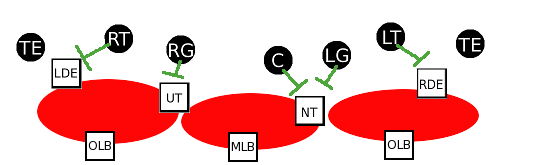
This is the Lions' base defensive line alignment:

diagram-based.png

The numbers represent where the defensive linemen line up. You've heard me reference this before: the "one-technique" defensive tackle lines up between the left guard and center, the "three technique" on the outside shoulder of the right guard. In the Tampa 2, these tackles are called the "nose" and "under" tackles, respectively. Though I don't believe Schwartz and Cunningham use that nomenclature, I've labelled the 3-tech and 1-tech as "UT" and "NT" in this diagram for clarity.

In the Schwartz/Cunningham system, the ends line up very, very wide--beyond the outside shoulders of the tackles. This serves several purposes: first, it sets an outside edge in the run game. Runningbacks cannot simply bounce outside of the defensive ends to find daylight; they're hemmed in between their offensive tackles. Also, screens and tosses are much harder to execute. Finally, it forces the offensive line to spread out to protect against the outside speed rush, opening up interior gaps.

Schwartz mentioned before last season started that the defense uses "3-4 principles"; this is what he was talking about. The ends set a hard edge on the outside, funneling runs back to the interior. Unlike a 3-4 set, though, there isn't a two-gap tackle handling the interior--there are two one-gap tackles:

diagram-based2.png

You see right away that all gaps aren't accounted for; that's okay. The ends funnel runs inside, and the tackles take up blockers. If everyone merely does their job, the result is something like this:

diagram-based3.png

The ends are in position to hold the edges, the under tackle has locked up the right guard, and the nose tackle has commanded a double-team. Depending on whether one, two, or zero tight ends stay in to block, the defense has already ensured the runningback must stay inside. What happens once this impasse is reached?

diagram-based4.png

Oh, right, linebackers. If the defensive line is doing its job, the linebackers should be able to clean up the mess. Unfortunately, this requires disciplined linebacker play. If the defensive line cannot stop the run by itself, the linebackers must be in position--or the tackle won't get made.

This is why the Lions need help at defensive tackle. If, in the above situation, the UT overwhelms the RG, then the play is disrupted--and there's no daylight outside. Further, if the NT can gain ground against the double-team, or split it, the play is again disrupted.

This is also why the Lions needed help at defensive end. If the DEs aren't strong enough to hold up at the point of attack, then all the interior disruption in the world won't stop the play. Many Lions fans will ruefully remember many times Shaun Rogers burst up the middle, only for the tailback or quarterback to sidestep him and have plenty of room to run.

Not only would excellent line play obviate the need for the linebackers to play cautious, stay-at-home football, it would keep blitzing lanes open, improving the blitz's effectiveness against both the run and pass.

Now, where to the Lions' defensive linemen fit into the picture?

  • Sammie Hill is the 1-technique tackle, labelled as "NT" above. He's a big, beefy, 330-pound DT with some real athleticism. His rookie year, he was primarily a space eater. However, he flashed the potential to become dominant in that role; not just drawing double-teams--demanding them, and making plays anyway.
  • Corey Williams was developing into a star in Green Bay as a 3-technique pass-rushing DT. Cleveland thought he'd make a perfect 3-4 end, and gave up a second-round pick to bring him in. Unfortunately, Williams just wasn't a fit for the scheme. He lacked the speed needed pressure the quarterback as an end, and his natural talent is penetration, not containment.
    It's presumed that he'll return to the 3-tech role that suited him so well in Green Bay, and if the Lions make no additions to the line between now and the regular season, he'll be the starter. However, I could see his role changing on obvious passing downs. Hill is not a penetrator, so the 320-pound Williams could slide over to the 1-tech spot, providing a pass rush without sacrificing size . . .
  • Kyle Vanden Bosch is the prototypical right defensive end for this defense: 270 pounds, very strong, very tough, difficult to keep off of the quarterback or runningback.  His tenacity, leadership, and—we hope—production should make him the Lions’ best defensive lineman, even best defender, in 2010.
  • Cliff Avril’s first two seasons with the Lions have been a tease.  At times, he’s looked like an elite pass rusher in the making--and at times, he’s disappeared.  At 260-to-265 pounds, he’s decidedly undersized as an LDE in this system.  That might be why he closed the season behind 271-pound Jason Hunter on the depth chart . . .
    Avril’s 2010 is going to be crucial to his development.  He has to continue to develop his body to the point that he can drop anchor on the left edge—and he has to prove he can consistently pressure the quarterback.
  • Jason Hunter is a developmental prospect, a hardworking special teams standout who was cut from Green Bay when they switched to a 3-4.  Hunter’s got the perfect body type for this defense, but his play has been inconsistent as well.  At times, he’s played the run well, and at times, he’s been easily blocked.  He’s gotten a little bit of pressure on the quarterback, but he doesn’t have the physical pass-rushing gifts that Avril does. 
    In some ways, he’s the mirror image of Avril: an inconsistent natural run-stopper instead of inconsistent natural pass-rusher, both trying to become a 30-snap guy within this defense, each improving at the expense of the other.
  • Kevin Carter is a guy who doesn't play for the Lions, but a player whose role in this defense the Lions would love to fill.  As a Titan, the 305-pound Carter was an outsized pass rusher, a three-down force who would play primarily outside, but would slide inside on obvious passing downs to provide an extra push.  It’s this role that would be filled by Saints RFA DL Anthony Hargrove, if he’s traded to the Lions.
    Hargrove's signing would likely relegate Hunter to the bench and special teams (where he arguably belongs, for now), and Avril would continue to rotate in on second and third downs.
  • Ndamukong Suh also doesn't play for the Lions, but as you all should know by now, I hope he will.  I think he’s a once-in-five-years prospect as a pass-rushing tackle, a guy that could, in rotation with Corey Williams and Sammie Hill, seriously disrupt opposing offenses—against both the pass and the run. 
    Assuming the Lions do not get Anthony Hargrove, Suh would likely play as the “UT” next to Corey Williams’ “NT” on passing downs—and he could even do a little Kevin Carter on running downs as well.  If the Lions got Hargrove, it wouldn’t necessarily mean the Lions couldn’t draft Suh and rotate him in, just that snaps would be lessened for all involved, and the DL depth would be much,um, deeper.  Picture a nickel-defnese line of Avril, Hargrove, Suh, and Vanden Bosch, or a second-down line of Hargrove, Suh, Williams, and Vanden Bosch, or a first-down line of Hargrove, Willams, Hill, and Vanden Bosch . . .
    Given the news, though, that the Hargrove has signed his tender and the Lions might try to trade out of the #2 pick, the Lions would prefer to trade for Hargrove, move down, and pick up a developmental tackle later.  Who knows if they’ll be successful—for now, though, I don’t think Suh and Hargrove both come to Detroit.

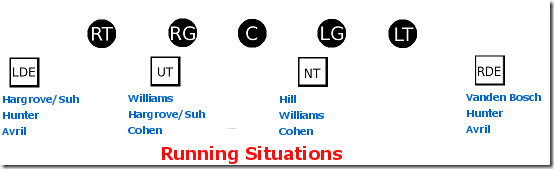
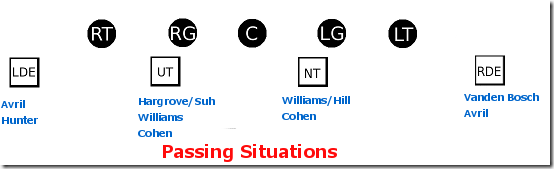
Submitted for your approval: my projected defensive line depth charts with the "Hargrove/Suh" role combined (for now), and rotations/position battles notated, too:

diagram-based-base diagram-based-run diagram-based-pass

Edited to add: Everyone’s been killing me for not including Turk McBride and/or Andre Fluellen, both of whom got a decent amount of snaps last year and are vaguely promising.  I see McBride (and Andre Fluellen) as occupying the role that I noted here “Hargrove/Suh”.  If either Hargove or Suh were a Lion next year, McBride and Fluellen would be battling for the role of “second-string DE/DT flex". Considering that there are first- and second-stringers at both DE and DT already, there aren’t a lot of leftover snaps.  If both make the team, I think Hunter or Cohen are the casualty.

This is kind of the thing about the Lions getting better—they’re going to let good players go, because those good players aren’t good enough to be on the Lions.  If you add in Vanden Bosch, Williams, and Suh, there are three fewer roster spots to go around for the Marinelli-style four-year projects and ‘tweeners.


Read more...

Karmelowicz, Kocurek, and Construction

>> 1.26.2010

burj_dubai_construction While penning this blog’s “birthday post”, I realized that this offseason is going to be much, much different than the last one.  January 2009 saw the complete and total destruction of the prior decade’s worth of work.  It was the demolition of a hideous, towering boondoggle; a structure half-complete, yet completely half-assed.  With the dust of the Old Lions still hanging in the air, new architects and new contractors were hired, and they immediately broke ground on the New Lions.  It was a time of great uncertainty, passion, and (Internet) violence. 

This offseason, meanwhile, should have no such upheaval.  Construction continues apace, and the blueprints haven’t changed.  The architects continue to oversee the work, the general contractor is meeting the goals, and all of their subcontractors are back for another season. 

Well, almost all of them.

Doing research for the birthday post, I realized something awful: the Detroit Lions have not retained both the offensive and defensive coordinators over an offseason in thirteen years.  That’s absolutely astonishing.  Is it any wonder that the Lions have never made any progress?  That haven’t had a direction or identity beyond “Barry Sanders” in decades?  That they haven’t developed a young quarterback into a consistent starter . . . well, ever?

Of course, that got me thinking.  What’s the first thing people point to as a reason why Drew Stanton’s failed to develop into a proven player?  The carousel of OCs and QB coaches who’ve broken him down and built him back up over and over: Mike Martz and Adam Gase, Kippy Brown/Jim Colletto and Scott Loeffler, and now, Scott Linehan and Jeff Horton.

Thank goodness, I thought, that Matt Stafford won't have to go through any of that.

My frustration was understandably palpable when I saw the news that Horton would, as Loeffler did, leave the Lions after one year to become an OC in the college ranks.  However, something Jim Schwartz said during his presser for Linehan’s hiring came back to me:

"I think that the quarterbacks need one voice -- they need the offensive coordinator's voice. We still may have a quarterback coach, but the quarterbacks coach is going to be responsible for fundamentals and drill work. The only voice to the quarterback is going to be the offensive coordinator.”

I can convince myself that Horton was essentially a drill runner and a ball fetcher—that Linehan was, and is still, Stafford’s only teacher and mentor.  Schwartz actually backed that up the other day:

“When we named Scott the offensive coordinator, it was very important to me that the offensive coordinator speaks directly to the quarterbacks,” Schwartz said today. “And Scott has led every single meeting that we’ve had with the quarterbacks. He goes into every single one. So it’s really not a change.”
But doing the defensive tackle review, I got to thinking about how critical the development of young DLs like Sammie Hill and Cliff Avril will be to success in 2010. 

Thank goodness, I thought, that we have Coach Karm in the fold for another year.

Well, that's apparently down the drain, too.  Bob Karmelowicz, the Lions’ 2009 DL coach, didn’t make the trip down to Mobile for the Senior Bowl, and is said to be strongly contemplating retirement.  According to Nick Cotsonika’s report, assistant DL coach Kris Kocurek would get strong consideration to replace him.

That’s very interesting, indeed—because Kocurek’s only 31.  A three-year All-Big-12 defensive lineman at Texas Tech, Kocurek was voted team captain and defensive player of the year as a senior.  He was drafted in the seventh round by the Seahawks, but landed in Tennessee (ah-HA!), spending two years on the roster.  He only got into one game, and had no stats, but Kocurek clearly made an impression on Jim Schwartz and/or Gunther Cunningham—and they made an impression on him.

Kocurek returned to Texas Tech to be a graduate assistant.  After one year, he went to Texas A&M-Kingsville to coach their defensive line, and get his master’s in Kinesiology.  He continued to bounce through small Texas colleges, coaching up prospects and building great defenses all the way.  He landed at Stephen F. Austin in 2008, and in the one year before the Lions hired him, he rebuilt:

a youthful defensive unit whose depth chart consisted of 15 players who were sophomores or younger. Kocurek had an immediate impact on the defensive front during his lone season in Nacogdoches. The 'Jacks led the Southland Conference with 32 sacks during the 2008 season.

Kocurek also helped transform junior Tim Knicky into one of the top defensive ends in the country. Knicky finished year with 74 tackles, and was among the national leaders in sacks and tackles for losses. Knicky wrapped up his junior campaign by earning AP third-team All-America honors, and Sports Network Honorable Mention All-America honors.

So.  A former standout player and leader, not far removed from his playing days, played for Schwartz and Gun, returned to his alma mater to take up coaching, moved up a rung practically every single year he coached, and has already been here for a year, learning the system and the players.

Okay.  Maybe losing Coach Karm isn’t the end of the world, either.  Maybe I needed to be prepared for a little turnover on this coaching staff.  Maybe I need to remind myself that the having one set of blueprints, one general contractor, and one unified vision of teambuilding means that losing a single subcontractor won’t doom the project.

Read more...

Neither Rain, nor Snow, Nor Sleet . . . nor 2-11

>> 12.18.2009

It seems bizarre that with so many questions already answered about the 2009 Lions, there’s still so much left to discuss; the mailbox was flooded with excellent inquiries.  To work, then?  To work.  From Scott:

Mr. Inwinter:
Okay that right there is quality.  Very well done, sir.
Had a thought for you- there's been a lot of talk of the Lions being "Stafford's Team" after the Browns game and even though I watched the "miked up" about ten times, I dismissed most of it as hype. On the other hand, I'm relieved that Stafford's not playing this week because it frees me to ignore the game entirely and watch decent teams. So maybe the fact that I'm not even going to watch, and I can't be alone here, means the Lions are Stafford's team even moreso than the hype would indicate.
This is something that I've felt, too--and the statistics bear this out. Not only is Matthew Stafford the future of the franchise, he's the present.
Right now, the Lions’s chances to win any game are zero if he is not playing, and nonzero if he is.  I didn’t expect that to be true this season, but it is.  I can’t wait until Stafford gets back on the field, because these Culpepper games feel like preseason.  Scott also asked about the draft:
Btw, I haven't seen anyone predict this, but I think they go DE in round 1 in April followed by a roadgrading OG in round 2. Better to draft athletes in round one, and if it goes well, it'll rotate protection outside and help the middle. Adequate run-stuffers are usually available among FAs.
A large part of this will be determined by the talent on the board, and where the Lions pick.  The Lions could end up picking anywhere between 1st and 10th, depending on how other teams do—I think they’ll be somewhere in the 4th-6th slots, myself.  To me, there’s no question that both lines, and the defensive secondary need the most help.
Pass protecting OTs, and pass rushing DEs are the premier positions.  If there was a stud prospect at either position, and the Lions were drafting, say, 3rd, I could see it.  But the top OT prospect, from what I’ve seen, is Russel Okung—he’s an athlete and a technician, but (IMO) isn’t strong or bulky enough to step in and play at an elite level yet; he’ll be a project and that’s not what the Lions need.
I take exception with you on the DE/DT thing—and not because you’re wrong; adequate run-stuffers are often there to be had.  The issue is that the Lions want another Haynesworth-type, a natural 315+ world devourer who can singlehandedly collapse the pocket, shrug off double teams, eat running backs, and flush QBs to the sidelines.
Given that so many teams are switching to the 3-4, a he-beast like that is in demand more than ever.  Ndamukong Suh is the perfect fit; he and Sammie Hill could be giving people fits on every down for years.  Yes, the Lions would like a pass rusher too, but their needs are a little bit different . . .
From excellent commenter SomeChoi:
But here is my question: if we do draft defense, is there a place for tweeners such as Brian Orakpo in Gunther's D? Prototypical 4-3 DEs seemed to be rare in recent drafts.
It’s interesting that you ask that.  My understanding of the blueprint for the Lions defense is this: start with a Williams Wall-like DT pair.  A 330-pound NT, like Sammie Hill, and a 310+-pound UT, like Ndamukong Suh, would overwhelm opposing offensive lines.
Bracing them would be two 270-to-280-pound DEs who can rush the passer--but be big enough and strong enough to set a hard edge against the run.  This funnels runs and screens back into the middle—where Hill and Suh (or a Suh-like player) will stop them.
People questioned Schwartz’s sanity when he put Jared Devries in as a starter—and even more when he decried the “great loss” of Devries in camp—but he did so because DeVries was a perfect fit for what they wanted to do.
This is where the OLBs come in.  Since the DEs aren’t 260-pound Freeneyish terrors, both OLBs need to be able to blitz like crazy.  Of course, they can’t be total liabilities in coverage, either.  They’re looking for big athletes who can run and hit; ideally, we’re talking about two Julian Peterson-in-his-primes.
Gunther included the dwindling stock of defenders with size in his tackling tirade:
"I don't like it because the linebackers are getting smaller and they're putting all those coverage people on the field. The (Brian) Urlachers are tough to find,'' Cunningham said. "A lot of teams in the NFL are going to the 3-4 because of that.
"The linebackers that are coming out are the size of safeties: 6-foot and 220 pounds. You look at the Cincinnati Bengals' tackles and they're 6-7 and those linebackers can't even see where the back is half the time. There's a real problem on defense to find the right players and the right mix for you to compete in this league.
So there is your answer: a 250-pound pass rusher like Orakpo could come in and play, but only if he had a little more lateral agility and wouldn't mind being a full-time OLB. Don't forget, Avril fit that mold coming out of college, and they've bulked him up quite a bit. Of course, he's not doing very well . . .
SomeChoi also added:
I'm one of the few who agree with Killer - Lions are better served drafting offense. The defense was good enough to keep us competitive in most games and a decent offense would've won us perhaps 4 more games. But I'm particularly worried we'll lose Calvin if we don't help him realize his potential soon, if we didn't lose him already. Not to mention being fearful for Staff's life. And Mayhew better be losing sleep over whether Pettigrew becomes a playmaker. Otherwise, passing on Oher will haunt him forever.
I'd love to agree with this line of thought: after all, the Colts have been an amazing offense paired with a bad-to-middling defense for over a decade now, and they've been consistently elite.  But the Lions’ defense . . . you guys, it’s so bad.  It’s truly terrible.   No matter how good the offense gets, they won’t be able to consistently outscore what this defense is allowing.
When Matthew Stafford has played, the Lions have been at the bottom of the middle third of the league in scoring—but the defense has been allowing almost double that number of points!  No, the Lions have to at least patch the defensive dam before they can finish constructing their offense.
I received several emails to the effect of, “If not Suh, then who?”  Lopper chipped in his suggestion:
In my opinion, the next best guy to take has to be Berry. The examples of a safety impacting a defense are all over the NFL this year. The Steelers with and without Polamalu, and just yesterday when Delmas was out it was painful watching White and Pearson bouncing off tackles. It seems like big plays against is the biggest problem for the Lions, and a safety pairing of Delmas and Berry would be the best way to stop them from happening. I might even rather see them draft Berry over McCoy depending on how things shake out in the off season.
Time for my usual disclaimer: I watch practically zero non-Big Ten college football; I haven’t yet seen most of these SEC and Big 12 players in action.  In general, the idea of pairing Delmas with another monster safety is appealing.
However, the defense is really weak at the line of scrimmage.  Blowing, in consecutive years, a high second-round pick and a high first-round pick on safeties, thinking they’ll clean up everything the corners and front seven let through . . . well, it seems like putting the cart before the horse.
Further, for as much as everyone raves about Polamalu, Ed Reed, Bob Sanders, and the difference those guys make to their defense, none of those guys were drafted in the top five, or even top ten.  I was curious: over the past few years, what safeties have been drafted high at the top of the first—and have they worked out?
LaRon Landry was the sixth overall pick of 2007.  Michael Huff was seventh overall in 2006, Antrel Rolle was selected eighth in 2005 (as a corner), and the late Sean Taylor was fifth in 2004.  The Other Roy Williams was the eighth overall in 2002—can you believe he’s a seven-year vet?
. . . that completes the list of Top Ten safeties of the past 10 years.  Sean Taylor, a fifth overall pick, was the highest-drafted safety in that time—and was developing into one of the most dominating players in the league, before his untimely death.  But the rest of these guys were either definite disappointments, or are too young to evaluate right now.
I believe that Berry’s a really nice talent, and pairing him with Delmas would indeed be SO AWESOME--but really good safeties can be had in the second, third, and fourth rounds.  Elite linemen, however, are pretty much only available at the top of the draft.
Joe asked:
One of my biggest questions that the usual suspects of Lions' media types don't seem to cover is WHERE exactly are the weaknesses on this team. I know it's easy to throw everyone under the bus and just flatly state we lack talent, but are you able to see exactly where? If you only had ONE pick in the draft or could only acquire ONE free agent with which to upgrade this team and could only draft/sign based on position, which position do you think most needs a serious upgrade?
Whew.  I think the Lions’ biggest problem positions are the non-Mega wideouts, the offensive guards, the defensive line, and the cornerbacks.  Since, again, guards can be had in the second or third round—and, again, I believe the Lions have to have a defensive focus in this draft—I’d look to fix either the line or the corners.  Joe said:
Personally, I think their biggest problem seems to be a lack of any pass rush, exposing the secondary which often has receivers initially covered. However, even the league's best cover corner can't cover a WR for 10 seconds while the QB assesses the entire field without the slightest pressure. I think DE is the biggest weakness on this team. We can't even seem to get pressure with blitzes and often get burned early, forcing Gunther to back off and only send four.
That’s a very strong argument.  With the addition of an elite pass rusher—a 270-plus-pound three-down beast, not an Orakpo or Dumervil—it would “shorten the field” for the corners.  I’ve said before that Will James would be much better if he never had to cover a receiver more than ten yards downfield; if we had a monster pass rush it would minimize the number of times he’d have to.  Killer even said last season that if there were a Mario Williams at the top of the 2009 draft, the Lions would have taken him over Stafford.
Let me be clear: I agree with that. If we could forklift Mario Williams from the Texans to the Lions, he’d make all the difference in the world.  Unfortuantely, there’s no Mario Williams in this draft—but keep an eye on this guy if he comes out.  At 6’-4”, listed at 272 going into his senior year, Derrick Morgan might well show up for the combine as the three-down end the Lions are looking for.
However, if the Lions end up with either of the explosive “under” tackles—Suh or McCoy—it’ll make nearly as strong of an impact.  I don’t see anyone running on a three-tackle rotation of Grady Jackson, a blossoming Sammie Hill, and Suh or McCoy.  Further, Hill and (Suh || McCoy) would be an incredibly athletic inside pairing; both could collapse the pocket with strength, and pursue if the QB scrambles—similar to the dynamic we saw with Big Daddy and Big Baby, only younger and faster.
Finally, don't forget that the shortest path to the quarterback is up the middle; a player like (Suh || McCoy) could “shorten the field” the way a DE could, and also demand double-teams that would make it easier for our existing DEs.
So, if I could add just one player, it’d be either a monster, three-down, athletic, pass-rushing DE, or a monster, three-down, athletic, pass-rushing DT.
. . . that'll do it for this week's mailbag.  Thanks again for all the great submissions, folks!

Read more...

Highlight Reel Diaries, Vol. I

>> 12.17.2009

Will Matthew Stafford start another game this season? It seems less likely by the day. With every tight end, runningback, and offensive lineman added to the Injured Reserve list, the already-iffy situation Stafford was drafted into gets . . . iffier.
He has fewer weapons with which he can attack opposing defenses, and less protection from enemy attacks. The Lions may indeed be his team now—but that team is currently as bad as it’s ever been. With only two wins so far, and three games left to go, victory has never mattered less.
We can debate about whether starting Stafford in week one, and on Thanksgiving, were wise decisions. But here and now, the decision to shut him down is easy. Unfortunately, it really is his team.
It’s become apparent that without Matthew Stafford at the helm, the Lions have no chance to win. It’s both exciting and depressing to say that about a rookie quarterback, but it’s true. Naturally, it follows that as fans, if there’s no chance of victory, there’s no reason to watch.
Ah, but there is. While the offense has been decimated by injuries, the defense is still relatively intact. Sammie Hill is developing into a force in the middle, and the battle between DeAndre Levy and Ernie Sims will affect the future of all three veteran starters.
Louis Delmas may, or may not, play—but the rest of the defensive backfield is auditioning for next season. Guys like Will James, Marvin White, and possibly new signee Brian Witherspoon will have to make an impact—or face the Turk.
Most importantly, we’ll see a rookie coach developing, too. How this team responds to last week’s fiasco will say a lot about Jim Schwartz’s ability to motivate. Two games ago, against the Bengals, it seemed as though the Lions’ defense played their best game of the season. Now, with absolutely nothing on the line, they’ll need to do that well again just to keep the Cardinals from blowing them out of the stadium.
It’s easy to throw in the towel. It’s easy to stop watching the games—especially when you’re assisted by the NFL’s blackout policy. It’s easy to start talking about free agency and the draft. It’s easy to start talking about Maybe Next Year all over again. But if you watch—really watch—on Sunday, you’ll get a sneak preview of Next Year.
Watch the players who’ll be the foundation of the defense for years to come. Watch the level of effort the veterans put out. Watch to see if Calvin Johnson plays, and if he does how hard he goes. Most of all, though, watch Jim Schwartz on the sideline—both his demeanor, and how the players respond to him. With luck, he’ll never have to coach through darker days than these—and there’s no true measure of a man than how he performs during his darkest days.

Read more...

Neither rain nor snow nor sleet . . .

>> 10.23.2009

It’s (finally) mailbag time!  Most of the questions I received had to do with a very round peg that just might fill a very big hole in the Lions’ lineup.  I'll print David M, of NFLDraftBlogger.com's instance:

I saw that Ed Johnson of the Colts was released today. We need DT help and he's a decent DT that hasn't been playing up to standards and being lazy (the reason for release was listed as him being overweight at 315 pounds). He got his wake up call from the Colts, so do you think the Lions will attempt to sign and shape him up?

Johnson is an interesting case.  The 6’-2”, 296# DT was released from the Colts last year, after a traffic stop resulted in the discovery of marijuana in his car.  He was re-signed by the Colts seven months later--after, essentially, promising to be good.  However, he was released again last week.  When pressed for a reason why, Colts coach Jim Caldwell denied that it was a character issue, saying that it was a case of “overall production, or lack thereof”.

This is an interesting philosophical question for Lions fans. If Ed Johnson was truly cut only for performance, and not character, issues, then he's not just a "turd", and might be of use. Then again, if he was truly cut only for performance, he must have been terrible indeed; NFL teams don't release a guy midseason unless they're clearing up a roster spot for someone else. The quagmire was cleared up a few days ago when, Colts GM Bill Polian finally came clean:

“Jim Caldwell about three weeks ago called him in and essentially said to him, 'Ed, you have to pick it up – the production, the hustle, the effort and the ability to lose the weight has to be improved,''' Polian said Monday, adding that Caldwell told Johnson, “Otherwise, we're going to have to make a change.'''
So there you have it: Ed Johnson was indeed cut for being lazy.  His weight was a just manifestation of that lack of intensity.  The many Polian, and Caldwell-via-Polian, quotes in that article make it crystal clear: the coaches wanted nothing more to do with Johnson’s half-hearted effort.  This guy is like a fat Chuck Darby, without Darby’s motor; I don’t think that’s someone who can help the Lions.  Moreover, Sammie Hill, a player with a naturally huge frame and a lot of heart, should come back healthy next week, or shortly thereafter.

David also highlighted another free agent target who might be worth pursuing:

I saw through various media outlets that former starting safety for San Diego Clinton Hart was released. Why have we not heard about the Lions going after him? Are they really pleased with Marquand Manuel starting next to Delmas? I know Ko Simpson is here too, and I like him as a player, but it never hurts to bring in someone with starting experience.

I have to admit, I hadn't heard of Hart's release. Judging by the fan reaction, it looks as though the Associated Press’ take on it:

Coach Norv Turner said the Chargers were carrying an extra safety and felt younger players Steve Gregory and rookie Kevin Ellison "have come along and are ready to play."
is essentially correct.  The Chargers are trying to shake things up in general, and Hart's release (following several weeks of poor play) sent a message to the rest of the defense that nobody's job is safe.

As far as the Lions making a move to pick him up, I think you answered your own question. The Lions already have a starter they seem to like in Ko Simpson, and I'd expect him to come back healthy after the bye.  I have not been fond of Marquand Manuel's play, but he's been on the team--and in the system--for much of the offseason, and can play either safety spot.  That's another thing to remember: Schwartz doesn't use the typical "strong" and "free" safety roles; a traditional SS who's a liability in coverage has no place in this defense. According to Adam Caplan of Scout.com, that's exactly what Hart's problem has been: coverage.

I also got another very good question from commenter SomeChoi:

S Hill and L Cohen seem to be good DTs who will only get better. Yet, Killer talks about DT as a major need for next year. Am I just overvaluing those guys? I would think LT is a bigger need than DT (but both behind DE, CB, and S).
I think we as Lions fans need to be clear: after Megatron, Matt Stafford, Brandon Pettigrew, Louis Delmas, and DeAndre Levy, just about everyone on the roster is a candidate to be replaced this offseason.

Of course, I would love for the Lions to get an elite left tackle--but the Lions' DT rotation, with Hill out, is Cohen, 36-year-old Grady Jackson, and 278-pound Turk McBride.  Understand that on a team with an established defensive line, Hill and Cohen would have each had to wait a year or two to get on the field--and instead, they're part of the starting rotation.

Likewise, the DEs are extremely thin: Avril is just starting to turn it back on after his injury, Dewayne White can't stay healthy, DeVries was going to START before going on IR, and his street-free-agent replacement, Jason Hunter, is also out. Six months ago, Jason Hunter was a special-teams standout for the Packers, who was then released.  Now, the Lions are eager for his return, so they can plug him back into the rotation? Yikes.

I've been ringing alarm bells all offseason long: the cornerback position is absolutely dire.  Henry is better suited to safety, Buchanon needs to pull his head out of his posterior, and there isn't another legitimate NFL starter on the roster.  Will James is a great story, but he's another weak #2/strong #3-type guy that could be a cog in an otherwise-excellent secondary, but he's no #1, not in a division full of excellent, strong-armed quarterbacks.

I could go on and on about the talent definciencies all over the roster--but I'll try to stick to your question.  Sammie Hill is still extremely raw; he doesn't yet know how to use that incredible build to its fullest. His technique, hand work, and use of leverage is simply not there yet. Once it is, though, his potential is limited only by his effort. If he reaches that potential, could be the Lions' nose tackle for years to come.  However, at this point he's just a big body--that helps, but only goes so far.

Landon Cohen has made absolutely unbelievable strides since the Lions took him in the 7th round of the 2008 draft, putting on about 35 pounds of pure muscle.  I bumped into him at the “Lions Uncaged!” event; he didn’t notice, but my clavicle was broken in three spots.  Still, he was a seventh-round draft pick just last year.  He BARELY saw the field--and all of the technique coaching he got last season was wiped out and rewritten with the opposite approach this summer.  If he continues to develop, he could indeed be a valuable rotational guy next to Hill.

This is kind of the thing: us Lions fans are so used to anyone who's even moderately decent starting; the notion of having both an excellent starter and a solid backup is disorienting.  I agree that Cohen and Hill are two excellent young prospects--but this defense needs to be built around the NEXT Grady Jackson, the next Albert Haynesworth, the next Pat Williams. If you have a chance to draft the kind of DT who stops people's running games cold all by himself, you don't pass on that guy because Landon Cohen is coming along pretty good.

Read more...

three cups deep: eating crow

>> 10.19.2009

eating_crow

Today I eat a foul meal, indeed.  After looking over the data, seeing a decisive systemic advantage for our Gridiron Heroes, and hearing that Matt Stafford took part in Wednesday practices, I bravely predicted a victory over the Packers.  I don’t think I need to describe the agony that Sunday’s results inspired--Neil over at Armchair Linebacker already sauced my crow plate with his own, unfailingly lyrical, take.

Adding insult to injury, I posted yesterday that I'd be Tweeting throughout the game--then either Twitter, or every Twitter client I could get my hands on, went down.  I also ran a quick pre-game errand that ended up not being quick at all, and so I listened to most of the first half on the radio.

There's something about following a game on the radio or internet that makes a blowout loss much worse.  Without the ability to see what's happening, to understand why, you really feel like the Football Gods are simply smiting you:

Daunte Culpepper drops back to pass . . .
Please don't be intercepted please don't be intercepted please don't be intercepted please don't be intercepted please don't be intercepted
. . . and it's picked off! He threw it RIGHT TO Cullen Jenkins!
DAMN!  DAMN!  DAMN!  DAMN!  DAMN!  DAMN!  DAMN!  DAMN!

It’s infuriating.  It’s nauseating.  It’s even emasculating--like your strength and pride as a fan is being taken from you, and there’s nothing you can do about it.

The Packers' emasculation of the Lions was swift and surgical, indeed.  Rogers exploited the Lions’ horrific secondary for an opening-drive bomb, Culpepper threw a horrific pick with his first pass attempt, the Pack cashed in, and the game was over with 7:25 left in the first quarter.  The numbers will show the Packers didn't play a very good game--13 penalties for 130 yards!—yet, the Lions were absolutely powerless to keep pace.

After the initial salvo, the Lions' D actually stiffened up.  The Lions had three offensive possessions in between the second TD and the Packers' next score, a Crosby FG.  If they'd turned those three possessions into just 10 points, we are talking about a COMPLETELY different ballgame.  Of course, they didn't, and so we are talking about a vicious loss that "feels" even worse than it looked--and it looked bad.  On Twitter, I called it the Lions' second "GPS Game" and, well, now we know exactly where the Lions are.

Well . . . we know where they're at without Matt Stafford.  Without Calvin Johnson.  Without Sammie Hill, DeWayne White, Jason Hunter, or Ko Simpson.  Isn't it interesting that already, these players are the difference between competitiveness and 2008-level play?  Stafford is already an immediate upgrade over Culpepper; there can be no debate about that now. Megatron we know is Megatron, and White's been solid when healthy, but Sammie Hill?  Jason Hunter?  Ko Simpson?  A fourth rounder from an NAIA school, a street free agent, and a guy who would have been cut if not traded for; they're already major contributors, missed dearly when they're gone.  It brings home exactly how bankrupt the Lions' roster was when Mayhew took over.

One phrase I've heard quite frequently this season from Lions fans, bloggers, and reporters: "I know there are no moral victories, but . . . ", with the "but" preceding, you know, why this past loss was a moral victory.  There is nothing like that here.  This was a brutal, punishing, vicious, demeaning defeat.  It stopped the momentum from the Steelers game dead.  It sheared the the little green rosebuds off the black and thorny stems of seasons past.

. . . and now, nothing.  Bleakness, emptiness; a bye.  As snow, probably, begins to fall outside our windows on Sunday, this loss will simmer, stew, marinate.  There's nothing to look forward to: no early previews of the upcoming opponent, no breathless injury report updates, not even "so-and-so looked good during jogging today".  No, my crow will be slowly braised, for two weeks, in a bitter broth of injuries, ineffectiveness, turnovers, and defeat.

Ugh.  After that, there's no way I can suck down a third cup of office sludge. I'm going out for espresso.

Read more...

three cups deep: the roster is set

>> 9.07.2009

After an especially lazy Labor Day morning, I have yet to sip even a single drop of coffee, let alone three cups.  Rather than attempt to rehash everything that happened last weekend, I’ll simply crib from Adam Caplan’s excellent Transaction Blog:

Claimed CB Cletis Gordon off of waivers from the Texans, waived WR Eric Fowler, released CB Keith Smith, waived WR Glenn Holt, released CB Dexter Wynn with injury waiver, signed QB Brooks Bollinger, claimed QB Kevin O'Connell off of waivers from New England, released G Terrence Metcalf, waived WR D.J. Boldin, waived LB Rob Francois, waived CB LaMarcus Hicks, waived DE Ryan Kees, acquired S Ko Simpson for an undisclosed 2010 draft choice, waived DE Orion Martin, released DT Chuck Darby, waived OT Lydon Murtha, placed CB Chris Roberson on IR, released DT Shaun Smith, waived LB Rufus Alexander, released QB Brooks Bollinger, released G Milford Brown, waived TE Carson Butler, released RB Aveion Cason, released WR Keary Colbert, waived DE Sean Conover, released K Billy Cundiff,  waived RB Tristan Davis, waived LB Zack Follett, waived C Dan Gerberry, waived TE Dan Gronkowski, released WR Dane Looker, released S Calvin Lowry, waived CB Ramzee Robinson, released S Stuart Schweigert, waived LB Spenser Smith, waived WR John Standeford, waived: DE Ikaika Alama-Francis, CB Cletis Gordon, WR Adam Jennings, traded QB Kevin O'Connell to New York Jets for future draft pick, claimed DE Copeland Bryan off waivers from Buffalo Bills, claimed WR Yamon Figurs off waivers from Baltimore Ravens, claimed CB Marcus McCauley off waivers from Minnesota Vikings, claimed CB Kevin Hobbs off waivers from Seattle Seahawks.

Signed to practice squad: WR John Broussard, TE Carson Butler, RB Tristan Davis, LB Zack Follett, C Dan Gerberry, TE Dan Gronkowski, OT Lydon Murtha.

Whew, got all that?  Really, there aren’t too many surprises here.  Mayhew flipped O’Connell, though faster than I anticipated; Cletis Gordon, Five-O, and Adam Jennings un-made the final roster; then a DR, KR, and two CBs  were claimed off of the waiver wire.  My guess is that McCauley and Hobbs will be given a chance to compete for a spot at nickel corner, and the loser will be shipped off as soon as another DT is acquired.  Why a DT?  Well, with Orien Harris (CORRECTION: several sharp-eyes readers noted that I got the wrong "Orion"; Orien Harris is still on the roster--though that hardly eliminates the concerns I expressed below), Chuck Darby, Shaun Smith, and Five-O all sent packing, the Lions are down to Grady Jackson, Landon Cohen, Sammie Hill, and Andre Fluellen at DT.  

Carrying only four DTs doesn’t sound dire—but Jackson is going to be  15-20 snap situational guy, Cohen’s a seventh-rounder in his second year, Hill was playing 3-4 DE in the NAIA like nine months ago, and Fluellen has been working primarily at DE.  There isn’t a single proven, reliable starter to play DT--though Cohen certainly read well for the role, when he auditioned against Atlanta.  In order to stop the run, this defense is going to need outstanding---both explosive AND disciplined—linebacker play, as well as help from the DBs.

New (presumptive) starting safety, Ko Simpson brings both size and speed to the position; one can only hope his athleticism leads to more plays made back there.  I’ve been sweating bullets about the cornerbacks since the day they let Leigh Bodden walk, and the addition of two waiver-wire scrubs doesn’t assuage my fears—especially given the physical-but-lackluster play of Eric King this preseason.  Even if this unit miraculously stays healthy, both skill and depth are going to remain a problem.

On the other hand, the addition of Yamon Figurs is one I’m excited about.  A 2007 third-round pick of the Ravens, Figurs exploded in his rookie season in relief of the injured B. J. Sams.  Figurs became the primary returner in 2008, but didn’t build upon his initial success.  The Ravens signed former Titans CB/KR Chris Carr—remember him?—and Carr edged out Figurs for the returner gig.  As Figurs couldn’t crack the WR depth chart, he was released. 

I still think Figurs has the explosiveness to be a primary returner for the Lions—and with Cason gone, the Lions have only one player with actual experience as an NFL returner: #1 CB Philip Buchanon.  Figurs should have the leg up on the punt returner gig, and should push Williams and Brown for looks at kick returner, too.

When you take a step back and look at how incredibly different this team is from the 0-16 squad, especially on defense, it’s impressive.  Barring any further miracle transactions—and without knowing the compensation given for Ko Simpson, or received for Kevin O’Connell—the Lions have very well in turning the roster over this season.  However, there’s still a long way to go before this roster matches up, on paper, with the better squads in the NFL.

Read more...

the first line of defense?

>> 8.12.2009

It’s a little bit difficult to believe that I’m about to write about the desperate, unsettled nature of the Lions’ defensive line.  After all, it was just three years ago that the Lions hired Rod Marinelli—one of the NFL’s top defensive line coaches, and reputed leaguewide to be a brilliant teacher and motivator.  He was going to revamp the Lions’ perennially toothless defense, and leading the way would be a Tampa-like front four, our very own Warren Sapp, Booger McFarland, Simeon Rice and Greg Spires to brutalize quarterbacks with.

The plan was, our fierce, fast, athletic line would crash through the gaps, and terrorize opposing quarterbacks.  Since the D-line would be so dominant, blitzing would rarely be required; our small, fast linebackers could park in short zones and deny the offense the short passing game.  With the terrorizing defensive line up front, and the blanketing zone behind, the Lions’ defense was going to be a nightmare for opposing offensive coordinators.

Yes, well.  We knew things weren’t quite going to go to plan when Marinelli’s “top priority” was to sign Kalimba Edwards to a massive five-year extension, based on an Avril-esque rookie season and three years of groin injuries.  This started a chain of events—bad signings, draft misses, Marinelli “I’ll coach him up” hubris, trades, and injuries--that left the Lions’ defensive line in its current state: a guy who couldn’t even make the Packers’ camp roster now has “the inside track” on starting at left end.

There was an incredible kids’ show on PBS when I was small called “Square One TV”.  Famous for its nonstop U-of-M football in-jokes, the show was somewhere between Sesame Street, a sketch comedy show, and a cartoon—all with math as the focus.  The latter half of each episode would feature “Mathnet”, a Dragnet spoof that followed the adventures of two detectives who would solve crimes with math.  Often, when they were completely flummoxed, with several conflicting leads, they would “play ‘What Do We Know?’”, and the answers would reveal themselves.  It’s played like this:

  • We know that Grady Jackson is listed at 6’-2”, 345#.  We know he’s a natural wide-bodied, two-gap run-stuffing defensive tackle, of which the Lions’ staff would love to have two in the center of their defensive line.  We know he’s 36 years old, and will likely only see action in running situations, i.e., first down and second-and-short.  Despite being limited to 15-25 snaps a game, Gunther Cunningham admits that “when you get him in there, everything else goes good.”  We know he will likely be (unjustly) suspended for the first four games.

  • We know that Chuck Darby is listed at 6’-0”, 297#.  We know that he’s a natural one-gap run-stuffer, blessed with an incredible motor, big heart, and not much else.  Darby is an overachiever who plays at his absolute limit every second he’s on the field, but he—like Jackson—is getting up there in years (33), and is best suited for running down duty only.

  • We know that Landon Cohen is listed at 6’-3”, 274#--though he says he was up to 285 last year, and weighed in to training camp at 302.  We know the Lions drafted him in the seventh round of the 2008 draft.  We know he did an absolutely astonishing 50 reps of 225 pounds on the bench press at the outset of training camp—for comparison, B.J. Raji only mustered 33 at the combine this year.  We know Tom Kowalski reported that he’s been making a splash at camp.

  • We know that Andre Fluellen is listed at 6’-2”, 296#.  We know he’s an athletically gifted 2008 third-round pick.  We know he played at both DT and LE last season, and, according to the official site, allowed only 1.74 yards per play directed at him his rookie season.  We have absolutely no clue where the official site got that stat from, how it’s derived, or where we could get it for more players, but we sure wish we knew.  We also have no word on his camp performance to date.

  • We know that Sammie Hill is listed at 6’-4”, 329#.  We know he was drafted out of tiny Stillman College in the fourth round of this April’s draft.  We know he’s raw and unpolished, but has the physical tools to remind Gunther Cunningham of Albert Haynesworth.  We know his technique and conditioning are a long way from being ready for the big leagues.  We know he was drafted to play Major League Baseball.  We know he is very impressed by hotel rooms (the famous YouTube video of him and fellow RRA clients doing the “Cribs” thing at their agent-supplied hotel room has apparently been taken down).

  • We know that Shaun Smith is listed at 6’-2”, 325#, and has been a moderately effective two-gap DT and DE in the Browns’ 3-4.  We know he was on the outs in Cleveland for motivation problems—motivation problems paired with a penchant for mouthing off to the media.  We know that immediately after signing, he told the Detroit media that ex-Lions DT Shaun Rogers would love to come back to Detroit.  We know The Grandmaster thinks Smith’s talents fit the Lions’ needs.

  • We know that Orien Harris is listed at 6’-3”, 300#, we know he’s a high-motor guy, and has been on six different rosters in his four years in the league.  We know the Lions’ brass thinks he had a better chance of making the roster than Ronald Curry.

  • We know that there’s no way the Lions keep eight defensive tackles on the roster, so John Gill won’t make the team. UPDATE! About an hour after I posted this, John Gill was released.  I apologize to Mr. Gill if I influenced the Lions staff in any way.

  • We know that Cliff Avril is listed at 6’-3”, 253#, though he reported to camp at a lean 260.  We know he’s an explosive edge rusher who led all rookies in sacks last season, in less than half a season’s work.  We know he played mostly outside linebacker at Purdue; the Lions were one of the few teams who saw him as a full-time defensive end.  We know he’s a prototypical 3-4 ROLB, a little bit light for a prototypical 4-3 RE, and probably ten or fifteen pounds shy of the ideal for Schwartz and Cunningham’s new scheme.

  • We know that Dewayne White is listed at 6’-2”, 273#.  We know he was effective in spot duty as a pass rusher in Tampa Bay, and we know that—when healthy—he’s been an effective pass rusher here.  We know he matches the ideal body type and game for a RE in the Lions’ new system.  We know he’s not as effective at rushing the passer from the LE spot, and isn’t the run-stuffer an LE should be.

  • We know that Jared DeVries is out for the season.

  • We know that Ikaika Alama-Francis is listed at 6’-5”, 280#, but that he’s bulked up to 292 in anticipation of switching to tackle.  We know he was a 2007 second-round pick.  We know former NFL head coach Jerry Glanville called him the most talented defensive lineman he’d coached.  We know that with the injury to DeVries, “Five-O” is back at LE.

  • We know that Jason Hunter is listed at 6’-4”, 271#.  We know that he matches the ideal body profile of a DE in Schwartz and Cunningham’s new scheme.  We know he had a promising first few years in Green Bay--including being their best special teams tackler--but that he had no place in their new 3-4 alignment.  We know he has the “inside track” at taking over DeVries’s starting gig.

  • We know that Sean Conover is listed at 6’-5”, 275#, and also fits the physical mold of a Lions DE.  We know he was acquired by the Titans as a rookie free agent, but after two seasons of semi-successful spot duty, he was released.  We know he then kicked off a practice squad tour: the Ravens, Falcons, and Jets all had spots on their practice squads or reserve list for him in 2008.

  • We know that Ryan Kees is 6’-6”, 275#, and also fits the physical mold of a Lions DE.  We know that he tore it up at D-II Saint Cloud State.

In true Mathnet style, let’s look for the emergent patterns.  One is obvious: we see that every defensive end the Lions have acquired this offseason goes around 6’-5” and is 270-275 pounds.  This is the body type the Lions would like to see two of set wide, bracing the offensive tackles on either side.  Two ends built like this can set a very hard edge, denying running backs the outside, denying the pitch, disrupting the screen.  Setting these strong ends out wide will force the running backs up the middle.

Speaking of the middle, another pattern emerges here: with Grady Jackson, Sammie Hill, Shaun Smith, and Orien Harris, every defensive tackle the Lions have acquired has been a natural two-gap run stuffer, with a big, wide body.  According to Schwartz, the Lions still use a one-gap responsibility system, but instead of trying to ‘get skinny’ and blast up those gaps with a leading shoulder, the Lions are now squaring up to the gaps, filling them, and then shedding blockers.

According to Nick Cotsonika and Carlos Monarrez of the Free Press, both Jason Hunter and Cliff Avril have been seeing time at both ends, but DeWayne White appears fixed at the right end.  This makes sense; White is a productive veteran who perfectly fits the mold of the new right end.  It will be between the gifted-but-too-small Avril and the bigger-but-less-explosive Hunter for the starting LE spot—but keep in mind, with the high levels of blitz, and extreme situalization of the defense, no matter what the depth chart looks like, Avril will see a “starter”-like snap count.  Ikaika Alama-Francis would have been the perfect left end coming out of college, but he’s about thirty pounds too heavy now; I have no idea if they’ll have him lose weight, or what.  He may challenge Hunter for first- and second-down LE reps.

When Grady Jackson was signed, the prevailing wisdom amongst fans was that he’s be the starting nose tackle and Chuck Darby would be the #2.  However, basing this on little more than hunch, I think the Lions will play them side-by-side on running downs.  Darby’s simply too small to play the nose tackle role in this defense.  Besides, with the employment of the 3-3-5 nickel defense, there may only be two tackles out there on running downs anyway.  If you have two natural run stuffers who aren’t much good for anything else, and only have 15-25 snaps a game in them, why not use them together for 15-25 ‘1st-and-10’s and ‘2nd-and-short’s?  I think Shaun Smith or Sammie Hill will be the #2 ‘bigger’ tackle; Smith if he shuts his mouth and plays well consistently, Hill if he can get his conditioning where it needs to be.  Landon Cohen’s had an incredible camp, and Andre Fluellen really impressed me with his inside/outside athleticism late last season.  I still think the best place for “Five-O” is at the under tackle spot.

So, where does this leave us?  I decided to chart it out, based on everything we that we know, plus a little good old-fashioned hunchwork:

AlignmentLEUTNTRE
Base 4-3 (run)Hunter/FrancisDarbyJacksonWhite/Hunter
Base 4-3 (pass)Avril/HunterCohen/FluellenSmith/HillWhite/Avril
Nickel 4-3Avril/WhiteCohen/Fluellen/
Francis
Smith/Hill/
Francis
Avril/Peterson
Nickel 3-3Francis/Fluellen/Cohen--Smith/HillWhite/Francis/
Fluellen

Read more...

  © Blogger template Simple n' Sweet by Ourblogtemplates.com 2009

Find us on Google+

Back to TOP