Showing posts with label lawrence jackson. Show all posts

Old Mother Hubbard: The Defensive Ends

>> 2.02.2012

Pantry

From last year’s Old Mother Hubbarding of the Lions defensive ends:

Cliff Avril was pigeonholed by most as a 3-4 ROLB, and I’m certain he could shine in that role. But he’s developed into the fast, athletic 4-3 rush end Rod Marinelli thought he could be. Avril will never be a 270-plus-pound, two-way monster—but he’s already an impact defender, top-flite pass rusher, and a huge part of this defense going forward. Signing this RFA to a long-term deal must be a top priority.

Kyle Vanden Bosch is the ultimate leader, a consummate professional—and as a player, the yang to Cliff Avril’s yin. Had he stayed healthy, he would have had seven sacks and fifteen QB hits, more than acceptable standalone production, besides the undeniable halo effect. Unfortunately, he’s 32, and recovering from a major neck injury. The Lions need to find a starting, impact, two-way end to replace him by the 2012 season.

Lawrence Jackson produced like an above-average starter in heavy rotation, and fron Week 10 on was one of the better 4-3 DEs in the game. I’ll hold off on anointing him the starter of the future for now, because I’d like to see more consistency—but there’s no doubt he’d be the perfect physical fit for the void KVB will eventually leave.

Willie Young is a developmental prospect with a very lean frame, a long way to go, and an undeniable knack for playing football. I hope he has a place on the roster for next season.

And then, the shopping list:

The Lions will need to find an impact two-way defensive end, ready to replace KVB as a starter by the 2012 season. Lawrence Jackson has the potential to be that end. Cliff Avril is an RFA who must be re-signed to a long-term deal. The Lions may look for a developmental speed-first end behind Avril, especially if Willie Young does not take major strides in the offseason.

It's important to restate the design goals of the Lions defensive line: to get consistent, excellent pressure from the without assist from the blitz. To have a pair of bookend DEs rushing from wide alignments, fast enough to turn the corner and strong enough to set the edge against runs and screens. To have two defensive tackles who can rush the passer up the middle of the pocket, one of whom can also collapse the running lane between himself and the nine-technique DE. Most importantly, to have depth all across the line, making sure the above design requirements are fulfilled for four quarters each of sixteen (-plus) games.

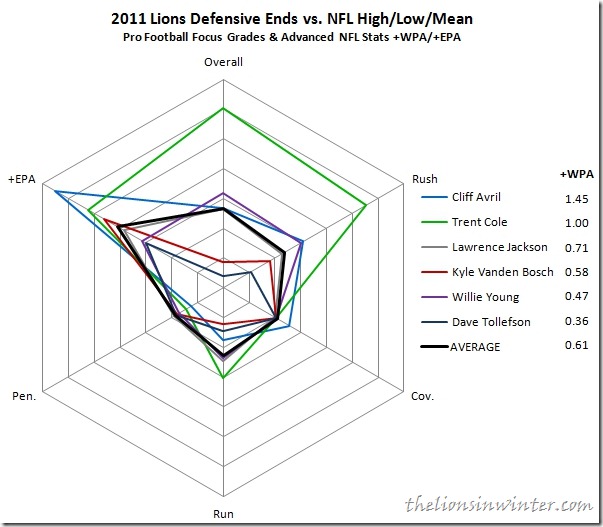
Now, that in mind, let’s look at the data:
detroit_lions_defensive_ends_2011_grades

For the second straight year, Philadelphia’s Trent Cole is the highest overall PFF-graded 4-3 DE. With the #1 overall pass-rush grade of +40.4, and the 11th-best run-stopping grade at +10.3, Cole fulfilled his responsibilities in the Eagles’ own wide-9 alignment perfectly. His two-way dominance was so complete, he kept his top overall mark despite being called for seven penalties in 640 snaps. Interestingly, Cole’s 1.00 +WPA is only ranked 23rd, and his 32.3 +EPA is 27th. For all his consistently positive play, Cole didn’t help the Eagles win much. May have something to do with the rest of the defense behind him.

Bringing up the rear is the New York Giants’ Dave Tollefson, whose –9.4 rush grade and –5.5 run-stopping grade put him at the bottom. His 0.36 and 10.0 +WPA and +EPA rank him 79th and 86th, respectively, out of 125 defensive ends ranked by Advanced NFL Stats.

Important note: Pro Football Focus separates linemen into DT/NTs, 4-3 DEs, and 3-4 DEs. Advanced NFL Stats has one bucket each for DTs and DEs. The two sites do not always agree on who is what.

Cliff Avril is another example of why I added+WPA and +EPA to these radar charts. When you add up all his positive, negative, and nothing-in-particular plays, he’s an average NFL defensive end. His +6.6 overall PFF grade almost exactly matches the NFL average of +6.5. That includes a pretty heavy ding for 11 assessed penalties, but a major boost from his linebacker-like coverage skills (+5.5). His pass rush grade is solid, ranked 19th overall at +11, but confusingly low for a guy who had 12 sacks, 8 hits, and 37 pressures on 822 snaps (one of those pass rush events per 14.7 snaps, 15th-best rate in the NFL).

For comparison, Trent Cole had 11 sacks, 11 QB hits, and 44 pressures on 640 snaps, one every 9.55 snaps (2nd-best). For further comparison, Jared Allen had 24 sacks, 8 QB hits, and 34 pressures on 1044 snaps—one every 15.8 snaps. Just putting that out there.

So from looking at just the PFF grades and stats, we’d mark Avril down as an average overall defensive end, pretty good at rushing the passer but otherwise mediocre. Then, we look at the +WPA and +EPA and whoa.

Avril’s +EPA is an excellent 45.1, 11th-best in the NFL; that’s well ahead of Cole’s 32.3 (Jason Pierre-Paul’s is tops at 83.4).  His +WPA is an outstanding 7th overall, at +1.45. The discrepancy comes from his impact plays: 4 passes defensed, 6 forced fumbles, 7 TFLs, and an interception. In terms of +WPA, it’s his knack for making big plays at the right times. He helped the Lions’ win-loss bottom line 45% more than Trent Cole helped the Eagles’.

Just as with the defensive tackles, we see Lions defensive ends—as a rule—make big plays when they matter most, far out of proportion to the rest of their production. Avril, though, takes that to the extreme. Keep in mind, he’s doing it from the left side, too: going against bigger/stronger right tackles and often in the quarterback’s field of vision. Imagine if he were working the blind side . . .

Bottom Line: Cliff Avril, in this system, plays like a top ten defensive end. If he is not re-signed, his production and playmaking ability will not be easily replaced—and his production and playmaking ability is essential to the success of the defense. His re-signing must be the Lions’ top priority.

Willie Young, a.k.a. The Great Willie Young, might indeed be the son of a panther god. His +11.7 overall PFF grade would be the highest of any Lions DE, if his 259 snaps weren’t just a few too few to qualify. His +10.2 pass rush grade is just behind Avril’s +11.0, and his run-stopping grade is far superior, +3.7 to –2.5. In a huge surprise, the not-as-spindly-as-he-used-to-be Young’s run defense was better than all but Lawrence Jackson’s.

Again, this is on limited snaps—and that cuts both ways. Young makes fantastic plays whenever he’s in the game, but he’s in the game most often when the situation is ripe for him to make plays. His 3 sacks, 4 hits, and 19 pressures put his snaps-per-pass-rush at 9.96 which would be third-best in the NFL if he’d played just thirty or so more snaps.

I believe that’s at least part of Trent Cole’s story above: he played 182 fewer snaps than Cliff Avril, and I’d be willing to bet a good chunk of “negative” plays were eliminated because of it. It’s a lot easier to be great against the run when you only have to do it on 2nd- and 3rd-and-long . . .

Still, Young’s +11.5 EPA and +0.47 +WPA speak to just how effective he was when he was in. The average +WPA for qualifying DEs was 0.61, meaning that in just 259 snaps Willie Young helped the Lions win almost as much as an average starter. Nobody put much stock in a sub-260-pound all-legs-and-no-torso seventh rounder developing into a vital contributor, but Young’s already there in just his second year. How much better can he get?

Bottom Line: Willie Young has proven his worth as a rotational end, and should be a big part of the picture for 2012, his make-or-break year. If he can shoulder an increased workload without his rate stats falling off, he’ll be every bit the player Cliff Avril has been. That is an enormous “if.”

Lawrence Jackson had an outstanding 2011, producing at the same level as Avril and KVB when he got reps. The natural big-bodied run-stuffer Avril isn’t, he seemed destined to take over on the left side as Avril transitioned to the right rush end spot.

Instead, Jackson played almost exclusively on the right side, in relief of KVB. He struggled against Tampa Bay, but had strongly positive games in Weeks 2-5. His season crescendoed on Monday Night Football, with a +3.4 overall grade (1 sack, 1 hit, 2 pressures on just 31 snaps). After that game, however, Jackson had three flat games before Week 10—where he graded out very well and suffered a deep thigh bruise that would bench him until Week 16.

You can’t help but feel like Jackson missed his opportunity to stake his claim as the Lions’ third-now-and-second-soon DE. However, Jackson’s 18.4 +EPA is a very positive sign; he nearly matched the NFL average of 21.07 with just 341 snaps. His 0.71 +WPA is an even better one: with less than half the snaps of a typical starting DE to work with, Lo-Jack contributed more to the Lions’ winning games than some other teams’ starters . . . unfortunately, that includes the Lions’ Kyle Vanden Bosch.

Bottom Line: Lawrence Jackson had a chance to prove to the Lions they were set at this position for years to come. Instead, his deep thigh bruise—and midseason lull—leaves us no closer to knowing if he’ll be ready to step in for KVB as a full-time starter when the time comes. However, he also flashed enough of that Secret Superstar form to prove he can play as well as anyone in the NFL when he’s “on.” Like Willie Young, 2012 will be his make-or-break year.

Kyle Vanden Bosch had a fantastic bounceback year, right? With 8 sacks, 6 QB hits, and 26 pressures, this was his best statistical year since the glory days of 2008. Unfortunately, he had a beefy 777-snap workload, meaning he only generated pass rush on one of every 19.4 snaps—35th-best in the NFL and below the 19.0 NFL average.

Vanden Bosch's -11.3 overall PFF grade is absolutely mortifying; it's the fourth-worst in the NFL. He was graded at –1.9 in the pass rush, definitely below the NFL average of +2.5. His run-stopping grade, however, was through the basement: –7.9, worse than everyone but St. Louis’s Chris Long. We saw this time and time again in the games: Vanden Bosch overpursuing like a maniac, and opposing teams scheming to take advantage.

Vanden Bosch improved in this area throughout the season. He got dinged with strong negative run-defense grades in Weeks 2, 3, 4, 6, and 7, but only once more after that. Unfortunately, that coincided with a huge dropoff in his pass-rush productivity. He had only one negative pass rush grade in the first ten games, then was in the red for Weeks 12, 13, 15, and 16.

KVB is the only Lion DE not to add Win Probability far beyond what his snap count and production would project: Despite those 8 sacks, he almost exactly met the NFL average with 0.58 +WPA. His 26.30 +EPA is solidly above-average, but that just highlights the fact that he got it done more often when it didn’t matter than when it did.

Bottom Line: Kyle Vanden Bosch’s time as a premier two-way defensive end is over. His heart, desire, toughness, and leadership are unquestionable, but he’s simply not getting it done as well or as frequently as the rest of the defensive ends. Without finding the fountain of youth, he cannot start and play the majority of every game in 2012 or the defense will suffer for it.

SHOPPING LIST: The Detroit Lions have some serious decisions to make at the Defensive End position, and have little information to go on. Kyle Vanden Bosch must recover his youthful form or play a reduced role in 2012. Cliff Avril is a proven game-changer but not under contract. Willie Young and Lawrence Jackson have played extremely well in limited time but are not proven full-time performers.

If the Lions have complete faith in Young, Jackson, or both they are set for defensive ends. If not, they need to acquire a defensive end who can step in and play at least as well as Vanden Bosch, if not better, in 2012.

Read more...

Three Cups Deep: Lions vs. 49ers

>> 10.17.2011

coffee

In every cup of coffee, there is bitterness. Some bitterness comes from the flavor of the bean, and some bitterness comes from how darkly it was roasted. Ever wonder how Starbucks turns out drinks that taste exactly the same in massive volumes all over the world? They roast all their beans so dark it doesn’t matter what they used to taste like. That’s why a downing a straight shot of Starbucks espresso is like drinking a campfire.

Yesterday's loss leaves a bitter taste in the Lions fan's mouth. It’s not a delicate touch of acidity awakening the earthy qualities of your Monsooned Malabar, it’s just nasty cup of bitter upon bitter.

Bitter, because it was an awful loss. The 49ers played well, but the Lions had every opportunity to win the game, and didn’t. Time after time, the defense got stops, and time after time the offense frittered good chances away. The “first quarter jitters” Lions fans have seen from Matthew Stafford and the offense never settled down. As I said in the Fireside Chat, it felt just like the Cowboys game: either the receivers aren’t getting open, or Stafford’s holding onto the ball too long.

Bitter, because the Lions lost Jahvid Best to a concussion. This is his second concussion of the season, and he had a history of concussions and neck injuries at Cal. This is now a serious concern . . . we must now worry about his medium- and long-range future.

Bitter, because Jim Schwartz and John Harbaugh got into a postgame skirmish that made both men look bad.  The story of the game wasn’t the 49ers win or the Lions loss or any of the great plays made on either side, it’s “OMG COACHFIGHT.” and that’s too bad.

Bitter, because 49ers offensive tackle Anthony Davis hopped on Twitter and ran a bunch of silly smack that Cliff Avril and Lawrence Jackson both called out.

Bitter, because I had a Twitter avatar bet with Bleacher Report NFL editor Dylan MacNamara, and now my avatar is a picture of Anthony Davis.

But Starbucks sells a hell of a lot of coffee every year, and there’s a reason why: they take that bitter swill and dump a bunch of heat-sweetened milk in it, then slather that in whipped cream and sugary sauces. Here’s the sweetness that makes yesterday’s loss palatable . . .

The Lions are 5-1. Only three other teams are either 6-0 or 5-1. The Lions are still two games ahead of the Bears, with a head-to-head win and a better division record. They’re now at the soft underbelly of their schedule: hosting Atlanta (3-3), at Denver (1-4), at Chicago (3-3), hosting Carolina (1-5). I’d expect the Lions to win at least three of those four games—and if they beat Chicago, it’s a two-horse NFC North division race.

They took their only loss against one of the toughest teams on the schedule. Remember when I called the Kansas City game a “must-win?” It’s because the Lions’ schedule is tough enough that they had to win their winnable games. Because the Lions started 5-0, they can lose some of their toughest matchups (this one, at New Orleans, both Packers games, etc.) and still make the playoffs.

Now that the Lions have brought their B-/C+ game for the third time this season and not won, they can take a breath, reset, and get to work on fixing the issues that winning has glossed over. The team and crowd should be doubly motivated to get a home win against Atlanta next Sunday.

Finally, though the nation is talking about “OMG COACHFIGHT” and what a black mark it is on both franchises, I choose to look at this a different way. Charles Robinson of Yahoo! said on Twitter:

Please let San Francisco and Detroit meet in the playoffs. I love it when the NFL coaching fraternity develops some bitterness within it.

I’ve said before that rivalries—real rivalries—are when it means a little more to the players and coaches. Those naturally happen when games are played for high stakes multiple times in short window. Tempers get high, slights real and perceived get magnified, and both teams carry grudges into the next important matchup. At this point it looks possible—even probable—that the Lions and 49ers will meet again in the playoffs, and both teams will want vengeance.

NFL.com’s Albert Breer said this kind of swagger is nice to see from two historically great franchises that have been moribund for nearly a decade—and you know what? I agree.

Take this to the bank: The players on both sides loved seeing their coaches get after each other. Each leader has instilled a fighter's mentality in his team, and this was the manifestation of that approach.

Harbaugh's bluster, Schwartz's intensity. All there on display.

I say, enjoy the show. And enjoy that, in this age of chuck-it-around-the-yard-all-day offense, we had a couple of teams going at it Sunday that are a little more Mike Tyson than Muhammad Ali when they get in the ring.

I’ll happily drink my third cup of bitter office-pot sludge to that.

Read more...

Contrition & Forgiveness: The Cusp of A NFL CBA

>> 7.19.2011

If all the reports are to be believed, the players and owners are within days, perhaps hours, of agreeing on a new Collective Bargaining Agreement. All outstanding lawsuits will be settled, all remaining hatchets will be buried, the NFLPA* will recertify itself as a union, and by week’s end the engines of professional football will crank up and roar to life.

I’ve been mulling this for quite a while. I, as much as any single-team independent blogger, have spilled barrels of ink into the rift between players and owners. The first of those pieces, “The NFL, the NFLPA, the CBA, and Their Fans,” laid out all the issues as I understood them, and my feelings as both a true-blue fan and an educated chronicler:

Pushing Thirty Minivan Me is just that: pushing thirty with a minivan. I’m not pushing fifty with a Harvard MBA, and I’m not pushing twenty with a Rolls Royce Drophead Coupe. I’m not in a position to bear investment risk, or rake in dividends off the profit. I’m the schmuck in line at the gate, ready to part with fistfuls of hard-earned jack I should spend on more important things. I’m the tool with a family of five, all dressed in jerseys on gameday. I’m the fool at the bottom of the pyramid scheme, the rube all this is built upon, the mark they’re all getting rich off of . . .

. . . and I’m the kid in front of the TV set, eyes as big as saucers, watching Barry run. Owners, players, coaches, front office, staff, agents, flaks, and all the rest: please. Remember me. Remember us. Remember who really bears the financial burden here—and ultimately, who really holds the cards. Baseball, 1994? Hockey, 2005? We are the golden goose, and you have your hands around our neck.

Many radical outcomes were foretold: an 18-game regular season, the “unpinning” of the salary cap from revenue, even abolition of the draft! There were frequent public spats between members of each side—even over issues like whether or not upcoming negotiations had been scheduled. The resultant bad blood between players and the league has been disturbing (case in point: James Harrison’s comments about Commissioner Goodell). Yet, soon that’s all supposed to be water under the bridge, as the John Hancocks are applied to a new CBA.

Who won? The biggest winners were the lawyers, and big business (thanks to that 8th Circuit ruling expanding the presumed boundaries of the Norris-LaGuardia Act). The next biggest winners are Roger Goodell and DeMaurice Smith, each of whom was hired to deliver in this moment. To a lesser extent, everyone who loves the NFL, or makes a living off the NFL, wins: we’ll get our full annual recommended amount of football.

In terms of semantics, the players nearly ran the table. The CBA will arise from a settlement of the Brady v. NFL lawsuit, as presided over by US District Court mediator Arthur Boylen—not collective bargaining sessions with FMCS Director George Cohen. They successfully maintained their decertified trade association status. They kept the money debate focused on a percentage of all monies coming in the door, rather than splitting the hairs of what money “counts” and what doesn’t.

Yet the result of all the semantics—and layoffs, and furloughs, and prematurely induced labors, and eight digits’ worth of lawyer bills—is a tune-up, not an overhaul. Players will receive an smaller piece of the biggest possible pie, continuing the trend started with the 2006 agreement. Rookie salaries will be reigned in, and the savings will go to active and retired veterans. Those retired veterans will be vastly better taken care of, player safety rules clarified, and player health benefits improved. In lieu of an 18-game regular season, there will be a weekly Thursday  Night package to wring more TV revenue out of the existing 16-game docket.

In short, the ultimate agreement will look like a very reasonable compromise; this is both good and bad. Good, because it should lay the foundation for another decade or two of labor peace. Bad, because it means the two sides were never really that far apart. All of the grandstanding and caterwauling, all of the doomsaying invective, the lockout and the lawsuit and all the bitter words, it all could have been avoided. I repeatedly begged both sides to do what it took to come to an agreement before the CBA expired—if for no other reason than to respect the investments of the millions of fans making them rich. But no, leverage was protected by any means necessary, and we’ll have a deal in late July that should have been struck in February.

Back in college, I studied an article by a dude named Francis Fukuyama called “The End of History?” Written at the close of the Cold War, it argued that liberal democratic governments, paired with market-based capitalist economies, were the culmination of human history. Once the entire world had converted to representative democracies, History—capital H, meaning the progress of humanity towards liberty and equality of opportunity—would end.

As an extension of this idea, some argued that the Cold War itself was History’s pause button. The two superpowers’ opposing ideologies were holding an entire world in thrall; other countries either aligned themselves with one side or felt immense pressure to do so. All that time the US and USSR stood at loggerheads, viewing the rest of the globe as a giant game of Reversi, and other nations’ political and economic development were stifled. Once the Soviet Union fell many democracies sprung up, China became an economic powerhouse, Korea and India started moving to the forefront of technology and industry, and now we’re in the midst of the Arab Spring.

TO BE CLEAR: I am not equivocating my stepfather’s service in Vietnam to my being really bummed about football. But, I can’t help but feel like the last seven months have been like that for NFL fans. There have been so many sacrifices by and of so many; people have lost their jobs over this. There have been so many feelings hurt, bad blood shared, and regrettable decisions made. Yet, in the aftermath, it feels like it was all a charade. The outcome was inevitable all along, and everyone will pretty much pick back up where they left off.

In light of that, I want to say a few things. First, to Commissioner Roger Goodell, and NFL PR folks Greg Aiello and Brian McCarthy: there were some times I abused the direct pipeline of Twitter. I crossed the line with my real-time emotions on more than one occasion. I’m sorry.

To NFLPA executive director for external affairs George Atallah, many thanks. You were open, honest, transparent, and accessible throughout the process—most especially to new-media types such as myself. I also thank DeMaurice Smith for delivering some classic quotes while defending the players’ interests well.

Special thanks go to the Lions. That includes the players who’ve taken time out to talk about the issues with me—Kyle Vanden Bosch, Lawrence Jackson, Cliff Avril, etc.—and members of the organization who’ve done the same, such as Director of Media Relations Matt Barnhardt. I come out of this experience more convinced than ever that the Lions are a great group of people led by a great group of people, and a classy organization from the top down.

All that’s left is for them to get on the field and play.

Read more...

Three Cups Deep: Off the Grid, Then Plugged In

>> 5.31.2011

I hope you all enjoyed your Memorial Day weekend; I did despite storms knocking out my power for the better part of a day. It was refreshing, if annoying, to detach from the grid, eat flame-grilled hot dogs, and read my kids bedtime stories by candlelight. My power was restored on Memorial Day itself, so I got a nice object lesson on how blessed we, as Americans, are, and how great our veterans’ sacrifices were to afford us these freedoms. It also underscored to me how strongly we depend on the technology all around us—and the energy that powers it—to lead our blessed lives.

Obviously, I didn’t post yesterday; even though my laptop had some juice, I didn’t have any Internet access. I do have an iron in the fire though: I’ll be updating the OMH Heat Map with the offensive players, hopefully by this afternoon. I’ll also be trying to finish out the Meet the Cubs series this week with Nick Fairley. I’ve got something big lined up to cap off the week, too . . . something of the other football variety.

While you’re all waiting, I’d like to draw your attention to Pride of Detroit, where Lions DE Lawrence Jackson has joined up as a commenter. Lo-Jack has been all over lately; he really “gets” social media in a way that few do—and what’s best, he has lots and lots and lots of interesting things to say. There are very few active pro athletes who are as candid, intelligent, and self-aware as Lo-Jack, and we should all be thrilled he’s a Lion. I know not all of you do Twitter, but if you do and you read this blog and you’re not already following @lojackson94, you need to fix that, pronto.

Part of the amazing part of digital media is the ability to be interactive, to say your piece and then mix it up in the comments—or to read someone else’s blog and mix it up in their comments. Or, you can “re-blog” something someone else wrote; take another blogger’s post and pen a reaction to it. Bloggers have the ability to be both writers and readers, journalists and fans. Any blogger knows it’s possible the people they’re blogging about might read their work—and sometimes, our subjects even grab a digital microphone and speak for themselves. But having an active Lion join the commentariat at PoD? That’s new, that’s awesome . . . and that’s kind of terrifying.

Just as the pro beat writers have to come back into the locker room then next day after they call a player out, serious bloggers are going to be held accountable by their subjects. I occasionally contribute to PoD; what do I do when one of the men I write about (and idolize) takes issue with something I write, and lets everyone know in the comments? How much do I let “what will X think about this?” affect what I write, while I write it?

Of course, I can’t ethically pull my punches here—those of you who read my stuff come to read my stuff, and not censored versions of my stuff. Moreover, I write here specifically to get my feelings out “on the page,” as it were. I always have been, and will continue to be, completely honest with my thoughts and emotions here. In the meantime, I expect everyone here to be real with me in return, even if William Clay Ford signs your paychecks.

Yesterday I was harshly reminded of how easily our brave new digital world can be unplugged. Today, I’m thankful to be a fan in a time when we can get past the artifice of uniforms and Bull Durham clichés, and connect with the people we cheer for as human beings.


Read more...

Old Mother Hubbard: The Defensive Ends

>> 3.07.2011

The Old Mother Hubbarding of the DTs got a bit of attention; I was even linked by ProFootballTalk. I’ve been a dedicated PFT reader for, like, ever, and secretly I’m over the moon about that—but I’ve decided to act like I’ve been there before.  So.

The Pro Football Focus data I’m using is widely misunderstood, so let me explain a couple of key points. First, the PFF data doesn’t measure pure talent. The final grade doesn’t mean that one player is “better” than another, just that they turned in a more effective performance, on a down-by-down basis. Second, PFF weighs penalties in the final grade—so Sammie Hill, who didn’t commit a penalty, graded out higher than Corey Williams, who was more effective, but flagged a ridiculous number of times.

Second, it’s my observation that PFF’s system rewards consistency. A player that repeatedly makes a positive impact (and is rarely a liability) will have a much higher final grade than a player who “swings for the fences,” makes a few spectacular plays, and is otherwise often ineffective . . . even if those few spectacular plays change the outcome of the game. Watching at home on TV, at full speed, we tend not to notice line play unless the results are spectacular—so a player who is always a little more effective than you think (like Sammie Hill) is going to grade out surprisingly well. Meanwhile, the home run hitters (like Ndamukong Suh) are going to grade out surprisingly poorly, since every time you notice them, they’re doing something awesome.

Sometimes, this leads to counterintuitive results. However, a lot of what’s really happening on the field is counterintuitive from a fan perspective. I’ve said before that watching film is the “red pill of fandom;” if you start doing it you learn the truth about what’s happening on the field . . . and you realize just how wrong most of the national football groupthink is. PFF is a group of dedicated football fanatics (like you and I) who spend outrageous amounts of time popping red pills like candy. If you and were committed enough do to what they do, we’d likely get the results they’re getting; that’s why I’m using their data. So, with all that in mind . . . to Wonderland.

image

Just as before, I’ve included the top-graded 4-3 DE, the Eagles’ Trent Cole, and the bottom-graded 4-3 DE, Kentwan Balmer of the Seahawks. The thick black line represents the average for 4-3 DEs who saw at least 25% of their team’s available snaps.

Just a week ago, I wrote that Cliff Avril was one of the two Lions who had the most to prove in 2010; boy, did he ever prove it. Avril was massively improved over 2009, and finished as PFF’s 11th-best graded 4-3 DT. He was 7th-best in the pure pass rush grading, and 4th-best in coverage. His athleticism, and linebacker pedigree, shows through in those grades. The question mark with Avril is his ability to anchor against the run; he grades out below-average there, but was far from a liability.

Avril was the Lions’ best defensive end, by a long shot, and a true difference-maker for the defense. He saw an average of number of snaps, fewer than most of the other top-ten-type—but that was due to injury, not lack of use. If he was healthy, he was in there. By my calculations, Avril was behind only Ray Edwards and Dwight Freeney in pressures-per-snap—he had a truly outstanding year applying heat to the quarterback. When Kyle Vanden Bosch was hurt, Avril not only didn’t wilt under the pressure, he took the reigns and ran with them, handing in better grades as the season went on. Food for thought: he turns 25 next month.

Interestingly, Avril only had two QB hits all season, far fewer than most with his kind of sack and pressure numbers. My guess is that he’s relying on pure speed to get around right tackles—then either getting there and flushing/sacking the QB, or not. I wonder if pass rushers the QB can see coming don’t get as many hits . . . an interesting project for another time.

Bottom Line: Cliff Avril was pigeonholed by most as a 3-4 ROLB, and I’m certain he could shine in that role. But he’s developed into the fast, athletic 4-3 rush end Rod Marinelli thought he could be. Avril will never be a 270-plus-pound, two-way monster—but he’s already an impact defender, top-flite pass rusher, and a huge part of this defense going forward. Signing this RFA to a long-term deal must be a top priority.

The centerpiece of the Lions’ free-agent additions, Kyle Vanden Bosch had a lot to prove, too: namely, that he could still get to the quarterback like he used to. In his first game, it seemed like he answered those questions in style; I said it was “one of the most amazing individual performances I’ve seen.” KVB poured his heart and soul out into that game, trying to will the Lions to victory. He was sideline-to-sideline, or as much so as a defensive end can be.  He put up a truly dominant PFF grade that week, too: a +6.1.

Unfortunately, KVB was inconsistent the rest of the season. He turned in very solid games against the Giants and Redskins, but was negatively, or neutrally, graded in every other game. He was graded well below-average in pass rush; negative in five of eleven games. He was the 46th-best pass rusher out of 65, and had less than half the pressures Avril did—yet, KVB had five sacks and ten quarterback hits in just eleven games. His sack-and-hit per-snap rate was 25th-best in the NFL. This suggests that he was “saving it up” for critical moments; generally just below average except for several plays a game.

However, all of this does an injustice to KVB’s contribution. He was the bell cow for the defensive line, the tone-setter; he pushed every single Lion on the line to practice at full speed, to workout like you practice, to push, to go to the limit and then realize it’s not really the limit and keep going. Avril, Suh, Hill, all the young linemen repeatedly pointed to KVB’s leadership as a major factor in their progression; he was a catalyst, and without him I doubt the others take the strides they did.

I had really good seats to the Jets game, and seeing KVB in action live was something else. He never missed an opportunity—before, during, or after the snap—to remind the Jets that he was there. That he was fighting. That they needed to keep their head on a swivel. That they needed to watch their ass. Vanden Bosch and the Lions out-Jetted the Jets on that day, mostly thanks to KVB and his leadership. PFF graded him at a –2.1 on the day, but I know he had a positive impact.

Bottom Line: Kyle Vanden Bosch is the ultimate leader, a consummate professional—and as a player, the yang to Cliff Avril’s yin. Had he stayed healthy, he would have had seven sacks and fifteen QB hits, more than acceptable standalone production, besides the undeniable halo effect. Unfortunately, he’s 32, and recovering from a major neck injury. The Lions need to find a starting, impact, two-way end to replace him by the 2012 season.

The most surprising line in the chart above is the red one, the one representing Lawrence Jackson. Jackson was the 25th overall pick in 2008, a four-year starter at USC. Lo-Jack is a 6’-4”, 270-pound two-way defensive end, the prototype end for this defense. He was the victim—and the Lions, again, the beneficiary—of “One Man’s Trash” syndrome. The Seahawks let a first-round pick two years into his career go in exchange for a sixth rounder, because he no longer fit their system. To replace Lo-Jack, the Seahawks traded their own sixth-rounder to the 49ers for . . . Kentwan Balmer, picked just a few spots after Jackson in the 2008 draft. Balmer, for the Seahawks this year, was the worst-graded DE in football (see chart).

Jonah Keri just wrote a whole book on how the Tampa Bay Rays went to the world series by making these kind of deals, over and over again. By trading one commodity for another, similar commodity, and getting a 2% edge, over time it really adds up—and at some point, you’ll get a few surprise deals where the edge is way more than 2%. In this case, the Seahawks essentially traded Lo-Jack for Kentwan Balmer. The difference, as you see above, is way more than 2% . . . and where did the benefit go? To the Lions.

Lo-Jack was not a terrifying speed rusher at USC. He had 30.5 sacks in four full seasons: 6, 10, 4, and 10.5, in order. But with size, strength, and attitude sharpened by life in hardscrabble Inglewood, Jackson was a force in both dimensions of the game; in his senior year he paired his 10.5 sacks with 60 tackles—a prototypical Schwartz/Cunningham defensive end.

When injuries hit the defensive line, Jackson answered the bell in a big, big way. Getting a steady diet of snaps from week 10 on, Lo-Jack had a huge (+5.0) game against Buffalo, at left end. He was flipped to the right when KVB went down, and was average against the Bears in his first game on that side. He was flipped back to the left against Green Bay, and had a very strong game, then back to the right against the Bucs and dominated (+4.5). He stayed on the right side the rest of the way out, struggling against Jake Long, but finishing strong against Bryant McKinnie.

Bottom Line: Lo-Jack produced like an above-average starter in heavy rotation, and fron Week 10 on was one of the better 4-3 DEs in the game. I’ll hold off on anointing him the starter of the future for now, because I’d like to see more consistency—but there’s no doubt he’d be the perfect physical fit for the void KVB will eventually leave.

Next, the ever-controversial Turk McBride. Controversial, because I repeatedly dismissed him in my offseason assessments last year, much to the chagrin of the commentariat. This season, the 6’-2”, 278-pound ex-Chief played about 40% fewer snaps than Avril or KVB, but about 40% more than Lo-Jack—exclusively at the left end until Vanden Bosch went down, then exclusively at the right end for the rest of the season.

The stats suggest that McBride was nearly as successful as Jackson; McBride had five sacks to Lo-Jack's eight. The second Green Bay game sheds some light on why they graded out so differently, though. By PFF’s reckoning, both McBride and Jackson had two sacks, yet McBride’s grade for that day was –0.3, and Jackson’s was +2.1. Jackson is clearly having more of an impact down-to-down; Lo-Jack’s run support is much better than McBride’s, as well.

Bottom Line: McBride is an interesting case. Phyiscally, he’s a bit of a ‘tweener, and he did manage to get to the quarterback five times. However, I’ve never liked the cut of his jib for reasons I couldn’t fully explain. The PFF grades show why: when he’s not sacking the quarterback, he’s simply not a factor. PFF’s consistency/home-run bias may be coming into play here, but it supports my eyeball take: Lo-Jack has long-term starter potential here; Turk McBride does not.

There’s nothing that can be said about The Great Willie Young that Neil from Armchair Linebacker hasn’t already said (at breathtakingly profane length!), but I will say this: in only six snaps, he was graded at a +1.5 on the season. He also impressed during the preseason.

Bottom Line: Willie Young is a developmental prospect with a very lean frame, a long way to go, and an undeniable knack for playing football. I hope he has a place on the roster for next season.

We’ve already talked about Andre Fluellen as a defensive tackle. He played 81 snaps there, as opposed to 72 at end, during the Avril/KVB injury phase of weeks 11-15. As a DE, he graded out as a below-average pass rusher, and a well-below-average everything else. I believe his future on this team is as a tackle.

Bottom Line: At 6’-2”, 302, Fluellen is a defensive tackle. He should get this offseason to be developed and coached strictly within that role, rather than being moved all over the line. Instead of frantically gaining and losing weight to fit immediate need, the Lions should develop him this year as strictly a three-technique DT.

SHOPPING LIST: The Lions will need to find an impact two-way defensive end, ready to replace KVB as a starter by the 2012 season. Lawrence Jackson has the potential to be that end. Cliff Avril is an RFA who must be re-signed to a long-term deal. The Lions may look for a developmental speed-first end behind Avril, especially if Willie Young does not take major strides in the offseason.

Read more...

Kyle Vanden Bosch: Music With What We Have Left

>> 12.08.2010

Kyle Vanden Bosch drives Eli Manning into the ground as the Detroit Lions very nearly, but not quite, defeat the New York Giants.

I named this post after a beautiful--but apocryphal--story about violin virtuoso Itzhak Perlman finishing a concert after breaking a string.  Perlman, so the story goes, snapped a string very early in the performance—and forged ahead, using alternate fingerings, different voicings, even detuning strings (!) on the fly to complete the piece without missing a beat.  Perlman, who was stricken with polio as a youth and so walks with crutches, then quieted the enthralled audience and (allegedly) said, “You know, sometimes it’s the artist’s task to find out how much music you can still make with with what you have left.”

Again, as I said, it didn’t actually happen, as far as anyone can tell—the story appeared in the Houston Chronicle six years after the concert supposedly took place, doesn’t jibe with Perlman’s known performance schedule from the time, and nobody who saw him perform around then reported anything like the above . . . but it is a good story.

Today, Kyle Vanden Bosch was placed on the Reserve-Injured list, ending his first season as a Detroit Lion.  A captain, and the unquestioned heart and soul of the defense, KVB finished with 33 tackles, 11 assists, 4 sacks, 2 forced fumbles, and a pass defensed.  This included a monster 10-tackle tour de force in the season opener; one of the greatest individual performances by a Lion in recent memory.  We’re told not to worry, the bulging disk will be easily corrected, and KVB will return to play “at a high level.”  I’d be inclined to question The Grandmaster on this one, except he was right about how much KVB had left in the tank to begin with . . .

So what’s left?  A freshly-broken-out Cliff Avril, Turk McBride, Lawrence Jackson, and (the Great) Willie Young.  If Avril can keep up his dominant play, this group won’t be too shabby—especially if the tackles continue to play as they have.  However, that’s a pretty big “if;” KVB’s leadership inarguably inspired Avril and the rest of the line to play as they have—will they keep it up in his absence?  In a way, KVB’s absence will allow us to judge his off-field impact on the team, just as much as his presence allowed us to judge his impact between the lines.

Moreover, it’ll be a stern test of just how far the defense has come under Schwartz and Cunningham: can they keep this group motivated and productive without the man they desperately courted in the offseason?  Knowing KVB would be the catalyst for great improvement on the defensive line, will the reaction keep going now that the catalyst is spent?  Can Guntherball keep playing the offense like a fiddle, calling just the right blitz at just the right time, now that a string has snapped?  We’ll get to see just how much music he can still make with what he has left.


Read more...

Tinderbox: It Never Fails! Lawrence Jackson Trade

>> 8.19.2010

When Twitter exploded with the news that the Lions had traded a late 2011 draft pick to the Seahawks for 2008 first-round DE Lawrence Jackson, I slapped my forehead.  Of course, it never fails; I wait for the wheeling and dealing to stop so I can summarize and analyze the changes from an intelligent big-picture perspective, and the instant the post goes up the Lions pull off a trade.
“Lo-Jack,” as he’s been called since his days at USC, stands at 6’-4”, and goes 271 pounds—precisely the same stature of the man he replaced, Jason Hunter.  Jackson, as he put it, was the only guy between 260 pounds and 280 pounds on the Seahawks roster; he was a misfit there, but is prototypical here.  I’ve written several times before that this exact phenomenon—scooping up talented young players cut down for not fitting The Scheme—seems to be a specialty of Martin Mayhew’s.  Again, the Lions profit.
If you want to know what Seattle fans thought of Lo-Jack, what they think of the trade, and what his future prospects are, Phil Zaroo pointed out an excellent post by the Seahawks blog Field Gulls, “The Slow Exit of Lawrence Jackson”:

Detroit wins this trade because the Lions have bought low on a still very good, very young and very volatile talent. Detroit wins because Jackson still has much better potential than a mid- to late-round draft pick. Detroit wins because Seattle had schemed Jackson out of its defense and had to either sell low or burn a roster spot on a misfit.
Besides the gradual, inexplicable Sehawkening of the Lions’ roster, this spells doom for longtime Lions end Jared DeVries—one of only two pre-Millen Lions left on the roster.  When DeVries was re-signed, much of the money was tied to the condition that he make the final 53—a hedge against both injury and lost performance.  It looks as though that hedge was wise, as DeVries’ knee has been keeping him out of practice—and having only Turk McBride and Willie Young behind Avril and Vanden Bosch would not have inspired confidence.
I won't engrave DeVries' epitaph, not yet--but I'm polishing the granite.

Read more...

  © Blogger template Simple n' Sweet by Ourblogtemplates.com 2009

Find us on Google+

Back to TOP