Showing posts with label maurice morris. Show all posts

Watchtower Review: Lions vs. Packers

>> 11.29.2011


It’s nearly a week after the fact.

It doesn't feel any better.

I couldn't complete the ritual healing of the Fireside Chat on Sunday night, despite my best efforts. My struggles with my DSL connection provided an apt metaphor for the Lions’ struggles against the refs, injuries, and their own failures. The talent was there, the effort was there, but they shot themselves in the foot and circumstances conspired to prevent them from recovering.

Though I did file my weekly “The Absolutely Worst of the NFL” column for B/R, I didn’t post here yesterday. I’m up to my eyeballs in film, studying what went wrong and how the Lions can fix it. I’m also studying Ndamukong Suh’s claims that he was mugged, and also the bizarre inconsistency in officiating. In the meantime, let’s have a look at that Watchtower.

When Scott Linehan offenses meet Dom Capers defenses, something very interesting happens. It’s one of the strongest statistical trends that has ever cropped up in The Watchtower. First, the Linehan offenses tend to rush much better than expected. Second, they tend to outperform scoring expectations as a result. Third, and most interestingly, quarterback runs are wildly more successful than usual.

Might the Lions draw up some surprise quarterback draws for Stafford? Or, might he scramble for some yardage? It’s something to keep an eye on.

Well, at least that part held up. Stafford scrambled for a career-high 31 yards, including a career long of 21, on a tied-for-career-high four rushing attempts. That and six dollars will get me a latté these days.

It’s hard to project Kevin Smith to repeat his NFL Offensive Player of the Week performance, or anywhere close, on Thursday. But his dramatic welcome-back party plays right into the Lions’ hands. With a back that can take advantage of the Lions’ systemic advantage, the Lions should exceed nominal expectations.

Therefore, I project the Lions to score 33-35 points, passing for 7.0-7.50 YpA and rushing for 4.75-5.0 YpC. I have very high confidence in this projection.

Or, you know, Kevin Smith could go out in the first quarter with a high ankle sprain . . .

Actually, that didn't have much effect on the game. Between Smith, Maurice Morris, Keiland Williams and Nate Burleson, the Lions racked up 136 rushing yards on just 21 attempts, a per-carry average of 6.48 yards. This wasn’t a Javhid-Best-against-the-Bears YpC average inflated by one length-of-the-field scamper, either. The Lions were legitimately running it down the Packers’ throats.

Once again, we see the schematic advantage. When Scott Linehan offenses face Dom Capers defenses, they run wild. It happens every single time.

Passing, not so much. The Lions gained 276 yards on 45 pass attempts, a 6.13 YpA average. Maurice Morris led all Lions with nine receptions. Burleson was second, with five. Calvin Johnson, Brandon Pettigrew, and Keiland Williams all had four. Kevin Smith caught three, Tony Scheffler two, and Titus Young one. Seeing a pattern here?

The Lions played it very, very very close to the vest. Against the Panthers, Stafford followed the mantra of “settle down and execute the offense” I’d been chanting for the previous month—and it served him very well. Against the Packers, his fear of turnovers (or the coaches’ fear of turnovers) turned “settling down” into “going into a shell.”

Against the Packers, the Lions more-or-less abandoned the downfield pass, settling for slants and curls and ankle-biting. If this had actually resulted in a turnover-free performance, the Lions would have won this game. Instead, a batted ball, a picked pocket, and a combination underthrow/mad linebacker hops hurt the Lions like they took bomb-it-downfield risk, with no bomb-it-downfield reward.

The defense gets sacks, gets turnovers, stiffens up on third down, and gets stops. This is doubly true when the offense isn’t going three and out, or turning it over right back, and the coverage units aren’t allowing scores. On Thanksgiving, the Lions’ defense will need the Lions offense to help them get it done.

Without any systemic advantage, I would expect the Packers to slightly outperfom their season average against the 19th-ranked defense. Taking the strong systemic advantage into account, I project the Packers offense to score 27-30 points, passing for 7.00-7.50 YpA and rushing for 4.25-4.50 YpC. I have medium-high confidence in this projection.

This is eerily similar to the very first Packers Watchtower, where my expectations of the Packers’ offensive output was right on the nose, while Daunte Culpepper and Drew Stanton combined for three interceptions and zero points. In both cases, if the offense hadn’t thrown three picks, the defense would have dramatically outperformed expectations.

The Lions defense did a magnificent job against the Packers, holding them to just 86 yards in the first half. Gradually, all four active Lions cornerbacks, plus safety Louis Delmas, went out with injuries. At one point, At one point, #5 safety (and special teams ace) John Wendling was in at cornerback, and WR Rashied Davis was playing safety. With all Lions secondary hands on deck, Aaron Rodgers started moved the ball well with quick passes to the outside—and his targets started to make hay after the catch.

With the secondary in tatters, Rodgers and the Packers passed for 9.30 YpA. Though they rushed for only 2.94 YpC, the Packers scored 27 offensive points, right on the button with my projections. Still, the defense has to be commended for this shorthanded effort in a game where their offense (and one of their own) hung them out to dry.

Read more...

The Hidden Detroit Lions Offense: 1st and 2nd Down

>> 10.26.2011

The Lions lost to the Falcons on Sunday, due to an astonishingly poor performance by the offense, and particularly Matthew Stafford. Many noticed the Lions seemed to be “in a lot of third-and-longs,” and blamed the lack of a power running game that could keep the Lions offense on schedule.

It’s been my contention the Lions use their backs in nontraditional—but effective—ways. If they can run for three or so yards on first down, that gives Stafford and the 7+ yard-per-attempt passing attack two attempts to get seven yards. If they can mix in the screens and draws on which Best and Morris are varyingly effective, they can move the ball very well and score points in bunches.

This has been empirically obvious: through five weeks the Lions had the #2 offense in the NFL, racking up an impressive 31.8 points per game. Subsequently, I have been directing all parties inquiring RE: fat guards and white running backs to talk to that statistical hand.

However, something is not adding up. Maurice Morris and Keiland Williams combined for over five YpC against the Falcons, yet indeed the Lions were constantly facing second- and third-and-long.

Chart?

Chart.

1ST DOWN RUN MM KW NB PASS CJ NB BP TS WH
22/8/6.59 12/2/3.8 7/0/2.0 5/2/6.4 0/0/0.0 10/6/9.9 5/3/16.2 1/0/0.0 1/1/9.0 1/1/6.0 1/1/8.0
2ND DOWN RUN MM KW NB PASS CJ NB BP TS WH
20/7/5.3 7/2/6.6 3/1/12.3 2/0/-1.0 2/1/5.0 13/5/4.62 4/1/6.25 1/0/1.0 3/2/5.0 2/2/13.0 0/0/0.0
TOTAL RUN MM KW NB PASS CJ NB BP TS WH
42/15/5.98 19/4/4.8 10/1/5.1 7/2/4.43 2/1/5.0 23/11/6.91 9/4/11.8 2/0/1.0 4/3/6.0 3/3/10.7 1/1/8.0

The Hidden Game of Football is a seminal book which tops every serious football analyst’s reading list (but which I still haven’t read). In it, so I am told, the authors outline a new way of defining a successful football play. On first down, a successful play gains four yards. On second down, a successful play gains half the remaining distance to converting the first down. On third down, a successful play converts first down. This theory informs the analysis at awesome websites like Football Outsiders and Advanced NFL Stats.

The chart above is a breakdown of the Lions first- and second-down plays against the Falcons. The first number in each box is the number of plays in that category. The number after the first slash is the number of “successful” plays, and the number after the second slash is the average yards-per-play rate of categorical plays. So.

The Lions faced 22 first-and-10 situations Sunday (including plays wiped out by penalties). They gained at least four yards 8/22 times, and averaged 6.59 yards per play. That sounds kinda okay-ish until you look at the run/pass breakdown: the Lions ran on first down 12 of 22 times, were successful twice, and averaged 3.83 YpC. This meshes with my “3-to-4 yards on first down is okay” theory until we go a little deeper.

Maurice Morris ran seven times on first down, never successfully, and averaged 2.0 yards per carry.

Keiland Williams fared a little better. He gained 4+ yards twice on five carries, including a long one that swelled the average up 6.4 YpC. However, neither could compare to the first-down passing game, which was successful six of ten attempts and averaged 9.9 YpA.

Megatron was targeted five times on first down, successfully three times, for a 16.2 average (yes, the 54-yard touchdown was on first down). Non-Megatron receivers were successful on 3 of 4 targets, for 5.75 YpA.

On second down, things were not much better. The running game chewed up half of the yards needed for conversion just twice on seven carries, though the YpC was an impressive 6.57. Part of that is due to a long run by MoMo, but part of it is the “on schedule” effect: the Lions average distance-to-conversion on second down was eight yards. This includes sacks, penalties, etc., but those count in the game, too. The Lions simply aren’t getting enough yards on first down, and it’s making second down much harder to convert.

The Lions running game was successful on first- and second-down just 4 of 19 carries, despite an apparently-excellent 4.84 YpC. The passing game was a better-but-still-not-great 11 of 23 plays for 6.91 YpA. Here’s the interesting bit, though: non-Megatron receivers were successful on 7 of 11 first- and second-down targets, for 6.09 YpA.

This points towards something else I’ve been saying: Stafford is pressing. He’s trying to force it to Calvin (see CJ’s second-down success rate above).  Despite the totally ineffective running game, when Stafford spreads the ball around the offense works. I’m wrong about Maurice Morris being a solid first- and second-down tailback, but I’m right that if Stafford does his job that doesn’t matter.

Read more...

Mikel Leshoure Out For Year; Lions Doomed Forever

>> 8.08.2011

Well, it was bound to happen. From Mikel Leshoure’s Meet the Cubs scouting report:

LeShoure reminds me of another Lions running back, one who stood a very similar 6’-1”, 224: James Stewart. Stewart, like LeShoure, made a lot of hay between the tackles—and if Stewart lacked a certain je ne sais quoi in comparison, he probably hit a little bit harder. Both had excellent acceleration into “good” straight-line speed, both played faster than their reputation or clock times would suggest. Stewart, though, struggled mightily to stay healthy . . . let’s hope LeShoure doesn’t have that problem.

This morning Mikel Leshoure ruptured his Achilles tendon, ending his 2011 Lions campaign, maybe his career, definitely the Lions’ playoff chances for the next five years, and also every reason you had to ever be happy again. Or, you know, not.

The culture of hype surrounding the NFL draft, and NFL draft picks, leads us to believe that every rookie drafted in the first few rounds should make an immediate impact on the bottom line. That every team should be counting on its first few picks to step in and excel. That each and every talented rookie will blaze the trail to your teams’ glorious new era of dominance and winning. Only a handful of rookies achieve anything like this kind of instant success in any given year, yet we all go on believing it will happen with next season’s first hundred picks.

Mikel Leshoure was drafted to fill a need; the Lions will miss him. Here’s another paragraph from that scouting report:

Mikel LeShoure looks to be an excellent complement to Jahvid Best, much the way Stewart combined with Fred Taylor in Jacksonville. This isn’t a “thunder and lightning” situation, like Tiki Barber and Ron Dayne, or Warrick Dunn and Mike Alstott. Some folks had LeShoure rated as their #1 workhorse back due to Ingram’s injury concerns; he and Best will doubtlessly find a mutually beneficial workload ratio. Together, they’ll spell each other, make each other more effective, and back each other up—the Lions’ offense shouldn’t ever be without a tailback that can keep defenses honest.

So, you want to know, who will the Lions add to fill that role? Nobody. Nobody else will fill that role. Anyone who can be 1b to Jahvid Best’s 1a is on another roster. There are “goal line backs” and “big backs” and used-up “veteran backs” with names you’ve heard of, but anyone who’s available right now likely won’t be as good as Maurice Morris, who grades out as a sightly-below-average heavy-rotation running back. The Lions had a need for Mikel Leshoure—that doesn’t mean they have a need for Clinton Portis.

After Best, Leshoure, and Morris, the Lions have tailback Aaron Brown, and fullbacks Jerome Felton, Matt Clapp, on the roster, as well as H-back Preston Dial. Those four guys were likely fighting for one, or possibly two spots—Leshoure going on IR means two, or possibly three, of those guys will be kept. This coaching staff seems to love Felton as a runner (when he isn’t fumbling), so he may be the “goal line back” going forward.

Part of building depth is understanding that you may have to use that depth. Though the lockout injury bug has struck the Lions’ “luxury pick” rookies hard, the starting 22 looks essentially the same: the pressure is on Ndamukong Suh, Jahvid Best, and Nate Burleson to succeed, just as it was last season—just because their rookie backups didn’t hit the ground running doesn’t mean the teams’ fortunes don’t still rest on their shoulders.

The Lions' season is not lost. What the Lions have lost is some breathing room, some, margin for error, and the lottery ticket stub that Young, Leshoure or Fairley each represent. Last year, they won the Mega Millions with Suh; don’t think that just because the Powerball didn’t  bounce their way in 2011 that these kids won’t become productive Lions soon. And, just because Mikel will be “pressing the pause button,” as Jahvid Best said, don’t think that you need to hit “Eject” on your hopes. The Lions’ short-tem picture has not dimmed; they will still win more games than they lose.

Read more...

Old Mother Hubbard: The Running Backs

>> 5.24.2011

Since Pro Football Focus doesn’t normalize their quarterback data—and, of course, we knew the Lions’ quarterback picture for 2011—this will be the last position group I apply the Old Mother Hubbard treatment to. Without further ado, the chart:

image

The bright red line is Jamaal Charles, who tied with Adrian Peterson for the best “Run” grade (+23.0)—but Charles’s +3.4 blocking grade is 8th-best in the NFL, while All Day’s –6.8 blocking grade is tied for last place with Chris Johnson, so Charles is “in charge” of the running backs. The dark brick red line is Tim Hightower, whose –7.3 receiving grade was, by far, the worst handed out to any NFL back last year; it went unredeemed by his +0.6 run grade (in a year where the NFL average run grade was +2.5). The AVERAGE, the thick black line, was soundly positive (+3.14), meaning running back play as a whole seems to be better than it was in 2008 (PFF’s baseline season). Interesting.

Per my emerging standard, I’ve given the highest-graded Lions tailback, Maurice Morris, a nice Lions-y blue. His –0.9 overall grade is well below NFL starter average; he ranked 37th of 58 qualifying tailbacks. His ability to catch the ball is probably underrated; MoMo’s receiving grade was a healthy +1.8, 17th-best. His running was graded out at +0.7, below the league average of +2.5, and ranked just below the median (34th of 58).

Statistically, PFF credited Morris with 336 yards on 90 attempts, an average of 3.7 YpC. That’s almost half a yard less than the NFL average of 4.2; he ranked 45th-best out of 58. I was hoping we’d find out Morris was better-than average when it came to yards after contact, but that’s not the case either. He averaged 2.3 yards after contact per carry; by itself that’s a well-below-average number. But, when you look at what percentage of his yards came after contact (62.2%) versus the NFL average (63.2%), he’s getting a typical portion of his gained yards after contact—he’s just not gaining that many yards.

I’ve spoken very highly of Maurice Morris before—indeed, he’s the best, most consistent back the Lions have had throughout the Mayhew Era. Keep in mind, all this doom-and-gloom in the above paragraphs is relative to players with at least 25% of their teams’ snaps. MoMo is a creditable, slightly-below-average starter or above-average rotational/backup NFL tailback. However, he’s not a difference-maker, and it’s not good news that he ended the season as the Lions’ best-graded RB.

BOTTOM LINE: Maurice Morris is a creditable all-around NFL tailback, but he has neither the down-to-down productivity, nor the home-run ability, that the Lions need from their long-term starter. If he sticks around he’ll be a great insurance policy for the Lions’ two young runners. If not, the Lions may look for a similar veteran retread.

My policy in these Old Mother Hubbards is to only review players who I believe can be considered an asset going forward—that is, if they clearly don’t have a place on next year’s roster, there’s no point in assessing them as an . . . asset. Aaron Brown straddles this line. With an overall grade of –3.0 on just 80 snaps, he was technically the second-best-graded 2010 Lions running back not already released. However, his tantalizing speed still can’t be harnessed effectively, because he still makes so many mental mistakes.

BOTTOM LINE: I think the former sixth-rounder is on his last legs here in Detroit. I will be surprised if he makes the roster.

It kills me that Jahvid Best, the Lions’ second 2010 first-round draft pick, was the Lions’ lowest-graded tailback. It kills me even harder that his –6.0 overall grade was third-worst in the NFL, ahead of only Donald Brown and Tim Hightower. His –4.0 running grade was tied for second-worst with Correll Buckhalter; only Thomas Jones’ appalling –9.7 bails Best out from being tied for worst.

I think we’re all well aware of Jahvid’s painful double turf toe injuries; I think we’re also well aware of the Lions’ problems with run blocking. Jahvid did a lot of running into a behind-the-line-of-scrimmage pile; he didn’t get much chance to hit holes hard, like we saw him do in preseason, or rip off long chunks of yardage, like we saw him do in the first few games of the season. He finished with 3.3 yards per carry, 54.5% of which came after contact (1.8).

Towards the end of the season, Jahvid's productivity and grades perked back up. I got a chance to speak with Jahvid about it in between Week 14 and 15, and he told me it was as much, if not more, about overcoming the rookie wall, and being mentally ready to handle the grind of the NFL, as it was physical limitations. Even unable to rest his turf toes, he still turned in positive overall grades in three of the last five games, including a nice 1.2 against Miami (in just 22 snaps). He also failed to be penalized at all—and only fumbled once—with the NFL’s 24th-heaviest workload (573 snaps, NFL avg. 498).

BOTTOM LINE: Jahvid Best showed us plenty of his Jim-Schwartz-up-late-at-night-alone-watching-YouTube-highlight-reels ability in the preseason, in the opening two games, and a little in the last five games. He was clearly hampered by his turf toes, however, and had almost no daylight to work with throughout the middle of the season. Between him getting healthy and Stephen Peterman getting healthy, I expect Jahvid to return to his explosive form. Still, the two questions surrounding Jahvid Best's rookie campaign were, 1) can he stay healthy? and 2) can he handle being an NFL feature back? Unfortunately, Best’s first year points more toward the answers being “No,” and “No,” than “Yes,” and “Yes.”

SHOPPING LIST: Pre-draft, I would have suggested that the Lions would be okay with Best as the returning #1—with the caveat that the Lions would either have to be very comfortable with Maurice Morris seeing significant carries, or acquire a power back to help carry some of the between-the-tackles load. Now that the Lions have drafted Mikel Leshoure, I see Best as the 1a to Leshoure’s 1b—with health, workload, and opponent determining the week-to-week load. Morris would be a fine insurance policy, and has one year left on his contract. If he’s willing to be the third wheel, the Lions will be in very good shape at this position for 2011—and beyond.

Read more...

The Watchtower: LIONS vs. BEARS

>> 12.03.2010

The bear watches the tower with interest.

The Bears were the first team I Watchtowered this season. They were also the first team to be Watchtowered in both the 2009 and 2010 seasons.  Now, they’re the first team to be Watchtowered twice this season.  The situation this time around is much different than in Week 1.  The Lions, at the time, seemed poised  for a breakthrough season; they had a clear vision and direction, and were primed with the talent to achieve it.  The Bears, meanwhile, were all over the place: loads of flashy talent, lots of money spent—but two new coordinators, and a sense that Death was lurking over the shoulder of Lovie Smith’s coaching tenure.

Of course, we know what happened: the referees insanely ruled that Calvin Johnson’s touchdown was not a touchdown, the Lions lost, and the Bears have been winning games ever since.  At times they’ve looked wobbly—even farcically inept—but eight times out of eleven, the Bears have beaten their opponent.

   . . . well, at least seven times out of eleven.

Scott Linehan vs. Lovie Smith

Lin   Ornk   PgG   YpA   YpC   Lovie   Drnk   PpG   DYpA   DYpC   PTS   PTSΔ   YpA   YpAΔ   YpC   YpCΔ  
MIN   6th   26.0   7.60   4.75   STL   22nd   21.6   5.87   4.15   17   -35%   6.88   -9%   7.27   53%  
MIN   6th   25.3   7.16   4.71   CHI   13th   20.7   6.49   4.13   27   7%   11.61   62%   4.04   -14%  
MIN   6th   19.9   5.94   3.69   CHI   13th   20.7   6.49   4.13   14   -30%   8.45   42%   6.64   80%  
STL   10th   22.9   6.69   4.26   CHI   3rd   15.9   5.36   3.96   27   18%   6.47   -3%   4.59   8%  
STL   30th   14.5   5.67   3.95   CHI   16th   21.9   6.2   3.42   3   -79%   6.56   16%   0.74   -81%  
DET   27th   16.4   7.80   4.42   CHI   21st   23.4   6.36   4.33   24   46%   7.45   -4%   2.46   -44%  
DET   27th   25.2   5.95   3.63   CHI   21st   23.4   6.36   4.33   23   -9%   7.70   29%   4.00   10%  
DET   12th   23.5   5.86   3.59   CHI   2nd   15.6   5.77   3.58   14   -40%   5.03   -14%   0.95   -74%  
DET   12th   23.5   5.86   3.59   CHI   2nd   15.6   5.77   3.58              

Last year, I thought I’d identified a strong trend when Linehan offenses meet Lovie Smith defenses, and then the Bears spent last year proving me wrong.  In the first Watchtower of this year, I modified my theory slightly:

Given greater or equal talent, Lovie Smith's relatively aggressive Tampa 2 will surrender a disproportionate amount of yards to Linehan's balanced offense, but also generate high numbers of sacks and turnovers, disproportionately disrupting scoring. Given mediocre or poor talent, Lovie Smith’s Tampa 2 surrenders disproportionately high yardage and points, respective to the Linehan offense’s talent level.

. . . I’ll say that based on extremely weak data, the most likely outcome of the game is a close Lions loss, with lots of sacks and turnovers for both sides, and a final score of 24-30.

The Lions only scored 14 points in the official reckoning—but of course, we know they actually scored at least 20, and would likely have gone for 2.  Even assuming they don’t convert the two, scoring 20 points slides the average/actual delta from -40% to -15%.  The Lions scoring 15% below their mean is not unexpected for the 12th-ranked offense going up against the 2nd-ranked defense.  The “sacks and turnovers” certainly were present, though: the Lions were sacked twice for –32 yards, fumbled three times (and lost two), and threw an interception, to boot.  Still, though, the Lions produced points when they absolutely needed to.  Here was my reaction in the Watchtower Review:

If the Lions were the beneficiary of a systemic advantage that allowed them to move the ball better than usual, either the Lions have an epically bad offense this season, or the Bears are much, much better than commonly thought.

It’s the latter.  The addition of Julius Peppers, and the return of Brian Urlacher to form, has this Bears defense playing like Bears defenses of old.  Allowing only 15.6 points per game on the average, and equally stiff against the run and pass, the Bears’ defense has been keeping the erratic offense in games.  In fact, only the Seahawks and Eagles have topped the Lions’ “20-point” performance against these 2010 Bears.  But, can the Lions repeat the feat?

Of course, the big difference between these two games is that Matthew Stafford and Jahvid Best started the first game, and Drew Stanton and Maurice Morris will be starting this one.  However, Stafford famously didn’t finish that game—and Best mustered only 20 yards on 14 carries.  So, then, the Lions shouldn’t be too far off their typical pace, unless Stanton completely implodes.  Also, note that the Lions’ mean YpA- and YpC-gained figured nearly match the Bears’ means allowed (5.86/5.77 YpA, 3.59/3.58 YpC).  Therefore, given a mild yard-producing advantage for Scott Linehan balanced offenses against Lovie Smith aggressive Tampa 2 defenses, I project the Lions to roughly meet expectations: 17-21 points, 5.50-6.0 YpA, and 3.50-3.75 YpC.  I have medium-to-high confidence in this projection.

Mitigating/Aggravating Factors:

Besides injuries (the Lions are missing their top two quarterbacks, and functionally missing their top two running backs), the main factor is the swing from a season-opening road game to a somewhat-meaningless home game.  This is a classic trap game, and it’s already a sellout.  If Drew Stanton (and the offensive line) can play like he did (and they did) against the Giants, the Lions could do at least this well, and possibly better.  If Drew implodes with turnovers, as he did in his only previous start . . . disaster.

Mike Martz vs. Gunther Cunningham:

MM Ornk PgG YpA YpC Gun Drnk PpG DYpA DYpC PTS PTS? YpA YpA? YpC YpC?
STL 1st 33.8 8.91 4.81 KCC 19th 22.1 6.32 3.83 34 1% 8.48 -5% 3.30 -31%
CHI 22nd 20.2 8.32 3.84 DET 23rd 22.4 7.13 4.79 19 -6% 10.63 28% 3.26 -15%
CHI 22nd 20.2 8.32 3.84 DET 23rd 22.4 7.13 4.79            

Here’s what I said in the previous Watchtower:

When the two teams faced one another, it was a study in averages: Martz’s offense produced exactly to its season mean in points, and very nearly so in YpA. Now, the Chiefs did manage to bottle up the run game, allowing only 3.3 YpC—and they also snared three interceptions, and garnered four sacks. Then again, Martz’s offense was notorious for surrendering both picks and sacks in the name of scoring. So, we only have one data point, and it points toward neither side having a systemic advantage or disadvantage. The two teams should play to their (relatively unknown) talent and execution levels.

Given that the Lions allowed 30.9 points last season, and given that they’re presumably improved, I’ll presume that they’re presumably good enough to allow the Bears to reach their season averages for 2010—which, of course, is a total guess anyway, since the one thing Martz does everywhere he goes is inflate scoring over the prior year. Let’s just call it thirty points. This is a guess and not a prediction, and I have extremely low confidence in it.

. . . and in the review:

On defense, Cutler and the Bears moved the ball with incredible ease; 10.62 YpA show that yards were coming in chunks through the air. Despite averaging only 3.25 YpC, the Bears continued to feed the ground game, too: 31 carries at that rate is good for 101 yards. Fortunately, the Lions managed to snare an interception, recover three fumbles, and sack Jay Cutler four times—and the timeliness of said turnovers kept points off the board. Even better was the tremendous four-down goal line stand. It was a signature performance by the defensive line, and it kept the game in the Lions’ control—for a little while, at least.

Going forward, the defense will probably be less spectacularly vulnerable; the Martz offense specifically attacks the Lions' defense's greatest weaknesses. Then again, the defense may well be less spectacular; the Martz offense’s greatest weaknesses played to the Lions’ defense’s strength. Even given the way the back seven was—for the most part—traumatized by the Bears, the Lions’ D played with enough heart, and enough pass rush, to make me think there’s hope for this team despite the painful loss.

That’s proved to be prescient: the Lions have played with a lot of heart, and a lot of pass rush, to this point—but there’s also been an awful lot of trauma in the back seven.  Hope?  Well, sure, there’s been that, but more for the 2011 harvest than the 2010 vintage.  The only important cogs missing for either unit will be Bears’ OLB Pina Tinoisamoa, and Lions’ DE Kyle Vanden Bosch—who put up one of the most amazing individual performances I’ve seen in the first game.  With luck, a finally-healthy-ish Cliff Avril, Lawrence Jackson, and Turk McBride will keep up the intensity.  Oh, and the Lions will play with DeAndre Levy, who wasn’t available for the first matchup.

It looks as though the only statistical trend for these two coaches, when facing off against one another, is that both units will play to their means: the 20.2-ppg Bears scored 19 against the 22.4-ppg Lions.  Note, however, that that included about thirty minutes of shutout play in between Matt Forte receiving touchdowns.   Given the data at hand, I’m inclined to project a repeat performance: 17-21 points, 7.50-8.00 YpA, and 4.0-4.25 YpC.  I have medium confidence in this projection.

Mitigating/Aggravating Factors:

Not many.  The Bears have been slowly evolving from a high variance, pitch-it-around scheme to a more safe and predictable spread-then-run approach.  Cutler’s cut down on some of the wildness, and the offensive line’s been bailed out with shorter routes and drops.  What they’ve done is take some of the teeth out of the offense, in exchange for committing fewer mistakes—the end result, though, is mostly unchanged: the defense is winning games for the Bears.  The major difference is, they’ve realized it and are playing to that strength.  Unless Martz releases the hounds, and the Bears go full-out track meet against the Lions’ secondary, I see a similar, if less wild, final result.

Conclusion

The one thing I’ve learned over the past two years of doing this preview, is that when the same teams play twice in a season, the results are rarely the same.  But the data points to a repeat—and the injury problems for the Lions should be offset by the difference between a season-opening road game, and a midseason sellout.  This is a statement game in many respects, and turnovers will likely make the difference.  Last time, there were five fumbles (three lost), two picks, and 6 sacks for –42 yards.  I see a similarly messy game this time around; how those turnovers and sacks are distributed will be the difference in the outcome.  I am tempted to call this a draw, but at this point in the season, I’ll go out on a limb one more time—despite having a limb hacked out from underneath me three times already this season.  I hesitantly project a 21-20 Lions victory, if for no other reason than the Lions need it much more than the Bears want it.


Read more...

Do the Lions Need To Cut Kevin Smith?

>> 9.01.2010

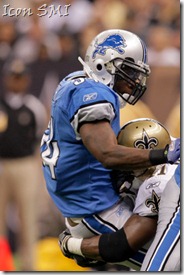
2009 September 13: Detroit Lions running back Kevin Smith (34) is hit by New Orleans Saints linebacker Jonathan Vilma (51) during a 45-27 win by the New Orleans Saints over the Detroit Lions at the Louisiana Superdome in New Orleans, Louisiana.Being a sports fan in 2010 is much, much different than it was in 2000, and much, much, much different than in 1990.  Our access to surging torrents of information, in real time, all the time, everywhere, has shrunken our attention spans and shrunken our perspectives.  Not too long ago, our sports information was found only in agate type on page D7, and our sports opinions were informed only by beat writers, columnists, and Jack the Sales Guy who you always see at the coffee pot on Mondays.  If you wanted to know which camp bodies the Lions had released—and you wouldn’t know who they were to begin with—you’d have to wait a day, and bring your magnifying glass.
It’s no wonder, then, that this time of year always strikes me as odd; great raging debates are had over who deserves the last few spots on the roster—when the last eight guys on the roster, by rule, can’t even dress for games.  Moreover, if there’s anything we should know about these Lions, it’s that being on the final 53 doesn’t mean you’re safe for any length of time.  Literally, hundreds of players have worn Honolulu Blue since Martin Mayhew took over as GM; Guy #53 might be out on his tail the instant some other team cuts a slightly more interesting player.

Imagine my surprise when, in the wake of his lackluster performance against Cleveland, people started calling for Kevin Smith’s job.  He’s done, they say.  He’s hurt, they say.  DeDe Dorsey looks really good, they say.  What good is he?  Why waste a roster spot on Kevin Smith?  I’m reminded of a famous quote from Charles Babbage, when asked if his “difference engine” would produce a correct answer when given incorrect inputs:

"I am not able rightly to apprehend the kind of confusion of ideas that could provoke such a question."

Yes, it’s true, Kevin Smith does not look like his typical self—and yes, it’s true that his “typical self” was just a step short of being a complete feature back.  Kevin Smith might be four-to-eight weeks away from being the back that ran 238 times for 976 yards—on the worst team of all time, just two years ago—but a sense of perspective on what that means, please.  Smith ran for more yards in the first five games of his rookie year than DeDe Dorsey has in his first four years in the NFL.

It’s true that the Lions won’t carry five tailbacks and Jerome Felton; as I believe Felton’s a lock at least one, and probably two, tailbacks must go.  Dorsey is an easy cut.  Yes, he’s looked good in preseason, but then so did Tristan Davis; you can sign a DeDe Dorsey during the season if you need to.  For that matter, they may be able to re-sign Dorsey himself!  Aaron Brown is a great special-teamer, and shows true explosion out of the backfield; he’s more than worth keeping around to see what he becomes.  However, he’s far too unreliable in protection to serve as a true #2 tailback.  The question then, is do the Lions cut Smith, cut Morris, or carry four?

I’ve championed Maurice Morris for quite a while; I even argued that his running last year obviated the need to “waste” a high draft pick on a co-starter for Kevin Smith.  However, Morris isn’t the blocker Smith is, and doesn’t have the vision Smith does.  Morris runs hard, and is an underrated athlete—but when Smith’s at his best, he’s a complete tailback;  he runs like a slower, stronger Jahvid Best.

As I said during my guest spot on “The Knee Jerks” internet radio show, Jahvid Best is probably the best reason to keep Smith around, because they run in a similar fashion.  There’s no need to custom-tailor the offense around each back, or change up the playcalling.  When both are healthy, they can simply spell each other, complement each other, sub in and out without skipping a beat.  Best will always be more explosive and more dangerous, Smith will always be stronger, and likely the better blocker—but over the next few years, I see them as an excellent complement to each other.

The question, then, is whether or not the Lions want their #2 tailback to simply be a Guy In Case Of Emergency.  If all they need is a guy they can run out there when Best is too tired to continue, or (God forbid) hurt, Morris will do just fine.  If they intend to have Best be 1A to someone else’s 1B, a cohabitation that would keep Best fresh and explosive for 15+ carries while also keeping a rookie off the field when Stafford needs protection most, then Smith should be that back.

Ultimately, though, every choice is weighed against another.  With Jack Williams’ PUP listing, and Amari Spievey’s switch to safety, there are eight cornerbacks and six safeties on the roster.  If Kevin Smith is kept, one member of the pile of bodies that is the defensive secondary might be yanked out from underneath the others.  Seriously, ask yourself: who will provide the most value to this team?  Kevin Smith, or Ko Simpson?  Kevin Smith, or Dante Wesley?  I know what my thinking is in that situation, but I can’t be so sure of The Grandmaster’s—or even Smith’s.

The Free Press’ Carlos Monarrez quotes Jim Schwartz like so:

"Kevin's a very, very smart football player, and he's going to do the right thing," Schwartz said. "He's got a lot of trust from those things. He just needs -- and it's not so much earning our trust -- he just needs to get his own trust with his knee and everything else.”

“I've known a lot of people to come back from knee injuries and they need to get to the point where it's not even on their agenda anymore; they don't think about it when they're out there. That's a long process. That's not an overnight thing. So he's still working that way."

It sounds like the problem at this point isn’t whether or not his knee is healthy, but whether or not he trusts it yet.  That’s good: once Smith regains that confidence and stops thinking about the knee, he’ll be the Kevin Smith that should be that 1B tailback.  That’s also bad; he might never regain that confidence—and for a tailback whose value is in running hard and blocking strong, playing hesitantly means not playing at all.


Read more...

Three Cups Deep: . . . It Is Finished

>> 1.04.2010

 The Lions' season is officially over.  Their 2-14 campaign fell just short of media expectations, and well short of fans’ hopes.  For what it’s worth, I believe that if Matthew Stafford had been able to play all 16 games at 100%, the Lions would have won several more—but at this point, that’s completely meaningless.
We saw what Daunte Culpepper’s checkdown mania can accomplish when the game is close, and players are making plays around him: caretaking, game-managing, not-losing.  However, that isn’t enough to keep pace with a team whose quarterback can actually push the ball downfield and make plays.
There was one other bright spot in the game yesterday, besides Megatron’s perfectly-executed fade: Maurice Morris.  Morris had 16 carries for 65 yards (4.06 YpC), and caught 5 more balls for 41 yards.  He looked really effective; he ran with burst and drive.  Aaron Brown also contributed a few very nice plays—the Lions ran for exactly 100 yards with 25 carries.
Unfortunately, the defense made the running game completely irrelevant.  On back-to-back forth quarter drives, they surrendered two ~50-yard plays that precipitated 17 Bears points in the final ten minutes of play.  Culpepper couldn’t cash in from the Bears’ 14, Derrick Williams fumbled a kickoff, and that was that.
These two facts throw two monkeywrenches into the current ‘hot topic’ of the Lions’ fandom: “Which runningback will the Lions pick up to replace Kevin Smith?”  From drafting C.J. Spiller with the #2 overall pick, to kicking a late-rounder to Baltimore for Willis McGahee, suggestions on how to acquire a new starting tailback abound.
Am I missing something?  Kevin Smith was drafted at the top of the third round two years ago, has been very productive in each of his first two seasons, and will be at full speed by midseason next year.  His top two backups are under multi-year contracts, and have looked good in relief.  Further, the Lions have had the worst defense in football for two consecutive seasons!
Here's the ugly truth: the Lions could add a Spiller, a McGahee, Adrian Peterson—last year’s Greatest Runningback Ever—or even Chris Johnson, this year’s Greatest Runningback Ever, and it wouldn’t matter.  In every game this season, the Lions have had to abandon the run no later than the third quarter.  Barry Sanders could walk into Allen Park and ask for his job back tomorrow, and Matt Stafford would still be asked to throw fifty times a game in 2010.
No, the Lions cannot waste a draft pick, or any significant money, on a halfback.  Defensive line (x2), defensive back (x3), offensive guard, and wide receiver are all desperate, red-alert level squeaky wheels—they will, and should, get the grease.
This going to be a very un-interesting offseason.  Last year, from the final gun of the final game, anything and everything about the Lions was in question.  The front office, the head coach, the assistant coaches—all of it, everything.  Even as answers to those questions resolved, everything else got shaken up: the logo, the uniforms, over half of the roster.
This season, though?  There will be no shakeup, no destruction.  The front office is in place, the coaches are in place, and the direction is set: forward.  All the Lions have to do is add talent.  To be themselves, only better.  To learn how to win.  To get bigger, stronger, faster, tougher, smarter.  To grow up.
dominic_lions_fixOh, and preseason predictions, based on game-by-game breakdowns?  I told you all they’re completely useless wastes of time.

Read more...

  © Blogger template Simple n' Sweet by Ourblogtemplates.com 2009

Find us on Google+

Back to TOP