Old Mother Hubbard: The Defensive Ends

>> 2.02.2012

Pantry

From last year’s Old Mother Hubbarding of the Lions defensive ends:

Cliff Avril was pigeonholed by most as a 3-4 ROLB, and I’m certain he could shine in that role. But he’s developed into the fast, athletic 4-3 rush end Rod Marinelli thought he could be. Avril will never be a 270-plus-pound, two-way monster—but he’s already an impact defender, top-flite pass rusher, and a huge part of this defense going forward. Signing this RFA to a long-term deal must be a top priority.

Kyle Vanden Bosch is the ultimate leader, a consummate professional—and as a player, the yang to Cliff Avril’s yin. Had he stayed healthy, he would have had seven sacks and fifteen QB hits, more than acceptable standalone production, besides the undeniable halo effect. Unfortunately, he’s 32, and recovering from a major neck injury. The Lions need to find a starting, impact, two-way end to replace him by the 2012 season.

Lawrence Jackson produced like an above-average starter in heavy rotation, and fron Week 10 on was one of the better 4-3 DEs in the game. I’ll hold off on anointing him the starter of the future for now, because I’d like to see more consistency—but there’s no doubt he’d be the perfect physical fit for the void KVB will eventually leave.

Willie Young is a developmental prospect with a very lean frame, a long way to go, and an undeniable knack for playing football. I hope he has a place on the roster for next season.

And then, the shopping list:

The Lions will need to find an impact two-way defensive end, ready to replace KVB as a starter by the 2012 season. Lawrence Jackson has the potential to be that end. Cliff Avril is an RFA who must be re-signed to a long-term deal. The Lions may look for a developmental speed-first end behind Avril, especially if Willie Young does not take major strides in the offseason.

It's important to restate the design goals of the Lions defensive line: to get consistent, excellent pressure from the without assist from the blitz. To have a pair of bookend DEs rushing from wide alignments, fast enough to turn the corner and strong enough to set the edge against runs and screens. To have two defensive tackles who can rush the passer up the middle of the pocket, one of whom can also collapse the running lane between himself and the nine-technique DE. Most importantly, to have depth all across the line, making sure the above design requirements are fulfilled for four quarters each of sixteen (-plus) games.

Now, that in mind, let’s look at the data:
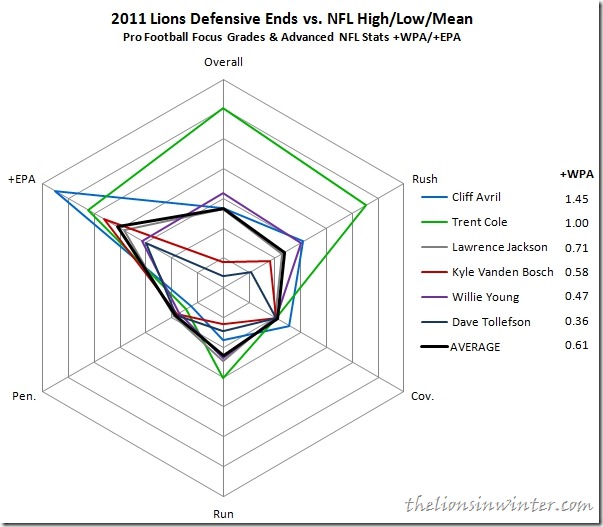
detroit_lions_defensive_ends_2011_grades

For the second straight year, Philadelphia’s Trent Cole is the highest overall PFF-graded 4-3 DE. With the #1 overall pass-rush grade of +40.4, and the 11th-best run-stopping grade at +10.3, Cole fulfilled his responsibilities in the Eagles’ own wide-9 alignment perfectly. His two-way dominance was so complete, he kept his top overall mark despite being called for seven penalties in 640 snaps. Interestingly, Cole’s 1.00 +WPA is only ranked 23rd, and his 32.3 +EPA is 27th. For all his consistently positive play, Cole didn’t help the Eagles win much. May have something to do with the rest of the defense behind him.

Bringing up the rear is the New York Giants’ Dave Tollefson, whose –9.4 rush grade and –5.5 run-stopping grade put him at the bottom. His 0.36 and 10.0 +WPA and +EPA rank him 79th and 86th, respectively, out of 125 defensive ends ranked by Advanced NFL Stats.

Important note: Pro Football Focus separates linemen into DT/NTs, 4-3 DEs, and 3-4 DEs. Advanced NFL Stats has one bucket each for DTs and DEs. The two sites do not always agree on who is what.

Cliff Avril is another example of why I added+WPA and +EPA to these radar charts. When you add up all his positive, negative, and nothing-in-particular plays, he’s an average NFL defensive end. His +6.6 overall PFF grade almost exactly matches the NFL average of +6.5. That includes a pretty heavy ding for 11 assessed penalties, but a major boost from his linebacker-like coverage skills (+5.5). His pass rush grade is solid, ranked 19th overall at +11, but confusingly low for a guy who had 12 sacks, 8 hits, and 37 pressures on 822 snaps (one of those pass rush events per 14.7 snaps, 15th-best rate in the NFL).

For comparison, Trent Cole had 11 sacks, 11 QB hits, and 44 pressures on 640 snaps, one every 9.55 snaps (2nd-best). For further comparison, Jared Allen had 24 sacks, 8 QB hits, and 34 pressures on 1044 snaps—one every 15.8 snaps. Just putting that out there.

So from looking at just the PFF grades and stats, we’d mark Avril down as an average overall defensive end, pretty good at rushing the passer but otherwise mediocre. Then, we look at the +WPA and +EPA and whoa.

Avril’s +EPA is an excellent 45.1, 11th-best in the NFL; that’s well ahead of Cole’s 32.3 (Jason Pierre-Paul’s is tops at 83.4).  His +WPA is an outstanding 7th overall, at +1.45. The discrepancy comes from his impact plays: 4 passes defensed, 6 forced fumbles, 7 TFLs, and an interception. In terms of +WPA, it’s his knack for making big plays at the right times. He helped the Lions’ win-loss bottom line 45% more than Trent Cole helped the Eagles’.

Just as with the defensive tackles, we see Lions defensive ends—as a rule—make big plays when they matter most, far out of proportion to the rest of their production. Avril, though, takes that to the extreme. Keep in mind, he’s doing it from the left side, too: going against bigger/stronger right tackles and often in the quarterback’s field of vision. Imagine if he were working the blind side . . .

Bottom Line: Cliff Avril, in this system, plays like a top ten defensive end. If he is not re-signed, his production and playmaking ability will not be easily replaced—and his production and playmaking ability is essential to the success of the defense. His re-signing must be the Lions’ top priority.

Willie Young, a.k.a. The Great Willie Young, might indeed be the son of a panther god. His +11.7 overall PFF grade would be the highest of any Lions DE, if his 259 snaps weren’t just a few too few to qualify. His +10.2 pass rush grade is just behind Avril’s +11.0, and his run-stopping grade is far superior, +3.7 to –2.5. In a huge surprise, the not-as-spindly-as-he-used-to-be Young’s run defense was better than all but Lawrence Jackson’s.

Again, this is on limited snaps—and that cuts both ways. Young makes fantastic plays whenever he’s in the game, but he’s in the game most often when the situation is ripe for him to make plays. His 3 sacks, 4 hits, and 19 pressures put his snaps-per-pass-rush at 9.96 which would be third-best in the NFL if he’d played just thirty or so more snaps.

I believe that’s at least part of Trent Cole’s story above: he played 182 fewer snaps than Cliff Avril, and I’d be willing to bet a good chunk of “negative” plays were eliminated because of it. It’s a lot easier to be great against the run when you only have to do it on 2nd- and 3rd-and-long . . .

Still, Young’s +11.5 EPA and +0.47 +WPA speak to just how effective he was when he was in. The average +WPA for qualifying DEs was 0.61, meaning that in just 259 snaps Willie Young helped the Lions win almost as much as an average starter. Nobody put much stock in a sub-260-pound all-legs-and-no-torso seventh rounder developing into a vital contributor, but Young’s already there in just his second year. How much better can he get?

Bottom Line: Willie Young has proven his worth as a rotational end, and should be a big part of the picture for 2012, his make-or-break year. If he can shoulder an increased workload without his rate stats falling off, he’ll be every bit the player Cliff Avril has been. That is an enormous “if.”

Lawrence Jackson had an outstanding 2011, producing at the same level as Avril and KVB when he got reps. The natural big-bodied run-stuffer Avril isn’t, he seemed destined to take over on the left side as Avril transitioned to the right rush end spot.

Instead, Jackson played almost exclusively on the right side, in relief of KVB. He struggled against Tampa Bay, but had strongly positive games in Weeks 2-5. His season crescendoed on Monday Night Football, with a +3.4 overall grade (1 sack, 1 hit, 2 pressures on just 31 snaps). After that game, however, Jackson had three flat games before Week 10—where he graded out very well and suffered a deep thigh bruise that would bench him until Week 16.

You can’t help but feel like Jackson missed his opportunity to stake his claim as the Lions’ third-now-and-second-soon DE. However, Jackson’s 18.4 +EPA is a very positive sign; he nearly matched the NFL average of 21.07 with just 341 snaps. His 0.71 +WPA is an even better one: with less than half the snaps of a typical starting DE to work with, Lo-Jack contributed more to the Lions’ winning games than some other teams’ starters . . . unfortunately, that includes the Lions’ Kyle Vanden Bosch.

Bottom Line: Lawrence Jackson had a chance to prove to the Lions they were set at this position for years to come. Instead, his deep thigh bruise—and midseason lull—leaves us no closer to knowing if he’ll be ready to step in for KVB as a full-time starter when the time comes. However, he also flashed enough of that Secret Superstar form to prove he can play as well as anyone in the NFL when he’s “on.” Like Willie Young, 2012 will be his make-or-break year.

Kyle Vanden Bosch had a fantastic bounceback year, right? With 8 sacks, 6 QB hits, and 26 pressures, this was his best statistical year since the glory days of 2008. Unfortunately, he had a beefy 777-snap workload, meaning he only generated pass rush on one of every 19.4 snaps—35th-best in the NFL and below the 19.0 NFL average.

Vanden Bosch's -11.3 overall PFF grade is absolutely mortifying; it's the fourth-worst in the NFL. He was graded at –1.9 in the pass rush, definitely below the NFL average of +2.5. His run-stopping grade, however, was through the basement: –7.9, worse than everyone but St. Louis’s Chris Long. We saw this time and time again in the games: Vanden Bosch overpursuing like a maniac, and opposing teams scheming to take advantage.

Vanden Bosch improved in this area throughout the season. He got dinged with strong negative run-defense grades in Weeks 2, 3, 4, 6, and 7, but only once more after that. Unfortunately, that coincided with a huge dropoff in his pass-rush productivity. He had only one negative pass rush grade in the first ten games, then was in the red for Weeks 12, 13, 15, and 16.

KVB is the only Lion DE not to add Win Probability far beyond what his snap count and production would project: Despite those 8 sacks, he almost exactly met the NFL average with 0.58 +WPA. His 26.30 +EPA is solidly above-average, but that just highlights the fact that he got it done more often when it didn’t matter than when it did.

Bottom Line: Kyle Vanden Bosch’s time as a premier two-way defensive end is over. His heart, desire, toughness, and leadership are unquestionable, but he’s simply not getting it done as well or as frequently as the rest of the defensive ends. Without finding the fountain of youth, he cannot start and play the majority of every game in 2012 or the defense will suffer for it.

SHOPPING LIST: The Detroit Lions have some serious decisions to make at the Defensive End position, and have little information to go on. Kyle Vanden Bosch must recover his youthful form or play a reduced role in 2012. Cliff Avril is a proven game-changer but not under contract. Willie Young and Lawrence Jackson have played extremely well in limited time but are not proven full-time performers.

If the Lions have complete faith in Young, Jackson, or both they are set for defensive ends. If not, they need to acquire a defensive end who can step in and play at least as well as Vanden Bosch, if not better, in 2012.

Read more...

Nike Detroit Lions Uniforms: Threat or Menace?

>> 1.30.2012

The Detroit Lions' Nike Pro Bowl Vapor Jet gloves

Nike premiered their Vapor Jet NFL gloves at the 2012 Pro Bowl. These are the first taste of the new 2012 uniforms that Nike will be supplying all teams, and . . . yikes. Those hoping Nike just translates the current classy, unmistakably Lions uniforms—like me—must immediately begin flop-sweating. From the official @usnikefootball Twitter account:

nike_football_twitter“Just the beginning.” Sends a chill down my spine. “If you were feelin the new Cleats and Gloves tonight,” Nike says, “download the Nike BOOM app fast for the next exclusive reveal.” Love that they had Suh model the BOOM app, but I’m mortified by what they’re going to do to the Lions image.

I know a lot of you out there don’t get my whole uniform fascination, but it’s important. We’re fans of the Detroit Lions, a franchise with eighty-three years of tradition. Everyone loves the Lions throwbacks—but you know what? Our “throwbacks” are as old as anyone’s and they’re still recognizable as Lions uniforms.

As legendary and venerable as the Packers franchise is, when they go to their primordial closet they don these eye-bleeding monstrosities:

green_bay_packers_throwback_uniforms My eyes! The goggles . . . they do nothing!

Not only are those duds hideous, they're totally urecognizable as belonging to the Green Bay Packers.

Except for one weirdo year the Lions hired Indiana University's coach and he forced red uniforms on the team, the Detroit Lions uniforms have been unmistakably the Detroit Lions uniforms for the better part of a century. The formula is simple: Honolulu blue plus silver.

Sure, maybe you add or remove some stripes, some trim, some black or gray or white, but the basic formula never changes. The result is both classic and iconic, modern and timeless. The current home unis are great, and the away whites are some of the best-looking uniforms on the planet. I mean, come on, here’s my authentic Matthew Stafford home jersey:

Matthew_Stafford_Detroit_Lions_Jersey

It’s gorgeous. It doesn’t need mesh patterns or interlocking filigreed zigzags or faux carbon fiber textures or Serengeti-themed artwork inlaid in mesh on the back. It doesn’t need 67 seams holding together 23 patches of various size, shape, and contrasting color. It doesn’t need to be a canvas for some Nike design team’s furious ideation brainstorm.

It just needs to be Honolulu Blue and silver.

Tell that to Nike on Twitter at @usnikefootball.

Read more...

Old Mother Hubbard 2012: The Defensive Tackles

>> 1.27.2012

pantry_overflowing
The Old Mother Hubbard series takes stock of what goods the Lions have left in the larder; i.e. the assets they have going forward. We’ll assess each player the Lions will likely bring to training camp. By tradition, we start with the defensive tackles and move away from from the ball. Here’s what last year’s Old Mother Hubbard had to say about each defensive tackle the Lions will be bringing forward:
Ndamukong Suh:

An incredible physical talent, with almost unlimited upside. As a rookie, he performed like an above-average starter, while carrying the heaviest workload in the NFL. If he continues to improve, Suh will become one of the best in the NFL—and maybe one of the best ever.
Sammie Hill:
A natural big body who is slowly fulfilling his top-flight physical potential, Hill will remain a big part of the Lions’ rotation as his technique and body develop.
Corey Williams:
Williams was a two-way force for the Lions in 2010, and an incredible addition to the roster. With his natural size (6’-4”, 320 lb.), great acceleration, and sometimes-too-quick snap anticipation, Williams is a difficult assignment for any offensive lineman. It would be really, really, really nice if he could cut down on the penalties.
Nick Fairley, of course, was not around to OMH, and Andre Fluellen is an unrestricted free agent whose time seems to finally have come. Let’s see how Suh, Hill, Williams, and Fairley stack up against the league high, low, and average:
image
Ndamukong Suh is the perfect example of why I decided to add Advanced NFL Stats WPA+ and EPA+ data to this analysis. You can see that solid down-to-down run-stuffing combined with few-to-no penalties results in an extraordinarily high PFF grade, as with like the Jets’ Sione Pouha. Though Suh is the highest-graded pass rusher of this group at +8.6 (avg. -0.76), Suh’s overall grade is barely above league average at +3.3 (avg. +2.13).
This describes something true about Ndamukong Suh’s play: his -1.7 rush grade (avg. +2.45) means that most of the game, he’s doing a mediocre job of run stuffing and “pass coverage” (screen-sniffing-out). This is where EPA+ and WPA+ come in.
As Brian Burke of Advanced NFL Stats explains, EPA is a statistic that measures the Expected Points Added on offense: for each play made, how many points is that play worth (in his mathematical model)? Defensively, Burke measures performance with +EPA: he adds up “the value of every sack, interception, pass defense, forced fumble or recovery, and every tackle or assist that results in a setback for the offense.”
+EPA captures the positive impact a player has on his team—his playmaking ability. Generally speaking, the more and more-positive plays a player makes, the better he is relative to players who make fewer plays. To borrow a phrase, this accentuates the positive and eliminates the negative; +EPA can’t possibly measure defensive plays not made (Suh getting trap-blocked out of a play, for example).
There is an obvious connection between +EPA and high overall performance: Sione Pouha has the highest overall PFF grade, and the 6th-highest +EPA. But while Ndamukong Suh ranks 33rd in overall PFF grade, he’s 8th in +EPA. Suh is a “plus player,” to use scout’s parlance; he makes a dramatic positive impact on his team and the game.
Now, we turn to Win Probability Added. Again, Burke:
The model created here at Advanced NFL Stats uses score, time, down, distance, and field position to estimate how likely each team will go on to win the game. For example, at the start of the 2nd quarter, a team down by 7 points with a 2nd down and 5 from their own 25 will win about 36% of the time--in other words a 0.36 WP. On that 2nd down and 5, let’s say there is a 30-yard pass, setting up a 1st down and 10 on the opponent’s 45. Now that team has gone from a 0.36 to a 0.39 WP. The WPA for that play would be +0.03.
EPA+ measures the expected points added by a defender’s positive plays, and WPA+ measures how much more likely a defender’s team is to win a game because of the positive plays he made. It makes sense that there’s a very high correlation between EPA+ and WPA+ (for this year’s DTs, it’s an r-squared of 0.883), but what WPA does is emphasize the game situation. A sack on 3rd and 6 is huge, but a sack on 3rd and 6 when you’re up by three late the 4th quarter is a lot huger than the a sack on 3rd and 6 when you’re up by 14 in the 1st.
So, back to Ndamukong Suh. He’s tied for eighth in WPA+ with 1.09; Pouha is 16th  at 0.86. But wait, how can Suh have had a bigger positive impact on the Lions’ chances to win than Pouha, when Pouha’s PFF grade was literally ten times higher? WPA+ is a descriptive stat; it describes what happened in context—and in the case of defensive players, only describes their positive plays. Pouha was a devastatingly effective run-stuffer this year, and that’s it. He didn’t rush the passer, he didn’t pick off passes, he made tackles whenever they ran near him and didn’t screw up. That’s a formula for very high PFF grade, pretty high EPA+, and very good WPA+; exactly what we see.
There’s been a lot of talk about Suh’s reduced production this season. By PFF reckoning, he went from 11 sacks to 5, and from 48 tackles to 26. That came partially because of his lightened workload: in games he was active, he played 77.9% of snaps (of course, he was suspended for two games). In 2010 that figure was 90.4%.
The missing piece of the puzzle: stats that are not sacks. In 2010, Suh had 24 pressures and 6 QB hits. In 2011, Suh actually had more pressures, 27, and 4 QB hits despite being on the field for 224 (22.5%) fewer snaps. Suh actually had a sack, hit, or pressure more frequently in 2011 (avg. one per 22.1 snaps) than in 2010 (per 24.3 snaps).
Bottom Line: Ndamukong Suh is a fast, powerful pass-rushing tackle who impacts games about as dramatically as any DT in the NFL. His physical tools and competitive drive allow him to make huge plays at critical moments. His habit of taking bad personal foul penalties has come to a head and been addressed. His down-to-down consistency and run-stopping is improving, if slowly. In 2012, he needs to continue developing if he wants to reach his unlimited potential. 
Sammie Hill had a 437-snap workload in 2011, and graded out at +2.5 overall, slightly above average. That’s a step down from 2010, when he received a +11.5 mark. From what I’ve seen on tape, they used Hill as the primary run-stopping tackle this year, and opposing lines are respecting that with double-teams. Hill is still learning how to handle this newfound attention, often getting dominated at the point of attack then using his strength to recover. His run-stopping grade went from +4.1 in 2010 down to +1.5 in 2011.
But like Suh, Hill had a positive impact much bigger than his PFF grade would suggest. His +WPA was 0.72, ranked 21st of 130 defensive tackles (and well above the 0.425 league average). His +EPA was 21.1, ranked 28th and nearly splitting the difference between Suh's 33.1 and the NFL average of 14.5.
Looking at the radar chart above, it's hard not to notice the Lions DTs hugging tightly to the NFL average in PFF grades, but flying way out towards the maximum in EPA+.
This confirms everything we think about the design of the Lions defense: they coach the linemen to get upfield and make plays, at the expense of typical DL responsibilities. Graded by traditional expectations of defensive linemen, they are mediocre. Graded by how they impact the game, they are outstanding. The whole picture takes both perspectives into account.
Bottom Line: Sammie Hill's is a powerful run-stopping DT with surprising athleticism. His role is growing, and his body and technique must scale with the challenge of his new responsibilities. He must learn to anchor against, or split, double-teams in the run game to take the next step.
Corey Williams needed to cut down on the penalties; he did, from 15 flags drawn in 2010 to just 8. However, he also cut down on the pass-rushing effectiveness. He went from a +9.2 PFF pass rush grade in 2010, down to -2.6. While his coverage and run-stopping grades held steady, cutting his penalties half only made him tied with Suh for third-most penalized DT in the NFL. His 0.5 +WPA and 13.8 +EPA closely match the NFL average for those stats, in a system that maximizes those metrics for DTs.
The ridiculous number of flags tossed his way were worth it when he was a dominant two-way player, not so when he's the least-effective pass rusher on the team. This is his contract year; I would not be surprised if 2012 is his last season in a Lions uniform . . . or if 2011 was.
Bottom Line: Corey Williams had an incredible 2011, arguably a better all-around performance than Ndamukong Suh's studly rookie year. But his pass-rushing performance fell off the face of the Earth when he stopped jumping snap counts, and he's still penalized far too often. If he does not recover some semblance of his 2011 form, he should (and will) be replaced.
Nick Fairley was a DT prospect nearly as beguiling as Ndamukong Suh; after the 2010 bowl season he was the consensus No. 1 overall prospect. Questions about his short on-field track record, his struggle with grades, and his off-field choices lingered, as did those about his long-term commitment to excellence. In the short term, it appears "excellence" is what he's all about.
His 236 snaps were just barely shy of PFF's 25% minimum threshold. If you discount that, Fairley was the Lions' top-graded overall defensive tackle in 2011. His pass rush, pass coverage, and run-stopping grades were all nicely positive, though he was assessed three penalties in those snaps, a poor rate going forward.
Fairley breaks the mold for Lions defensive tackles: he is consistently outstanding in every traditional phase of the game, nearly every down he plays. However, his low snap count and his lack of pursuit game have prevented him from generating enough "flash plays" to shine in metrics like +WPA and +EPA. This will change.
Bottom Line: On the field, Nick Fairley was everything the Lions could have asked for. His size, power, and desire to be great showed through every time he stepped on the field. Unfortunately, a foot injury slowed him at the beginning and end of the season. If he can stay healthy, and continue to develop his "country strong" physique, he could be a monster in 2012.
Overall, the Lions defensive tackles look deep and strong for 2012. Suh and Hill retrenched a little in 2011, but in the context of added responsibility. In very limited time, Nick Fairley was no less dominant in the NFL than in college. Corey Williams, though, had a relatively awful year, and the Lions must make a decision about him.
The Lions need three strong tackles to rotate, and a fourth for depth/development. If Williams is no longer a part of the top three rotation, he could be let go in favor of someone younger. Then again, if he's let go Hill becomes the graybeard of the group at 25. The Lions would also then rely on Hill to realize his potential as a dominant one-technique DT. The Lions may want to keep Williams for his veteran presence, if nothing else.
SHOPPING LIST: Nothing needed here, unless the Lions choose to jettison Williams in favor of someone younger/cheaper.

Read more...

  © Blogger template Simple n' Sweet by Ourblogtemplates.com 2009

Find us on Google+

Back to TOP