Showing posts with label doug hogue. Show all posts

Breaking Down Harvin’s Return Touchdown

>> 10.02.2012

This is an excerpt of my weekly film breakdown of the week’s biggest plays over at Bleacher Report, for your edification and edumacation:

On a day when the Vikings managed only six offensive points, Percy Harvin’s runback of the game’s opening kickoff provided the margin of victory. The Lions took a brutal home division loss, mostly because of this play:

According to MLive.com's Justin Rogers, Vikings head coach Leslie Frazier said it was a victory of Xs, Os and film study:

I remember in our first special teams kickoff return meeting we saw some things, and we pointed out that if everybody held their blocks, Percy's going to score. I mean, it was obvious. There are some things that we saw if we just held our blocks and our guys did it. They leveraged the football. They got where they needed to be and Percy did the rest.

Let's see if we can see what they saw.

Film breakdown of Percy Harvin's kickoff return touchdown against the Detroit Lions, in 2012 NFL Week 4.At the kickoff, we see nothing unusual. The Lions are lined up conventionally, and so are the Vikings. But by the time the Vikings finish retreating, some things take shape:

Film breakdown of Percy Harvin's kickoff return touchdown against the Detroit Lions, in 2012 NFL Week 4. Slide 2.Doug Hogue and Stefan Logan were set up as the second- and third-leftmost players, but by now Hogue's inside the hash mark and Logan's nearly so. The Vikings have paired up into their two two-man wedges (the most allowed by current NFL rules), but are also double-teaming Hogue.

Film breakdown of Percy Harvin's kickoff return touchdown against the Detroit Lions, in 2012 NFL Week 4. Slide 3.

The key here is No. 34, Keiland Williams. He was initially lined up five yards outside the left hash, but in order to avoid former Lions fullback Jerome Felton's block, Williams dances to the outside of the right hash. The Lions' fate, and Williams, is sealed by Felton.

Hogue can't beat the upfield double-team, and one wedge takes out No. 97, Ronnell Lewis. The other wedge splits up; one man seals Logan, while the other, Matt Asiata, splits off to block the widest Lion, Jonte Green:

breakdown_harvin_4This creates the lane Harvin eventually runs through, having sprinted on a steep angle from the far right corner. Incredibly, one Lion does his job and then some. Special teams captain John Wendling:

breakdown_harvin_5

Wendling was lined up all the way to the right, but he shadowed Harvin's sprint to the left around all his blocked-off teammates. He has neither the angle nor the speed to make a play, though, and Harvin races off to the end zone untouched.

The Lions overcommitted to the right and didn't penetrate deep enough downfield to prevent Harvin from beating them far to the left. The Vikings knew exactly who they had to keep from making the play, and they made sure they had more than enough beef in place to block them.

That's the power of breaking down film.

For the Lions, this seems to be a coaching failure: the Lions have “obvious” flaws in their approach to covering kickoffs, and Vikings special teams coordinator Mike Priefer (yes, longtime Lions STC Chuck Priefer’s son) had no problem exploiting it.

However, note the big “if” in Frazier’s statement: “We pointed out that if everybody held their blocks, Percy's going to score.” The Vikings double-teamed the two guys with the size and speed to blow the run up: Doug Hogue and Ronnell Lewis. Keiland Williams is next biggest/fastest, and he got assigned the strongest single blocker, Jerome Felton. The Vikings knew nobody else would tackle Harvin, especially if he made sure to get away from Wendling.

What this means is that it's also a failure of execution: the three beefiest Lions couldn't overcome the stiff blocks, nor could any of the other Lions get free to make a play. In all three phases of the game, the Lions are coaching to execution; they expect the talented players to make plays. When they don't, it looks like bad coaching, as in here. The question is, can the Lions coaches scheme up good performances out of okay special-teams talent? Or should they try and upgrade the talent?

At this point in the season, the latter's almost impossible--which means, the former had better happen fast.

Read more...

Old Mother Hubbard: The Outside Linebackers

>> 2.14.2012

justin_durant_detroit_lions_outside_linebacker

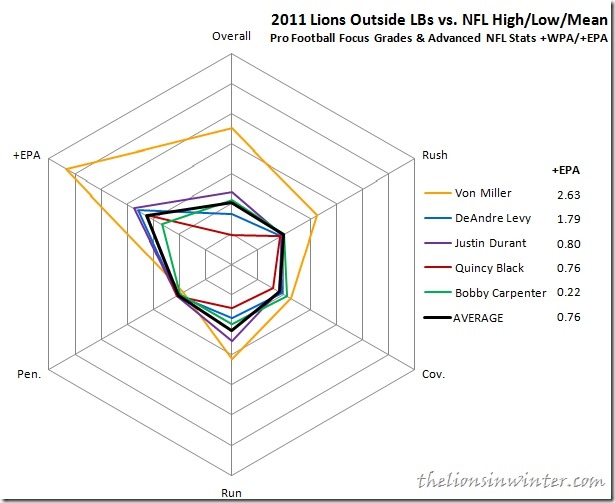
The outside linebackers saw some churn this season, with DeAndre Levy sliding over full-time from the his prior inside spot, and newcomer Justin Durant taking most of the snaps on the other side, this group looks much different than it did in 2009. The radar chart looks a lot different, too:
detroit_lions_outside_linebackers_2011_grades

Von Miller was Pro Football Focus’s top-rated 4-3 outside linebacker in 2011, and No. 2 isn’t anywhere close. His +50.3 overall grade is simply massive, and nearly double the second-best 4-3 OLB, Jacksonville’s Daryl Smith (+27.3). His monster pass-rush grade (+25.4) dwarfs the second-best there, too (Kamerion Wimbley, +16.4). Smith has the top coverage grade at +8.7, but Miller is #2 at +5.2. When it comes to stopping the run, Miller is again top dog at +22.6.

At the bottom is Quincy Black, which makes me skittish about my assessment of him last season. Black’s –3.1 rush grade is just below the average of –0.5, but it actually makes him the third-worst run-stuffer in the NFL. This speaks to something I’ve talked about before: the vast, vast majority of 4-3 outside linebackers are virtually indistinguishable in terms of production. There are some at the top, one or two at the very top, and a few at the very bottom. Most of the rest are fungible with each other.

Reminder: Advanced NFL Stats does not differentiate between 3-4, 4-3, inside, or outside linebackers. All "ranks" for +EPA and +WPA are amongst all NFL linebackers.

Here's what last year's Outside Linebacker OMH had to say about the two outside linebackers the Lions will carry forward from 2012 into 2012:

DeAndre Levy is exactly where Cliff Avril was at this point last year: third-round pick from a Big Ten school, battling injuries and switching positions. Levy will have to take an Avrilesque step forward in 2011 to prove he’s a long-term solution to the ILB problem—but even if we get more of the same, he’s not a liability on this defense.

Bobby Carpenter showed he can be a creditable player for the Lions. He’ll never be the pass rusher the Lions want from the OLB spot—but with a full offseason in the system he should be able to pull his weight out there.

Let me qualify that last one: I no longer believe the Lions value pass-rushing as a primary tool in their outside linebackers. From Schwartz and Cunningham’s original comments about the design goals of the defense, I understood Julian Peterson to be the prototype: an impact pass-rusher with size and tools, and “good enough” in run-stopping and coverage.

In 2012, it became obvious that the Lions prefer not to blitz if possible, and instead rely on the linebackers as the primary line of defense against the run. Secondly, they need the linebackers to cover well—if the Lions are rushing four and dropping seven, they’re relying on that back seven to be smothering.

Now, in the Shopping for Linebackers OMH, my take on Justin Durant:

The dark horse of the OLB free agent class is Justin Durant, a 6’-1”, 240-pound wrecking ball from the Jaguars—a wrecking ball with a couple of cracks. Just look at the radar chart above: Durant’s stonking +15.5 against the run is second-best in the NFL. His missed tackle rate, one per 8.1 made, is right in the middle of the pack. This suggests, like Bulluck, Durant is slicing through blocking to get to the correct lanes, over and over and over again, showing veteran savvy in just his fourth year. even if his finishing isn’t top-notch.

There are two big concerns about Durant: one is his inability to stay healthy; he’s missed at least two games in each of his first four seasons, plus six games last season. Second, he graded out as poorly against the pass as he did well against the run. His appalling –13.2 on coverage put him fourth-worst in the NFL, and his –1 in pass rush is below-average, too. He’s allowed a slightly-better-than-average 75.6% of his targets to be caught, and his passer rating allowed is dead on NFL average: 98.6, vs. 98.8 . . . but you don’t earn a –13.2 on only 491 snaps without being consistently poor in coverage. Durant has the physical tools to be an impact player, but so far it’s more potential than production.

Justin Durant is not fungible with any Lions outside linebacker I’ve given the OMH treatment. His +7.8 overall PFF grade ranks him 15th among 4-3 outside linebackers, just outside that second tier. This strongly above-average production is the best I’ve seen from the OLB position in the three years I’ve been charting it.

Pro Football Focus grades take a lot of heat, but Durant’s effectiveness in 2011 strongly resembled that of 2010. Durant plays the way he plays, here or in Jacksonville. He again pulled a double-digit run-stuffing grade, at +10.7. That was the ninth-best mark in the NFL, despite playing only 558 snaps.

Durant has struggled to stay healthy, and this season wasn’t quite an exception. He suffered a concussion against Minnesota in Week 3, and wasn’t able to return until the Atlanta game in Week 7. Other than that, though, he was able to make a major impact on running downs from wire to wire.

When it comes to passing downs, though, Durant is less effective—and he wasn’t on the field often in nickel packages. He was just slightly below average on the blitz, graded at –1.1 (-0.5 avg.). Again, though, that’s not a priority in this defense. The OLBs do need to cover, though, and that’s been Durant’s Achilles heel. This season, he was much improved in that arena: his coverage grade was –4.7 (up from –13.2), despite playing 67 more snaps.

Most of that, however, came in a –3.2 performance against Carolina, where screens to Jonathan Stewart and DeAngelo Williams on Durant’s side went 4-for-4 for 73 yards. When Durant was asked to simply drop back into coverage, he did it at an NFL average level—vastly improved from 2010 and more than good enough for 2012.

Bottom Line: Justin Durant is an athletic, physical run-stuffer with great strength, speed, and instincts. He was mostly taken off the field on passing downs, and mostly average against the pass when he wasn’t.  Overall, he’s given the Lions the best OLB production in the Schwartz era, and should remain a vital part of the defense for 2012. If Stephen Tulloch is not retained, I’d favor sliding Durant inside over acquiring another MLB.

DeAndre Levy did not take an “Avrilesque” step forward this season. Expected to develop into an athletic, hard-hitting, great-in-coverage-but-can-stop-the-run-too MLB, Levy instead yielded that spot to Stephen Tulloch and slid over to the outside. He once again struggled with consistency, mixing flashes of truly outstanding play with stretches of invisibility or even liability.

Levy played 981 snaps this season, doing most of the nickel-linebacker duty. His overall PFF grade of –6.7 is 38th-best, which is unfortunately also ninth-worst. What pushes Levy so far down the list is that he doesn’t do anything particularly well. His –2.4 blitz grade is not that far below the –0.5 average, his –1.7 coverage grade is actually above the –3.1 average, and his –4.1 run-stuffing grade is well below the +3.7 average.

DeAndre Levy not a blitzer, a run-stuffer, or coverage guy. He’s a true all-around linebacker, and when he’s on he’s fantastic. Crucially, he’s been “on” when the Lions have needed him the most. He had three games where he graded out positively in all three phases of play (and strongly positive overall): On Monday Night against Chicago, the following week against San Francisco, and the regular-season finale at Green Bay. Clearly, he has a knack for coming up big in big spots.

If you need confirmation of this, just check out his eye-popping +WPA: 1.79, by far the highest on the team and 11th-best in the NFL. It was high enough for Levy to make the Advanced NFL Stats NFC All-WPA team. ANS's Brian Burke points out that 0.71 of that 1.79 came on the last second sack-fumble of Joe Webb against Minnesota—where Levy singlehandedly changed a probable loss to a certain win.

Even without that play, though, Levy’s +WPA would be 1.08, still best amongst Lions OLBs and 61st out of  198 NFL linebackers. Levy and Durant’s +EPA (32.0 & 34.7 respectively) were very similar too, meaning Levy got more game-changing impact out of the plays he did make. However, the wide disparity in PFF grades shows Durant was much more solid when he wasn’t making splash plays.

Bottom Line: DeAndre Levy is left in limbo, yet again. He continues to show flashes of the player the Lions hoped he’d become, but he doesn’t appear to be significantly better than he was as a rookie. He has the athleticism, intelligence, and hitting ability to be a complete all-around linebacker capable of playing all three positions well—but as it is, he’s a mediocre-to-poor coverage OLB with a knack for making big plays in big spots. Levy will be a restricted free agent this offseason.

Bobby Carpenter surprised everyone with his strong rotational play in 2011, and though his snap count increased in 2012 his play only got stronger. You’d expect a 6’-2,” 256-pound former first-round pick to be a run-stuffer, or a blitzer, but he’s neither. Carpenter is a rare bird: a 3rd-down linebacker in a two-down body.

Those who were paying attention remember Carpenter having a banner day against the team that drafted (and cut) him: the Dallas Cowboys. Besides this ridiculous pick-six, Carpenter was +1.6 against the run, giving him the strongest-PFF-graded game of his career (+3.6).

Unfortunately, he was just as bad (-3.6) against Atlanta as he was good against Dallas, and with Durant, Levy, and Tulloch all healthy Carpenter didn’t see the field much after that, save for 51 unremarkable snaps against Minnesota. His overall PFF grade was an above-average +2.1, which if he’d played another game or two would have made him the 24th-best 4-3 OLB this season. His 25.0 +EPA and 0.22 +WPA accurately reflect his contributions: he didn’t play much, and when he did he didn’t have major impact (I’d bet most of that 0.22 came on that pick six).

Bottom Line: Bobby Carpenter is a a coverage and special-teams specialist who looks like he should be so much more. The Lions have come to rely on him as a steady fourth ‘backer, but he will be an unrestricted free agent.

SHOPPING LIST: The Lions have some decisions to make about their linebackers, and first and foremost is the retention of Stephen Tulloch. If he is not retained, Durant could move inside and the Lions would be shopping for at least one starting OLB.

If Tulloch is retained, Durant should keep his job as a two-down run stuffer, but Levy will need to become much more consistent in pass coverage—assuming, of course, Levy himself is re-signed. My gut tells me he will be; he’s still got too much upside to let walk away.

If Tulloch and Levy are retained, Doug Hogue might be tabbed to fill Bobby Carpenter’s role—or the Lions might re-sign Carpenter, too. Ashlee Palmer should remain a special-teams specialist.

Read more...

Meet The Cubs: Doug Hogue

>> 5.05.2011

12 September 2009:  Penn State QB Daryll Clark rolls out and throws as Syracuse's Doug Hogue (32) hits him as he throws.  Clark threw for 240 yards and 3 TDs.  The Penn State Nittany Lions defeated the Syracuse Orangemen 28-7 at Beaver Stadium in State College, PA.
5.26 (157): Doug Hogue
          Outside Linebacker, Syracuse 

    Deep into the fifth round, the Lions finally “addressed a need.” That is, they finally took a player who plays a position that fans and media identified as a weak spot in the starting lineup. But just taking a linebacker doesn’t mean the “need” has been “addressed;” if a late-fifth-round player stepped off the plane and into the starting line, it’d be surprising. Does Doug Hogue really have what it takes to challenge for a starting role?

Hogue, at 6’-3”, 235 pounds, is slightly shy of prototypical Schwartzingham OLB size. However, he was the fifth-fastest linebacker at the combine, turning in an official 4.63. With that combination of height, weight, and speed, he has a lot of potential. Like Johnny Culbreath, Hogue has the tools to become an above-average NFL player. Unlike Johnny Culbreath, it’s because Hogue’s only been playing his position for two years.

Maybe we should back up. First, I suggest you read this SyracuseFan.com Doug Hogue feature, which gives you a peek into just how long and winding Hogue’s road to the NFL has been:

“Who the heck is that?” Roosevelt High coach Anthony Fiorelli demanded. “Who is that running the ball?”

The answer came from one of the assistants standing motionless in the backfield, his jaw scraping the grass.

“That’s Doug Hogue, coach. He goes to Mark Twain Elementary School. And he’s coming here next year.”

The first play from scrimmage Doug Hogue ever made with the varsity was a run anybody who witnessed it can still recount juke move for juke move.

Fiorelli certainly knew what he was watching. He’d coached three Division I players before. And even as a scrawny 14-year-old, he knew Hogue was destined to be the fourth.

“You just knew it right there,” Fiorelli said. “Even at that age, you knew he was going to play major college football.”

It’s a story Fiorelli loves to retell at every opportunity — not because he can boast some sort of eye for talent, but because its the first chapter of an urban fairy tale.

Hogue grew up into a pretty big boy: 6’-3", 210 pounds by the end of high school. Those moves and that speed in that big of a package is bound to attract attention—and sure enough, Hogue was rated a four-star RB prospect by Scout.com, and a three-star (5.6) by Rivals. He racked up a very impressive offer list of Big Ten and Big East schools, including Michigan and Michigan State. Neither made his top three, however; the Yonkers native went fifty miles along I-95 to Syracuse University.

Hogue was added to the mix at tailback, and in his first two years he tallied 483 yards on 111 carries. Oddly, 77 of those carries came in his freshman season. His role in the offense actually decreased his sophomore year, despite his YpC increasing from 3.26 to 6.63 (4.41 if you take out an 82-yard touchdown run)! Syracuse blog of record Troy Nunes Is an Absolute Magician suggests it’s because Greg Robinson hates Doug Hogue. But the man Michigan fans know as GERG (apparently in Syracuse territory it’s GROB) was axed, and Hogue was moved to outside linebacker after the first spring practice. Per The Cuse Connection, Hogue made an immediate impact:

In his first career start at linebacker against Minnesota in the Dome, Hogue recorded four tackles. Two weeks later against Northwestern Hogue led the defense with 11 tackles, seven of them solo. A week later against South Florida, Hogue added another 5 tackles and his first career sack.

He finished the year with 72 tackles, 49 solo, 16.5 TFL, and 9.5 sacks—6.5 of those TFL coming in one MONSTER game against Rutgers. That performance broke Syracuse’s single-game TFL record—previously owned (in part) by Dwight Freeney—AND earned Hogue the Walter Camp Football Foundation National Defensive Player of the Week. Phil Steele named Hogue to his All-Big East second team, to boot.

In Hogue's second season at linebacker, he switched to the weak side, and took it to the next level: starting all thirteen games, Hogue notched 95 tackles  (60 solo), 10.5 TFLs, and three sacks. He earned Player of the Week honors from both the Big East, and the Walter Camp Football Foundation again with his performance against West Virginia: 10 tackles (8 solo), 2 INTs, half a sack, and a batted pass. By the end of the season, he’d led the defense in tackles four more times, and was named First Team All-Big East.

In just two seasons (25 games) on defense, Hogue climbed his way to ninth on Syracuse’s all-time TFL leaderboard. Impressively, he put on about ten pounds from the start of his senior year to the combine, and didn’t slow down at all (the lower of his two 40 times was a blazing 4.52!). Comments from Hogue’s high school coach just before he committed to Syracuse indicate the Orange didn’t build Hogue’s body out to its maximum potential, either:

“Doug hasn’t touched a weight in his life. He’s incredibly strong from doing natural movements like pushups and pull-ups. Three kids had dislocated shoulders from trying to tackle him last year. His potential in the weight room is insane. I think he’ll end up a 235 pound running back running a 4.4 forty-yard dash. Our school is small. Our starting center last season was 140 pounds. If he played for Christian Brothers Academy in Syracuse, NY, Doug would be one of the top 20 recruits in the nation.”

What are the experts saying?

  • My friends at Sideline Scouting:

    Positives: Athletic and speedy, transitioned from running back to linebacker in 2009... Has pretty good coverage skills for the position... Plays with a lot of passion, tries hard to improve as a linebacker... Had good production in 2009 and 2010, combined for 167 tackles, 12.5 sacks and three interceptions in those two seasons... Shows good quickness and flexibility, hips are pretty fluid... Has very good range, can get sideline to sideline pretty quickly... Does a pretty good job blitzing off the edge and is shifty enough to shoot gaps when blitzing... Has a lot of upside, but will need to continue to work hard to improve as an all-around player.

    Negatives: Doesn't have great size or strength, will need to put on some bulk to make the transition to the NFL smoother... Inexperience at linebacker position shows, does not have great instincts, takes too long to diagnose plays and will get fooled by misdirection plays far too often... Struggles to get off blocks, does not have the size to overpower blockers and disrupt plays... Not the surest tackler, wraps up fairly well but does not have the strength to drag some ball carriers down after contact... Has some minor durability issues (knee injury), size may be some cause for concern in that area... Is still very raw, will likely need some time to adjust at the next level.

  • Pro Football Weekly:

    Positives: Has a frame to carry added bulk. Very athletic with good movement skills, knee bend and hip flexibility. Redirects efficiently. Chases hard and can run and hit. Accelerates quickly, ranges to the sideline and shows burst to close when he sees it. Flashes explosive striking ability and potential as a blitzer. Good character. Stood out at the East-West Shrine Game.

    Negatives: Does not play with pop or power in his hands — only 18 reps of 225 pounds at the Combine. Not stout at the point. Stays stuck on blocks. Speed-dependent as a blitzer. Still developing positional instincts. Most production comes when he has a clear path. Could require extra reps to understand a complex game plan.

    Summary: Undersized, athletic, field-fast, converted running back with starter potential on the weak side in a 4-3 where he could be protected and allowed to flow to the ball. Could require patience but should be able to contribute readily on special teams.

  • SI.com:

    Positives: Athletic linebacker who displays tremendous skill in space. Shows good awareness and instincts to quickly locate the ball. Gets depth on pass drops, displays outstanding skill in coverage, and constantly around the ball. Very aggressive and productive in his all-around game. Fluid pedaling in reverse and smooth opening his hips in transition. Stays with tight ends or running backs down the field, plays with explosiveness, and moves quickly in every direction. Immediately alters his angle of attack and loses no momentum. Breaks down well and uses his hands to protect himself.

    Negatives: Lacks bulk and easily controlled at the point of attack. Gives effort defending the run but not stout at the point.

    Analysis: Hogue showed tremendous improvement the past two seasons and ranks as one of the more underrated weakside linebacker prospects in this draft. In many ways he reminds us of former Syracuse star Keith Bullock, and like the NFL veteran, Hogue should eventually find his way into a starting unit at the next level.

  • CBSSports.com:

    Strengths: Works best in space and to the sideline, scraping to chase down backs before they get the corner. Has a strong safety build and is smooth in coverage of running backs and tight ends from the strong-side position. Gets his hands on a lot of passes by staying home. Good recovery speed when beat on play-action or misdirection. Used regularly on run and pass blitzes, can catch running backs from behind from the backside or wiggle through creases to track down quarterbacks in the pocket. Defeats cut blocks on the run.

    Weaknesses: Lacks strength at the point of attack, losing leverage battles against fullbacks and tight ends and winds up on the ground too often. High-cut defender doesn't always break down easily in space. Ballcarriers can stiff-arm him easily. Does not beat blocks to reach the quarterback when blitzing. Has fair hands but dropped potential interceptions. Had arthroscopic surgery on right MCL/meniscus after an injury in the 2010 spring game.

You see a very, very consistent picture: Hogue’s height, weight, speed and athleticism give him the potential to start in the NFL someday—and he isn’t maxxed out yet. He’s still raw technically, and doesn’t always make use of what size and strength he has. He’s more of a hunter and pursuer than a guy who’s going to meet a ball carrier in the hole and pop him—but this may be due to lack of instincts/experience putting him a step behind at the snap. Still, he’s an excellent pursuer, and if the defensive line can keep blockers off of him—Hello, Nick Fairley!—he should be able to make plays from the weak side soon, if not right away.

But who cares what I (or the experts) think? We appeal to the dispassionate Circuit Court Judge Panel of NFL Potential: YouTube Highlight Reels!! Unlike Johnny Culbreath, there is an Doug Hogue-specific YouTube Highlight Reel:

Next up, two video vignettes featuring extensive player interviews about Hogue's switch to linebacker. The first is from the spring practice where he was switched, and the second was recorded a few games in:

I can't embed it, but CBSSports.com has its own Doug Hogue highlight reel.

What do we see? Again, a lot of what they told us above: a lot of speed, a lot of backside pursuit, a lot of playmaking. Not much running through guys, not much blowing stuff up before it happens, but definitely a guy who stands out athletically.

Where does he fit on the Lions? Honestly, I don’t see him as an immediate upgrade over Ashlee Palmer, more like an immediate rough equivalent with notably higher upside. Honestly, Hogue reminds me of Ernie Sims, minus the musculature, plus some height, minus some pop, and minus some crazypants. Hogue is knocked for a lack of instincts, but not a lack of decision-making; unlike Sims, Hogue is sometimes a step slow to get to the correct hole, rather than flying two steps past the correct hole with his hair on fire.

If you're thinking it's ridiculous to compare a former #1 overall recruit in America, who was drafted with the eighth overall pick, to a fifth-round converted running back, you may have a point. But remember: Hogue graduated his small public high school at 6’-2,” 210 having “never touched a weight in his life.” Ernie Sims, meanwhile, graduated from a private Florida football powerhouse rocked up like Wesley Snipes in Blade. Sims was made the centerpiece of one of the best college defenses of the last decade, while Hogue was a tailback in the doghouse of one of the least-well-regarded college football coaches of the last decade.

However valid the comparison is, Ernie Sims is gone—and for the first time, we have an idea who his replacement may be. If the lockout shortens the offseason much further, I can’t expect Hogue to see time at linebacker this season. He’ll certainly be an immediate contributor on special teams, though—and who knows? Maybe by the end of the year, he’ll make a play that’ll leave us all shouting, “Who the heck is that?

Read more...

  © Blogger template Simple n' Sweet by Ourblogtemplates.com 2009

Find us on Google+

Back to TOP