NFL Free Agency: The Detroit Lions Bunker In

>> 3.13.2012

Today at 4:00 pm, NFL free agency begins. For the first time in my memory, there will be no 12:02 am faxes to the league office, or midnight gift-bearing showings-up at houses. Free agency will begin in an orderly fashion, just as office workers everywhere would begin looking for football news on the Internet anyway.

Yesterday a lot of contract-y things happened, the upshot of which is Tom Lewand got the Lions under the cap, as he always does. Unfortunately, he did not get them under enough to sign Cliff Avril or Stephen Tulloch to a long-term deal before the deadline.

Here is the situation with Tully: last offseason, he thought his body of work merited a long-term deal, and it did. But he and the Lions were unable to come to terms, so both sides agreed to a one-year deal. This is known as a “prove it” deal: sign a contract, prove you’re worth big money, then get that big-money deal from whoever’s offering it.

Tulloch did his part; he proved it. As the Old Mother Hubbard showed, Tully was one of the best—and most valuable—inside linebackers in the game in 2011. His performance removes all doubt: he is worth the big money he’s sought for years.

Free agency allows a player to earn his market worth. The problem for Stephen Tulloch is, the market doesn’t think he’s worth a whole lot. As Anwar Richardson pointed out, Tulloch is not being targeted by the teams with big money to spend and a hole at MLB. Whether that’s because he doesn’t fit their system, they like someone better, they don’t think they can afford him, the devaluing of the MLB position in a “base nickel” NFL, or what, I couldn’t tell you.

The upshot of it is, there is no team who needs Stephen Tulloch more than the Detroit Lions—so salary cap notwithstanding, there will be no team willing to pay more than the Detroit Lions.

This is all a thought experiment on my part; no hard news or even rumor fuels it. But the vibe I’m picking up is that once again, Tulloch will need the Lions to need him just as much as they indeed need him . . . but first, he has to know for sure; he has to test the market. That’s fine. If and when he comes back, it will be for good.

Calvin Johnson has been the straw that stirs the Lions’ drink for quite some time, and he is once again today. If he the Lions re-sign him to a long-term deal, it could greatly increase breathing room against the cap—and long-term deals with Tulloch and Cliff Avril become much easier to reach. If not, the Lions can retain Avril at his tendered salary—but Tulloch and the Lions will be in limbo for quite a while.

Jeff Backus is also an unrestricted free agent, both both sides seem exclusively intent on Backus returning. As I said on Twitter, it’s so not even a thing that they’re not even talking about it. In fact, I wonder if the tacit plan is to simply wait until the last of the CJ/Avril/Tulloch/Eric Wright dominoes has fallen and then get Backus some money however they can.

I don’t see the Lions as  players for signing other teams’ free agents. The Lions’ roster has matured; there are only a few select roster spots available on either side of the ball. Further, the lack of cap money means they can’t sign starters—and given the choice, I’m sure the Lions prefer to draft their backups.

So don't plan on any excitement today, Lions fans. The offseason is no longer our Super Bowl; the Super Bowl is our Super Bowl. The Lions need to re-sign their guys as best they can, then draft as wisely as they always do.

. . . now, watch them go sign Mario Williams.

Read more...

Old Mother Hubbard: The Offensive Tackles

>> 3.12.2012

jeff_backus_detroit_lions_offensive_tackle

Ah, the offensive tackles. Ever the source of Lions fan frustration, ever the source of Lions fan controversy, ever the source of Lions blogger pageviews. Last season’s Old Mother Hubbarding of the offensive tackles was a pleasant surprise; it concluded that the only need at the position was a possible upgrade over Jason Fox as the Backus’ heir apparent.

Here's what last year's bottom line was for each of the Lions tackles who saw time this year:

Jeff Backus, for the second-straight year, has turned in a solidly-above-average performance at left tackle. His ten-year consecutive games streak is an amazing accomplishment, and he’s playing the best football of his life. The Lions will be fine with him for 2011—but how much tread is left on those tires?

Gosder Cherilus took a huge step forward in 2010—specifically, in Week 4 of 2010. I can’t explain what turned the lightswitch on, but if he recovers from his knee injury and picks up where he left off, Cherlius will be a top ten RT in 2011 and beyond. That’s a big “If,” though.

By only allowing one sack in 271 snaps, Corey Hilliard flashed performance we had no idea was there. He played only better than you’d expect from a 2007 sixth-rounder with very, very few snaps of live action—but you wouldn’t expect much at all, and Hillard was far short of revelatory. I expect him to be in the mix as a backup for 2011, but Hilliard does not appear to be a long-term answer. He is, however, only 25.

This season will be similar, but not the same:

image

The green line is Jason Peters, Philadelphia’s bookend LT. With the third-best pass block grade (+14.9), second-best run block grade (+10.5), and third-best screen block grade (+2.5), Peters was an outstandingly balanced all-around tackle. With seven flags thrown his way (one declined/offset), he took a very small penalty ding.

Bringing up the rear is the Packers' Marshall Newhouse. A -40.6 overall, the 2010 5th-round pick was as bad against the pass (-21.3) as he was against the run (-17.4). His performance was marked by the worst single-game grade I've ever seen: a -12.4 against Jason Pierre-Paul and the New York Giants.

Jeff Backus was slightly off his 2010 pace, in absolute terms. His -2.0 overall, –0.8 pass block, and –2.5 penalty grades are just below last year’s marks (+1.4, –0.3, +2.5). However, his +0.3 run block, and +1.0 screen block grades are up from last season. The averages, however, are higher; Backus was not as far above average this season as he was last season.

. . . but he is still above average. Backus was the 17th-best left tackle to start most of his teams’ games, and his –2.0 overall is well above the NFL average of –6.0. His –0.8 pass blocking, it won’t surprise, is well below the +4.0 NFL average, but his screen block and run block grades (+1.0, +.03) are right in line with the NFL mean (+0.6, +0.7). He was penalized 11 times, tied for 4th-worst in the NFL . . . though four of those flags were offset or declined.

Statisically, Backus allowed a sack, pressure, or hit once every 24.0 snaps. That ranks him 48th of 76 NFL tackes, below the average of 36.6. As with the other OL positions, we must note that the Lions had the 4th-most offensive snaps and passed more often than any other team, so these results are skewed a little bit—but they reinforce the idea that Backus’s pass-blocking is the weak link in his game.

Update: the good folks at Pro Football Focus encouraged me to, as I almost always do but somehow forgot this time, take a look at Backus' game-by-game breakdown and OH MY GOODNESS:
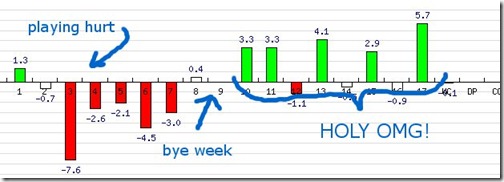
jeff_backus_pro_football_focus

I knew Backus started the season playing hurt, but didn't seem too far off his career norm. What I missed was his incredible ramp-up over the last half of the year (though I did see how Backus shut down the Saints' Will Smith in Week 16). Many thanks to the PFF staff for pointing this out

Bottom Line: Jeff Backus is an above-average starting left tackle. He is not dominant, but when healthy has played the best football of his life over the last two seasons. He hasn’t missed a start in eleven seasons, which is simultaneously incredible and troubling; how long can he maintain this level of performance? He is an unrestricted free agent, though both sides have publicly confirmed they intend to re-up.

After getting a wake-up call last season, Gosder Cherilus flipped a switch from “horrible” to “amazing.” His first three grades of 2010 were –3.0 or worse; after that he was positive for the remainder of the 2010 season . . . until he broke his knee in Week 13.

The story of Gosder Cherilus’s knee is the great untold story of the Lions’ 2011 season. Late in 2010, Cherilus blew out his knee. On December 17, 2010, Cherilus underwent microfracture surgery, a procedure that typically requires a full year of recovery (and until very recently, possibly a career-ender). March 24, 2011, the Lions anticipated Cherilus being ready for a full schedule of 2011 work, albeit with possibly-permanent pain in the knee.

Gosder started the first game, but committed a brutal late-game penalty against Tampa Bay, triggering a benching for Week 2. Corey Hilliard struggled, so Cherilus got the start in Week 3, at Minnesota. Cherilus was quickly overwhelmed, going back to the bench after just six snaps.. The Grandmaster was not pleased. Quoth Schwartz

We need to improve that position. ... One guy not getting it done on the offensive line makes the whole group look bad.

Unfortunately, Corey Hilliard didn’t get it done either, and Cherilus returned to the starting lineup at Dallas, where he played every snap and graded out at an impressive +1.5. For the remainder of the season he was inconsistent, mostly neutral with two peaks (+3.4 and +2.2 at Denver and Green Bay) and one nasty valley: -6.5 against Minnesota.

From this, we conclude Gosder just can’t block guys in purple.

Overall, Gosder the Gozerian graded out at –6.7, ranked 38th out of 76 tackles in the NFL. In pass blocking, he was ranked an eyelash below Jeff Backus, at –0.9. In run blocking, he was far worse at –7.5. For a player we thing of as a huge angry masher, his run blocking ranked him 61st of 76; that’s flatly awful.

You might want to sit down for this.

After the two cruical penalties in Week 1, Gosder was flagged just two more times all season. Jeff Backus had more penalties declined or offset than Gosder had called on him! Only Marc Colombo and D'Brickashaw Ferguson played as many snaps as Gosder and had fewer penalties. That's saying something.

Bottom Line: Gosder Cherilus was an average starting/rotational tackle in 2011, subpar in pass protection and poor against the run. But he was solid in the screen game—and, after a boneheaded Week 1, displayed gentlemanly play worth of the Lady Byng. Still, more questions than answers: how badly was his knee hurting him? Where did the consistency go? Why can’t he block guys in purple?

After an excellent performance in relief of Cherilus last season, Corey Hillard dramatically regressed to the mean. With just 147 snaps, Hilliard did not meet Pro Football Focus’s minimum cutoff. However, he got painted with a –6.8 grade’s worth of red in that time; a hair lower than Gosder Cherilus (who had seven times as many snaps)!

Hilliard's main problem was pass protection. He allowed a sack, hit, or pressure an average of once every 21.0 snaps; his pass block grade was -3.0. His -4.2 run block grade was slightly better than Gosder's—but again, he accumulated all that negativity on just a few reps. Any notion of Hilliard as a long term swing/rotational/starting tackle has to be shelved for the time being.

Bottom Line: Corey Hilliard had several opportunities in the first three games to overtake Gosder Cherilus, but he couldn’t come close to his 2010 performance. He’ll have to fight Jason Fox, Johnny Culbreath, and any theoretical draftees in camp for a chance at another auditiones.

SHOPPING LIST: Jeff Backus is solid at left tackle, but the Lions must find, and begin grooming, his replacement. Gosder Cherilus remains a mediocre, inconsistent right tackle with maddening potential. The Lions like Jason Fox, but he must get healthy, improve his conditioning, and do it on the field before the Lions name him Backus’s heir, or even Cherilus’s.

Read more...

Old Mother Hubbard: The Offensive Guards

>> 3.08.2012

Last year’s offensive guard Old Mother Hubbard was sobering indeed. The Lions had stolen a productive young starter from Seattle in Rob Sims, and Stephen Peterman was coming off an outstanding 2009. In 2010 they were pretty good and horrible, respectively. Worst of all, the bad performances fueled each other: Raiola does best with help from the guards in the run game, but when the guards are struggling there’s no hope.

Let’s look at last years’ bottom line for each of them:

Rob Sims is an above-average starter just entering his prime. If it weren’t for an odd midseason slump, Sims would have graded out amongst the best in the NFL. He’s locked up until 2014, and should provide stability at the spot for the first time in a very, very long time.

Stephen Peterman turned in incredibly consistent, strongly positive grades in 2009, and was clearly hampered by a laundry list of dings this season. We can reasonably expect a major bounceback in 2011—and, like Sims, he is under contract through 2014.

2011’s performance chart looks much, much, much better:

image

At the top of the list is Philadelphia’s Evan Mathis. At +34.6 overall, he was in a class by himself. His run block grade was a breathtaking +20.4, more than three times as high as the next-best effort. His pass blocking wasn’t too shabby either; at +10.6 he was the 9th-highest rated guard out of 77. Screen blocking has very little variance, but Evans was in a seven-way tie for 4th place at +2.0.

At the rear, ranked 77th, we have Jacksonville’s Will Rackley. –12.7 run block, –18.9 pass block, –3.6 penalty, –35.7 overall. Brutal.

The Lions guards are much closer to the former than the latter.

Rob Sims was the 14th-highest graded guard in football, and the eighth-highest graded left guard. Most of that comes from his outstanding +11.1 pass block grade, tied for seventh-best in the NFL (second-best amongst left guards). With three assessed penalties on 1,143 snaps, his +2.1 penalty grade was an asset, too.

Now the bad news: Sims earned a –6.5 in run blocking, and had a vicious run of four negative grades from Week 3 to Week 7. The run-block mark isn’t as bad as it looks; the NFL average is –4.3. But Sims’ –4.9, –1.3, –4.3, and –1.4 for Weeks 3, 5, 6, and 7 respectively were his only negative grades of the year. I’m not even excluding neutral/weakly negative grades, as I usually do: those four awful games were his only not-positive grades all year.

What's even weirder, this slump mirrors Sims' performance from 2010: all but one of his negative grades came in five consecutive games from Week 6 to Week 11. I can’t explain either swoon, but when he’s not in the midst of one Sims is absolutely rock-solid, especially against the pass.

Statistically, Sims allowed one sack, eight QB hits, and 11 pressures over 1,143 snaps. That's one every 57.2, 20th-best in the NFL and above the league average of 50.9. However, as I noted with Raiola, the Lions ran the fourth-most offensive plays in the NFL and passed on 63% of those plays—the most frequent pass rate in football.

So far, Bleacher Report’s Matt Miller and staff have only completed the analysis of the right guards; I can’t give you Sims’ scouting profile (though I will update this piece when their piece goes live). Update: here’s the B/R 1000 scouting report on Rob Sims; he’s ranked the 12th-best left guard in the NFL.

Bottom line: Rob Sims is one of the 10 best left guards in the NFL, and in the top 15 overall. He is an exceptional pass-blocker, and keeps his nose clean. He is subpar in the run game, and seems to have a several-game stretch of poor form every season. But outside of those midseason swoons, he’s extraordinarily dependable. He is signed through 2014 and will be a key component of the offense going forward.

Stephen Peterman needed to have a big-time bounceback after last year’s injury-riddled campaign, and he did. Peterman’s performance was just a tick below Sims’ in every facet of the game: +4.2 overall, 20th-best in the NFL and ninth-best amongst right guards. His pass block was +9.1, 14th-best overall and eighth-best rightie.

Peterman's run block grade is further off the pace than Sims’s,  at –8.0. That figure is ranked 56th of 77, and deeper below the NFL average of –4.3. Peterman was also flagged five times, with one declined/offset, so his overall grade got dinged for that.

Ready to have your mind blown? At +3.0, Stephen Peterman registered the second-best screen block grade in the NFL. Remember, we’re talking about 6’-4",” 323-pound Stephen Peterman here.

Peterman was more inconsistent than Sims. He registered more peaks (four games graded +2.5 or better, compared to three for Sims), but also had more flat/weakly negative games, and his five negative games were sprinkled throughout the season instead of clustered in one big slump.

Statistically, Peterman allowed 2 sacks, 4 hits, and 13 pressures, one every 60.2 snaps. That rate is slightly better than Sims’s, and of course Peterman played the same number of snaps in the same offense that Sims did.

Bleacher Report graded out Stephen Peterman as the 12th-best right guard in the game, at 70.5 overall. As with Raiola, their scouting report dovetails nicely with what we see above: great size, great movement in space, very good pass blocking, extremely shaky run blocking  and off-putting inconsistency.

By the way, for those of you who don’t know Matt Miller’s work, I relied on his New Era Scouting draft evaluations extensively before he signed up with B/R. I’m not forwarding you to his because we’re colleagues, I’m forwarding you to it because it’s great stuff.

Bottom Line: Stephen Peterman proved his horrifying 2010 backslide was due entirely to injury. He’s shares Sims’s and Raiola’s weakness in the interior run game—not what you want from a right guard—but he completes a fantastic pass-blocking interior trio . . . maybe the best in the NFL. Like Sims, he is signed through 2014.

“Davis, Leonard” is a name that appears on the Lions’ roster next to some very big numbers like 6’-6”, 355, 33, 11, and Texas. The former Cardinal and Cowboy was tipped to replace Peterman after his disastrous performance in Dallas. However, the Lions didn’t sign Davis until a month after that game, and he never saw the field.

Except for practice squadder Jacques McClendon, Davis is the only backup for either guard position, and will be 34 shortly after the season starts.

SHOPPING LIST: The Lions have two top-third starters in their prime locked up until 2014. Their only backup, however, hasn’t played since the close of the 2010 season and is at, or near, the end of his career. Ideally, the Lions will draft a talented center who can push Davis to back up one, if not both, guard positions.

Read more...

  © Blogger template Simple n' Sweet by Ourblogtemplates.com 2009

Find us on Google+

Back to TOP