Showing posts with label new york giants. Show all posts

The NFL's Proposed 18-game Regular Season Schedule

>> 1.21.2011

If' you read this blog regularly, then you know about the NFL’s proposed “enhanced 20-game schedule,” consisting of two 2 preseason games and 18 regular season games.  Commissioner Goodell, in more places than I care to link, has stated that they’re listening to the fans’ concerns about the lackluster preseason games. To his credit, those are real—remember the Lions’ sparsely-attended preseason closer against Buffalo? The fourth preseason games are played almost entirely by spots 54-72 on the roster, the guys who aren’t making the team.  For the most part, they’re completely futile.

However, eighteen regular season games are simply too many. It increases risk of injury—and when the NFL is supposed to be more concerned about player health than ever, it’s hypocritical. It’s also part of an obvious cash grab by the owners—attendance is clearly going to be better for two games that count than for two games that don’t, and TV deals for an 18-game season are going to be richer. However, neither of those problems are my biggest concern.

The game of football has always been based on the idea that it’s the best against the best.  At first, even the specialization of offense and defense didn’t exist; it was simply the best eleven against the best eleven.  When U-M head coach Fritz Crisler invented “two-platoon football” to give his Wolverines a chance against mighty Army, players’ skills could be maximized, and they could stay fresher longer. Over the next sixty years, specialization, rotation, and have slowly, gradually played an increased role in football—but always, there’s been an inviolable depth chart.  It’s your best against their best, every single Sunday—and your best third-down back will get rotational reps over your second-best third down back.

This is unusual in the sports world.  See MLB’s 162-game season, the NHL and NBA’s 82-game seasons, or the MLS’s 45-game season: you don’t always get best against best. Jim Leyland regularly infuriates Tigers fans by resting his players on a set schedule; no matter how badly the Tigers need a given game is, if  it’s Magglio Ordonez’ day off, he sits.  Imagine this applied to the NFL: the Patriots come to town for Thanksgiving—the Lions’ only national showcase game!—and Tom Brady (secretly battling a stress fracture) sits.  After all, it’s only the Lions, right?

Imagine all the fans who bought tickets expecting to see Brady play! Imagine if Brian Hoyer couldn’t engineer the same fourth-quarter explosion Brady did and the Lions won—the victory would have been hollow.  Meanwhile, the NFL’s most marketable superstar would have been on the bench in a baseball cap, helplessly watching his team take an “L” so that he can be fresh for the middle of February.  It goes against everything we’ve ever seen as football fans, and it will ruin the whole point of the NFL.

This is the key point: the NFL is king because it has the best product. Watching the NFL, at home or on TV, is the best sports experience going. If they expand to 18 games, they’ll have to expand the rosters, too—and those players in roster slots 54 to 72? They’ll be playing in games that will determine playoff berths in January, not functionally scrimmaging against each other in September. An eighteen game schedule dilutes the quality of the NFL.

It takes the NFL’s two key selling points, its superstars and its parity, and waters them down.  Nobody wants to pay seventy bucks to see scrubs against scrubs in a meaningless game, but nobody wants to pay seventy bucks to see scrubs against scrubs in a game that counts, either.

Recently, the NFLPA hosted a conference call (and I promise you, I’ll have more about that in upcoming posts). I the panel asked about this very thing, and Jets safety Jim Leonhard—on the shelf for these playoffs due to a season-ending injury—reflected my own thoughts on the issue:

“We love to play football, that’s what we want to do. Whatever the decision comes down to be, we’re going to do it and we’re going to be glad to do it . . . amongst fans, there’s a lot of debate, even with the current system, that the Super Bowl champion, the champion of this league, doesn’t necessarily go the best team, but the team that can stay the healthiest throughout the season.  If you add two more games I think it just adds to that debate. It’s such a long season, and to play at a high level for four or five months is extremely difficult, and the longer you make the season, you’re going to see more ups and downs with the level of play.”

Again, look at baseball: the teams that seem like locks for the World Series in April and May rarely meet in October.  In basketball, we need only look at our own 2005-06 Detroit Pistons, who started off the season 35-5, murdering just about everyone along the way.  They went 29-13 in the back half of the season, though, and were knocked out of the playoffs by the eventual champions, the Miami Heat (who went 23-17 in the first half). 

We’ve even seen it, just the edge of it, in the NFL.  In 2007, the New England Patriots dominated the NFL like never before seen: 38-14, 38-14, 38-7, 34-13, 34-17, 48-27, 49-28, 52-7, 24-20, 56-10 . . . the Patriots, with Randy Moss and Tom Brady, had neatly solved the NFL.  They were the most dominant, two-phase-of-the-game team I’ve ever seen, and I grew up worshipping the Montana-era 49ers.  In the Super Bowl, though, they of course failed to finish their incredible 19-0 run.  They lost that Super Bowl to the New York Giants—who two months before had been lucky to escape Ford Field with a W after one of the more abysmal football games I’d ever seen two teams play.  Even now, in a season where Lovie Smith was supposed to be coaching for his job this year, the Bears’ astonishing total lack of injuries have propelled them to the NFC Championship Game—where the injury-decimated Packers will probably beat them. anyway.

So, NFL, I implore you: don't ruin the football. Don't make it so starters are healthy scratches. Don't make the sport of football more about "who's hot" heading into the playoffs than who the best team is. You have the most balanced, competitive regular season in sports; it’s a big reason for your success.  Don't make wins hollow and losses acceptable.

Read more...

Three Cups Deep: Lions vs. Packers

>> 12.13.2010


Surreal.

That’s the only word to describe it.  In just over twenty four hours, the roof of the Metrodome collapsed, the Lions held the 25-point-per-game Packers offense to a field goal in a 7-3 victory, and Ford Field sold out of free tickets to the re-located Vikings/Giants game in just 90 minutes.

Turk McBride led the Lions with two sacks, as the Lions’ defensive line won the game almost by themselves.  The Lions’ 190 team rushing yards outstripped their team passing yards by the length of a football field.  Nearly as many Lions, 7, had at least one rushing attempt as had at least one reception, 8.  Greg Jennings not only didn’t put the team on his back, his bobble was the difference between a 75-yard touchdown and an Amari Speivey interception.  Drew Stanton, after an appalling game throwing the football, was flawless on the game-winning drive.  It must be said: the Lions won as they have lost—improbably, incredibly, nerve-shreddingly, and with more than a touch of surreality.

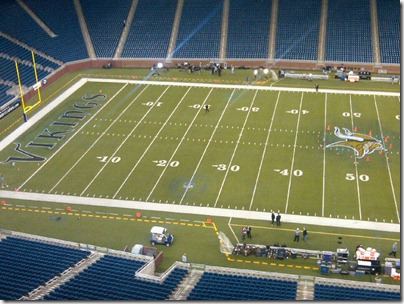
Jim Schwartz has given the players the day off today, which is a fitting reward.  Those hearty souls who waited outside in the freezing cold of the wee small hours were rewarded with tickets to tonight’s Vikings-Giants game—which the Lions’ staff has truly pulled out all the stops to accommodate.  Kevin Seifert detailed the Lions’ efforts to make their division rivals feel at home, which includes stadium sounds, scoring their mascot Ragnar a Harley, and scrubbing off the Lions wordmark and logo from the turf, and painting the Vikings’ logos on the field instead.

I’m incredibly proud of Lions fans, and the Lions organization, for putting together this incredible effort.  With just over a day’s notice, the Ford Field staff and the city of Detroit will give the nation a Vikings-Giants environment nearly indistinguishable from the one that had been scheduled for months.  This is a tremendous achievement, one that should be worn as a badge of honor by Mr. Ford, Tom Lewand, everyone in the Lions organization, the people of Detroit, and all Lions fans everywhere.

If you're lucky enough to go, a list of acceptable TLiW modes of rooting:

  • Wear Vikings gear and root Vikings. They're our NFC North neighbor, after all, and having them avenge the Giants loss would be nice. Besides, if we're replicating the real home field experience for them, why not be truly committed?
  • Wear Lions gear and root for a good game.  Hey, it’s a free NFL game in Detroit!  Let’s just make it classy and memorable for everyone.
  • Wear Lions gear and boo the hell out of the Vikings, because screw the Vikings.

Now, all that having been said . . . I can’t wait until they scrub that Vikings crap off our field.  It’s making me itch.


Read more...

Watchtower Review: Lions at Giants

>> 10.19.2010

This one will be fairly brief, since nobody likes a braggart, but last week’s Watchtower was almost spookily accurate:

The Lions haven't lost in the Meadowlands since 1990 (H/T: Tom Leyden, via Twitter), which is an incredible thing—but the Lions’ road losing streak is an incredible thing, too, and unless the Giants simply fail to motivate themselves for this game, I don’t see it stopping. With sadness in my heart, I must admit that the mostly likely outcome of the game is a 20-24 Lions loss.

Before the game, I took a fair bit of heat from Giants fans for predicting so close of a game—but after the fact, I nearly nailed the final score!  Unfortunately, my projection for how the Lions would get there wasn’t quite as prescient:

Given greater or equal talent, Perry Fewell's aggressive 4-3 front, zone coverage defenses will surrender a disproportionate amount of yards to Linehan's balanced offense, but also generate high numbers of sacks and turnovers, disproportionately disrupting scoring. Additionally, regardless of talent level, Scott Linehan's inside running game is disproportionately effective against Perry Fewell defenses.

Given the Lions’ systemic scoring disadvantage, I project the Lions to score 17-21 points, even while outpacing their season averages through the air (6.50-7.00 YpA) and on the ground (4.00-4.25 YpC). I have medium confidence in this projection.

The passing effectiveness estimate was quite close.  With 313 yards on 49 attempts, Drew Stanton and Shaun Hill combined averaged 6.39 YpA.  However, the ground game only averaged 3.05 YpC—and that’s counting Drew Stanton’s three scrambles for thirty yards!  The Giants absolutely shut down the Lions’ running game.  I remember being distinctly impressed with the job the O-line did with pass protection for Drew (just two sacks, and he was holding it forever on many plays)—but once again there was nowhere for Best and Smith to run.

I’m going to do a film thing on this, because I’m trying to pin down why Jahvid is sometimes “.44 Cal,” 2010 Offensive Rookie of the Year and why sometimes he’s  just a rookie.  If the running game had been able to get going at all, it would have bailed Drew out in a big way.  They need this dimension of the offense to work; throwing it 50 times a game is never a recipe for success.  With luck, the bye week will let Jahvid rest his turf toes, and the interior of the O-line can get back in synch.

Defensively, there wasn’t enough data to make any kind of prediction:

Given that Kevin Gilbride now runs a more conventional “New York Giants” offense that includes tight ends and multiple running backs, I do not have enough data to draw any firm conclusions about Gilbride’s offense against a Schwartz/Cunningham defense. There may, however, be a mild systemic advantage for the Giants’ ground game.

. . . and yeah, ouch.  With two solid running backs in the stable, an absolutely decimated Lions linebacking corps, and a mild systemic advantage, the Giants gashed the Lions for 5.67 YpC.  Interestingly, the Lions contained Eli Manning, allowing only 5.90 YpA—but he did complete 20 of his 30 passes for 2 TDs and no INTs, so while he wasn’t effective he was at least efficient.

Unfortunately, there’s not much to glean from this—for all the wild and wooly happenings, the end results was yawn-inducingly expected.  Let’s get back to the surprise 44-6 blowouts, eh?


Read more...

Three Cups Deep: Lions at Giants

>> 10.18.2010

Drew Stanton, of the Detroit Lions, makes a fool of the New York Giants' Deon Grant

Last night, I mourned the loss of the 2010 season.  I buried my dreams of a surprise playoff run, set the marble marker atop the grave, and shed a single tear for what might have been. 

O for the Lions of twenty ten, fantastic team too early made rest
here Stafford, Pro Bowler, sleeps with top rooks named Suh and Best

They battled foes sixteen strong, besting nine to be wild card
these Lions made their fans proud, this little blue fire bright roar’d

Yet alas, this season met early doom, so fans again must don
their parkas, tend little flame, as winter's wind bloweth on

Yesterday, the Bears and Packers both lost—and the Lions lost their last opportunity to claw back into the division race.  If they’d been able to come away from Your Company Name Here Stadium with a win, they’d be tied with the Vikings at 2-3, one game behind the 3-3 Packers, and two games behind the 4-2 Bears—with nine left to play.  For the sake of our collective sanity, I’ll refrain from mentioning that the NFL stole a win from the Lions and gave it to the Bears, and the Lions would actually be one game behind both the Bears and Packers if they’d completed yesterday’s comeback . . .

. . . but, they didn’t.  They didn’t, and a happy truth we’d been glumly unaware of—that the Lions weren’t really out of it, even at 1-4—has been erased, before we could even enjoy it.  I’m not going to blame Drew Stanton, because he played better could be expected of a third-string quarterback.  I’m not going to blame Brandon Pettigrew, even as the old saw “in the NFL, anything that hits your hands you have to catch” indicts his hands, again.  I’m not going to blame the defense—for though they were gashed by the run in the second half, they kept getting off the field on third down.  I’m not going to blame the refs, either, though the hankies certainly fell like snow from the New Jersey sky.

This team is simply not good enough to beat the Giants, on the road, with an already-iffy LB corps completely depleted.  They’re not good enough to overcome the mistakes, and—before you flip out about the penalties—they’re not good enough to simply not make the mistakes, either.

As I said in the Fireside Chat, some of these penalties—like defensive holding in the secondary—are being made because the Lions can’t beat the other guys clean.  If they’re losing the one-on-one battles, they’re going to commit more penalties to prevent total disaster.  Further, we heard in the offseason that the Lions’ coaching staff was going to accept the occasional offsides or encroachment call from the defensive line in order to get as much jump off the snap as possible.  The pointless after-the-play personal fouls have to stop—but other than that, there’s not a lot that can be done.  This team is what it is, and what it is wasn’t good enough to win  yesterday.

So . . . now what?  Two weeks, then the Lions start up again.  For the second straight year, the Lions will have a healthy Matthew Stafford at the the helm as they host the Redskins—and the leashes will be off.  From here on out, the Lions have nothing to lose—they can bench habitual mistake-makers, they can bomb it down the field, they can call any blitz they want.  Without the absolute, suffocating necessity to play mistake-free football, the Lions can cut loose and have fun.  They can attack without abandon on both sides of the ball, they can play the young guys whenever and wherever they want. . . and who knows?  With that schedule, they just might win a bunch of ballgames in the process.

The 2010 Lions’ season is over, requesicat in pace.  But maybe, just maybe, the 2011 Lions’ season has just begun . . .

Read more...

Fireside Chat: Lions at Giants

>> 10.17.2010

If, for some reason, you want to hear my quick-take reaction to yesterday’s loss, check out this week’s Fireside Chat:


Read more...

Gameday Post: Lions at Giants

I really don't know what to think about today. The Lions are going to be riding a wave of tremendous momentum--but then, so will the Giants. The Lions haven't lost to the Giants in New York since 1990, but the Lions haven't won on the road in 23 games. The Lions have a great pass rush, but the Giants have a better one. Every reason I can think of for the Lions to have a chance today, the Giants can match--or better.

. . . except one thing: hunger. Drive, passion, the desperate need to win. The Lions' entire season rides on today: a win keeps 2010 on life support; contention is still mathematically possible. With a win, the losing streak snapped, a bye to build off of it, and the return of their quarterback, the Lions--if not realistically playoff-bound--at least have a pulse. Lose today, and the Lions' plug will be pulled.

I can't say I have the unshakable faith in victory that I had last week--but I believe the Lions want it more, need it more--and that gives them a chance.

Read more...

The Watchtower: Lions At Giants

>> 10.15.2010

eiffel_tower_giant

On Sunday, the Lions will make their first trip to Your Company Name Here Stadium, colloquially referred to as “New Meadowlands.”  There they will take on New York Giants and Justin Tuck—who dramatically guaranteed on Tuesday that there would be “no ties.”  The Lions are 1-4, coming off of a 44-6 blowout of the previously-surprising St. Louis Rams.  The Giants are 3-2, feeling their oats after two consecutive wins over the Bears and Texans—during which their fierce pass rush netted 13 sacks.  What will happen with the Lions’ red-hot offense meets the Giants’ red-hot defense?  As always, I turn to the track record each coordinator has against the other . . .

Scott Linehan vs. Perry Fewell

Okay, you know what?  Let’s just get this out of the way right now.

Perry Fewell and Perry Farrell are NOT the same dude.

Lin Few Ornk PgG YpA YpC Drnk PpG DYpA DYpC PTS YpA INT YpC FumL Sack
MIN STL 6th 26.0 7.60 4.75 17th 20.5 6.15 3.64 17 6.88 1 7.27 3-2 8-54
STL BUF 30th 14.5 5.67 3.95 14th 21.4 6.65 4.28 14 7.15 1 5.76 2-1 2-23
DET NYG 6th 25.2 5.95 3.63 14th 19.6 5.33 3.55            

Perry Fewell’s coaching track record is short and sweet. He was initially hired by Tom Coughlin in Jacksonville, in 1998, to serve as the defensive backs coach.  Fewell held that post through under defensive coordinators Dick Jauron (!), Dom Capers (!!), Gary Moeller (!?!), and John Pease (???).  When Coughlin was broomed after the 2002 season, Fewell caught on with Lovie Smith in St. Louis for 2003 and ‘04, and came with Smith to Chicago in ‘05.  When Dick Jauron got hired as the Bills’ head coach in 2006, he tabbed Fewell, his old DB coach, to run the defense.  When Jauron was broomed after last season, Tom Coughlin tabbed Fewell, his old DB coach, to run the defense.

What jumps right out at you is the number of “mentors”  Fewell has had, and the variety of alignments and systems they play out of.  Jauron, Moeller, and Pease ran variations on the traditional one-gap 4-3, Capers runs a 3-4 zone blitz, and Smith is a Tampa 2 disciple.  More confusingly, Jauron hired Fewell to install a Tampa 2 variant in Buffalo, and Coughlin hired Fewell to run whatever Fewell wanted in New York.  Fewell is one of those rare coaches who is a mixture of the sum of his influences, rather than the heir of a coaching legacy.

One of the most interesting things Justin Tuck said during Tuesday's Subway event was that Fewell listens intently to the players, and tweaks his scheme and playcalling based on what they feel is working, and what they’re seeing on the field.  Kawika Mitchell, the former Bills’ linebacker, Tweeted this about Fewell upon the Giants’ hiring of him:

"on the rise. Creative. Listen 2 his players. Gr8 experience especially when u add n his time as interim HC. A lot of respect 4 PF"

So we know that Fewell is flexible and creative, favoring zone defenses behind a one-gap four-man front.  The best possible data to use for comparison would be from within this season with New York, or his early Jacksonville days under Coughlin and Jauron.  Unfortunately, Scott Linehan didn’t take over an NFL offense until 2002, so there’s no Jacksonville data.  Instead, we’ll use Fewell’s time with the Rams (an aggressively-called, but  archetypal, Tampa 2) and the Bills (a mix of T2 and traditional 4-3).

In 2003, the Vikings’ offense was in full bloom: 6th in the NFL and scoring 26.0 points per game.  The Rams’ defense was 17th, allowing 20.5—though they were likely having to defend more possessions than most, thanks to The Greatest Show on Turf scoring quickly and often.  When the two teams met, the Vikings mustered a pathetic 17 points against the Rams’ 48.  A first-quarter Culpepper-to-Moss TD pass, a second-quarter field goal, and a 1-yard Moe Williams TD plunge on the next possession accounted for all of the Vikings’ points.

The thing is, the Vikes moved the ball like crazy: 330 passing yards at a 6.88 YpA clip, plus 186 rushing yards at a stonking 7.27 YpC each.  This includes a 42-yard scramble by Culpepper—but even without that, we’re talking 5.88 YpC, total domination on the ground.  As I noted in my Watchtowering of the Bears, this performance is part of the historical evidence of a systemic advantage for Linehan-offense rushers against Lovie Smith defenses.  However, that advantage wasn’t evident against the Bears in Week 1.  With the Lions rushing for a limpid 3.63 YpC so far this season, and the Giants not even allowing that much, on the average (3.55 YpC), things look dim for the Lions’ ability to run the ball on Sunday.

How could the 2003 Vikings generate 519 yards of offense and only score 17 points?  Well, Daunte Culpepper was at the helm, so the answer is easy: 8 sacks for 54 yards, 3 fumbles, two of which were lost, an interception, and 11 penalties for 65 yards.  Now, the fumbles and turnovers are par for the course with the Culpepper-era Vikings, but 8 sacks is egregious even for Daunte.  This indicates another factor I’ve seen in previous Watchtowers of aggressive Tampa 2s: an inordinate amount of sacks surrendered.

The other data point we have is much more recent, and likely a better representation of what Fewell’s doing these days (as he was the DC): 2008, when Dick Jauron’s Buffalo Bills took on Scott Linehan’s St. Louis Rams.  Unfortunately, this is the worst possible sample of Linehan data: the Rams were rock-bottom awful, and this game is the last one he coached for them.

30th in the NFL, scoring just 14.5 PpG, Linehan’s Rams were the definition of a stoppable force.  Their scoring that day was exactly you’d expect when a team scoring about 14 points a game faces a 14th-ranked defense: 14 points.  However, they once again dominated on the ground, racking up 167 yards and 2 TDs on 29 carries (5.76 YpA).  Their passing effectiveness was well above their season average, too: 7.15 YpA (5.67 on the season).  Our conclusions must be similar to what we saw with Lovie Smith's tendencies:

Given greater or equal talent, Perry Fewell's aggressive 4-3 front, zone coverage defenses will surrender a disproportionate amount of yards to Linehan's balanced offense, but also generate high numbers of sacks and turnovers, disproportionately disrupting scoring.  Additionally, regardless of talent level, Scott Linehan's inside running game is disproportionately effective against Perry Fewell defenses.

Mitigating/Augmenting Influences:

The first factor that mitigates these results is the Lions’ evident lack of a power inside running game.  Steven Jackson is Steven Jackson, and the Vikings’ offensive line in 2003 was a thing to behold.  Unless Stephen Peterman suddenly regains his 2009 form, Jahvid Best will again struggle to find creases inside.  However, Michael Schottey brought up an excellent point on Twitter: The Lions may well use Kevin Smith much more in this game, since he’s the stronger blocker.  Smith also runs harder—and he’s clearly much stronger now than he was at the beginning of the season.

The key to the Lions’ offensive performance will be in the running game’s ability to make the defense stay home and contain, rather than pin their ears back and attack—and if Smith (or Best) can make hay in between the tackles, the Lions could be in business.  If not, it could be a very long day.  Also—turnovers.  If the Lions do not turn the ball over at all, they’ll get to turn all those yards between the 20s into points.

Expectations would be that the Lions underperform their season average (25.2 points), and the Giants would allow more than theirs (19.6).  Given the Lions’ systemic scoring disadvantage, I project the Lions to score 17-21 points, even while outpacing their season averages through the air (6.50-7.00 YpA) and on the ground (4.00-4.25 YpC).  I have medium confidence in this projection.

Gunther Cunningham vs. Kevin Gilbride:

Gil Gun Ornk PgG YpA YpC Drnk PpG DYpA DYpC PTS YpA INT YpC FumL Sack
PIT KCC 7th 22.0 6.86 4.78 19th 22.1 6.32 3.83 13 5.64 0 5.80 1-0 3-28
BUF TEN 30th 15.2 5.35 3.90 13th 20.2 6.60 3.79 19 5.60 0 4.45 1-1 3-16
NYG DET 14th 21.2 7.12 4.49 23rd 22.4 7.13 4.79            

Kevin Gilbride is even more infuriating than Fewell.  Gilbride came up as a pure Run ‘n Shoot guru, even working with June Jones.  He was the architect of the pinball R&S offenses in Houston, opening up the throttle with Warren Moon, and putting up huge numbers.  Gilbride was also Tom Coughlin’s offensive coordinator for his first two seasons in Jacksonville . . . noticing any trends here?  Unbranched coaching trees aside, Gilbride used journeyman Steven Beuerlein to great success, and the Jags’ air attack helped them reach a 9-7 record in just their second year of existence.

Enamored of the Jags’ success, the Chargers fired the staid, stuck-in-the past Bobby Ross, and hired Gilbride to be their head coach.  They wanted Gilbride’s wide-open passing attack to lead them into the future, and drafted him the triggerman he needed to do it: Ryan Leaf.

That worked about as well as might be expected.  Two seasons later, Gilbride was run out on a rail—but was then picked up by none other than Bill Cowher and the Pittsburgh Steelers.  Gilbride realized that Kordell Stewart’s slow decision-making ability and often-inaccurate passes wouldn’t be a great fit for the run ‘n shoot, so he simplified and customized his offense, using “Slash” all over the field to great effect.  Just look at the first row of season numbers up there: 22 points per game (in the mid-90s, that was 7th-best in the NFL), 6.86 YpA, and—with a mix of Jerome Bettis and Kordell Stewart running the ball—4.78 YpC. 

Unfortunately, that offense bears no resemblance at all to what Eli runs in New York, so comparing Gunther’s relative success (or lack thereof) against it would be folly.  No, the the only even sort-of comparison we have is 2003, when Gilbride was running the offense in Buffalo under head coach Gregg Williams.

It’s a wretched data point for Gilbride, as Drew Bledsoe really struggled to execute Gilbride’s multi-WR sets.  Even with an elite target in Eric Moulds, and a running game featuring Travis Henry and his 1,356 yards, Bledsoe only completed 58.2% of his passes, for 2,860 yards, 11 TDs, and 12 INTs.  The Bills were 30th in the NFL in scoring offense, averaging just 15.2 points a game—and Gilbride would be headed for the bread line again at the end of the year.

Meanwhile, Cunningham was working with Jim Schwartz in Tennessee, and their defense was fairly decent: 13th in the NFL, with 20.2 PpG allowed, and especially stout against the run, surrendering only 3.79 YpC.  The result seems to blow away expectations, 26 points for the Bills—but 7 of them came on a 28-yard  fumble return by Pat Williams.  Yes, that Pat Williams, the larger half of the Williams Wall.  Has he run 28 consecutive yards before or since?

So, 19 offensive points for the Bills; still mildly above expectations. We see that passing effectiveness was right in line with the averages, but the Titans allowed the Bills to gain over a half-yard more per carry than the Bills usually did—is this indicative of something systemic?  Without a second data point, I can’t be sure—and unfortunately, these two coordinators were in and out of work at similar times; I simply don’t have another time they faced off while running anything like the schemes they run today.

Given that Kevin Gilbride now runs a more conventional “New York Giants” offense that includes tight ends and multiple running backs, I do not have enough data to draw any firm conclusions about Gilbride’s offense against a Schwartz/Cunningham defense.  There may, however, be a mild systemic advantage for the Giants’ ground game.

Mitigating/Augmenting Influences:

Well . . . without any firm conclusions, there’s really nothing to mitigate or augment, is there?  Given the paucity of data, I can only conclude that the Giants’ offense will meet expectations against the Lions’ defense: scoring 24-27 points, gaining 7.00-7.50 YpA, and 4.50-4.75 YpC.  I have low-to-medium confidence in this projection.

Conclusion

The Lions haven't lost in the Meadowlands since 1990 (H/T: Tom Leyden, via Twitter), which is an incredible thing—but the Lions’ road losing streak is an incredible thing, too, and unless the Giants simply fail to motivate themselves for this game, I don’t see it stopping.  With sadness in my heart, I must admit that the mostly likely outcome of the game is a 20-24 Lions loss.


Read more...

  © Blogger template Simple n' Sweet by Ourblogtemplates.com 2009

Find us on Google+

Back to TOP