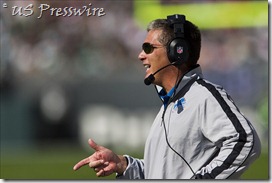
Jim Schwartz, on why the Lions have scored more points in the fourth quarter than the first three in all of their games so far:
"We've had to in the fourth. We've been behind and that's put the pressure on us to have to do it. We're trying just as hard in the first quarter. Certainly no design or scheme or anything like that. We have to be efficient all four quarters and it can make a difference for us if we can get a lead and we can hold a lead. But we've got to battle for 60 minutes. You're judged just like a 16 game season, you're judged on all 16 games, you're judged on all 60 minutes. So no matter where you're scoring them they all count."
“We’ve had to in the fourth.”
Schwartz says it’s “no design or scheme or anything like that,” but the Lions’ close games are the result of obvious changes in approach on offense.
The biggest change from last season to this season is the way defenses are playing the Lions—and all of last season’s 5,000-yard passing offenses. The Saints, Patriots and Lions went 36-10 last season; through Week 6 of this season they’re 6-10. NFL defensive coordinators are paid way too much to let teams beat them with the same thing over and over—so they’re taking away the bombs-away offense and forcing these teams to adjust.
The Lions have adjusted by re-emphasizing the run game, drastically cutting back on hopeful shots downfield, and trying to emphasize intermediate routes. Linehan has also been doing a lot of “setting up” defenses with repetitive/predictable playcalls early in games, to subvert them later—or in the case of this play broken down by TuffLynx at Pride of Detroit, use repetitive/predictable playcalls in early games, to subvert them in later games.
By taking fewer risks and being less aggressive on offense, the Lions are pursuing a low-variance strategy.
This concept has been discussed all over the Internet, but it was synthesized best for me by Brian Cook at MGoBlog, in a piece called “Keep it Close and Lose in the Fourth Quarter," and its follow-up, "Mathy Mailbag." Read them both, plus all the links in both if you really want to grok this.
To summarize: low-variance strategies result in fewer possible outcomes. Two equally-matched teams both running more often than they pass and always punting on fourth down regardless of field position and never blitzing on defense won’t produce a 48-0 blowout in either direction.
This is, as discussed by Cook, Chris Brown, and Malcom Gladwell a “Goliath strategy.” When you’ve got a massive talent and skill advantage—as Goliath did over David—you want to eliminate the chance of anything crazy happening. Since the expected outcome is “you win,” you want to maximize the probability of getting the expected outcome.
As Cook notes, this is the strategy used by Bo Schembechler at Michigan: grind it out, play suffocating defense, take few risks, minimize mistakes, and use your massive size and talent advantage to consistently beat opponents with execution. Cook cited a passage from a book called Bo’s Lasting Lessons, wherein Bo, at a coaching clinic, veered dangerously close to schematic enlightenment before reaffirming his fevered belief in fundamentals and “playing Michigan football.” Cook:
This may have been brilliant in 1985, and brilliant against the poor, huddled masses that comprised Michigan's opponents at the time, but it's fundamentally a variance-hating strategy that presumes better talent. In it are the seeds of Michigan's time-honored failure against Rose Bowl foes, and its recent struggles to put away inferior competition.
It’s that old chestnut, attributed to darn near every midwestern football coach of historical note: “Only three things can happen when you pass the ball and two of them are bad.” Passing is a high-risk, high-variance strategy.
No NFL team passed more, or more often, than the Lions did in 2011.
This is why the Lions aren’t doing it again in 2012: the Lions can assume a talent advantage over most NFL teams. They just beat the Eagles, one of the most talented teams in football, and Jeff McLane of the Philadelphia Inquirer wrote you could “see” the Lions were “physically dominant.” This is why the Lions passing twice as often as they run would be dumb, and playing things close to the vest is smart.
But.
One of the side effects of playing for low variance by running the ball a lot, making ultra-conservative fourth-down calls and, I don’t know, refusing to try an onside kick when you’re kicking from the opponent’s forty-yard line is that you shorten the game. With more time running off the clock, there are fewer plays and possessions—fewer chances to press your advantage.
If you flip a coin that’s weighted to land on “heads” 60% of the time 10,000 times, it will land on heads 60% of those 10,000 flips. If you flip that same coin ten times, it’s much more likely to land on heads for some other percentage.
If you reduce the number of ‘trials’, you increase the chance for an unexpected outcome. That is to say, if the Lions have an advantage over their opponent, attempting to control the clock gives them fewer chances to leverage that advantage. Re-stated again: by playing to reduce risk, the Lions can’t blow people out like they used to. They’re also not going to get blown out, but that’s cold comfort when you’re starting 2-3 instead of 5-0.
As a consequence, the Lions are running into the same problem Lloyd Carr did: if you’re going to keep it close for four quarters, you actually have to execute significantly better than the other team. Bo's reliance superior talent and execution left him unarmed against opponents with equal talent. Carr's similar approach with less-superior talent against less-hapless Big Ten opponents guaranteed him at least one embarrassing upset a season.
The Lions let the Rams hang around when Stafford throwing three first-half interceptions, and it almost cost them. The Lions were on track to beat the Titans 27-20 and the Vikings 13-6 except, you know, two punt return touchdowns, two kickoff return touchdowns, and a fumble return touchdown. By playing it close to the vest, the Lions couldn't build up the kind of lead that can withstand these freak occurrences/horrible mistakes. They have to get touchdowns from their early scoring opportunities and not settle for field goals.
Still, throughout these games, the Lions’ advantage has become apparent in the final stanza: Mikel Leshoure and Joique Bell punishing bruised defenses, Matthew Stafford and Shaun Hill carving up beleaguered secondaries downfield, shellshocked quarterbacks running for their lives and throwing picks.
Over the course of the season, the weird bounces and fluky breaks will even out. Stafford quickly eliminated the terrible picks of the Rams game, and the coverage teams managed to go a whole game without allowing a single return touchdown. The Lions are taking the correct approach—but they’re going to have to improve their offensive execution, or continue dropping games to inferior opponents.
Read more...



 Posts
Posts


