What Jerry Jones, & the NFL, Can Learn from Detroit

>> 2.11.2011

Michigan Central Station, Detroit MI

This is the Michigan Central Station. It’s familiar to Detroiters as the avatar of the city’s decline. Any national “Woe is Detroit” story has to be accompanied by an image of this beautiful, awful edifice.  Designed by the same firm that penned New York’s Grand Central Terminal, the Beaux-Arts Classical visage of this 18-story monolith contains a message for the NFL.

The MCS was built to accommodate a large volume of rail traffic, part of a grand vision to unite the station and the Michigan Central Railway Tunnel to Canada along the main Detroit-Chicago railway line. The 18-story tower was to provide office space for the future businesses sure to spring up around the new transportation hub.

That’s right, the city’s new main train depot was not in the heart of the city. Situated along the main line, as opposed to the branch that ran through downtown, passengers got to and from the station via intercity trains and shuttles, at least until 1938. Unfortunately, thanks to the Great Depression, that development never really came—and the original designers hadn’t planned on people driving there, so there was no passenger parking lot.

After World War II, the automotive revolution that fueled the growth of the Motor City sapped the MCS of much of its relevance. At various points throughout the fifties, sixties and seventies, the station was put up for sale, partially shut down, sold off, partially re-opened, shut down, and sold off again, until 1988, when the last Amtrak train rolled out of Michigan Central Station. It cost fifteen million dollars to build in 1913. It was put up for sale (with no takers) for five million in 1961, and eventually changed hands several times for undisclosed sums in the 80s and 90s, with rumored prices as low as $80,000.

Now it sits empty. Now looters have stripped it of wiring and fixtures. Now it’s a quietly decaying monument to a bygone era of unbridled growth and fantastic excess: too far gone to revive, far too beautiful to tear down, and far too ugly to let stand.

“Unbridled growth” and “fantastic excess” are apt descriptions of the state of the NFL. While America’s economic belt has been slowly tightening for several years, the NFL’s revenues have exploded. In a time when cable and satellite offer hundreds of viewing options, and America has never split its TV focus so wildly, the NFL’s ratings continue to smash records. Attendance has been flat at nearly the maximum possible numbers; even the Lions sold out all but one of their home games.

The NFL and NFLPA scheduled two negotiating sessions this week, and the first one went so poorly that the second one was cancelled. The rumored dividing point was the most basic one, the one that started it all: how to divide all the money that the NFL earns. The owners already receive the first billion of revenue off the top, to cover expenses.  The owners want to increase that by 18%, to cover anticipated capital investments in the game that will bring in more revenue. What capital investments—designed to bring in revenue—could require that much money?

Cowboys-Stadium-Innovative-Stadium-by-HKS-in-Dallas-United-States-4This is Cowboys Stadium. This $1.1 billion-dollar edifice sits on a 140-acre site a 45 minute drive from downtown Dallas. Its 300 luxury suites, along with its concessions stands, bars, and restaurants—not to mention auxiliary attractions like a football-inspired art gallery—provide huge streams of revenue that have little to do with watching a live football game. In fact, “live” might not be the best way to watch a football game inside Cowboys Stadium: there are 2,900 TVs scattered throughout the dome, plus the infamous titan that hangs over the field, a sixty-yard HD monitor able to display a blue whale at a 1:1 scale.

Nicknamed “Jerryworld” after the Cowboys’ owner, Jerry Jones, this stadium marks the endpoint of one stadium-building craze, and perhaps the beginning of another. In the mid-90s, teams explored the brave new salary-cap world, and realized that unshared revenue like luxury suites and concessions not only didn’t have to be shared with other owners, it didn’t have to be shared with the players! This kicked off almost two decades of teams building new stadiums filled with luxury suites and swank accommodations. Teams, for the most part, took advantage of easy credit and/or public financing. Jones used $325 million worth of public funds, secured $625 million of credit—and received a $150 million loan from the NFL.

That's the money the owners are looking to keep from the players: nearly a billion dollars a year to help build the Vikings’ Zygiworld, the Bills’ Ralphworld, and many others. Even the Panthers, a team whose stadium is was built in 1996, are already talking about building another one. Over the next ten-to-twenty years, most NFL cities will feel the pressure to either build a similar monuments to unbridled growth and fantastic excess—or risk their teams’ Ownerworld being built in another town.

The problem is, it’s not sustainable. Sally Jenkins of the Washington Post wrote, brilliantly, that Super Bowl XLV’s rough edges hint at the fault lines running through the “billionization” of the NFL:

It's not clear what the pain threshold of the average NFL fan is: Thirty-two owners digging relentlessly in our pockets haven't found the bottom yet. But the NFL would be advised to recognize that it's getting close. Those folks who found themselves without seats? Many were among the league's most loyal paying customers, season ticket holders. Yet they were treated like afterthoughts, awarded half-built, jerry-rigged seats, folding chairs on auxiliary platforms. Which begs the question of what the "NFL fan experience" really means anymore.

The NFL’s surge in popularity has granted it great profits in the face of an economic downturn—but that downturn is real. Municipalities are out of stadium-building funds; free stadiums, like the one Hamilton County built the Bengals, don’t come with sixty-yard TVs. The credit bubble has burst; loans are much tougher to secure—and imagine how big Jerry’s mortgage payments must be on his borrowed $725 million! Roger Goodell said it himself, in his email to fans:

“Economic conditions, however, have changed dramatically inside and outside the NFL since 2006 when we negotiated the last CBA. A 10 percent unemployment rate hurts us all. Fans have limited budgets and rightly want the most for their money. I get it.”

If Jerryworld is the template for new stadiums going forward, I don’t think he does. He—and the owners—need to learn a lesson from Michigan Central Station. It cost about  $335 million in today’s dollars—almost exactly the same amount the city of Arlington paid for Jerryworld. If the CBA is not extended, that massive revenue pie owners and players are fighting over will shrink. Even with the public thirst for football, the Cowboys pushed the envelope. If that thirst is quenched by other sports during a needless lockout, they’ll be unable to fill Jerryworld, or Zygiworld, or Stephenworld once play begins again.

America’s cities can’t afford to drain their public coffers again. Americans can’t afford to blow their personal budgets on even-more-expensive tickets, parking, and concessions. America—for our entertainment, and for the thousands, maybe millions whose livelihood depends directly or indirectly on professional sports—needs the NFL to keep chugging along.


Read more...

Shaun Rogers: Once and Future Lion?

>> 2.10.2011

This is how I like to remember Shaun Rogers. Likely, it’s how you like to remember him too: an impossible combination of size and athleticism. A relentless, disruptive force that demanded—and overwhelmed—double-teams. A goofy, lumbering country boy, simultaneously awkward and balletic, gamboling and galloping, groan-inducing and breathtaking.

Shaun Rogers had some incredible highlights in his seven years as a Lion—and more than a few lowlights, too. For the most part, when the Lions dealt him to Cleveland, fans knew it was simply time to part ways. Of course, it stung when he immediately made an impact there—especially as the 0-16 Lions’ defense was manhandled by opposing offensive lines. As opposing running backs averaged 5.1 yards per carry against the helpless, hapless Lions, we looked south to Cleveland and got all nostalgic. As the Dawg Pound swooned over Rogers’ ability, many of us were bitterly jealous.

But the honeymoon didn’t last long. Thanks to a perceived slight by new coach Eric Mangini, Rogers asked the team to not pay his option bonus, presumably to finagle a quicker trade or release. Eventually, the ice between Rogers and Mangini thawed, or at least partially so. From that Akron Beacon-Journal come successive paragraphs that sum up everything you need to know about Shaun Rogers:

Rogers insists he can still dunk. ''All day,'' he said. Two hands? ''Two hands. All day. Vertical? 360? What you want?'' Rogers said. Two-time Pro Bowl left tackle Joe Thomas said dunking is probably the least of what Rogers can do. ''He tests better than any player on the team when we do testing in the spring,'' Thomas said. ''He's faster than any lineman, offense and defense. He can jump higher. He's got incredible speed. He's probably a 4.6, 4.7 guy.'' Anderson doesn't think a healthy Rogers can be blocked. ''Not when he's going and he's healthy and rested, there's not a human being who can stop him one-on-one,'' Anderson said. ''I've seen him take double-teams with his body and one arm and get through guys. He spins . . . he's a freak.''

. . . and then the flip side:

Former Detroit Lions coach Rod Marinelli told former Tampa Bay Bucs and Oakland Raiders defensive tackle Warren Sapp that Rogers didn't want to be featured in Detroit. ''Rod Marinelli went to Detroit (in 2006), showed Shaun Rogers my tape and said, 'I'm going to get you one on one,' '' Sapp, now on Showtime's Inside the NFL, said last month in New York. ''Shaun Rogers looked at Marinelli and said, 'What if I don't want to be one on one?' ''Gilligan wanted off that island, too, right? That island is a lonely place. Either you want it or you don't. The great ones do.''

Shaun Rogers’ talent, his potential, his upside—it’s intoxicating. It’s addictive. But, to borrow a phrase, he’s a grown-ass man. He’s 31. He’s—if visual evidence is any indication—way over his listed 350, possibly over 400. He’s been unable to stay healthy, getting just 12 starts and 26 games played in the last two seasons—and when he’s played, he’s been less effective; he has just 41 tackles and 4 sacks in that time.

Now, he’s been released--and unlike other free-agents-to-be, he can actually be signed right now. Should the Lions bring him back to Detroit? As a commenter on the Browns blog Dawgs by Nature said:

Shaun had become a part-time part-timer. At his age and given his shape/condition it’s better to get rid of him, rather than overpay him. He’ll sign for a fraction of that amount somewhere. I’d be happy if it were Cleveland, but not at $5mill.

He’s a rotational player who’s struggling to stay healthy. As a 400-pound two-gap tackle, he doesn’t have a clear role in this defense, either. He’d essentially take up Sammie Hill’s role, but Hill is a very young, very raw, developing player whose best football is all in front of him. As amazing as it still is to daydream about a 400-pound man who can run a 4.6 40 and dunk from a standstill, Shaun Rogers is a ten-year veteran. He was Matt Millen’s third-ever draft pick. He is what he is. He’s not going to realize that incredible potential any sooner than Dominic Raiola is grow two inches and add thirty pounds of muscle.

Those of you who say, “But what if he really is motivated to play? What if a change of scenery does him good?” Well, then are a dozen wannabe 3-4 teams out there who need a nose tackle more than the Lions need a fifth DT to rotate—and they’ll certainly be willing to pay more than the Lions will. The case is stronger, and the role is clearer, for Albert Haynesworth—and I’m not all that anxious to get him on the Lions’ roster, either. The Lions’ defensive line, both starters and depth, was the strength of the team in 2010. Players like Sammie Hill and Andre Fluellen made major contributions late in the year, and both of those players haven’t yet hit their primes.

I’d rather the Lions continue to try to win like the Packers, always thinking about the future, than try in vain to recapture the recent—godawful—past.


Read more...

The Detroit Transplant’s Lions Nike Pro Combat Kits

>> 2.09.2011

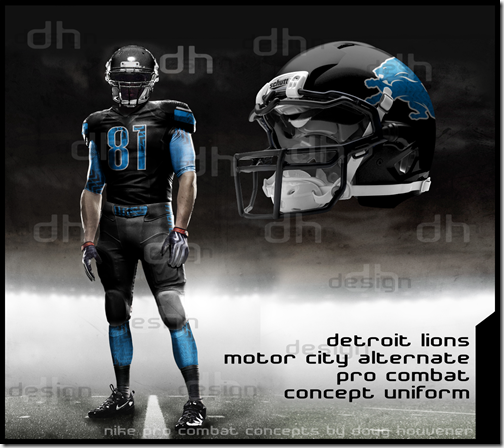
The Detroit Transplant is a very cool Detroit-focused sports blog, penned by a graphic designer named Doug. Last year, he (along with the rest of us) learned that that the NFL had chosen Nike to begin supplying all uniforms and apparel in 2012. Doug mulled the possibilities, and late last year applied his considerable talents to four possible Lions Nike Pro Combat uniforms.

Here’s my favorite, a reboot of the infamous black alternates:

Detroit_Lions_Nike_Pro_Combat_Concept_Doug_Houvener

I loved this one, especially the detail of the blue tire tread patter on the numbers, sleeves, and socks. However, I was less enthused by the liberal application of black in the home and away concepts; in my mind they look very “Panthers” and not very Lions. Doug responded to similar feedback with a second set of three Lions Nike Pro Combat concepts; they’re very much to my liking. The white helmet, especially, intrigues me.

However, as cool as these designs are, and as much fun as we’re about to have discussing them, I feel compelled to note: I love the current unis. I think they’re the perfect balance between unmistakably the Detroit Lions’ uniforms, and being fresh and up-to-date.  They’re clean, they’re classy, they have a touch of style in the numbers. I think the Lions finally got the uniforms perfect, and I’m worried the move to Pro Combats will mess them up.

As you can see in Doug’s designs, the busier, Oregon-esque stuff looks really cool on the second-skin fabric . . . but simple, clean looks just don’t look clean. It’s almost as though the fit and finish of the Pro Combat uniforms not only enable intricate patterns and nontraditional design elements to look good, but demand them. Otherwise, it just looks like dudes out there in long johns.

To that end, Doug Tweeted (@drdougfresh) that he's going to start working on a complete brand ID package for the Lions. He warns that "traditionalists" like myself may not care for it . . . but I'm looking forward to it anyway. Thoughts'?


Read more...

  © Blogger template Simple n' Sweet by Ourblogtemplates.com 2009

Find us on Google+

Back to TOP