Showing posts with label 2011 nfl draft. Show all posts

Old Mother Hubbard: Wrap-Up, Analysis, Needs List

>> 6.02.2011

Yesterday, I posted the final post-draft “awesomeness” heat map of the Lions’ current depth chart. I didn’t really analyze it, per se, just provided a list of clarifying/qualifying bullet points. The coolest thing about data visualization is that it simply is, and anyone can understand at a glance what’s going on. That said, I slaved over making the thing, so you folks are probably curious about what caught my eye in the process.

The offensive line needs help. Clearly, the center and right guard were well below average last season; Stephen Peterman in particular played poorly (no doubt due to myriad injuries, as he was much much better in 2009). With the exception of right tackle, there isn’t a quality backup anywhere along the line. The left side of the line is actually quite good, though; if Peterman and Raiola return to their usual standard of play, the starting five should be one of the better lines in the game. If not—or if the injury bug bites—the Lions’ line could be in big, big trouble. I also have big concerns for 2012 and beyond; Hilliard, Fox, and/or Culbreath need to stake their claims on future starting roles.

Calvin Johnson is so good. Megatron was the Lions’ best player in 2010, and it wasn’t close. He was the third-best graded WR in the NFL, and two-and-a-half standard deviations from the mean! I think Lions fans forget how good he is, because they know how good he can be. We keep waiting for him to haul in 140 catches for 2,400 yards and 30 touchdowns—and if anyone ever could do that, it’s him—but maybe we should stop a minute to appreciate 77 catches for 1,120 yards and 12 touchdowns, especially given the quarterback situation.

Non-Megatron receivers need to step up. It’s no secret that Bryant Johnson and Derrick Williams simply haven’t produced. Johnson has struggled mightily to catch the ball, and Williams, when used, isn’t getting open. Nate Burleson is dangerous with the ball in his hands, but isn’t a threat to stretch the field. If Titus Young can make an immediate impact, Johnson and Burleson should have much more room to operate. I’m counting the tight ends here, too; Tony Scheffler had a mysterious stretch of poor form after an electrifying first few games, and Brandon Pettigrew dropped an awful lot of balls he got his hands on (and got called for ten penalties!). Both of them have the ability to be top ten receiving TEs—if either of them can play like it, it’ll be a huge boost to the offense.

The defensive line is strong and deep, but wasn’t invincible last season. Ndamukong Suh likely won’t improve his sack total from last year—in fact, I’d expect a regression—but his overall effectiveness should be better than we see here. Corey Williams played like a man possessed, but his horrific penalty total (15 called, 2 declined/offset) put a huge damper on his final grade. Nobody had more penalties called, or assessed, than Williams. Nobody in the NFL, at any position. That’s not just aggression leading to the occasional jump—that’s a chronic problem that extends drives, in a defense built to stop them.

The much-maligned back seven is just below average. As much as observers like to pretend the Lions’ back seven consists of Louis Delmas and six tackling dummies, none of the presumed starters were more than a standard deviation below NFL average. Amari Spievey actually turned in the best grade of the back seven, and Louis Delmas was playing through a severe groin injury. The Lions added Erik Coleman to the safety corps, and should add a corner and/or linebacker in free agency. If they can get a little better in a couple of spots, the excellent defensive line will be backed by a perfectly average ‘backer corps and secondary.

That said, the back seven dominates the remaining shopping list:

  • An impact two-way defensive end to rotate soon, and develop for 2012 [Upon further review, Lawrence Jackson fits this bill].
  • A credible backup middle linebacker.
  • An athletic, pass-rushing OLB ready to start right away.
  • An athletic, pass-rushing OLB to rotate soon, and develop for 2012 [I'm giving Doug Hogue the benefit of the doubt here].
  • An athletic cover corner, ready to take over one side in 2012.
  • If Chris Houston leaves, a complete two-way corner, ready to start right away.
  • A left tackle who can be groomed to replace Jeff Backus [I like Culbreath, and have hope for Jason Fox, but calling this need "filled" is too much of a stretch].
  • A center who will be ready to rotate at guard soon, and compete at center for 2012.
  • A field-stretching #2 WR.
  • A power back to complement Jahvid Best.

Read more...

Old Mother Hubbard: 2011 Post-Draft Heat Map

>> 6.01.2011

Without further ado, your 2011 Detroit Lions, as they exist post-draft, as graded by Pro Football Focus:

The 2011 Detroit Lions team needs heat map, powered by Pro Football Focus grades and The Lions In Winter's Old Motherr Hubbard analysis.

click for big

IMPORTANT INFORMATION:

  • All of the above colors represent that player's Pro Football Focus "overall" grade for 2011.
  • The grades have been banded into tiers, one half of one standard deviation from the mean for each position. Green is good, Red is bad, Gray indicates insufficient 2010 snaps, a rookie, or a hazy depth chart.
  • The main (inside) color is the presumed starter for 2011. The exterior ring is the presumed backup.
  • As a reminder, PFF's overall grade weighs penalties strongly; Corey Williams would be several tiers higher if not for his 13 penalties. PFF’s grade also tends to value consistency over sporadic big plays.
  • Brandon Pettigrew is the “starting” TE; Tony Scheffler the #2.
  • Nate Burleson is the #1 X receiver and #1 Y receiver; I anticipate he will be the X in 2-WR sets and Y in 3-WR sets.
  • Titus Young is the #2 X receiver and #2 Z receiver; I anticipate he will be the X in 3-WR sets.
  • Jahvid Best is the #1 RB; Mikel LeShoure the #2.
  • Quarterback data is not normalized, so I have not included it.
  • Corey Williams is the starting Nose Tackle (1-technique); Sammie Hill the #2.
  • Ndamukong Suh is the starting Over Tackle (3-technique); Nick Fairley the #2.
  • KVB and Lo-Jack are the #1 and #2 LDEs, respectively.
  • Cliff Avril and Willie Young are the #1 and #2 RDEs, respectively.
  • Bobby Carpenter and Ashlee Palmer are the starting RLB and LLB, respectively.
  • Chris Houston is CB1, Nate Vasher CB2, and Alphonso Smith NCB.
  • Amari Spievey is the LS, and Louis Delmas the RS.

Read more...

Meet the Cubs: Mikel LeShoure

>> 5.13.2011

27 December 2010; 2010 Texas Bowl- Baylor Bears v Illinois Fighting Illini; Illinois Fighting Illini running back Mikel Leshoure (5) hoists his MVP trophy after the game; Illinois won 38-14

2.25 (57): Mikel LeShoure
          Running Back, Illinois

On the day he declared for the NFL Draft, Mikel LeShoure’s words matched those of thousands of other kids who’ve gone through the process. It’s practically boilerplate:

"I believe I have accomplished everything I can at the college level and want to go after my dream: playing in the NFL.”

For millions, playing in the NFL is a dream they’ll never have the opportunity to pursue, because they weren’t born with the talent. Mikel LeShoure was born with talent, but little else—Mikel LeShoure was born in prison.

Mikel, and his mother Jacqueline “Jazz” Frasier-Jones, faced an almost impossible climb up life’s mountain. Post-release, Jazz battled drug and alcohol addictions (and prior drug convictions), and worked multiple jobs to provide for Mikel. Meanwhile, Mikel spent the earliest years of his life with his aunt and stepmother; his father was in sporadic contact, fighting drug demons and prison sentences of his own. All three persevered, though: his mother has stayed clean and sober for 15 years, father got a good job, got back in contact, and was present at Mikel’s draft announcement, and Mikel racked up 4,652 yards and 52 rushing touchdowns at Champaign Centennial High School.

That’s Champaign, as in Champaign, Illinois—and from the sound of it, Illinois head coach Ron Zook didn’t let LeShoure, a three-star RB recruit per both Scout.com and Rivals.com leave his backyard. Listed at 6’-0”, 220 pounds, LeShoure had offers from Iowa and Wisconsin, as well as Missouri, Kansas, Colorado, and Boston College. He was Rivals’ 28th-ranked running back, nationally, and Scout’s 52nd.

Mikel saw some platoon time right away his freshman year, and even started a game. However, he got into a fight with teammate Jeff Cumberland, now a TE with the Jets, and Cumberland broke LeShoure’s jaw. LeShoure spent six weeks on a liquid-only diet, and he realized he could stand to drop his freshman fifteen. In the layoff between his freshman and sophomore year, Mikel went from 237 back down to a very lean (4.8% body fat) 228. In car circles, there’s a classic quote from Lotus founder Colin Chapman: “If you want to add speed, add lightness,” and that’s exactly what LeShoure did.

Besides his diet, Mikel knew that he had to make lifestyle and attitude changes, too, if he was to be the lead dog in the Illini’s four-tailback pack:

"I'm bigger, stronger, faster — all of that," LeShoure said. "The main things were my diet and not going out and partying, handling it and being smart. I stayed in more, just hanging out with the family. It was pretty easy because the No. 1 thing I thought about was football season and what would make me better."

With his maturing mind, maturing frame, and returned explosion, LeShoure notched multiple hundred-yard games his sophomore year, culminating in a 184-yard explosion against Fresno State that got him Big Ten Offensive Player of the Week honors. He used his size, speed, and improved conditioning to wear down defenses; his second-half YpC was 7.6, and all five of his rushing TDs came after halftime. He was named Honorable Mention All-Big Ten.

In his junior year, Mikel LeShoure blew everything up. I’ll just quote the official bio:

AWARDS & HONORS
• College Football Performance Awards Running Back of the Year (2010)
• Second-team All-American by the Associated Press (2010)
• Third-team All-American by Rivals.com and Phil Steele (2010)
• Honorable mention All-American by SI.com and Pro Football Weekly (2010)
• First-team All-Big Ten by both coaches and media (2010)
• 2010 Texas Bowl MVP
• 2010 Team MVP and Most Outstanding Offensive Back

RECORDS
• Illinois season rushing yards (1,697)
• Illinois season points scored (122)
• Illinois season total touchdowns (20) and rushing touchdowns (17 - tied with Rashard Mendenhall)
• Illinois season 100-yard rushing games (9) and consecutive 100-yard rushing games (5)
• Illinois single-game rushing yards - 330 vs. Northwestern at Wrigley Field, 11/20/10
• Finished sixth on the UI career rushing list (2,557) and second in school history in all-purpose yards (1,893)

Got all that? Mikel LeShoure was one of the best running backs in the nation in 2010, with some truly astounding numbers and performances. Of course, Michigan fans remember LeShoure’s five-touchdown game against them, but Mikel’s real masterwork was the Northwestern game at Wrigley Field, where he carried the ball a whopping thirteen times at a staggering 10.0 YpC clip, for a crushing 330 yards and two touchdowns. He was named Big Ten Offensive Player of the Week, Walter Camp Foundation National Player of the Week, Rivals.com National Player of the Week and College Football Performance National Performer of the Week for that magnum opus.

Now, let’s see what the experts are saying.

  • Sideline Scouting:
    Positives: Great size, very strong build... Plays faster on tape than timed speed... Does a great job holding the football close to his body... Very quick feet, reaches his top speed almost immediately which makes him a big play threat... Gets his first 15-20 yards in a hurry, tough to contain... Runs through tackles, does a great job getting through trash and running between the tackles... Keeps his legs moving at all times, very hard to slow down... Runs with low pad level, delivers hits rather than absorb them... Great vision, waits for his blockers... Soft hands, is growing to be a capable receiver out of the backfield... Put up big numbers against tough Big 10 defenses, had only one game this year with less than 75 rushing yards... One of the few backs in this class that has the potential to be a true workhorse.

    Negatives: Really has only had one great season thus far... Often tries to break the big play rather than settle for a short gain, is prone to some negative yardage plays... Broke his jaw in 2008 after an altercation with a teammate at Illinois... Conditioning was a concern in the past... Takes most of his handoffs out of the shotgun in Illinois' spread option offense... Ran poorly at combine.

  • CBSSports.com:

    Inside running: Powerful back, gets behind his pads when running inside. Runs with lean, and has a small strike zone for which opponents to get a square hit. Good vision to cut away from traffic, very smooth in his cuts. Keeps legs moving after initial contact. Can jump over piles near the line. If the line provides a big hole, he has an elite burst to hit second level at full speed. Excellent ball security, keeps it high and tight. Must avoid stopping to run outside when defenders penetrate, instead taking the couple of yards behind his line. Usually uses his fullback when in the I-formation, but must trust him in short yardage situations. Sells fake handoffs.

    Outside running: Thick upper- and lower-body build but he has the vision and quick feet to bounce outside as if he were a smaller back. Exceptional burst makes him capable of turning the corner to break off chunks of yardage. Has patience and vision to take a pitch and find a cutback lane and explode through it. Keeps his pad level low outside, which combined with a low center of gravity and strong legs, make him tough to tackle. Not afraid to push a pile or carry a defender a few yards after initial contact. Does not go out of bounds right away, willing to lower a shoulder to get a couple of extra yards.

    Compares to: Ryan Mathews, Chargers -- Mathews had a stellar junior season but didn't stand out in San Diego, battling ankle problems until late in the season. Leshoure has the same combination of open-field burst and power, with a chance to be an impact rookie.

  • I don't know if I'm taking crazy pills or just not a subscriber or what, but SI.com apparently only lists "negatives" this year. They graded him at 2.82, "FIRST-YEAR CONTRIBUTOR," though:

    Negatives: Loses a lot of momentum when he must quickly change direction. Not a creative ball carrier. Does not consistently run with an aggressive style. Effective when he gives effort blocking yet not consistent in that area. Cannot run to daylight in the open field. Has an upright running style that leads to a lot of heavy hits.

  • Pro Football Weekly:

    Positives: Looks every bit the part with a chiseled, NFL physique with little body fat. Sturdy runner equipped to make a living between the tackles. Quick-footed and shifty and shows some shimmy in the hole. Can get to and through the second level. Barrels through contact. Can handle a heavy workload and responds to a lather. Soft hands. Physical cut blocker. Outstanding production — paced Big Ten running backs his final two seasons with 6.4 yards per rush. Has a 38-inch vertical jump.

    Negatives: Inconsistent down-to-down compete level. Does not attack holes, and too much of his production is blocked for him — was barely touched on long gains in career-best 330-yard performance against Northwestern. Is tight in the hips. Lacks extra gear to break away and play speed is not exceptional. Average vision and run instincts — the game does not come natural to him. Does not run angry and is not as powerful or as punishing as he could be.

    Summary: A downhill runner who looks every bit the part, Leshoure carried the offense and flashes starter-caliber ability, though he could require time to acclimate to a complementary big-back role and handle the physicality of the NFL game. Sheer size and bellcow potential will appeal most to physical, ground-oriented attacks such as that of the Dolphins, Steelers, Jets, Titans or Lions.

    But what do “the experts” really know? We have indisputable, infallible, visual evidence—the one and only prognosticator of future NFL success: YOUTUBE HIGHLIGHT REELS!!

    FIrst, the highlights of that incredible day against Northwestern:

    Next, we have some Illinois offense-only "every snap" videos; first the aforementioned Michigan game, and then the 2010 Texas Bowl vs. Baylor (the pic above is LeShoure accepting the Texas Bowl MVP trophy). Lots of non-LeShoure snaps, of course, but you’re getting the lumps along with the good stuff, here, too:

    Finally, a true and proper YouTube highlight reel, complete with hype music:

    LeShoure reminds me of another Lions running back, one who stood a very similar 6’-1”, 224: James Stewart. Stewart, like LeShoure, made a lot of hay between the tackles—and if Stewart lacked a certain je ne sais quoi in comparison, he probably hit a little bit harder. Both had excellent acceleration into “good” straight-line speed, both played faster than their reputation or clock times would suggest. Stewart, though, struggled mightily to stay healthy . . . let’s hope LeShoure doesn’t have that problem.

    LeShoure has wonderful stop/start for a man his size, and you see it deployed to his advantage many times up above. He also has nicely fluid legs that let him redirect and cut while keeping his shoulders square and his upper body quiet. He appears to have nice hands, but for some reason wasn’t used much in the passing game—and I don’t think he’ll be thrown to much here, either.

    His vision seems to be okay, but not as prescient as Best’s; he doesn’t have that Sandersesque “I’m cutting this way and setting my shoulders that way, thereby juking the guy in front of me and freezing the guy behind him” way of seeing the field. Sometimes he seems to go for the home run when he just needs to get four, and sometimes, he plows ahead when there was another lane open. Remember, he only started one full season; he has a lot of learning left to do. Further, unlike Kevin Smith, Mikel Leshoure has a lot of tread left on his tires—extremely important for a mostly-between-the-tackles back.

    In short, Mikel LeShoure looks to be an excellent complement to Jahvid Best, much the way Stewart combined with Fred Taylor in Jacksonville. This isn’t a “thunder and lightning” situation, like Tiki Barber and Ron Dayne, or Warrick Dunn and Mike Alstott. Some folks had LeShoure rated as their #1 workhorse back due to Ingram’s injury concerns; he and Best will doubtlessly find a mutually beneficial workload ratio. Together, they’ll spell each other, make each other more effective, and back each other up—the Lions’ offense shouldn’t ever be without a tailback that can keep defenses honest.

    Researching this piece has me deep in thought about the power of the NFL, the power of people’s dreams, and the incredible diversity of paths these young men take to achieve glory. The truth is, whether you were born in a correctional facility, or grew up down the street from Bobby Layne’s house in an exclusive suburb, it takes incredible dedication, hard work, perseverance—and still, even, a little luck—to make it to the NFL. For most of these rookies, the hard part is just beginning . . . but for Mikel Leshoure, I bet, even two-a-days will still feel like a dream.

  • Read more...

    Old Mother Hubbard: The Wide Receivers

    >> 5.10.2011

    Finishing up the Old Mother Hubbard series, post-draft, seems anti-climatic. However, there’s plenty of offseason left (maybe too much), and this cupboard isn’t done being restocked. To that end, we dig into the Pro Football Focus grades for wide receivers:

    image

    In this case, “Pass” refers to their grades in the passing game, i.e. their receiving performance. “Run” refers to their performance when running the football (on reverses, etc.). Unlike tight ends, run blocking and pass blocking are consolidated into “Blocking,” as receivers rarely pass block. The bright orange line represents Brandon Lloyd, the wideout who turned in the best overall grade. His +24 is predicated almost entirely on his +23.4 receiving grade (the other dimensions have little variation, and therefore little impact on the overall grade). Should we be surprised that Darrius Heyward-Bey is bringing up the rear? His –14 overall grade is the worst of any NFL wideout.

    There’s a little thing in research called “confirmation bias,” where you seek out objective facts that confirm your preconceptions. That the Lions drafted a speedy receiver with their second pick suggests the Lions saw a need that had to be filled. I simply have to acknowledge this: I’m curious to see why the Lions thought they should pick a wideout so high, especially one whose game superficially matches Nate Burleson’s. I’m going to do this straight, but keep an eye out for signals that there’s a need to stretch the field.

    The Lions’ WR corps is the most divergent unit on the team. Most of the other positions’ players are clustered around the thick black AVERAGE line, with only a few strong deviations in either direction. However, Calvin Johnson was PFF’s third-best graded receiver in 2010, with a very strong +14 overall grade. That was powered by a +14.5 receiving grade, and only having a single penalty called against him all year. He also had a (very) slightly above-average rushing grade.

    Surprisingly, Megatron’s blocking grade was awful. He turned in a –3.1 blocking mark, well below the NFL average of –1.27, and ranked 94th out of 110 receivers. We don’t play Megatron to block, but you’d think a dude who has half a foot and sixty pounds on most corners could do better than that without breaking a sweat.

    Statistically, Calvin caught 77 of 131 passes thrown at him; his percentage of passes caught is actually a little below-average at 58.8% (NFL average: 59.6%). Part of this is definitely due to system and quarterbacking. The top receiving percentage guys are typically slot receivers in pass-first, multi-WR offenses featuring quality quarterbacks; Megatron is a #1 wideout in a conventional offense driven by very inconsistent quarterback play last year. Still, I’d expected Calvin to be better than the mean at getting to, and hauling in, footballs.

    Perhaps it's in the way they use him? Megatron was thrown at once every 7.8 snaps, exactly the NFL average. His yards per reception, 14.5, is definitely a notch above average, 13.2. But his touchdowns . . . well, his 13 12 vastly outstrip the league average of 4. It was my eyeball observation that the Lions tended to move between the 30s with passes to slot WRs, TEs, and RBs, then take shots at the endzone with Calvin once they got close. I divided receptions by touchdowns and . . . yup! Megatron was 10th in the NFL with 6.4 receptions per touchdown (4th with 5.9 if you count the Chicago Robbery). If the Lions were throwing to Calvin, they were often taking a shot at the end zone.

    Bottom Line: Calvin Johnson was one of the NFL’s best receivers in 2010, despite being targeted the average number of times, primarily in the red zone, by a rotating cast of quarterbacks. If he and Matthew Stafford play all 16 games in 2011, expect Megatron to be #1 by a long shot.

    The neon-green line a little ways inside of AVERAGE is Nate Burleson, the Lions’ second-splashiest free agent acquisition of 2010. Burleson turned in a –2.7 receiving grade, which couldn’t be offset by his run grade (+1.6, tied with Devin Hester for third-best in the NFL), or his relatively clean penalty grade. His very-slightly-below-average blocking performance (-1.4) didn’t help either.

    Burleson’s negative grade didn’t come entirely from dropped passes, as Brandon Pettigrew’s clearly did. Burleson was ranked 56th in snaps-per-drop, with 17.0 (avg.: 17.6)—not great, but barely off the NFL median and mean. His YAC was excellent; 18th-best in the NFL with 5.6. He also made a defender miss on a post-catch tackle 8 times on just 55 receptions—the 21st-highest rate in the NFL (6.9 Rec./MT; NFL avg. 10.8).

    That is the end of the good news for Burleson—who, outside of two great games against the Jets and Dolphins (+2.9, +3.4), turned in neutral or weakly negative grades the rest of the year (none worse than his –1.8 week one; most not nearly that low). He also, despite his well-above-average YAC rate, could only muster 11.4 yards per reception. Think about that: he ran for an average of 5.6 yards after every catch, but only gained 11.4 yards on an average catch. He caught the ball an average of 5.8 yards downfield! The picture this all paints is of a slightly-below-average receiver who struggles to get open deep—but becomes a genuine threat once the ball is in his hands.

    Bottom Line: Nate Burleson proved to be a valuable asset, often getting open short and manufacturing yards in space when there were none to be had. However, he failed to provide a credible threat across from Calvin Johnson, instead carving out a niche in underneath the coverage. “Recepticon” has a future in this offense, but it will be much brighter if he can work in the space created by a legitimate deep threat.

    Bryant Johnson is a receiver from Penn State who seems like a really cool guy on Twitter. Unfortunately, PFF’s grades are not kind to him. Johnson’s –13.1 overall grade is second-worst in the NFL, ahead of only Darrius Heyward-Bey. His –13.5 receiving grade is at the very bottom; it’s only his total lack of penalties called that pull him up above Heyward-Bey. His 37.5% of targets caught is also second-worst in the league; dropping 7 passes on just 48 targets didn’t help.

    Here’s one positive tidbit for Johnson, though: his 4.2 catches per missed tackle means he was the third-hardest WR to bring down in the NFL. Should he happen to catch the ball, Bryant Johnson is tough to stop.

    Bottom Line: Bryant Johnson struggled mightily to catch the ball in 2010, as he did in 2009. Though his body type and tool set would be the perfect complement to draw coverage away from Megatron and open up space for Burleson, his inability to catch the ball strips him of any credible threat—and of any real chance of returning for 2010.

    Derrick Williams is a receiver from Penn State who seems like a really cool guy on Twitter. Williams's commitment to giving back to the Detroit community is as impressive as it is unheralded. Unfortunately, PFF’s graders took a dim view of his 2010 performance, as well. Williams, whose 154 snaps didn’t qualify him for the 25% cutoff, only saw time in weeks 3, 4, 5, 11, 12, and 13.

    His –6 overall rating and –4.8 receiving rating didn’t come from doing a bad job catching the ball. The problem was, he was never open: in 154 snaps played, Lions quarterbacks only targeted him three times. Astonishingly, that’s the exact same number of penalty flags he drew (though one was called back).

    Bottom Line: Despite being, by all appearances, a great guy and a good teammate, Williams’ single reception for 7 yards was probably the former #1 recruit in America’s last as a Lion.

    SHOPPING LIST: Though no one identified WR as a need prior to the draft, had I managed to crank this one out I’d have been screaming from the mountaintops about this one, too. Calvin Johnson is a flat-out stud, Nate Burleson is a quality slot ninja, and after that the Lions have two guys who’ve proven they can’t help, and practice squadders like Brian Clark and Tim Toone. The need for a wideout with legitimate downfield speed and NFL hands to go with it was, in fact, desperate—and the Lions may have filled it with Titus Young.


    Read more...

    Meet The Cubs: Doug Hogue

    >> 5.05.2011

    12 September 2009:  Penn State QB Daryll Clark rolls out and throws as Syracuse's Doug Hogue (32) hits him as he throws.  Clark threw for 240 yards and 3 TDs.  The Penn State Nittany Lions defeated the Syracuse Orangemen 28-7 at Beaver Stadium in State College, PA.
5.26 (157): Doug Hogue
              Outside Linebacker, Syracuse 

        Deep into the fifth round, the Lions finally “addressed a need.” That is, they finally took a player who plays a position that fans and media identified as a weak spot in the starting lineup. But just taking a linebacker doesn’t mean the “need” has been “addressed;” if a late-fifth-round player stepped off the plane and into the starting line, it’d be surprising. Does Doug Hogue really have what it takes to challenge for a starting role?

    Hogue, at 6’-3”, 235 pounds, is slightly shy of prototypical Schwartzingham OLB size. However, he was the fifth-fastest linebacker at the combine, turning in an official 4.63. With that combination of height, weight, and speed, he has a lot of potential. Like Johnny Culbreath, Hogue has the tools to become an above-average NFL player. Unlike Johnny Culbreath, it’s because Hogue’s only been playing his position for two years.

    Maybe we should back up. First, I suggest you read this SyracuseFan.com Doug Hogue feature, which gives you a peek into just how long and winding Hogue’s road to the NFL has been:

    “Who the heck is that?” Roosevelt High coach Anthony Fiorelli demanded. “Who is that running the ball?”

    The answer came from one of the assistants standing motionless in the backfield, his jaw scraping the grass.

    “That’s Doug Hogue, coach. He goes to Mark Twain Elementary School. And he’s coming here next year.”

    The first play from scrimmage Doug Hogue ever made with the varsity was a run anybody who witnessed it can still recount juke move for juke move.

    Fiorelli certainly knew what he was watching. He’d coached three Division I players before. And even as a scrawny 14-year-old, he knew Hogue was destined to be the fourth.

    “You just knew it right there,” Fiorelli said. “Even at that age, you knew he was going to play major college football.”

    It’s a story Fiorelli loves to retell at every opportunity — not because he can boast some sort of eye for talent, but because its the first chapter of an urban fairy tale.

    Hogue grew up into a pretty big boy: 6’-3", 210 pounds by the end of high school. Those moves and that speed in that big of a package is bound to attract attention—and sure enough, Hogue was rated a four-star RB prospect by Scout.com, and a three-star (5.6) by Rivals. He racked up a very impressive offer list of Big Ten and Big East schools, including Michigan and Michigan State. Neither made his top three, however; the Yonkers native went fifty miles along I-95 to Syracuse University.

    Hogue was added to the mix at tailback, and in his first two years he tallied 483 yards on 111 carries. Oddly, 77 of those carries came in his freshman season. His role in the offense actually decreased his sophomore year, despite his YpC increasing from 3.26 to 6.63 (4.41 if you take out an 82-yard touchdown run)! Syracuse blog of record Troy Nunes Is an Absolute Magician suggests it’s because Greg Robinson hates Doug Hogue. But the man Michigan fans know as GERG (apparently in Syracuse territory it’s GROB) was axed, and Hogue was moved to outside linebacker after the first spring practice. Per The Cuse Connection, Hogue made an immediate impact:

    In his first career start at linebacker against Minnesota in the Dome, Hogue recorded four tackles. Two weeks later against Northwestern Hogue led the defense with 11 tackles, seven of them solo. A week later against South Florida, Hogue added another 5 tackles and his first career sack.

    He finished the year with 72 tackles, 49 solo, 16.5 TFL, and 9.5 sacks—6.5 of those TFL coming in one MONSTER game against Rutgers. That performance broke Syracuse’s single-game TFL record—previously owned (in part) by Dwight Freeney—AND earned Hogue the Walter Camp Football Foundation National Defensive Player of the Week. Phil Steele named Hogue to his All-Big East second team, to boot.

    In Hogue's second season at linebacker, he switched to the weak side, and took it to the next level: starting all thirteen games, Hogue notched 95 tackles  (60 solo), 10.5 TFLs, and three sacks. He earned Player of the Week honors from both the Big East, and the Walter Camp Football Foundation again with his performance against West Virginia: 10 tackles (8 solo), 2 INTs, half a sack, and a batted pass. By the end of the season, he’d led the defense in tackles four more times, and was named First Team All-Big East.

    In just two seasons (25 games) on defense, Hogue climbed his way to ninth on Syracuse’s all-time TFL leaderboard. Impressively, he put on about ten pounds from the start of his senior year to the combine, and didn’t slow down at all (the lower of his two 40 times was a blazing 4.52!). Comments from Hogue’s high school coach just before he committed to Syracuse indicate the Orange didn’t build Hogue’s body out to its maximum potential, either:

    “Doug hasn’t touched a weight in his life. He’s incredibly strong from doing natural movements like pushups and pull-ups. Three kids had dislocated shoulders from trying to tackle him last year. His potential in the weight room is insane. I think he’ll end up a 235 pound running back running a 4.4 forty-yard dash. Our school is small. Our starting center last season was 140 pounds. If he played for Christian Brothers Academy in Syracuse, NY, Doug would be one of the top 20 recruits in the nation.”

    What are the experts saying?

    • My friends at Sideline Scouting:

      Positives: Athletic and speedy, transitioned from running back to linebacker in 2009... Has pretty good coverage skills for the position... Plays with a lot of passion, tries hard to improve as a linebacker... Had good production in 2009 and 2010, combined for 167 tackles, 12.5 sacks and three interceptions in those two seasons... Shows good quickness and flexibility, hips are pretty fluid... Has very good range, can get sideline to sideline pretty quickly... Does a pretty good job blitzing off the edge and is shifty enough to shoot gaps when blitzing... Has a lot of upside, but will need to continue to work hard to improve as an all-around player.

      Negatives: Doesn't have great size or strength, will need to put on some bulk to make the transition to the NFL smoother... Inexperience at linebacker position shows, does not have great instincts, takes too long to diagnose plays and will get fooled by misdirection plays far too often... Struggles to get off blocks, does not have the size to overpower blockers and disrupt plays... Not the surest tackler, wraps up fairly well but does not have the strength to drag some ball carriers down after contact... Has some minor durability issues (knee injury), size may be some cause for concern in that area... Is still very raw, will likely need some time to adjust at the next level.

    • Pro Football Weekly:

      Positives: Has a frame to carry added bulk. Very athletic with good movement skills, knee bend and hip flexibility. Redirects efficiently. Chases hard and can run and hit. Accelerates quickly, ranges to the sideline and shows burst to close when he sees it. Flashes explosive striking ability and potential as a blitzer. Good character. Stood out at the East-West Shrine Game.

      Negatives: Does not play with pop or power in his hands — only 18 reps of 225 pounds at the Combine. Not stout at the point. Stays stuck on blocks. Speed-dependent as a blitzer. Still developing positional instincts. Most production comes when he has a clear path. Could require extra reps to understand a complex game plan.

      Summary: Undersized, athletic, field-fast, converted running back with starter potential on the weak side in a 4-3 where he could be protected and allowed to flow to the ball. Could require patience but should be able to contribute readily on special teams.

    • SI.com:

      Positives: Athletic linebacker who displays tremendous skill in space. Shows good awareness and instincts to quickly locate the ball. Gets depth on pass drops, displays outstanding skill in coverage, and constantly around the ball. Very aggressive and productive in his all-around game. Fluid pedaling in reverse and smooth opening his hips in transition. Stays with tight ends or running backs down the field, plays with explosiveness, and moves quickly in every direction. Immediately alters his angle of attack and loses no momentum. Breaks down well and uses his hands to protect himself.

      Negatives: Lacks bulk and easily controlled at the point of attack. Gives effort defending the run but not stout at the point.

      Analysis: Hogue showed tremendous improvement the past two seasons and ranks as one of the more underrated weakside linebacker prospects in this draft. In many ways he reminds us of former Syracuse star Keith Bullock, and like the NFL veteran, Hogue should eventually find his way into a starting unit at the next level.

    • CBSSports.com:

      Strengths: Works best in space and to the sideline, scraping to chase down backs before they get the corner. Has a strong safety build and is smooth in coverage of running backs and tight ends from the strong-side position. Gets his hands on a lot of passes by staying home. Good recovery speed when beat on play-action or misdirection. Used regularly on run and pass blitzes, can catch running backs from behind from the backside or wiggle through creases to track down quarterbacks in the pocket. Defeats cut blocks on the run.

      Weaknesses: Lacks strength at the point of attack, losing leverage battles against fullbacks and tight ends and winds up on the ground too often. High-cut defender doesn't always break down easily in space. Ballcarriers can stiff-arm him easily. Does not beat blocks to reach the quarterback when blitzing. Has fair hands but dropped potential interceptions. Had arthroscopic surgery on right MCL/meniscus after an injury in the 2010 spring game.

    You see a very, very consistent picture: Hogue’s height, weight, speed and athleticism give him the potential to start in the NFL someday—and he isn’t maxxed out yet. He’s still raw technically, and doesn’t always make use of what size and strength he has. He’s more of a hunter and pursuer than a guy who’s going to meet a ball carrier in the hole and pop him—but this may be due to lack of instincts/experience putting him a step behind at the snap. Still, he’s an excellent pursuer, and if the defensive line can keep blockers off of him—Hello, Nick Fairley!—he should be able to make plays from the weak side soon, if not right away.

    But who cares what I (or the experts) think? We appeal to the dispassionate Circuit Court Judge Panel of NFL Potential: YouTube Highlight Reels!! Unlike Johnny Culbreath, there is an Doug Hogue-specific YouTube Highlight Reel:

    Next up, two video vignettes featuring extensive player interviews about Hogue's switch to linebacker. The first is from the spring practice where he was switched, and the second was recorded a few games in:

    I can't embed it, but CBSSports.com has its own Doug Hogue highlight reel.

    What do we see? Again, a lot of what they told us above: a lot of speed, a lot of backside pursuit, a lot of playmaking. Not much running through guys, not much blowing stuff up before it happens, but definitely a guy who stands out athletically.

    Where does he fit on the Lions? Honestly, I don’t see him as an immediate upgrade over Ashlee Palmer, more like an immediate rough equivalent with notably higher upside. Honestly, Hogue reminds me of Ernie Sims, minus the musculature, plus some height, minus some pop, and minus some crazypants. Hogue is knocked for a lack of instincts, but not a lack of decision-making; unlike Sims, Hogue is sometimes a step slow to get to the correct hole, rather than flying two steps past the correct hole with his hair on fire.

    If you're thinking it's ridiculous to compare a former #1 overall recruit in America, who was drafted with the eighth overall pick, to a fifth-round converted running back, you may have a point. But remember: Hogue graduated his small public high school at 6’-2,” 210 having “never touched a weight in his life.” Ernie Sims, meanwhile, graduated from a private Florida football powerhouse rocked up like Wesley Snipes in Blade. Sims was made the centerpiece of one of the best college defenses of the last decade, while Hogue was a tailback in the doghouse of one of the least-well-regarded college football coaches of the last decade.

    However valid the comparison is, Ernie Sims is gone—and for the first time, we have an idea who his replacement may be. If the lockout shortens the offseason much further, I can’t expect Hogue to see time at linebacker this season. He’ll certainly be an immediate contributor on special teams, though—and who knows? Maybe by the end of the year, he’ll make a play that’ll leave us all shouting, “Who the heck is that?

    Read more...

    Old Mother Hubbard: Shopping for Need, Talent, Impact, Patrick Peterson, etc.

    >> 5.04.2011

    Just after the regular season ended, I wrote a piece called "On the Instant Impact NFL Rookie." I was trying to make a few key points. First, that college coaches now prefer to schematically maximize players' raw natural gifts, rather than slowly build positional technique and craft. Second, that these rawer players are being asked to step in and start as professionals earlier than ever--and given up on before they have a chance to develop. Finally, even when lighting does strike, it doesn't always translate into long-term success. You should read the whole article, because I meant it, but here's the upshot:

    Not every good player is an instant-impact player. Not every instant-impact player evolves into a Hall of Famer. “Great for a rookie” is only “decent” overall. As the Lions round the bend into this draft season, they do so with only a few pressing needs. I trust the Lions leadership not to reach for those needs, but I’m cautioning us as fans to do the same. As this roster matures, the Lions should indeed be drafting to develop, not to start; the second- or third-round pick may not start right away and that’s okay. The likes of Sammie Hill will have to hustle to make the team, and that’s okay. The Lions have a much bigger need for a Mike Williams type, who slowly develops into a quality starter, than a Michael Clayton—who set the world on fire in his rookie year, and has barely moved the needle since.

    In the 2011 draft, the Lions snagged three outstanding talents who will rotate in at positions of strength--rather than start from Day one at positions of weakness. With no free agency to this point, and murky prospects thereof going forward, Lions began to panic that they'd be stuck watching the same dire back seven . . . maybe even a worse one, without FA-to-be Chris Houston. Last night, Jason LaCanfora reported that the Lions explored moving up to the top of the draft to address their most immediate need—cornerback—and teh Twitterz asploded.

    It's true, I did that the Lions need two corners in this draft. I do see a need for an immediate challenger for Nate Vasher at the #2 spot, as well as a developmental corner who'll be two-to-three years away from seeing heavy rotation. I was thinking that challenger-for-#2 could be Prince Amukamara with the 13th pick, or a second-rounder like Ras-I Dowling. However, it's clear that the Lions saw only one corner in this draft as a possible immediate starter: Patrick Peterson.

    I told Wade at The Honolulu Blue that I didn't think the Lions could do this deal, because they didn't have enough ammo to move up as far as they needed to--not without making it, essentially, a one- or two-man draft plus a seventh-rounder. Sure, the Lions would dramatically upgrade at a position of pressing need, but it would mean missing out on adding either (or both) of the immediate needs they addressed--not to mention all of the immediate and developmental needs they didn't address.

    Through the runup to the draft, I'd noticed the Lions’ active search for a change-of-pace power back conflicted with my understanding of their approach. With all the high-priced, high-powered skill position talent they'd collected, why on Earth would they take carries and catches away from them so some fifth-round rookie could pound it into the line a few times? It seemed like a cavemanesque "you gotta move the pile, hurr hurr" capitulation to football orthodoxy, way out of character with The Grandmaster we've come to know and love.

    Turns out, the Lions never had any intention of giving precious reps to an unremarkable player. They replaced the Kevin Smith/Maurice Morris/Aaron Brown/Stefan Logan platoon with a dynamic talent many rated the second-best back available--and at a lower position on the board than most thought he'd go at. He meets the immediate need of a change-of-pace back, and has the potential to be half of a long-term star tandem with Jahvid Best.

    Same goes for wide receiver: the Lions had need of a field stretcher who could open up space for Burleson, Pettigrew, and Scheffler—and draw coverage away from Megatron. I thought maybe the Lions would target a fifth- or sixth-rounder like USC (and Muskegon’s) Ronald Johnson, since there were more pressing needs. But again, RoJo wasn’t going to pull any coverage off of Megatron, not for a couple of years. Instead, the Lions got Titus Young—again, an impact player who meets the immediate need at third WR, but will have a permanent role in this offense for years to come.

    This morning, Dave Birkett of the Detroit Free Press reported that the Lions offered Arizona their first-, second-, and fourth-round picks to move up and get Peterson. The Cardinals said no. This should give you an idea of A) how pressing the need is at cornerback, B) what they thought of Peterson’s ability to fill it, and C) how skimpy of a draft class this would have been if the Lions had sweetened the pot until the Cardinals said “yes.”

    Again, I know the OMHs aren't complete yet, but here is the Lions' updated shopping list:

    • A power back who can complement—and serve as an insurance policy for—Jahvid Best.
    • A receiver who can stretch coverage downfield.
    • an impact starting center for 2012 and beyond.
    • An impact two-way defensive end to rotate soon, and develop for 2012.
    • A credible backup middle linebacker.
    • An athletic, pass-rushing OLB ready to start right away.
    • An athletic, pass-rushing OLB to rotate soon, and develop for 2012.
    • An athletic cover corner, ready to take over one side in 2012.
    • If Chris Houston leaves, a complete two-way corner, ready to start right away.

    If the Lions had sweetened the pot by upgrading that fourth-rounder to the third-rounder, those top two lines wouldn’t have been crossed out—and, at best, only one of the other ones would have. All of those needs would be left to fill in free agency (and of course, many of them can’t or won’t be) . . . or for next year. The Martin Mayhew Mantra has always been “right player at the right price,” and that sticking with that philosophy no matter what would serve the Lions well. Remember when the Lions refused to give the Steelers anything more than a seventh-round pick for Larry Foote?  “BUT C’MONNNN!!!” we all said, “THE NEED IS SO GREAT! LARRY FOOTE’S SO GREAT! IT’S JUST A SIXTH-ROUNDER!”

    Yeah, well, Larry Foote was okay for one year on a totally horrible Lions team. He was never the long-term answer—and that sixth-round pick became Chris Houston, who is the Lions’ only legitimate starting cornerback. The Lions needed Chris Houston last year (and this year!) more than they ever needed Larry Foote—and the Lions need Nick Fairley, Titus Young, and Mikel LeShoure for the next five years more than they need Patrick Peterson now.


    Read more...

    Meet The Cubs: Johnny Culbreath

    >> 5.02.2011

    Johnny_Culbreath_SCSU_Detroit_Lions

    7.6 (209): Johnny Culbreath

        South Carolina State OT

    With their fifth and final pick in the 2011 NFL draft, the Detroit Lions selected Johnny Culbreath, an undersized (6’-5”, 278#) offensive tackle out of South Carolina State. Or, possibly, Johnny Culbreath, a huge (6’-5”, 322#) offensive tackle out of Sound Carolina State.

    I haven't been able to figure out the reason for the discrepancy, but ESPN’s database has Culbreath 44 pounds lighter than he weighed in at his Pro Day (he wasn’t at the NFL Combine). I’d already identified “developmental offensive tackle,” in a general sense, as a need for the Lions, but Culbreath is not Nate Solder—and by pure draft grade, he’s also looking up at Jason Fox, last year’s “well I guess this guy is our developmental tackle.”

    Scout.com’s high school recruiting database doesn’t contain Johnny Culbreath, and Rivals has him as an unranked tackle. Culbreath lettered in football and wrestling in his hometown of Monroe, Georgia—even winning a state wrestling championship! Rivals lists his high school size at 6’-5", 273—which, I’m not sure how wrestling weight classes work, but did he win the 273-pound class by default? That’s a big high schooler. I’d hate to think that’s what ESPN based their size figures for Culbreath off of, but it looks like it. They even said:

    He is an undersized OT who needs to add bulk to his frame and has raw tools. He is clearly a developmental project at this point.

    Were they looking at old film? A different guy? How much more bulk than 323 pounds can you add to a 6’-5” frame? Still, at 6’-5”, 273 going into college, Culbreath looked like the real deal. He drew interest from several SEC schools, including plain old South Carolina ($), before committing to Florida State. Unfortunately, Johnny didn’t have the grades to qualify; that may be why a naturally huge dude from Georgia with SEC offers ended up with no ranking. Culbreath went instead to South Carolina State, alma mater of NFL veteran Orlando “Zeus” Brown.

    If the name sounds familiar, it’s because Brown lost three seasons of his NFL career after an errant penalty flag hit him in the eye. Brown sued the NFL and got a $25M settlement, but nevertheless worked his way back to play one more season for the Ravens. Culbreath says lots of people at SC State—including one who coached “Big Zeus”—compared him to Brown . . . considering Brown was a multi-year NFL starter despite losing his best years to that injury, that’s quite a compliment.

    In Culbreath’s freshman year, he started eight games for the SC State Bulldogs, sliding over to start at left tackle for the fourth game. In SCSU’s first-ever game against South Carolina, Culbreath started at both OT and DT! In 2008, he played and started the first 12 games, missing the last game of the year with an injury. After that season, he was named first team All-MEAC for the first of what would be three straight times. In his junior year, the “starting left tackle” thing wasn’t a question. At the end of that 2009 campaign, Culbreath was named MEAC Offensive Player of the Year, and FCS All-American by several media outlets. In 2010, he was named a team captain, Preseason All-everything, and held up his end of the deal—again FCS All-American, first-team All-MEAC, etc.

    Now, what the experts have said. I already embedded ESPN’s (plainly erroneous) take above, but here are some more:

    • Pro Football Weekly:

      High school wrestling champion, team captain and four-year starter who looks the part with very good size, long arms and large hands with nice movement skills. However, is raw and unrefined technically. Has a lethargic lower body — is not explosive out of his stance and kickslide needs work. Held his own against Georgia Tech, flashes a mean streak and has moldable tools for a patient position coach to work through mental hurdles.

    • CBS Sports:

      Positives: Looks like an NFL tackle with thick lower and upper bodies, good height and long arms. Has natural bend, good technique on slide. Owns a strong punch and extends arms to maintain distance with defender, resets hands multiple times. Effective cut blocker on stretch plays and in pass protection. Hits multiple targets on zone blocks and downfield. Plays with real attitude, attacks defenders in the run game and latches on, finishing the play. Team captain in 2010.

      Negatives: Overextends in the run game and in pass protection, losing posture and opening himself up to be out-quicked in space. Needs to move his feet after contact because won't dominate with pure strength athleticism as he did against FCS competition.

    • SI.com:

      Negatives: Does not use his hands well and tends to do too much catching of defenders rather than jolting them with good punch. Falls asleep at times and is late picking up assignments or recognizing blitzes. Marginal strength in his base and really does not get movement at the point of attack. [Ed. Note: there weren't any 'Positives'.]

    The lack of explosion and lower-body drive is the only flaw that sounds like a permanent one; most of the rest of the issues seem as though they’re coachable. Some of the assessments vary wildly, and it sounds as though whether you scouted him during 2009, after 2009, during 2010, or after 2010 makes a big difference on your impression of him. He grew an awful lot in his upperclassmen years (from 278 to a senior season weight of 310; now 322), and his technique improved along with it. Though he isn’t an academic stud or considered a film room junkie, I don’t believe his ability to understand or execute complex plays is in question. He told the National Football Post:

    "I think I made a good impression with the visits with the board work I did with all the offensive line coaches. They want to see if can take in the plays. I did real well. They showed me plays. They did an install and I took notes and did a recall."

    Normally, this would be the part where we consult the indisputed arbiter of truth in draft prospects, YouTube Highlight Reels, but the pickings are slim. First, an interview:

    Last, a SCSU Bulldogs 2009 highlight reel:

    This is the only real footage of Culbreath I could find, and a lot of it is defense and special teams . . . and white text on black, and the ESPNU intro, and cheerleaders, and a bulldog . . . anyway. Check out 3:02 for protecting his QB in space, 3:47 for help springing a long run, 4:35 for what seems to be a good zone block (they cut to another angle mid-play)  . . . and then, the best part. At 6:00, pick out Culbreath (#50). He gets his hands on a guy and drives him from inside the numbers all the way to the sideline, pancaking him and knocking his helmet off in the process. If you miss it, our editor helpfully replays it three times. At 7:40 and 8:20 you’ll see Culbreath do his job well.

    Mostly, what little info these plays give us confirm the scouts: NFL body, NFL mean streak, and technique that isn’t polished because it didn’t need to be against FCS competition. With some help from George Yarno, and a couple-three seasons to . . . well, season, Culbreath definitely has the potential to become a legit NFL tackle. Whether he does so sooner than Jason Fox, or in time to contribute if/when Backus or Cherilus need to be replaced, well, that I can’t say. If nothing else, history’s on our side: the last SCSU Bulldog drafted by the Lions was a fella named Robert Porcher.


    Read more...

    Parenting, and the NFL draft

    >> 5.01.2011

    I can’t remember which parenting book I read that contained this description, but imagine this: everything is black. You’re sitting on a chair, and your feet are on the floor. You have no idea where you are, where the walls are, or how far out the floor extends. You feel out with one foot a bit, and it seems as though the ground is solid. After building up your resolve for a little while, you take a chance and stand up. Nothing happens, so you take another step or two. Then, on the third step, you hear a “CRACK” and a piece of the floor gives way. You rush back to that chair--and you don’t leave it unless you absolutely have to, right?

    This illustrates the importance of consistency. When a child’s learning the world around them, they need to know there are absolutes they can count on—especially, their parents, and the rules their parents set. When they know where the boundaries are—and that the floor isn’t going to drop away beneath them—they have the confidence to keep exploring.

    Us Lions fans aren’t new to this whole “football” game, what we are is traumatized. We’ve been burned so many times, over and over by terrible drafting, we’re scarred by it. When the Lions’ picks match our desires and expectations (like Ndamukong Suh) we have no problem abandoning ourselves to the moment. However, the Lewand/Mayhew/Schwartz crew has been so logical, so rational, so ruthless in taking the best talent on the board that we’ve grown comfortable with it. Further, the results have finally begun to show on the field.

    But, when the pick comes out of left field—and is, let’s just say for the sake of argument, a wide receiver—we panic. We frantically scramble back to our mental safe place. We boo. We hiss. We moan. We kvetch . . . at least, some of us do.

    I’m already working on my annual Meet The Cubs series, so I won’t do a quick rundown of Titus Young or Mikel Leshoure just yet. Suffice to say, most national football analsysts love what the Lions have done—and in fact, all of the first three picks will each be able to make immediate, positive impacts, as well as have obvious roles on the team going forward. That was such a tall assignment going in, I flat-out said it wouldn’t happen.

    It’s true; I was stunned the Lions went WR so early, and even more stunned when the Lions traded back up into the second, who took an RB. Even though I didn’t see it at the time, the more I learn about the young men the Lions have added to the team, the better I feel about where the Lions are headed in 2011 and beyond. Full credit goes to the Lions’ leadership, whose consistent vision, and unwavering execution, helped complete a Lions’ offense that’s going to be one of the best in the business for years to come—and make sure the Lions’ defensive line is THE best in the business for years to come. That’s something we can be confident about.

    Read more...

    LIVE PHOTOBLOG: Lions Hard Rock Café Watch Party

    >> 4.29.2011

    Tonight, the Lions are going to be hosting a second-round watch party at the Detroit Hard Rock Café, and I’ll be there live blogging! I’ll be updating this post throughout the night as things happen, so refresh often . . .


    Update #1: Still at the office. Have a drive from Lansing, so I'll miss the 4:00 start.

    Update 2: plus one boy:


    Pimpin' the Sanders.

    Update #3: On the road.


    Update 4: Here! Roary is holding court.


    It's PACKED. Totally crazy. LOVE the support.


    Reaction to Barry . . . and then to the Titus Young pick.

    YouTube Video


    We won the raffle for an autograph!


    Waiting for our turn with the big man . . .


    The big man and my big man. Terrible photography but I was a little caught up in the moment.


    . . . and the man you know as Commenter Matt won the luxury suite tickets to the MNF game!


    We ran into Superfan, and his compatriot with an awesome Suh Pro Bowl jersey.


    Of course, we had to pay our respects on the way out of town.


    The boy didn't last long once we got into the car.


    It was an excellent party, and an awesome time; one none of us will soon forget. Nick Fairley was really cool with my son, and I'm thrilled he'll be a Lion. Titus Young called in and sounded overwhelmed, ecstatic, and pretty funny. He said he can't wait to footrace the other Lions skill position players . . .

    Big thanks to the Lions for putting this on.

    Read more...

    The Lions’ Gate: Detroit Lions D-Line Death Cult

    Last night, as Detroit’s time to pick approached, Spencer Hall a.k.a. Orson Swindle, of Every Day Should Be Saturday, Tweeted:

    edsbs_detroit_fairley_suhFollowing the Lions’ pick, he followed it up with:
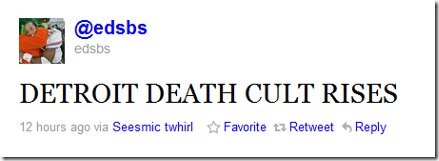
    edsbs_detroit_death_cultFrom there, things kind of got out of hand:

    edsbs_detroit_death_cult_2

    edsbs_detroit_death_cult_3

    detroit_the_lions_gate_defensive_line

    With Nick Fairley, the Lions have added the player many thought was the best available talent in the draft—especially in that limbo between the college bowl season and the Combine. In Mel Kiper’s first mock (and many other early mocks, Fairley went #1 overall, to the Panthers. Instead of the “reach” that I was worried about yesterday, the Lions had an incredible player fall right into their lap—mostly thanks to four quarterbacks being taken in front of them, pushing a Top 5 talent all the way down to 13. The problem is, he plays the same position as Ndamukong Suh—doesn’t he?

    Well, yes and no. First, Fairley spelling Suh would hardly be a bad thing: according to Pro Football Focus, Suh led all NFL defensive tackles with 997 reps. He barely came off the field at all! With Suh and Fairley, Williams and Hill, the Lions will always have two fresh impact tackles on the field. Beyond that, the Lions are extremely creative with their defensive line; they use weird sets, they stunt and loop, they shuffle guys around. Adding this weapon to Kocurek and Cunningham’s arsenal is dangerous, indeed.

    Ultimately, it was a question of value. When the Vikings were on the clock, Adam Schefter reported that the Lions wanted, “badly,” to trade out of their subsequent pick. Apparently, the Lions feared Minnesota replacing the aging Pat Williams with Fairley, rather than roll the dice on a quarterback (as they did). This tells us what we need to know about the Lions’ draft board.

    Yesterday, I wrote that the Lions, at 1.13, would be sitting on a pile of good-but-not-great prospects. At that point, the Lions would be loathe to stand pat—if they could find a partner, I’d thought, the Lions would try desperately to slide back. Faced with the possibility that Fairley wouldn’t be there, that’s exactly what they did. Clearly, for them, Prince Amukamara fell into that class of “a whole bunch of guys we’d gladly take at 20 but not so much at 13”—and considering he went 19th, that valuation must have been in line with the rest of the NFL’s.

    For the Lions to have passed on Amukamara speaks volumes—not just about their thoughts on Fairley, but their thoughts on Amukamara. Obviously, cornerback is an area of pressing concern. Obviously, Amukamara was widely thought of as a Top 10 talent. Ndamukong Suh would be more than willing to tell the Lions everything they need to know about Prince. For them to not only pass on him, but be panicked at the thought of reaching for him at 13—well, as I said, it speaks volumes. It’s not that I think Prince will be terrible now, or something, but that if you woke up today thinking the Lions passed on the guy who’d immediately solve all their problems at corner . . . apparently, they didn’t.

    It’s not all air guitars and pryotechnics, however, as not everyone is sold on Fairley and Suh becoming the Lions’ answer to the Mighty Ducks’ Bash Brothers. Pro Football Focus just posted an article called The Fairley Verdict, and the verdict was mixed, indeed:

    It wouldn’t be the most ridiculous statement to say the Lions walked into the draft with the best combination of defensive tackles in the league.

    So they didn’t need another one. Let alone a guy who on paper looks to suffer from the same weaknesses as Ndamukong Suh, as well as some pretty big character issues that caused him to drop in the first place. Presuming he plays up to his one good year in college, the Lions got themselves a guy who will likely be very good at penetrating, but perhaps lack a little in run defense. Just think how the combo of Suh and Fairley would leave them susceptible to draw plays and trap blocks? To say they don’t have the linebackers to deal with that level of linemen coming at them would be an understatement.

    Eep. They even invoke "same old Lions," a phrase that sends a chill down my spine, and should induce shudders in anyone reading this. Yet, it’s important to note, Suh and Fairley will likely be rotating together in the same spot, not always playing side-by side—and, they are, Suh may be playing defensive end. Don’t forget, Suh has always had a little inside-outside to him, and rumors the Lions might play Suh more on the outside compelled Schwartz to publicly denounce them a few weeks ago. I’m not saying Suh is going to switch positions, but that he’ll be able to join the DE rotation for a number of different looks. Think about:

    Avril * Suh * Williams * KVB

    Jackson * Suh * Fairley * Avril

    Suh * Williams * Hill * Jackson

    These are just to wet your whistle. My calculator tells me there are 81 possible combinations with Avril, Lo-Jack and Suh rotating at left end, Suh, Fairley, and Williams at 3-tech, Williams, Hill, and Fairley at 1-tech, and KVB, Avril, and Lo-Jack at right end. As Jim Schwartz said:

    "Well, we play 130 defensive tackle snaps in a game. So, if we're rotating three guys through and they're playing 45 snaps apiece ... No. 1, there'll be a little bit of pressure. We can keep rolling waves and waves."

    Ultimately, this was simply a Mayhew Pick. The Lions have a defensive philosophy: build the most dominant defensive line in the NFL and let them handle it. Mayhew took the best player available—to some, Nick Fairley was the best player available to anyone in this draft—that fit in with their approach.

    Now pass me that Honolulu Blue Kool-Aid.


    Read more...

    the Detroit Lions 2011 Pre-Draft Extravaganza

    >> 4.28.2011

    28 April 2007: Calvin Johnson is all smiles after the Detroit Lions made him their 2007 #1 draft pick at Radio City Music Hall in downtown Manhattan, New York, New York.25 April 2009: A happy Matthew Stafford holds his jersey after being drafted first overall by the Detroit Lions during the 2009 NFL Draft at Radio City Music Hall in New York, NY.  Super Bowl XLV

    images by Icon SMI

    All spring long it felt like this day would never come. Now, it’s here: the 2011 NFL Draft begins tonight, smack dab in the middle of the craziest labor chaos the league has ever seen. If you’re looking for my take on the Lions’ draft strategy, head on over to The Honolulu Blue, and check out my interview with THB’s author, Wade. We talk about needs, strategy, and my “gun-to-my-head” first-round choice. Wade does a great job, so keep going back after you listen!

    Next, if you’re looking for my mock draft, I collaborated with Michael Schottey and Zac Snyder on #mockThree, a blogger/writer mock conducted entirely on Twitter. Schottey, who’s had real training as a scout, and goes to all the college All-Star games to grade these guys in person, did a fantastic job of wearing the Mayhew Hat. The expert graders haven’t turned in their marks for us yet—but just stepping through it made me thrilled for the Lions’ possibilities:

    Picks:

    • 1.13 (13) Da’Quan Bowers, DE – Clemson
    • 2.12 (44) Brandon Harris, CB – Miami
    • 3.28 (92) DeMarco Murray, RB – Oklahoma
    • 4.32 (129) Brandon Fusco, C – Slippery Rock
    • 5.23 (154) Buster Skrine, CB – Tennessee-Chattannooga
    • 5.28 (159) Casey Matthews, LB – Oregon
    • 5.32 (163) Ronald Johnson, WR – USC
    • 7.02 (205) Chris Conte, S – California

    Trades:

    • Traded #75 to New England for #92 and #159.
    • Traded #107 to Green Bay for #129, #163, and #233.

    This mock was a dream scenario for the Lions. Let’s get this out of the way: I’ll out myself as the guy who pushed hard for Bowers. If the Lions stand pat at 13, they should take a developmental DE or OT. Why? Two reasons.

    First, dominant power/speed combo rushers and huge, athletic pass protectors are only available in the top half of the first round. If 2011 goes as expected, the Lions won’t be picking anywhere near this high for a while, and eventually Backus and KVB must be replaced. Taking this opportunity to do so just makes sense.

    Second, there are only a few positions on this roster where a rookie can come in and start—and with the possible exception of Prince Amukamara, there won’t be any impact players at those positions. Even if the Lions go with a corner or outside linebacker, they’ll likely be developmental guys anyway. If reaching for an immediate need won’t satisfy that need, then why do it? Take the best prospect that fits a long-term need.

    Ultimately, I think the Lions should trade down from 13. There will be four-to-six players the Lions should be happy to add to their roster there, so why not move down a few slots, add a pick, and take who’s left? In #mockThree, Michael Schottey couldn’t find a trading partner before our clock ran out, so we took the prospect with the highest upside: Bowers.

    After that, the board unfolded beautifully for the Lions. CB Brandon Harris fell to us in the second round, which I couldn’t believe—but even after that, corners were bountiful throughout the draft. Ras-I Dowling, a corner many believe the Lions might take in the second, fell to us in the third—along with OLBs like Quan Sturdivant and KJ Wright, RBs like DeMarco Murray and Kendall Hunter, and OG/OC Will Rackley. Unable to decide between so many strong options, we traded back and picked up an extra fifth-rounder. At our new, lower third-rounder, we added Murray, a complementary tailback of the sort we know the Lions are looking for.

    Things just kept working out. Schottey brought up Slippery Rock C Brandon Fusco’s name in the third, and was Schottey’s #2 choice for our original fourth-rounder. Then we got a whopper of an offer to move back in the fourth and add a fifth and a seventh, and we took it. Fortunately, Fusco was still there with the later pick. Bam, developmental center. With the three fifth rounders, we nabbed Buster Skrine, a CB Schottey had a third-round grade on, and LB Casey Matthews, a 4th-5th graded guy. With the last fifth, we picked up WR Ronald Johnson—a Muskegon product with whom some of you may be familiar. Seventh rounders are always BPA.

    After the confounding first round, the board sets up perfectly for the Lions’ needs. Of the Old Mother Hubbard shopping list, (which, I know, isn’t complete), we filled every need except developmental tackle. We added six players who could all be major contributors, if not starters, in 2012. If the Lions are crafty, they could do just as well.

    What the Lions won’t be able to do is add three 2011 starters. That’s because of the skill and talent already on the roster, not a lack of skill in the front office or talent in the draft. The Lions have become a good team, and on good teams you don’t draft a raw project in the fourth round and start him Week 1, a la Sammie Hill. On good teams,  a fourth-round project has to work to make the roster, let alone the starting lineup!

    I’ll be honest: tonight, I have no idea who the Lions will take. I’m hoping they pull off a trade down, and get a player who’ll be great someday, plus change. Whether they get an OT or DE for the future, or a CB for the present, the amazing thing about this draft is that we can just sit back and enjoy it. If you’re smart, you trust Mayhew, Lewand, Schwartz and his staff, Shack Harris, and all the scouts—they’ve done beautifully with their first two drafts, and I have faith they'll do so with this one, too.

    Read more...

      © Blogger template Simple n' Sweet by Ourblogtemplates.com 2009

    Find us on Google+

    Back to TOP