
Showing posts with label detroit lions. Show all posts
Showing posts with label detroit lions. Show all posts


Three Cups Deep: Sailing the Gravy Boat
>> 12.02.2013
It is December 2nd, and the Detroit Lions are in sole possession of first place in the NFC North.
They have a one-and-a-half-game lead over the Green Bay Packers, and a one-game lead (with head-to-head tiebreaker) over the Bears. The Lions face only one team with a winning record over their last four games, and basically have no good reason not to finish at least 10-6 (and 5-1 in division).
The Lions have just four short weeks and an ocean of gravy separating them from their first division title since 1993.
If you're reading, you know all this.
You also know the Lions destroyed the Packers, 40-10, for their first Thanksgiving win in a decade. You also know Matthew Stafford is rewriting the Lions record book, and Peter King just called Reggie Bush and Joique Bell "absolutely unequivocably" the best one-two tailback combo in the NFL.
I know that these Lions are still not good enough—not yet, anyway.
King also said this:
Detroit’s reward for earning the third seed in the NFC playoffs—if that’s where the Lions end up, and it’s no lock—would be one of the most rugged roads to the Super Bowl ever. Consider this possible slate: a Wild Card home game against San Francisco, a divisional game at New Orleans, a championship game at Seattle. Who survives that?Not a team who's turned it over 25 times in 12 games, that's for sure. The Lions are ranked fifth in the NFL in scoring differential, racking up 27.2 points per game. Opposing teams are scoring an average of 23.9 points per game, ranked 18th. That gives them the ninth-best scoring differential in the NFL (3.2 points per game).
Now, imagine how many more points they'd be scoring, and how many fewer points they'd be allowing, if they weren't ending 16.9 percent of their offensive drives with a turnover.
Despite that mindblowing, field-flipping, win-preventing error rate, the Lions have still ended 35.8 percent of their drives with a score, 11th-best in the NFL. Only the New York Giants and New York Jets are coughing it up more frequently, yet the Lions statistically have a top-five offense and middle-of-the-pack defense.
As I've said several times here and at Bleacher Report, this team is not going to reach its limitless potential until Matthew Stafford, Calvin Johnson and Reggie Bush cut down on the mistakes.
For some reason, this has made my fellow Flamekeepers really, really mad at me.
"You can't put it on Matt," they say, before proferring excuses for why his habitually high, behind, late and too-hard passes keep getting getting intercepted off of deflections. "It's the coaches' fault for not preparing him correctly," they say. I do believe coaching factors into it, but I think it's more to do with their hesitance to throttle Stafford down than an Xs-and-Os problem.
Then we get deeper into the blame game: receivers, protection, playcalling, the defense. Look: Matthew Stafford has the best wide receiver in the world, a solid running game, the fifth-best pass protection in the NFL (per Pro Football Focus) and a defense that—more often than not—is keeping him in the game while he and the offense spend the first quarter in neutral.
Yet, he's ranked 27th in the NFL in completion rate, at a miserable 59.2 percent. He's throwing picks on 2.8 percent of his dropbacks, his worst rate since his rookie year. His 5.4 percent touchdown rate can't touch his 2011 or 2010 numbers, 6.2 and 6.3 percent respectively.
What, then, is the more rational statement:
A) Matthew Stafford needs to more consistently play up to the talent level that made him a No. 1 overall pick, earned him a big-money extension, and showed through in 2011 when he threw 41 touchdowns against 16 interceptions.
or
B) Brandon Pettigrew needs to play like Rob Gronkowski, Kris Durham needs to play like Calvin Johnson, and the Lions defense needs to play like the 2000 Ravens'.
If we could wave a magic wand and make either A or B come true, they'd have equal effect on the Lions' bottom line. Yet, if you're staring at these numbers and concluding B is the more reasonable non-Fairy-Godmother request, I don't know what to tell you.
"Well then, what do we do?" Lions fans ask me. "Fire the coach?"
Let's re-read that first sentence:
It is December 2nd, and the Detroit Lions are in sole possession of first place in the NFC North.No, we do not fire the coach. In fact, we—the fans—don't do anything at all. Nor, honestly, do I think the Lions need to consider making any major moves. If any shakeup needs to occur, it's in the QB coach/Offensive Coordinator department (As a fifth-year veteran, I'm no longer worried that any change there will stunt Stafford's development, especially since it seems to be stunting anyway).
No, what needs to happen is Matthew Stafford taking preparation, execution, and all the little things that make the difference between a good quarterback and great quarterback seriously. This team is built to win because of him, not in spite of him; until he fixes the fixable mistakes they won't do enough of the latter—especially not come the bitter cold of January. Read more...
Boys of Summer, Men of Autumn
>> 11.13.2013
The purest expression of sports fandom can be found on elementary school playgrounds.
Still learning (and arguing over) the rules of the game as they play, kids merge their identity with the players they know and love from TV. Just as fights broke out over who got to be Barry Sanders or Cecil Fielder when I was a tyke, kids today call out "I'm Calvin Johnson!" or "I'm Miguel Cabrera!" when they take the ball field at recess.
They learn the game by mimicking the moves and styles of their favorite players. On the rare occasions they shake a defender with a jump-stop, or hit one over the playground fence into the scary old lady's yard, for an instant sports superstardom is their reality.
Since I was tiny, in sports—heck, in life—I've always been drawn to spectacular talent. I watch sports for many reasons, but there's nothing I love more about it than when a surpassing athlete deploys screw-you ability at a critical moment, defying physics and reality to win at will.
That's why I've always loved players like Dominik Hasek, Clint Dempsey and Barry Sanders--local allegiances aside.
When I watch sports, I want my jaw dropped. I want to throw up my hands, shake my head and laugh out loud at the absurdity of the skill required to pull off what I just saw.
When I played youth sports, I wanted to drop jaws.
As a baseball playing tyke, I was very short, very thin, but pretty quick. For someone of my limited gifts, the only path to jaw-dropping baseball I saw was "infield glove wizard" in the mold of Ozzie Smith.
As a baseball playing tyke, I was very short, very thin, but pretty quick. For someone of my limited gifts, the only path to jaw-dropping baseball I saw was "infield glove wizard" in the mold of Ozzie Smith.
I played wall ball for hours, honing my glove chops. I watched Johnny Bench's wierd baseball technique show for kids. I demanded my tee-ball coaching father play me at short, or MAYBE I'd deign to play second base. As soon as we were allowed to lead off and steal, I'd park my skinny white butt halfway between first and second and DARE pitchers to pick me off. I decided to be a switch-hitter, because of course great utility infielders switch-hit, right?
Here's the thing: I was terrible.
I had no glove, and a horribly inconsistent arm. I could throw to the first base region-ish, or I could throw ten feet short of the first baseman's waiting glove, and I was never sure which it was going to be. I had no instincts to where to go with the ball, turning every fielder's choice into Sophie's Choice.
My father, who typically coached the team, was remarkably patient with all this. I HAD talent, but I wasn't using it right. I had a good natural right-handed swing with relatively strong pop in the bat (though my small size usually meant I hit towering outs rather than towering home runs).
One game, after several fruitless left-handed at-bats, I came up in the order with two runners on. Dad insisted I bat righty. On the first coach-pitched lob, I drilled it deep into the right-center gap--which, in fourth grade, might as well be the Atlantic Ocean.
I skipped around the bases, sticking a two-footed landing on home plate while my teammates cheered. Dad was waiting for me, and immediately grabbed me by the shoulders. He growled, "Look: Do you want to be DIFFERENT, or do you want to EXCEL?"
This is how I feel watching Matthew Stafford.
Watching this dude play football in my team's colors is a joy, a blessing and an honor. He has the talent to be as good as anyone is; to be his generation's John Elway. By the end of this season, he'll hold nearly every Lions passing record that matters; by the end of his current contract he'll hold all of them, period.
That's why it's so infuriating to watch him play.
As a grownup, as a father, as a bill-having taxpayer with a mortgage and insurance and all those stupid things, it drives me absolutely crazy to watch Stafford incompletely apply his incredible talent.
I've written, tweeted and spoken at lengths about his tendency to get cute with arm angles, get sloppy with his feet and miss critical passes. It was there in force on Sunday, as Stafford threw what seemed like 16 sidearm passes into the arms of the Bears defensive line. Game after game, week after week, we've seen Stafford miss wide-open receivers, tying one hand behind his back by going all Elway instead of just executing like he's clearly capable of doing.
We've also seen him win those games, coming back from the brink with one hand tied behind his back and a blindfold over his eyes, threading needles through double- and triple-coverage, making plays with his legs, and beating the Dallas Cowboys--his hometown team--with a jaw-dropping mix of natural quarterbacking talent and balls the size of his oversized brain.
When he and Calvin Johnson--together, the most talented QB/WR pair in the NFL--went to Solider Field and won for the first time in forever, it felt like the tipping point. It felt like the mountain had been climbed. It felt like Stafford and the Lions had finally realized the potential we've spent five years daydreaming about.
When Nick Fairley followed up a game-losing personal-foul penalty with a game-winning TFL, it hit me: these are the Lions.
Like Barry Sanders and negative yardage, like Dominik Hasek and the occasional four-goal brain fart, the Lions are always going to be a mix of pleasure and pain. They're going to beat themselves with sanity-testing mistakes and beat other teams with searing, unstoppable talent. They're going to turn blowouts into close shaves and close shaves into heart attacks.
You can't separate Stafford from sidearm, Johnson from bumps and bruises, Suh and Fairley from penalty flags or Schwartz from spending all week in the film room with a MacBook only to break it over his knee and throw the pieces at a ref on gameday.
As Jack Nicholson once shouted at a room full of mentally ill folks in the movie of the same name, "What if this is as good as it gets?"
There's snow on the ground in Michigan, and the Lions are effectively two games clear of the rest of the NFC North. They have one of the league's easiest schedules from here on out, and they fully control their path to their first division title since 1993, when my middle-school baseball coach told me I was a natural centerfielder and everything made sense.
There's no use denying it: I love this team, because of the rough edges as much of in spite of them. Nothing thrills me like seeing the impossible made possible; if the Lions have to do that every week just to overcome their own mistakes, so be it: my favorite team in sports is delivering heaping helpings of my favorite thing about sports, week after week.
What more could I ask for? What more could any of us ask for?
The other day, I walked into the living room to see my seven-year-old son playing Madden. "Dad," he excitedly said, "I built my Madden Ultimate Team!" Oh yeah, I asked, who's on it?
"Pretty much all the Lions, but with Aaron Rodgers," he said.
With this season just halfway over, I guess we can't hang a banner just yet. Stafford and the Lions haven't answered all the questions yet--and until they win a Super Bowl, they never will.
But right now, the Lions are different, AND they excel. Let's appreciate that.
Cross Road Blues
>> 8.10.2013
As the legend goes, Robert Johnson met the Devil himself at a crossroads, and sold his soul for the ability to play guitar like no one ever had. Though Johnson didn’t achieve worldwide fame and success until after his mysterious poisoning death, Johnson will reign as King of the Delta Blues for eternity.
A Faustian bargain made in a swirling mist of hoodoo, it’s an intoxicating tale that Johnson never shied away from—after all, it didn’t hurt from a marketing perspective. According to blues historian Robert McCormick (via Wikipedia, yeah what of it), Johnson’s friends and family believed Johnson’s death was divine retribution for making secular music instead of glorifying God with his talent.
Johnson, McCormick believes, accepted the idea of “selling his soul” as a metaphor for abandoning honest work and playing the blues full-time.
Last November, I made the same choice.
I accepted a full-time position with Bleacher Report as a National NFL Lead Writer. I continued working my day job full-time for weeks afterwards to handle the transition. Between that workload and my family life, I struggled to keep up TLiW.
For four years, I’d kept the blue flame burning while burning the midnight oil. The words written here were penned during lunch hours, stolen moments, and brain-melting early-morning sessions that often had me waking up to a darkened computer, both hands still on the keyboard.
Switching careers at 31—with a wife, three kids, two cats, a dog, a mortgage and two cars hanging in the balance—was not something I could afford to do halfway. TLiW is a labor of love, but owed my loved ones every ounce of my labor.
Old Mother Hubbard, Meet the Cubs, eulogies for the careers of Jeff Backus and Jason Hanson: these are all projects I sincerely meant to undertake and just… never… did.
This season, the Lions are at a crossroads of their own.
The 2013 iteration of the Detroit Lions made their preseason debut last night. Despite massive turnover on both the offensive and defensive lines, and shiny new toys on both sides of the ball, the 2013 model looked largely similar to the 2012 edition.
The Lions’ greatest flaw from last season—a total inability to cross the opponent’s 30-yard line in the first half—was there for all to see. The dominance of Stafford-to-Calvin, the not-dominance of just about every other Stafford-to-whomever combination, and the boom-or-bust running game looked spookily familiar (remember, Joique Bell hurdled fools last year).
The defensive line looked overwhelming, with Ziggy Ansah and Jason Jones combining with Suh and Fairley to form a front line shocking in its size, strength and athleticism. I mean, look at this:

The obvious size and strength of the line up front allows the Lions to be ridiculously aggressive with the back seven, as you can see. The much-maligned Wide 9 alignment maximizes this up-front advantage. At first, this made a hash of everything the Jets tried to do offensively. Then, the back seven fell apart, with multiple blown coverages making Sanchez look good.
The Ziggy thing? Yeah, that was awesome. Snagging a pick-six on his first series in Lions uniform? Awesome. Don’t make too much of it, though. As Jim Schwartz said at halftime, per the Detroit Free Press:
“We said from the beginning that he plays screens well, he plays draws well and all those kinds of things. We’ve seen that stuff on tape so wasn’t a surprise when he made that play.”
As I said all along (on Twitter, mostly), the Lions having coached Ansah at the Senior Bowl means the whole staff knew exactly what they were getting. Those speculating assumed Ansah would be raw and lack instincts because Ansah’s only been playing football for a few years. The reality is, Ansah’s grasp of the game is exactly that: instinctive. He’s still not the Pro Bowler they need him to be.
Don’t make too little of it, either. The strength, hands, athleticism and playmaking skills the Lions knew they were getting in Ansah were on full display against the Jets. That’s awesome. He definitely has the talent to be the Pro Bowler they need him to be.
There weren’t a ton of valuable takeaways from this game. Shaun Hill is still way too good to be a backup. The kickers and punters look good, and the special teams overall are improved. Riley Reiff is not going to put Stafford’s life in danger. Other than that drive, the Jets couldn’t do much against the defense—then again, the Jets have almost no offensive firepower.
There were still too many two-yard runs, incomplete passes, stalled drives and punts for a theoretically high-flying offense.
Throughout the offseason, I’ve fought the impression that this is going to be a tantalizing but unsatisfying “sim year,” one we’d simulate though if we were playing on Madden. There are too many young and inexperienced players in key roles, too many question marks yet unanswered, and too little proof that Matthew Stafford has enough rapport with anyone besides Calvin Johnson to take his game (or the Lions) to the next level.
Though this team has more than enough talent to make the playoffs, and my faith in the coaching staff is still strong, nothing I saw on Friday looks significantly better than in 2012—or 2011, for that matter.
This was the maddening thing (not the Madden-ing thing) about the 2012 season: the team looked so much like the 2011 squad, but the offensive touchdowns just evaporated. The margins were so thin and the outcomes so unlucky, it not only defied belief at the time but threw into doubt just how “real” the magical 2011 season was.
Even if the 2013 Lions perform at exactly the same level as 2012, they could still be a seven- or eight-win team, if they’re as lucky this year as they were unlucky last year. If Reggie Bush can terrify defenses with more explosive plays like that hurdle, and Stafford takes advantage of the space, they could win the division. If not, they could struggle to reach .500.
Did I make a deal with the Devil himself to express myself for a living? No, but I did make a deal with you folks. I swore I'd never let the little the blue flame die out, and I won't this site go dark. I can't promise anything too regular or too specific, but I'll be writing throughout the season (and, Lord willing, Fireside Chatting again on game nights).
If TLiW's not already bookmarked or RSS feed'd, you can always keep track of new posts at my Twitter feed, and the VERIFIED (!!!) Lions in Winter G+ page.
If you're reading this (and surely, if you've read this far), you're part of the reason I was able to follow my dream and do what I love for a living. Even more than I was up all night writing for me, I was up all night writing for you.
It's the unique spirit of the Lions fan that compelled me to providing a warm, comfortable place for us frozen and weary souls. You came, in shocking and humbling humbling numbers, to join me by the fire. You encouraged me, supported me, let me know when I did well and let me know when I'd strayed from my Flamekeeping duties.
The Lions in Winter—its words, posts, community, comments, podcasts, UStreams, all of it as a whole—has changed my life. Thank you, all, for letting it be a small part of yours. I hope it still will be, for as long as the blue flame burns.
Read more...On Taking the Wind
>> 6.17.2013

Deadspin's Drew Magary and Dom Cosentino asserted the opposite late last week, based partly on Mornhinweg's 5-27 record as head coach, but mostly on the HILARIOUS STUPIDITY of taking the wind in overtime.
The article makes a lot of cogent points about the NFL having moved beyond coaches getting "hired to be fired," straight into a swirling vortex of hiring blatantly unqualified candidates to turn around talentless rosters, and poleaxing them if they don't immediately succeed.
As I've written before, trying to catch "lightning in a bottle" is the wrong way to hire a coach. As often as not, the young coach who pretends to have the NFL figured out is found out. (see: McDaniels, Josh).
Mornhinweg, in a way, was the model for this particular way to fail. Not only was he not an experienced NFL head coach, the 38-year-old had never been a head coach at any level. He'd been calling plays under Steve Mariucci in San Francisco for only two years, and the 49ers were 10-22 over that span.
Mornhinweg was hired to be fired, quite literally. As rumor had it, Matt Millen's relationship with Mooch was part of the reason the Ford family entrusted the franchise to Millen. Mornhinweg was basically there to install Mariucci's flavor of the Bill Walsh offense and keep Mooch's seat warm.
On December 31st, 2002, Millen announced that the Lions would be retaining Mornhinweg for a third season. Then Mariucci was unexpectedly let go by the 49ers. Three weeks after the public vote of confidence Mornhinweg was awkwardly terminated; a week after that the prodigal Yooper returned.
Marty Mornhinweg was then, and is now, a gifted offensive coach with a bright future. Mornhinweg did a lot of learning on the job, which included a contrived move-for-move reenactment of a Mike Holmgren training camp tirade-and-motorcycle-peel-out. Lions veterans profoundly did not buy it.
One thing Mornhinweg got right, though—or at least, did not get as wrong as everyone thinks—was taking the wind on that fateful day.
Now-defunct site Football Commentary did a beautiful win-probability analysis of the decision back in 2004. I can't find anything today that backs this assertion up, but my memory is that all 34 points scored in regulation that day had been scored with the wind.
I've talked and written many times about football's hilariously risk-averse culture, wherein even the game's greatest coach is pilloried for maximizing win probability instead of "playing the percentages" when he doesn't get a result.
In reality, Mornhinweg's mistake was accepting a holding call on a 3rd-and-8 incompletion that would have forced the Bears to send Paul Edinger out for a 42-yard kick into the hellacious wind—or even wave the white flag and send out Brad Maynard to punt it away. Had the Lions gotten the victory with that decision, Mornhinweg's outside-the-box decision would have been lauded as crazy-like-a-fox, instead of idiotic.
[Ed.- Per request, I used the Advanced NFL Stats WP calculator to judge this decision. The Bears had a 0.68 WP at 4th-and-8 from the 35, and an 0.62 WP at 3rd-and-18 from the 45. However, this is based on modeled leaguewide historical expectations, and wind into the teeth of which none could score is certainly unexpected.]
Continuing to shame Mornhinweg over that call is stupid and destructive and misses the point: Marty Mornhinweg was a great position coach, hired as a Plan D, and put into an impossible situation.
Mornhinweg took over a not-talented-enough roster filled with veterans not much younger than he was, a brand-new front office with no idea what they were doing, got saddled with a No. 3 overall rookie quarterback he wanted nothing to do with, then was forced to lie through gritted teeth that he was completely on board hitching his career to Joey Harrington.
Mornhinweg made a lot of mistakes, but taking the wind wasn't one of them. Unlike Rich Kotite or Dennis Erickson or many of the others on the list, Mornhinweg has proven he's a quality NFL coach—and before long, will get another head-coaching gig.
Let's just hope he stays away from motorcycles. Read more...
Biding Time on Prime Time: Saturday Night Football
>> 12.22.2012
The left boot’s lace snapped as I tied it. The axe was rusty and dull. It took a few tries to open the shed’s padlock, and I forgot to zip my parka. The wind driving the year’s first snowfall whipped into my chest, chilling me to the core. I steeled myself against it and set to work.
I walked the path to the bonfire, sled laden not with wood but with guilt. Too long, I’d let my tasks go uncompleted. Too long I’d left my duty undone.
The Lions aren’t going to the playoffs. They aren’t winning more games than they lose, or even winning as many games as they lose. They’re having a terrible season, and all the close calls and almosts and maybes and robberies adding up to a measly four wins out of 14 games.
The problems have been the same all season: a misfiring Matthew Stafford, special teams disasters, and a defense that can’t quite make up for all the offense’s mistakes. Calvin Johnson is going to break the single-season receiving yardage record, but the Madden Curse robbed him of his touchdowns—and the Lions of every other useful receiver.
Tonight, the Lions will take Ford Field for the second-to-last time this season. They face the 12-2 Atlanta Falcons, with nothing but pride at stake. Lions fans will fill Ford Field again, expecting to witness an excruciating loss for the fifth time this season.
And yet, the Lions will play, and the fans will watch and cheer and roar.
Trudging through the woods, the cold red light in the west fading, I pulled the sled toward the bonfire spot, fearful of what I’d find. To my surprise, I could make out a wan blue light dancing off the tops of the trees. As I got closer, I could hear voices.
People. Fans.
The blue fire was nothing like the raging, towering inferno it had been. But it was bright and strong enough to keep the folks gathered there warm. There was no laughing, no singing, no loud carousing. The cider had long since run dry, the casks I’d last left weeks ago emptied and never replaced. But people were quietly resting, basking, keeping each other company.
Whether the Lions win or lose tonight, the blue flame is not threatened. Many, myself included, have had our faith tested this season, and the old bickering can be heard in murmurs around the edges of the fanbase. Many are questioning if the Lions are on the right path, but few have abandoned the flame completely.
Many have left the blue bonfire, but not for good. Not for long. Just for the winter.
Read more...On Thanksgiving, Lions Fans Give Thanks
>> 11.21.2012

“…although it be not always so plentiful as it was at this time with us, yet by the goodness of God, we are so far from want that we often wish you partakers of our plenty.”
-- Edward Winslow, A Relation or Journal of the Beginning and Proceedings of the English Plantation Settled at Plimoth in New England
Ten games in to the 2012 season, the Lions have won four games and lost six. Jeff Backus’s 186-game starting streak is about to end. Nate Burleson will be in crutches, cheering from the sideline. Titus Young will be in street clothes, inactivated for insubordination. Jahvid Best may never play again.
Corey Williams is iffy, Aaron Berry is in New York, Bill Bentley is on IR, and Drayton Florence will likely be out with a concussion. Two of the Lions’ top three safeties are on IR, and the third (Delmas) likely won't play either. Everything we thought this season would be is lost, or nearly so.
Now, let us fill Ford Field to the rafters and roar thanks for all our blessings.
Last season was the first season I made the more-literal-than-usual Pilgrimage to Ford Field on Thanksgiving Day. I was not surprised to find the atmosphere as it always seemed at home, on TV: an extra-special mood of festivity, a wide-open expression of joy and pride, a welcoming, party atmosphere.
There's something magical about the Lions on Thanksgiving, doubly so when you're there in person. Through thick and thin, and there's been an awful lot of very thin, this game sells out. It’s an annual national celebration of blessings, and no matter how bleak things have been on- and off-field for the Lions, their fans turn out in force to spend all day reveling in the immutable fact that we are still here.
The Pilgrims themselves gathered ‘round with some corn and some eel and some venison and a few pints of homebrew and toasted their incredible luck at just being able to do so. It’s the same with the Lions and their fans: spit on the team, on the City of Detroit, the State of Michigan, on our way of life all you want. Dismiss us, deny us, wish us all to lose our jobs, whatever.
We are still here.We're here: 64,000 of us, 750,000 of us, four million of us, ten million of us, and we’re all wearing blue and fake turkeys on our heads and we’re going to raise a glass to one another and scream our fool heads off and you can’t deny it. You can’t take it away. We have our team, we have each other, and we are united in celebration of those simple facts; we are still here.
Whether you are there with me and mine tomorrow morning, or at home in the City of Detroit, or at home somewhere else, or visiting Grandma’s House, or even if you’re on the other side of the world: tomorrow we are all together, united in support of our team and each other.
There have been much, much worse seasons than this one. There have been much, much less exciting versions of our team. There have been much, much worse Thanksgiving Day games than this one will be, even if the Texans beat the Lions by more than the three-point spread. It’s not about the winning or the losing, though a win would be wonderful and a loss the final doom of the Lions’ playoff hopes.
Tomorrow, we give thanks for the blessings we have, and the blessings we have are so many: We have a team, we have a stadium, we have food and drink, we have each other, and we have hope. Always, always we have hope.
By the goodness of God, we are so far from want, we wish you partakers of our plenty.
Read more...Turkey Day Q&A with TexansChick Steph Stradley

Today, TLiW is thankful for Stephanie Stradley (@StephStradley on Twitter), a Houston lawyer who writes about the Houston Texans for the Houston Chronicle online and a general interest, non-Texans blog at her own site. Stephanie is a sports blog O.G., and one of the very best.
I answered her Qs with my As at her TexansChick Houston Chronicle blog, and after adding her own must-read analysis, she’s provided her own As for us, here:
What are differences between this Texans team and previous ones? And why are Andre Johnson's numbers (with the exception of last week) down this year?
“The Texans offense with few exceptions hasn't had to open up much because with better defense, the team has played with many early leads. Due to salary cap concerns, they had to replace the starting right guard and right tackle, which would also make a team lean toward a more conservative, less-risk filled approach. The strength of the 2012 Texans is their experienced tight ends relative to their young 3-5 WRs, so they can use their TEs to help the offensive line but also to make pass plays and create mismatches.
The Texans have three tight ends that are listed in the top 15 in TE efficiency: Owen Daniels, Garrett Graham and James Casey. Casey is not built like a traditional tight end and came into the league as a do-everything athlete after his remarkable time at Rice University. (Nickname: "Thor"). The Texans use him as a hybrid TE, FB, WR and line him up in various ways. They run/pass out of the same looking formations and create matchup problems for defenses, especially given that no teams look like what the Texans are doing this year.
Andre Johnson is still Andre Johnson. He's made key move-the-sticks plays, and big plays downfield. But this year he has functioned mostly as a "Break Glass In Case of Emergency" option. If the Texans have a big lead, there's no reason to take downfield shots at him. In the game against the Jaguars, he faced some unusual single coverage matchups. In addition, with the Texans down by 14 late, they started running more 3-4 wide receiver sets with a more open offense like they used to do a lot when their defense was terrible. Eventually, if the Texans decide they are going to throw on teams, Andre Johnson is going to get his.
He's a very unselfish player and would rather have wins over stats.
In general, the Texans offense is all about taking advantage of what the defense gives you. Some defenses load up against RB Arian Foster. Some defenses aim at taking Andre Johnson out of the game. So each week the targets are different...the yard can be all about Arian Foster or the TEs or the #2 WR or the Andre Johnson show. They have many ways they can be efficient in moving the ball, and I think Texans coach Gary Kubiak is underrated as a playcaller. (The old "It's the players when things are going well, and the playcalling when things aren't." If you talk to the Texans players, they have a great deal of respect for what Kubiak does).
It's also worth mentioning with Andre Johnson that both he and Matt Schaub were coming off of injury filled seasons where neither one of them had a full camp. Johnson says he is feeling more like himself as the season progresses.”
What are key injuries for this team or players coming off of injury?
“The number one concern is whether standout CB Johnathan Joseph is going to be available for this game given his hamstring issue coming out of the previous game. He's usually the corner who is matched up with the best WR when there's a clear dominant #1. The Texans haven't played a lot of snaps with him off of the field.
Probably the greatest loss for the Texans this year was losing ILB Brian Cushing for the year to an ACL injury suffered against the Jets. He is a physical player against the run and the pass and gave Wade Phillips flexibility for what he could call on defense. Against better offensive teams, his aggressive play in the middle of the field will be missed. Tim Dobbins has played well in replacement, but suffered a shoulder injury after an interception return that makes his return uncertain.
Darryl Sharpton was expected to play alongside Cushing in 2012, but had a hard time coming back from a quad injury suffered last year. He had his first game against the Jaguars after coming off of IR and played well despite the rust. He played well before his injury, and Texans fans will be watching if he is the same player now. He will likely get the start on Thursday.”
What do you think are the strengths of this Texans team?
“Balance. If you look at the best teams in 2012, they are very balanced between offense and defense. In recent years, there's been a trend for teams to be dominant on one side of the ball and use that dominance to overpower opponents. (Typical examples: Patriots, Colts). This year, there's a number of good teams that are balanced: Texans, 49ers, Broncos, Seahawks, Packers. Teams that can win through both their offensive and defensive play.
Even within their offense and defense, they are balanced. They're run/pass playcalling is almost 50/50, and they can be very effective doing either one or both. The Texans defense is balanced as well, being good against both the run and the pass.
The Texans defense third down percentage numbers allowed is absurdly low. Currently the Texans defense leads the league in fewest a 3rd down percentage made at 26%. To put in context, the Bears and 49ers are 2nd and 3rd in that number respectively at 32%, 33%.
The Texans are also 1st in the NFL at Time of Possession (excluding OT) at 34:38. The defense has been doing a great job at forcing punts, and the Texans are usually good for a number of clock chewing offensive drives each game and at the end of games with a lead.”
What concerns Texans fans?
“Special Teams. This is the biggest concern by far. This unit has a number of new faces and new a kicker and punter who weren't the plan A's going into the season. Coverage units rarely worked all together in the preseason, and they did not appear to be a cohesive group going into the season. The unit has had some untimely penalties, and sometimes have created problems with the field position battle. They've looked better in recent weeks, and the hope is that with more time together, they won't lose the Texans games.
The right side of the offensive line. The Texans have been doing an unusual rotation on the right side of their line. Usually it has been fine, but in a couple of games it has led to some cringeworthy shots against Matt Schaub and difficult yards for Arian Foster.
Pass rush other than JJ Watt. Second year defensive linemen JJ Watt has been having an absurdly productive year. They move him up and down the line to give him good matchups, and he often takes advantage. The question for some is whether the other linemen/OLB can take advantage of situations where JJ Watt is being double teamed. Given the wild productivity of the Texans defense in 2012, that might be a quibbling concern.”
What do you think is the best way to beat the Texans?
“Stop the run and don't overpursue such that the best playaction/zone running team in the league kills you. Disguise coverages and bring infrequent, delayed blitzes to keep Matt Schaub from finding a rhythm. Bring quality pass rush with only four rushers and make sure Schaub makes few clean throws.”
What do you think the Texans gameplan will be against the Lions?
“The Texans focus mostly on what they like to do. On defense, stop the run, don't get beat by the deep play, take plenty of hard shots on the quarterback. Give extra attention to what the opponent does best, in this case, make it difficult to throw to Calvin Johnson.
On offense, see what the defense is giving you with the scripted plays at the beginning of the game, and then take advantage of defensive tendencies and matchups. Throw early in the game to amass a big lead and then run a lot late to chew clock.”
Who are some Texans players that Lions fans may not know who may have an impact on the game either in a negative or positive way?
“I've already mentioned the tight ends. Specific to the line, Ben Jones is a rookie who is rotationally playing right guard. He was a quality center in college, didn't play guard but started working on it during camp. He rotates with Antoine Caldwell, and both of them have had some up and down moments. Right tackle Ryan Harris rotates with Derek Newton, and Harris sometimes reports as an eligible receiver in red zone situations.
Those from Michigan may be familiar with rookie WR Keshawn Martin who went to Michigan State. He had his first touchdown last week, and had his best game as a returner last week. The Texans are slowly giving their inexperienced WRs more work, and if this game becomes a shootout, it is easy to hear other receiving target names being called other than just Andre Johnson because of how much Schaub distributes the ball.”
Read more...Three Cups Deep: Week 10, Lions at Vikings
>> 11.13.2012

Fire is mysterious. It burns, it sears, it destroys—and it heals. You know me to be a man of facts, of analysis, of numbers and science and truth. But I’m also a man of emotion, perception, and faith in ultimate justice. There are times when truth is inescapable, and times when it is ineffable. There are times to rely on intellect, and times to open up to what we don’t know.
After nine games the Lions are one game below .500, and the Lions fanbase is wounded. We watched the Vikings again grind out an improbable victory, again saw the offense flail ineffectively as the defense stood tall, and again saw huge Vikings touchdowns nullify a spectacular fourth-quarter offensive awakening.
Once again, the Lions fanbase is crying in pain, dazed and struggling for answers. Are the Lions a good team, playing below expectations and falling victim to circumstance? Are the Lions an overrated team, a castle built on sand, heading for another complete collapse? Are the Lions a young team, experiencing growing pains as they learn to win? Or are these manifestations of that poltergiest undisciplinedness; Mikel Leshoure’s offseason pot habit mischievously causing Stafford to throw a pick, Ponder to throw deep spirals, Megatron to fumble and Adrian Peterson to reel off 120 yards in the last 15 minutes?
There is an ancient art of healing called fire cupping, which if you saw the Karate Kid reboot you know what I’m talking about: a lick of flame in a glass jar pressed against skin, causing a partial vacuum that bursts capillaries and rushes life-giving blood to the patient’s afflicted body part. Science, it isn’t. But in this case a little mysticism, a little blue flame, is exactly what Lions fans need.
While the treatment might be ineffable, the disease is not. The Lions offense is, statistically, still among the best in the NFL. They’ve gained the third-most yards, scored the 13th-most points, are ranked 6th in overall offense by Pro Football Focus, fifth in Offensive Expected Points Added and ninth in Offensive Win Probability Added. But anyone watching sees a much less effective offense.

So: the Lions are throwing the ball much less farther down the field, and they’re doing it less effectively. For the first three quarters of nearly every game, Matthew Stafford is able to hit the broad side of a barn, but it seems like he’s only able to hit the broad side of a barn.
In prior games, Stafford’s problem has been his ineffectiveness on third down. The Lions were again dreadful on third down (1-of-9, 11%) against the Vikings, but that was because they were so often dreadful on first down, especially in the first half.
By my count, the Lions faced 35 first downs on Sunday, 17 in the first half. Of those, they rushed 9 times at 3.1 YpC (10 at 3.7 including a Stafford scramble), and passed 7 times at 6.71 YpA. In the first quarter, the Lions lined up for a first down, and were held to two yards or less five times. That’s just not good enough. Putting the offense in constant second-and-long and third-and-long situations is going to result in punts.
Punts kill defenses.
Through the first seven quarters the Lions faced the Vikings in 2012, the Lions allowed 153 rushing yards and no touchdowns from Adrian Peterson, and 312 passing yards and 1 touchdown from Christian Ponder. That’s 106 offensive plays, an average of 4.39 yards per play, and seven offensive points.
In the last quarter, the dam burst: the Lions allowed 120 yards and a touchdown to Adrian Peterson, plus a 20-yard touchdown pass to Christian Ponder. That’s 15 offensive plays, an average of 9.33 yards, and 18 offensive points.
The Lions are an offensive team. It is built to score 28-plus points every time it takes the field. This Lions defense is an aggressive defense, built to ravage teams playing catch-up. Asking them to completely deny Adrian Peterson any yards and the end zone for eight quarters is asking too much. Asking this defense to shut down the run and suffocate the pass for eight quarters is too much. Asking this defense to make up for a cornucopia of punts and turnovers committed by a 200-million-dollar offense is too much.
Stafford and the offense have to stop playing scared in the first quarter, and incandescently in the fourth. Stafford has to stop breaking down and rolling out and flushing away when he’s got the second-best pass protection in the NFL.
But what, you ask, is the good news? That the incandescent play of Stafford & Co. is still there. That the switch is still able to be flipped. That when push comes to shove, these coaches, these players, and these schemes can still rip other teams to shreds. As long as all the elements are in place, anything is possible—even making the playoffs.
Before you scoff, remember: the Lions have made the playoffs from unlikelier circumstances.
Read more...Three Cups Deep: Week 7, Lions at Chicago Bears
>> 10.23.2012

It was all but a must-win, and the Lions didn’t win.
This loss hurt. It hurt to see Calvin Johnson stone cold drop a sure long gainer. It hurt to see Matthew Stafford again struggle to make good reads quickly, struggle to stand tall in the pocket, and struggle to execute the offense efficiently. It hurt to see Mikel Leshoure and Joique Bell pound the vaunted Bears defense for five yards a carry and each lose a scoring-drive-killing fumble.
It hurt to see the Lions excel on special teams: block a field goal, allowing only 1 return of 4 to exceed five yards—and then have Stefan Logan lose yet another fumble.
It hurt to see the Lions defense kick the Bears' ass and lose.
The Lions are 2-4, two games below .500 and functionally three-and-a-half games behind the Bears. The sputtering offense is scoring just 22.2 points per game—and despite the defense allowing just 18 points per game, the six non-offensive touchdowns scored on the Lions are mean they have a –2.8 point per game scoring differential. They’re –5 in turnovers, ranked 25th in the NFL. That’s down from +11 last season, which was fourth-best.
So far, it’s been all but a Murphy’s Law season for the Lions: they have two semi-miracle comeback wins and three that fell just a bit short. They’re seemingly inches from being 4-3 or 5-2, yet they’re no further from 0-6. The offense seems like it’s this close to putting everything together, and yet if they haven’t by now when will they? The defense is playing out of its mind and getting better every week—but how long can that last?
Fortunately, it’s a short wait to this weekend, and a game against a team much like the Bears. The Lions will face a Seahawks team with just as vicious of a defense, just as strong of a running game, and with a quarterback even harder to pin down.
But it will be during the day, in the welcoming den of Ford Field, instead of at night in the Windy City. It won’t be in front of a primetime national audience. It won’t have any of the historic, bitter import. It won’t have any of the divisional implications. It’ll just be another football game—one the Lions, again, will have the talent to win.
But this time, it will be a must-win. There will be no “margin for error,” as Jim Schwartz said. The Lions, as ever in the Schwartz era, are victims of playing in the best division in football. Had they won this game they’d still be in the cellar, even at .500. This Sunday, the Lions offense has to execute. The Lions defense cannot take their foot off the gas. The Lions special teams cannot blow it again.
The Lions must win.
Read more...Monday Night Vengance: the Bears-Lions Rivalry Renewed
>> 10.22.2012

"They don't like us. We don't like them. That's how it is.”
--Dominic Raiola, Detroit Lions center, on the Chicago Bears
They don’t like us. We don’t like them. The Chicago Screwjob. Last season’s Monday Night triumph. The return blowout at Solider Field. Glorious wins, stinging defeats, bitter complaints, searing pain, delicious triumph.
Actual rivalry.
A “rivalry” can be any recurring matchup. Any two teams with history, any two teams in the same division, any two teams that have played each other before can be called “rivals.” But this rivalry is something different; this rivalry means more. This isn’t about Alex Karras or Dick Butkus or Gayle Sayers or Lem Barney or George Halas or Dutch Clark. This is, but isn’t just about soliders bearing the livery of Honolulu Blue and Silver and a Leaping Lion meeting soliders clad in Light Black and Grody Orange bearing the standard of that tweezers-C.
This is about two groups of men who hate each other.
This is something rare in professional sports. With its mercenary nature, massive salaries, players rarely have time to inspire true loyalty, or true contempt. With the genteel manner in which we demand the modern player behave, we rarely see two pro sports teams who truly want to kick each other’s ass.
Tonight, on Monday Night Football, the nation will see exactly that.
Of course, this means something extra to the fans, too: we won a game ball for our support on the last Monday Night Football matchup between these two teams, and restored pride to our beleaguered franchise’s national reputation. Then, the Bears returned the favor, putting a serious wobble in the Lions’ playoff trajectory and dulling the roar of the “Lions Nation Army” for most of the rest of the season.
Here in Week 7, the season’s already at stake for the Lions: win, and they pull up to .500: within a half-game of the Packers, a game of the Bears, and a game-and-a-half of the Vikings. Lose and they’re down three full games to the 5-2 Bears, with the tiebreaker unlikely.
The situation's similar for the Bears: win and they're sitting atop the division, lose and they're a mortal 4-3 with a murderous second-half schedule lurking around the corner.
This will come down, as always with these two teams, to two factors: the quarterbacks, and the defensive lines. Whichever quarterback makes more plays and avoids the other’s defensive line wins.
The hour is late; the Lions are at the gate. The Bears stand ready to defend their fortress. The rivalry is about to be renewed.
We cannot tilt the battlefield in favor of our team. We cannot intimidate their players or bully the refs or short-circuit their communications or make them commit penalties in their terrified confusion; all we can do is watch.
Watch, and hope.
Watch, hope, and hate.
Read more...Bo Knows Low-Variance Football. So Does Jim.
>> 10.19.2012

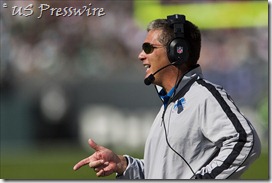
Jim Schwartz, on why the Lions have scored more points in the fourth quarter than the first three in all of their games so far:
"We've had to in the fourth. We've been behind and that's put the pressure on us to have to do it. We're trying just as hard in the first quarter. Certainly no design or scheme or anything like that. We have to be efficient all four quarters and it can make a difference for us if we can get a lead and we can hold a lead. But we've got to battle for 60 minutes. You're judged just like a 16 game season, you're judged on all 16 games, you're judged on all 60 minutes. So no matter where you're scoring them they all count."
“We’ve had to in the fourth.”
Schwartz says it’s “no design or scheme or anything like that,” but the Lions’ close games are the result of obvious changes in approach on offense.
The biggest change from last season to this season is the way defenses are playing the Lions—and all of last season’s 5,000-yard passing offenses. The Saints, Patriots and Lions went 36-10 last season; through Week 6 of this season they’re 6-10. NFL defensive coordinators are paid way too much to let teams beat them with the same thing over and over—so they’re taking away the bombs-away offense and forcing these teams to adjust.
The Lions have adjusted by re-emphasizing the run game, drastically cutting back on hopeful shots downfield, and trying to emphasize intermediate routes. Linehan has also been doing a lot of “setting up” defenses with repetitive/predictable playcalls early in games, to subvert them later—or in the case of this play broken down by TuffLynx at Pride of Detroit, use repetitive/predictable playcalls in early games, to subvert them in later games.
By taking fewer risks and being less aggressive on offense, the Lions are pursuing a low-variance strategy.
This concept has been discussed all over the Internet, but it was synthesized best for me by Brian Cook at MGoBlog, in a piece called “Keep it Close and Lose in the Fourth Quarter," and its follow-up, "Mathy Mailbag." Read them both, plus all the links in both if you really want to grok this.
To summarize: low-variance strategies result in fewer possible outcomes. Two equally-matched teams both running more often than they pass and always punting on fourth down regardless of field position and never blitzing on defense won’t produce a 48-0 blowout in either direction.
This is, as discussed by Cook, Chris Brown, and Malcom Gladwell a “Goliath strategy.” When you’ve got a massive talent and skill advantage—as Goliath did over David—you want to eliminate the chance of anything crazy happening. Since the expected outcome is “you win,” you want to maximize the probability of getting the expected outcome.
As Cook notes, this is the strategy used by Bo Schembechler at Michigan: grind it out, play suffocating defense, take few risks, minimize mistakes, and use your massive size and talent advantage to consistently beat opponents with execution. Cook cited a passage from a book called Bo’s Lasting Lessons, wherein Bo, at a coaching clinic, veered dangerously close to schematic enlightenment before reaffirming his fevered belief in fundamentals and “playing Michigan football.” Cook:
This may have been brilliant in 1985, and brilliant against the poor, huddled masses that comprised Michigan's opponents at the time, but it's fundamentally a variance-hating strategy that presumes better talent. In it are the seeds of Michigan's time-honored failure against Rose Bowl foes, and its recent struggles to put away inferior competition.
It’s that old chestnut, attributed to darn near every midwestern football coach of historical note: “Only three things can happen when you pass the ball and two of them are bad.” Passing is a high-risk, high-variance strategy.
No NFL team passed more, or more often, than the Lions did in 2011.
This is why the Lions aren’t doing it again in 2012: the Lions can assume a talent advantage over most NFL teams. They just beat the Eagles, one of the most talented teams in football, and Jeff McLane of the Philadelphia Inquirer wrote you could “see” the Lions were “physically dominant.” This is why the Lions passing twice as often as they run would be dumb, and playing things close to the vest is smart.
But.
One of the side effects of playing for low variance by running the ball a lot, making ultra-conservative fourth-down calls and, I don’t know, refusing to try an onside kick when you’re kicking from the opponent’s forty-yard line is that you shorten the game. With more time running off the clock, there are fewer plays and possessions—fewer chances to press your advantage.
If you flip a coin that’s weighted to land on “heads” 60% of the time 10,000 times, it will land on heads 60% of those 10,000 flips. If you flip that same coin ten times, it’s much more likely to land on heads for some other percentage.
If you reduce the number of ‘trials’, you increase the chance for an unexpected outcome. That is to say, if the Lions have an advantage over their opponent, attempting to control the clock gives them fewer chances to leverage that advantage. Re-stated again: by playing to reduce risk, the Lions can’t blow people out like they used to. They’re also not going to get blown out, but that’s cold comfort when you’re starting 2-3 instead of 5-0.
As a consequence, the Lions are running into the same problem Lloyd Carr did: if you’re going to keep it close for four quarters, you actually have to execute significantly better than the other team. Bo's reliance superior talent and execution left him unarmed against opponents with equal talent. Carr's similar approach with less-superior talent against less-hapless Big Ten opponents guaranteed him at least one embarrassing upset a season.
The Lions let the Rams hang around when Stafford throwing three first-half interceptions, and it almost cost them. The Lions were on track to beat the Titans 27-20 and the Vikings 13-6 except, you know, two punt return touchdowns, two kickoff return touchdowns, and a fumble return touchdown. By playing it close to the vest, the Lions couldn't build up the kind of lead that can withstand these freak occurrences/horrible mistakes. They have to get touchdowns from their early scoring opportunities and not settle for field goals.
Still, throughout these games, the Lions’ advantage has become apparent in the final stanza: Mikel Leshoure and Joique Bell punishing bruised defenses, Matthew Stafford and Shaun Hill carving up beleaguered secondaries downfield, shellshocked quarterbacks running for their lives and throwing picks.
Over the course of the season, the weird bounces and fluky breaks will even out. Stafford quickly eliminated the terrible picks of the Rams game, and the coverage teams managed to go a whole game without allowing a single return touchdown. The Lions are taking the correct approach—but they’re going to have to improve their offensive execution, or continue dropping games to inferior opponents.
Read more...Three Cups Deep: Week 6, Lions at Eagles
>> 10.17.2012

Victory.
It was neither easy nor pretty. It did not answer questions or inspire confidence. It was much, much, much, much more exciting than it needed to be. But the Detroit Lions went into The Linc with their season on the line and came out victors.
The defensive line won this game. PFF credits the Lions with 3 sacks, 10 QB Hits, and 15 QB Hurries.
Kyle Vanden Bosch had his best game in ages. Avril had two sacks, including one in overtime that essentially won the game. Suh and Fairley were stout inside, especially against the run; LeSean McCoy was held to a laughable 1.57 YpC on 14 attempts. Suh and Fairley also each had a batted pass; Suh’s likely preventing a game-winning TD for the Eagles. LoJack got two hits and two hurries in just 18 pass rush attempts.
The return of Louis Delmas had a big impact, though he gave back his interception with an Eagles touchdown off his blown assignment. Despite a mix of solid play and obvious rust in coverage, Delmas made a huge impact in the run game. He had 9 solo tackles (and 4 stops) with just 2 misses.
The Eagles have been a thorn in the Lions' paw as long as I can remember. Until Sunday, the Lions hadn't beaten the Eagles since 1986; I was five years old. Of course, there was the 1995 first-round playoff rout that ended the Lions' incredible seven-game win streak. Those Lions started 2-5, ran to 10-6, then ran a bunch of smack before facing the Eagles in the first round and were down 51-7 by the middle of the third quarter.
Somehow, the 2008 game was even worse: the Eagles beat the Lions 56-21, an even bigger margin of defeat than the 1995 debacling. I have never, ever felt more helpless watching a football game.
The Eagles offensive dominated the Lions front seven in a way I've never seen before or since. Shaun Rogers and Cory Redding were being driven five yards off the ball even when the Eagles were pass protecting. Brian Westbrook ran for 110 yards on just 14 carries (7.86 YpC!). Donovan McNabb completed 21-of-26 for 381 yards (14.65 YpA!!). Worst of all, receiver Kevin Curtis—who averaged 412 yards per season in his 8-year career—racked up 211 yards and 3 touchdowns on 11 catches.
Sunday, the script was flipped: the Lions dominated in the trenches, on both sides of the ball. The result was never going to be similar domination; 2012 Eagles have as much talent as any team in the NFL and the 2007 Lions would go 0-16 the next season. But the opportunities were there for this game to be a much bigger win.
The Philadelphia Inquirer's Jeff MacLane on the Eagles' performance against the Lions:
The same excuses were there following the game, but there didn’t seem to be as much passion behind the Eagles defensive line’s claims that they’re not getting sacks because opposing offenses are max protecting and quarterbacks are making quick throws.
The extra blockers and chip blockers were there on occasion, but Matthew Stafford was taking plenty of chances downfield. The line had its chances to pressure the Lions quarterback. It just didn’t get there. It was dominated by Detroit’s unspectacular, yet workmanlike, offensive line. The Lions’ defensive line, meanwhile, manhandled the Eagles’ o-line. You could see how they were physically superior...
...right guard Danny Watkins struggled against Suh and Nick Fairley. Both Lions crushed Vick after Watkins made very poor blocking attempts. In the first quarter, Suh penetrated and knocked the quarterback to the ground. In the third, Vick threw a short slant but was clobbered by Fairley after he released the ball. The Lions rushed only four but Watkins did little to impede the second-year defensive tackle’s path. The second-year guard wasn’t much better as a run blocker. In the fourth quarter, Fairley blew by Watkins and tackled McCoy for a four-yard loss.
So yeah. How about those other opportunities?
This offense is simply not in sync. Defenses are taking away the easy option—Calvin Johnson—and forcing Stafford to beat them with trickier, intermediate stuff. Titus Young hasn’t been reliably getting open—and, as we saw with that dropped bomb, isn’t as reliable as Johnson and Nate Burleson. Brandon Pettigrew, as a surehanded safety valve, has regressed. And even when everything’s working, Stafford has occasionally misfired like he never seemed to last season.
Stafford made some amazing throws on Sunday, but he also missed some easy stuff. That wouldn’t be an issue if it weren’t for the way his targets are failing him. PFF credits him with 42 “aimed” passes (not spikes or throwaways), and just 22 completions (52.4%). Stafford threw for 311 yards (6.91 raw YpA), a touchdown, and one armpunt of an INT—a case of Calvin stumbling trying to get from from airtight double-coverage, but still.
That throw, as I said on Twitter and in the Fireside Chat, is an example of why I've always railed against the "just throw it up to Calvin" offense that so many Lions fans push for: it simply doesn't win football games. It's great for fantasy owners, but it's awful for consistently scoring points against NFL defenses. Throwing a long ball up to a guy with a defender down both the front and rear of his pants is not a strategy, it's a prayer. There's a time for those, and it's not during a hard-fought, close-scored, crucial road game.
These kinds of throws are part of Stafford's football DNA. Check out Trae Thompson's outstanding SB Nation piece on Stafford, "The Making of a Quarterback." He's been beating teams with prayers like that since middle school.
The Lions need Stafford to have that confidence, that swagger. But it's one thing to read a defense, see weakness and know your guy's going to be able to make a play; it's another thing to read a defense, see they're trying to stop your guy at any cost, and lob it up there anyway because they're stopping everything else and you're out of ideas.
This is part of Stafford's maturation, part of his growth process, part of his evolution into a quarterback who can stand atop Mount Quarterbackmore with Brees and Brady and Manning and Elway and Montana and Unitas. He shouldn't have made that throw, and he should have found a way to get it into the end zone when he had three tries from no distance in the fourth quarter.
Flip those two outcomes, and this a somewhat comfortable win instead of another amazing comeback. Flip those two outcomes, and the story is how a bruising defense and punishing Lions running attack (128 yards on 28 carries! 4.23 YpC!) led the Lions to an inexorable, inevitable win borne of pure physical domination.
That's the challenge for Monday Night: eliminate that pick, make that touchdown happen.
Read more...Mad Ducks and Houses of Spears: Karras and Suh
>> 10.13.2012


US Presswire
The story of the NFL stretches back ninety-two years, to 1920. It has existed as long as the greatest lifetime of a man. The NFL’s most celebrated chronicler, Ed Sabol, is just four years its elder—and tragically, he has already outlived his equally celebrated son.
The history of the NFL is at at turning point: when Ed Sabol passes, the last person who can understand and share its entire story will be gone. Like baseball, the history of the NFL will have to be told through generations, kept and tended and groomed and passed down from parent to child; from scribe to scribe.
Earlier this week, Fredorrarci at The Classical wrote a fascinating piece about being a foreigner trying to understand baseball. This line struck a chord with me:
My principle sporting passion, soccer, seems to be in the process of shedding its memory, believing itself to be an invincible megabeing that sprung from nothing, fully mega, around 1992.
I have often complained about this phenomenon in the NFL, where anything that happened before Jerry Rice never happened. With every franchise relocation, with every schedule realignment, with every record broken our collective sporting consciousness distances itself further from its glorious past. History becomes legend, legend becomes myth, and things which should not be forgotten fall out of memory.
This week, Alex Karras passed away.
I knew him first as Webster’s dad, a wise and gentle giant with a quick wit and a big heart. I knew him second as ‘Alex Karras, Former Detroit Lion’ in sundry TV appearances, local commercials, and the like. I knew him third as Mongo in Blazing Saddles, and nary an internet scribe mourned Karras’s passing this week without quoting his immortal line. I knew him most recently as the ringleader of the Lions' rowdy band in George Plimpton's Paper Lion.
It is this amalgam of genial wiseacre, big-hearted big guy, and former jock who was anything but dumb that most of us deep in the football Internet streets will picture when we think of The Mad Duck.
It is a gravely incomplete picture.
"For me, Alex Karras will always be a pink giant with a towel wrapped around his waist. He will always have a scowl on his face, a cigar in one paw and a cold beer in the other."
Karras was a fiercely competitive player, a relentless hater and destroyer of quarterbacks. Karras, as Greg Eno reminds us, once nearly killed his own quarterback, Milt Plum. Karras threw his helmet at Plum’s head after Plum cost the Lions a crucial win over the Packers with a late interception.
Karras moonlighted as a professional wrestler. He owned a bar—and not just any bar, a seedy joint with a sports betting ring with ties to the mob. After admitting he’d placed bets on the NFL, too, Karras was suspended for a year. During his suspension, he went back to pro wrestling and kept on doing his thing. When he got unsuspended, he went right back to humiliating quarterbacks, rookies, kickers and other “milk drinkers,” both on the field and off.
Karras is not in the Hall of Fame, despite his on-field dominance and off-field, well, fame. His flouting of law and authority kept him out of Canton, though I guess nobody told the San Jose Mercury-News.
NFL Films, with Steve Sabol at the helm, produced this feature on Alex Karras as one of the top ten players not in the Hall of Fame. Not only are there several hard-to-find-online clips of Karras’s game footage, but Gayle Sayers weighs in on whether Karras belongs in Canton:
“No. Alex Karras was a dirty football player.”
Watch the footage of the legendary Lions defensive tackle. See the athleticism. See the relentlessness. See him fly to the quarterback regardless of everything else. Hear the lamentations of his opponents about his dirty play. Consider the obvious intellect and humor, and the improbably spectacular array of headline-grabbing off-field exploits.
Sound familiar?
The day after Karras passed, Ndamukong Suh made headlines after being involved in yet another car accident—and, allegedly, another incident of losing his temper. Suh, I hardly need point out, is famously considered dirty. Famously competitive. Famous for losing a grip on his temper on and off the field.
Less famously, Suh is smart. He’ll discuss his vicious pursuit of quarterbacks with charm and loquaciousness. Talk to Suh for a few minutes, as I have, and you’ll feel he’s got a lot more to give the world than quarterback sacks.
Lions fans across the globe spent a lot of words, appropriately, praising good old Alex Karras this week. With Karras’s violent, vicious, dominant play a memory from another generation, and his post-sports career as lovable TV and film personality wore his famous rough edges smooth.
Lions fans across the globe also spent a lot of words dismissing Ndamukong Suh this week. They’re sick of his antics, sick of his temper, sick of dreading whatever his next crazy, embarrassing mistake will be.
I was sick of going 0-16.
It’s hard to think of pro athletes as human beings. But they are: real, complicated, multifaceted people with neuroses and complexes and contradictions and flaws and hopes and goals and favorites and family. They can be a vicious sonuvabitch on the field, and hug their mother off it. They can scream at people in traffic and donate millions to their alma mater. They can be a brilliant, generous, funloving guys and flip out when maybe your actions have consequences you’d rather not have to deal with.
Don’t let this incident be the last straw for you with Suh, or the Lions. He, and they, are young and talented and have the next few years to fulfill their potential. If, as I’ve implied, Suh could become the next Karras, get a head start now on accepting his flaws, so you can accept his many strengths.
Read more...Breaking Down Harvin’s Return Touchdown
>> 10.02.2012
This is an excerpt of my weekly film breakdown of the week’s biggest plays over at Bleacher Report, for your edification and edumacation:
On a day when the Vikings managed only six offensive points, Percy Harvin’s runback of the game’s opening kickoff provided the margin of victory. The Lions took a brutal home division loss, mostly because of this play:
According to MLive.com's Justin Rogers, Vikings head coach Leslie Frazier said it was a victory of Xs, Os and film study:
I remember in our first special teams kickoff return meeting we saw some things, and we pointed out that if everybody held their blocks, Percy's going to score. I mean, it was obvious. There are some things that we saw if we just held our blocks and our guys did it. They leveraged the football. They got where they needed to be and Percy did the rest.
Let's see if we can see what they saw.


The key here is No. 34, Keiland Williams. He was initially lined up five yards outside the left hash, but in order to avoid former Lions fullback Jerome Felton's block, Williams dances to the outside of the right hash. The Lions' fate, and Williams, is sealed by Felton.
Hogue can't beat the upfield double-team, and one wedge takes out No. 97, Ronnell Lewis. The other wedge splits up; one man seals Logan, while the other, Matt Asiata, splits off to block the widest Lion, Jonte Green:


Wendling was lined up all the way to the right, but he shadowed Harvin's sprint to the left around all his blocked-off teammates. He has neither the angle nor the speed to make a play, though, and Harvin races off to the end zone untouched.
The Lions overcommitted to the right and didn't penetrate deep enough downfield to prevent Harvin from beating them far to the left. The Vikings knew exactly who they had to keep from making the play, and they made sure they had more than enough beef in place to block them.
That's the power of breaking down film.
For the Lions, this seems to be a coaching failure: the Lions have “obvious” flaws in their approach to covering kickoffs, and Vikings special teams coordinator Mike Priefer (yes, longtime Lions STC Chuck Priefer’s son) had no problem exploiting it.
However, note the big “if” in Frazier’s statement: “We pointed out that if everybody held their blocks, Percy's going to score.” The Vikings double-teamed the two guys with the size and speed to blow the run up: Doug Hogue and Ronnell Lewis. Keiland Williams is next biggest/fastest, and he got assigned the strongest single blocker, Jerome Felton. The Vikings knew nobody else would tackle Harvin, especially if he made sure to get away from Wendling.
What this means is that it's also a failure of execution: the three beefiest Lions couldn't overcome the stiff blocks, nor could any of the other Lions get free to make a play. In all three phases of the game, the Lions are coaching to execution; they expect the talented players to make plays. When they don't, it looks like bad coaching, as in here. The question is, can the Lions coaches scheme up good performances out of okay special-teams talent? Or should they try and upgrade the talent?
At this point in the season, the latter's almost impossible--which means, the former had better happen fast.
Read more...
Subscribe to:
Posts (Atom)

 Posts


